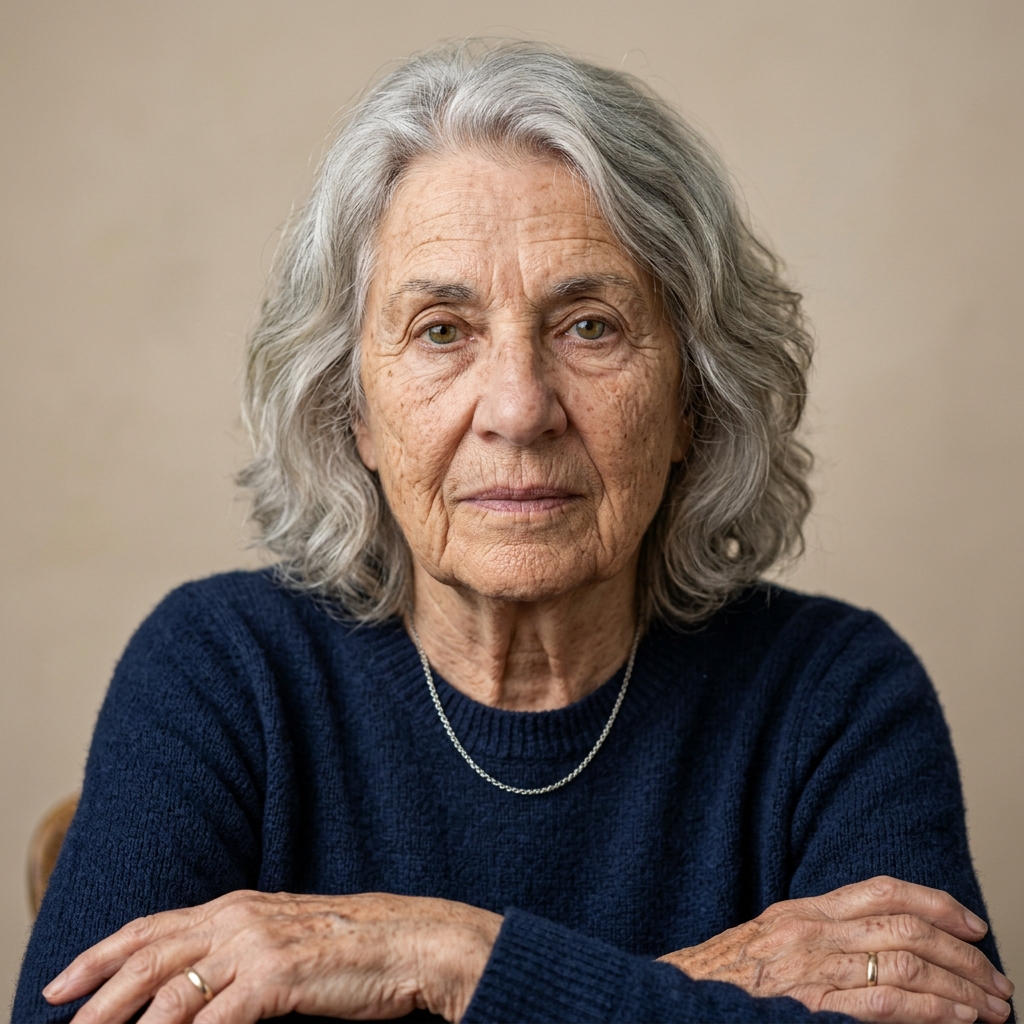
I never expected to see her again.
It was November 14, 1999.
I had just buried my Aunt Margaret in a small town north of Atlanta.
She was the last of my mother’s sisters, and the funeral had hollowed me out.
I drove back alone, taking I-75 north through Georgia, then merging onto I-40 west near Nashville.
The sky was a dull gray, and a cold drizzle streaked the windshield.
I hadn’t eaten all day.
Somewhere west of the city, my hands started trembling from fatigue, so I pulled off at the next exit.
There it was: a Waffle House, its yellow sign glowing like a lighthouse in the fog.
I parked my old Buick and walked inside, smelling the familiar aroma of bacon grease and fresh coffee.
The place was nearly empty.
A young waitress with tired eyes and auburn hair pulled back under a hairnet smiled at me from behind the counter.
“Sit anywhere you like, ma’am,” she said.
Her voice was soft but worn, like she had been on her feet for ten hours.
I slid into a booth by the window, staring out at the traffic crawling along the interstate.
She came right over with a mug of coffee.
“Rough day?” she asked, and her kindness almost broke me.
I told her I was coming back from a funeral.
She nodded slowly, her expression full of a compassion that seemed older than her years.
“I’m sorry,” she whispered.
“It’s never easy. Can I get you something to eat?”
I ordered a pecan waffle and a side of bacon.
As she wrote it down, I noticed her nametag said “Clara.”
She couldn’t have been more than nineteen.
There were dark circles under her eyes, and her uniform was slightly too big, like she’d lost weight.
But she moved with a quiet dignity that caught my attention.
When she brought my food, she asked if I wanted company.
I nodded, and she slid into the booth across from me for just a moment.
“I’m working a double shift,” she said with a tired smile.
“Trying to save up.”
“For what?” I asked.
“My GED test. It costs $120, and every extra penny I can scrape together helps.”
She told me she’d dropped out of high school to take care of her sick grandmother.
Now her grandmother was gone, and she was determined to make something of herself.
“I want to be a nurse someday,” she said, and her eyes lit up for the first time.
I nodded, feeling a surge of admiration.
We talked for maybe ten minutes more.
Then she looked at the clock and apologized.
“I’ve got six more hours, and those tables won’t clean themselves,” she laughed.
I finished my meal slowly, thinking about grief, about second chances.
When the bill came, it was $8.47.
I pulled out my wallet, still half in a fog.
I meant to leave a twenty.
That would be more than double the bill, a small kindness for a girl who deserved it.
I put the bill on the table, tucked my wallet away, and walked out into the chilly night.
I didn’t look back.
The drive to Dayton, Ohio took another five hours.
I got home just before midnight, my bones aching.
I emptied my pockets onto the kitchen counter, and that’s when I saw it.
In the glow of the overhead light, I stared at the empty slot in my wallet where two crisp $100 bills had been.
My heart dropped.
I had taken out $200 from the bank before the trip, meaning to give it to Aunt Margaret’s daughter to help with the funeral expenses.
But in my sorrow, I’d forgotten.
The two hundreds must have been stuck together.
I had left them on that Waffle House table.
I sat down heavily in a kitchen chair.
My first thought was to call the restaurant.
But it was late, and I was exhausted, and I told myself I’d call in the morning.
When morning came, I hesitated.
I thought about Clara, her tired eyes, her dream of becoming a nurse.
Was it really a mistake?
Or had some part of me, buried under grief, done it on purpose?
I never called.
I never went back.
Years passed, as they do.
I thought of that moment only rarely, and when I did, I hoped that girl had used the money well.
But life has a way of swallowing up such memories.
I raised my children, buried more loved ones, and grew old with my husband, Henry.
Henry was a good man.
He worked thirty years at the same factory, never complained, loved me with a quiet steadiness.
When he turned seventy, the cancer came.
It started in his lungs, then spread with a cruelty that stole his breath and his strength.
By the spring of 2024, there was nothing more the doctors could do.
We brought him home.
Hospice was arranged, and a nurse would come every night from 8 p.m. to 8 a.m.
I was grateful for the help, but my heart was a stone in my chest.
The first night, I sat in the dim living room, listening to the rattle of Henry’s breathing from the hospital bed we’d set up in the den.
Just before eight, a knock came at the door.
A woman in her mid-forties stood there, carrying a black medical bag.
She had a kind face, hair pulled back neatly, and the same tired eyes I’d seen on so many nurses.
But there was something else, something I couldn’t place.
“I’m Clara,” she said softly.
“I’ll be with your husband tonight.”
I let her in, showing her to the den.
She moved with efficiency, checking Henry’s vitals, adjusting the oxygen, speaking to him in a low, soothing voice even though he was barely conscious.
Then she looked at his chart, which included my name as the primary contact.
She froze.
Her eyes lifted to my face, and something shifted.
“Mrs. Thompson?” she whispered.
I nodded.
“What was your maiden name?”
I told her.
She took a step closer, her hand going to her heart.
“Did you ever eat at a Waffle House off I-40 near Nashville? Back in November 1999?”
I went very still.
The memory flooded back: the yellow sign, the rain, the young waitress with tired eyes.
I shook my head, not out of denial but because I couldn’t speak.
“I don’t remember,” I finally managed, my voice cracking.
She said, “I remember you.”
“I was your waitress.”
“I was nineteen, working doubles, trying to save for my GED.”
She pulled me gently to the small sofa in the living room and sat beside me.
Her eyes filled with tears.
“Do you remember leaving money on the table?”
“You thought you left a twenty.”
“It was two hundred dollars. Two hundreds stuck together.”
I couldn’t breathe.
“I ran after you,” she went on, “but your car was already on the ramp back to the highway.”
“I stood in the parking lot holding that money, crying.”
“It was exactly what I needed. The GED test cost $120, and with the rest, I bought a used set of textbooks for a CNA program.”
Her voice trembled.
I reached out and took her hand.
It was warm, strong, the hand of a woman who had worked hard her whole life.
“I never forgot you,” she said.
“Your kindness. I was invisible to most people. But you saw me.”
“I paid for the test the next week. I passed. Then I enrolled in the CNA course, and later I went to nursing school.”
“All because of that moment.”
She leaned closer, and I could see the faint lines around her eyes, the echoes of that tired girl I’d met twenty-five years before.
“When I saw your name on Henry’s chart tonight, I knew it was you.”
“I had to tell you. I’ve been hoping for years to thank you.”
I broke down then.
The tears came hard, not just for Henry but for all the grief of that long-ago day, for my aunt, for the girl I’d been and the woman I’d become, and for the incredible, impossible mercy of this moment.
Clara held me while I cried.
After a long time, I whispered, “It was a mistake. I didn’t mean to leave that much.”
She smiled through her own tears.
“Maybe it wasn’t a mistake at all.”
She spent the rest of the night caring for Henry.
But she also cared for me.
She brought me tea, sat with me in the dark hours, and told me more about her journey.
She had worked in nursing homes, then in hospitals, and now she did hospice work because she understood grief.
She said she treated every patient like family because a stranger had once treated her with an undeserved generosity.
Before the sun came up, she took both my hands in hers.
“I will take care of Henry like he was my own father,” she promised.
And she did.
Night after night, she was there, her presence a balm to my soul.
Henry passed away peacefully three weeks later, with Clara and me at his side.
But the story doesn’t end there.
Clara became my friend.
In the weeks after the funeral, she came by just to check on me.
We sat on my front porch, drinking sweet tea, and I learned more about the life she had built.
She had two daughters, both in college now, one studying to be a teacher and the other a doctor.
“They always ask me why I became a nurse,” she said one afternoon, looking out at the maple tree in my front yard.
“I tell them about a lady at a Waffle House who believed in me before I believed in myself.”
I squeezed her hand, my throat tight.
I never told anyone about that $200, not even Henry.
But now, I realized, it was the best mistake I ever made.
Sometimes the smallest, most accidental kindness can ripple across decades and come back to you when you need it most.
I think about that often.
How a moment of forgetfulness in a tired old diner turned into a lifeline for a struggling girl.
How that girl grew into a woman who held my hand while my husband took his last breath.
Life is full of such hidden threads.
So if you ever doubt that a tiny gesture can matter, please hear my story.
You may never know the fruit of your kindness until the universe decides to reveal it.
But I promise you, it’s there.
Growing quietly in the heart of someone who needed it.
If this story moved you, please take a second to like our page, follow along, and share it with someone who could use a little hope today. Sometimes the most beautiful stories are right under our noses, waiting to be told.