At My Daughter-in-Law’s Baby Shower, She Told Forty Guests I’d Move Out of My Late Husband’s Lake House Once the Baby Came—But When My Son Looked at the Floor and My Phone Buzzed From the County Records Office, the Papers They Rushed Me to Sign After My Fall Stopped Looking Like Concern
The cake was still untouched.
That is the detail I remember first, even before I remember Olivia’s voice, even before I remember the clapping, even before I remember my son staring down at the floor like a boy who had broken a window and was waiting for someone else to confess.
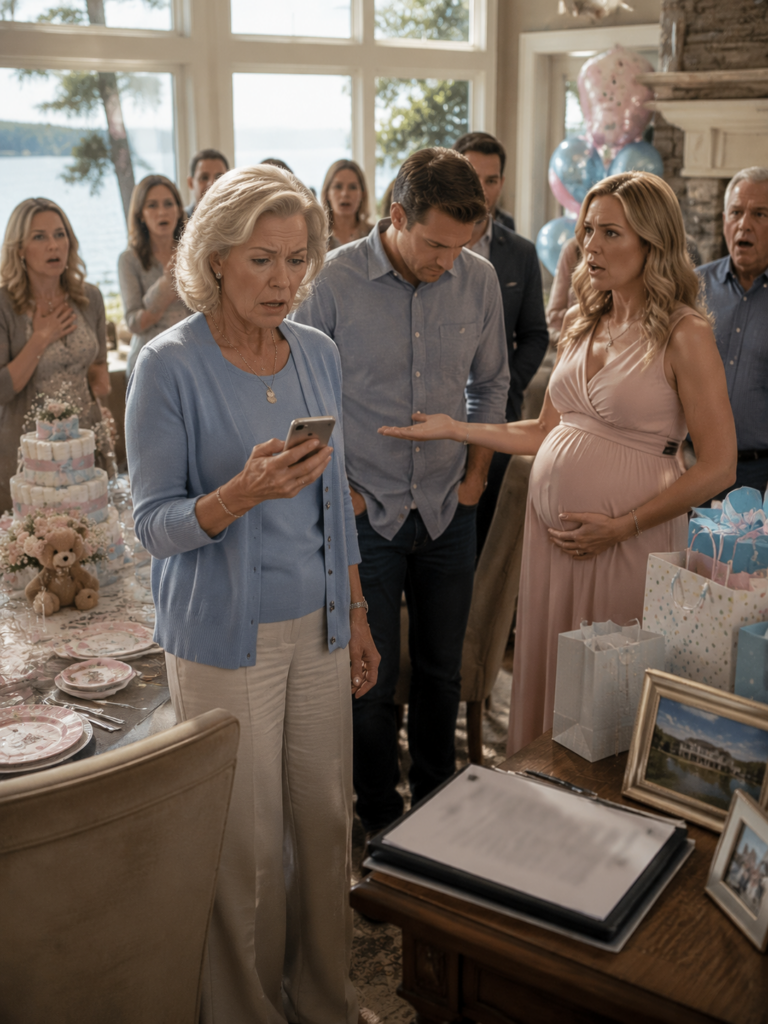
The cake sat on the dining table beneath the bay window, white frosting smooth as fresh snow, little pink roses piped around the edges, the words Welcome Baby Emma written in gold across the top. Someone had placed a silver knife beside it with a pink ribbon tied around the handle. It looked so pretty, so harmless, so ready for celebration.
Pink and white balloons floated near the ceiling, bumping gently every time the air conditioner kicked on. Little gift bags sat in neat rows on the coffee table, each one tied with a ribbon Olivia had picked because it matched the invitations. Her mother had arranged them twice before guests arrived, moving them half an inch left, then right, as if order could make generosity look more expensive. Someone had taped a banner above the fireplace that said Welcome Baby Emma in looping gold letters.
And right underneath it was the stone hearth my husband built with his own hands.
That was the part that nearly took the breath from my body.
Not the balloons. Not the crowd. Not even my daughter-in-law standing in my living room as if she had been born with the right to do so.
It was that banner hanging over George’s stones.
My name is Eleanor Whitaker. I am sixty-eight years old, and that lake house was never just a house to me.
It sat at the end of a narrow road outside a small Michigan town where people still waved from pickup trucks and knew which church had the best rummage sale. The place was not fancy in the way magazines use the word. Nobody ever came through the front door and gasped at marble countertops or cathedral ceilings. The floors creaked in winter. The kitchen cabinets were old maple, scratched near the handles from decades of hands opening them without looking. The upstairs bathroom had one stubborn tile that never stayed flat no matter how many times George fixed it. The screen door had a habit of slapping too hard when the wind came off the lake, and every spring I told myself I would adjust the hinge, and every spring I forgot because that sound had become part of the house’s voice.
But it was ours.
George and I bought the land when we were young enough to think a mortgage was a mountain and stubborn enough to climb it anyway. We were twenty-six and twenty-four, married three years, with more hope than money and a little boy who still slept with his fist curled against his cheek. George worked weekdays at the paper mill and weekends on that house. I painted trim while Mark slept in a playpen under the oak tree, his cheeks flushed from lake air, his little legs kicking under a faded yellow blanket my mother had made. George hauled stone for the fireplace one wheelbarrow at a time from a quarry thirty miles away because he said store-bought stone had no soul. When his back ached, he would lie flat on the dock, one arm thrown over his eyes, and say, “Ellie, someday this place will hold us when the world gets too loud.”
He was right.
It held us through layoffs, through arguments about money, through Mark’s teenage storms when he slammed doors and claimed he hated the lake even though he always came down to the dock before sunset. It held us through my mother’s passing, through Christmases where the lake froze silver and the whole house smelled like cinnamon, pine, and woodsmoke. It held us through summers where wet towels hung over every chair and George fried perch in a black skillet while Mark and his friends came in barefoot, sunburned, and hungry enough to eat anything.
It held George through cancer too.
The last clear photograph I have of him was taken by that bay window. He was thinner than he wanted anyone to notice, wearing his old navy cardigan, one hand resting on the back of my chair as if even standing had become a negotiation. Behind him, the lake was bright and blue. He smiled like he was trying to leave me courage.
So when my daughter-in-law, Olivia, lifted her glass of lemonade in that same room and said, “Once the baby comes, Mom will move somewhere easier, and this place will finally become our family home,” something inside me went very still.
Forty people clapped.
Women from Olivia’s Pilates class. Her mother’s friends from the country club. Two neighbors I barely knew because they had moved in after George died and preferred cocktails on their deck to coffee on mine. A few cousins from Mark’s side who looked uncomfortable but clapped anyway because that is what people do at baby showers when someone says something that sounds sweet if you do not understand what you are hearing.
My son stared at the floor.
That hurt more than Olivia’s words.
Mark had always been gentle. Even as a boy, he would carry spiders outside in a paper cup instead of stepping on them. When he was twelve, he cried because George sold an old fishing boat to help pay for braces, even though George swore the boat was more trouble than it was worth. When Mark was twenty-seven and his first marriage failed, he came home and sat beside me on the dock until the sun went down, not saying a word, just leaning his shoulder against mine like he had when he was little.
But lately, his gentleness had turned into silence.
And silence, I had learned, can become a room where other people do the damage.
Olivia was still smiling.
She was beautiful in the polished way some women are beautiful when they have never had to wonder whether the electric bill could wait another week. Her blonde hair was swept back in a soft twist that probably took forty minutes and looked effortless only because someone had worked hard to make it look that way. Her maternity dress was pale blue and likely cost more than my monthly groceries. She stood with one hand resting on her stomach, looking out at the guests with the glowing confidence of a young woman who believed the future had already agreed with her.
“It just makes sense,” she continued. “The house is too much for Eleanor now. The stairs, the dock, the winter road. And with Emma coming, we’ll finally be able to give our daughter the kind of childhood Mark had.”
More clapping.
Someone said, “That’s wonderful.”
Another woman dabbed at her eyes.
I sat by the fireplace with my purse on my lap and felt George’s house shrink around me.
For months, Olivia had been hinting at it.
At first, it came wrapped in concern.
“Eleanor, those steps are getting steep for you.”
Then in suggestions.
“There’s a senior community near town with a heated pool and weekly card nights.”
Then in little jokes.
“You know, one day Mark and I are going to have to pry you away from this lake.”
I smiled through most of it because that is what women of my generation were trained to do. We smoothed tablecloths. We ignored sharp edges. We made coffee when people behaved badly because we did not want the house to feel cold. We told ourselves that younger women were just direct now, that times changed, that maybe we were being too sensitive. We took words that cut us and folded them into napkins.
But I was not foolish.
I had seen the way Olivia looked around my kitchen when she thought I was not watching. Not with affection. With measurement. She noticed the view, the square footage, the road frontage, the dock permit, the storage shed George built, the finished loft Mark had slept in when he came home from college. She talked about “updating” the guest room and “opening up” the kitchen. Once, when I went to the hallway closet to find fresh hand towels, I heard her on the phone with her mother.
“It’s wasted on one person,” she said.
One person.
As if a widow became a waste of space once her husband was gone.
The week before the baby shower, I slipped on the back step carrying groceries. It was a foolish little accident, the kind that becomes larger only because other people decide it means something. The paper bag split. Two oranges rolled under the porch swing. A carton of eggs broke open on the steps. My left wrist hit the railing hard enough to bruise from thumb to elbow. Nothing broke, thank God, but I sat there for a few minutes with my heart thumping and my pride in pieces, listening to the lake slap softly against the dock.
I did not call Mark right away.
That was the first thing people forgot later. I did not fall and reach helplessly for my son. I sat, collected myself, picked up what groceries I could, and drove myself to urgent care because I still knew how to do things. The doctor wrapped my wrist, told me to ice it, and warned that pain pills might make me drowsy. I came home, made tea, and told myself I would be sore for a week and embarrassed for longer.
Mark found out because Mrs. Donnelly saw me unloading groceries one-handed and called him before I could stop her.
He came over that afternoon with Olivia.
She walked in carrying soup from the grocery store deli and a folder full of papers.
“Mom,” Mark said, “you scared us.”
“I scared myself,” I admitted.
Olivia set the soup on the counter and touched my shoulder with fingers that barely rested there.
“We just want to make sure everything is in order,” she said. “You’re alone out here, Eleanor. What if something worse happens next time?”
“I’m not helpless,” I said.
“No one said you were,” Mark replied quickly.
But he did not look at Olivia when he said it.
They sat me at the kitchen table. The same table where George used to clean fish on newspaper when it rained. The same table where Mark did his algebra homework, tapping his pencil against his teeth until George threatened to hide every pencil in the county. The same table where I had opened sympathy cards after the funeral until my hands smelled like paper and tears.
Olivia opened the folder.
“Just basic forms,” she said. “Emergency contacts. Medical permission. House access. Little things.”
My wrist hurt. My head still felt foggy. I had taken two pain pills the urgent care doctor said were safe, but they made me slow, as if my thoughts had to walk through knee-deep water to reach me. Mark sat beside me, rubbing his hands together. He looked tired. Not just ordinary tired, but worn thin. I remember noticing that and feeling a tug of motherly concern, even as Olivia turned pages and pointed to sticky notes.
“Here.”
“Here.”
“Initial there.”
“This one just lets us help if you’re in the hospital.”
“This one makes sure Mark can speak for you.”
“This one is for utilities.”
“This one is for insurance.”
Too many pages.
Too much ink.
Too many places where Olivia’s finger covered the top line while she said, “It’s nothing complicated.”
I signed some of it.
Not all.
Because something about her smile made me slow down.
There is a difference between help and hurry.
Help lets you breathe.
Hurry wants your hand before your mind catches up.
When Olivia pushed one page closer and said, “This one is just about the house, so Mark can handle repairs,” I pulled my hand back.
“I’ll read that later.”
Her smile did not move, but her eyes changed.
“Of course,” she said.
Mark looked relieved and frightened at the same time.
That was when I knew.
Not enough to accuse. Not enough to make a scene. But enough to know that some part of my son was standing in a place he did not know how to leave.
After they went home, I sat alone in the kitchen with my wrist wrapped in a beige bandage and called my attorney.
His name was Paul Brenner, and he had handled George’s estate. He was the kind of small-town attorney who still sent Christmas cards with a picture of his old golden retriever on them, even though the dog had been dead for six years and Paul could not bring himself to change the card. He had known George for twenty years. He had sat at this very table after the funeral and walked me through accounts, insurance forms, deeds, and all the paperwork grief expects you to understand while your heart is still on the floor. He had once told me, “Eleanor, paperwork is where people hide their intentions.”
When I told him what had happened, he went quiet.
“Did you sign anything transferring ownership of the lake house?” he asked.
“No.”
“Did you sign anything giving Mark power over real estate decisions?”
“I don’t think so. They said medical and emergency.”
“Eleanor,” he said, and I heard his chair creak through the phone, “do not sign another thing. Not a birthday card, not a delivery receipt, not a church raffle ticket if Olivia is standing within ten feet of it. I’ll check the county records in the morning.”
He tried to make it sound light.
But he did not laugh.
Now, one week later, Olivia was standing in my living room, announcing my home like it had already changed hands.
And my phone buzzed in my purse.
I looked down.
Mrs. Whitaker, did you authorize a deed transfer this morning?
The message came from the county clerk’s office.
For a moment, the room sounded far away.
Laughter.
Wrapping paper.
A woman saying, “Oh, look at the little booties.”
Olivia’s mother cooing over a bassinet.
The clink of ice in lemonade glasses.
My son still staring at the floor.
I typed with one hand.
No. I did not.
The reply came almost immediately.
Please step away from the room if possible. This file has been flagged.
The room tilted, not physically, but in the way a life tilts when a suspicion becomes a fact.
I stood slowly.
Olivia noticed first.
Of course she did.
Her smile tightened like a ribbon pulled too hard.
“Eleanor?” she said. “Are you okay?”
Every face turned toward me.
At sixty-eight, you learn that panic is rarely useful in public. Panic feeds the people waiting to call you confused. It gives them a story to tell later. I had seen it happen to widows at banks, in doctor’s offices, at family dinners. Raise your voice and suddenly you are overwhelmed. Cry too hard and suddenly you are fragile. Demand answers and suddenly everyone wants you to sit down.
So I picked up my purse, smoothed the front of my cardigan, and said, “I need some air.”
Mark’s head lifted.
For the first time all afternoon, he looked directly at me.
His eyes were not cruel.
That made it worse.
I walked through the sliding glass door onto the back deck. The lake was quiet, gray-blue under the afternoon sun. A pair of kayaks drifted far out near the reeds. George’s old wind chime moved softly by the railing, the one made from bits of copper pipe he saved from a plumbing job because he said even scrap could sing if you hung it right.
My phone rang.
I answered before the second ring.
“Mrs. Whitaker?” a woman said. “This is Denise Hall from the county clerk’s office.”
“Yes.”
Her voice was careful. Official, but kind. “We have a document submitted this morning attempting to transfer title of your property on Lake Hollow Road. The document carries your signature and initials. However, there are irregularities.”
My fingers tightened around the phone.
“What kind of irregularities?”
A pause.
“Your attorney contacted us earlier this week and asked that any filings related to your property be reviewed before recording. When this came in, we compared it to your prior documents on file. There are differences. Also, the notary stamp belongs to someone whose commission status we need to verify.”
Behind me, the sliding door opened.
Mark stepped out first.
Olivia stood behind him with one hand on her stomach, but her face no longer looked soft. Her father, Richard Langford, hovered just inside the doorway, one hand already reaching for his coat.
Richard had been laughing by the gift table ten minutes earlier, telling a story about golf and pretending to be the proud grandfather. He was a tall man with silver hair and a tanned face, the sort who wore loafers without socks in May and called waitresses “young lady.” He sold lakefront property two counties over. I knew because Olivia told everyone. Often. She said it with a brightness that suggested Richard’s profession had given her family a superior understanding of property, inheritance, and the way older people should eventually step aside.
“What’s going on?” Mark asked.
I kept the phone to my ear.
Denise continued, “Mrs. Whitaker, your attorney is already on another line with our office. He asked that we advise you not to discuss this privately with anyone involved.”
Involved.
Such a clean word for something dirty.
I looked at my son.
He looked back at me with a face I had seen only once before, when he was sixteen and George caught him taking money from the coffee can to impress a girl. Shame, fear, and a child’s wish that someone else would speak first.
Olivia stepped around him.
“Eleanor,” she said lightly, though her jaw was tight, “you’re scaring people. Is this about the shower? Because if what I said came out wrong—”
Richard pushed past her toward the living room.
I lifted my voice just enough.
“Richard.”
He stopped.
Forty guests inside had gone quiet. The kind of quiet that happens when polite people realize they may have dressed up for the wrong kind of gathering.
Richard turned slowly.
“Yes?”
“Did you notarize a deed transfer for my house this morning?”
Olivia made a small sound, sharp and breathless.