
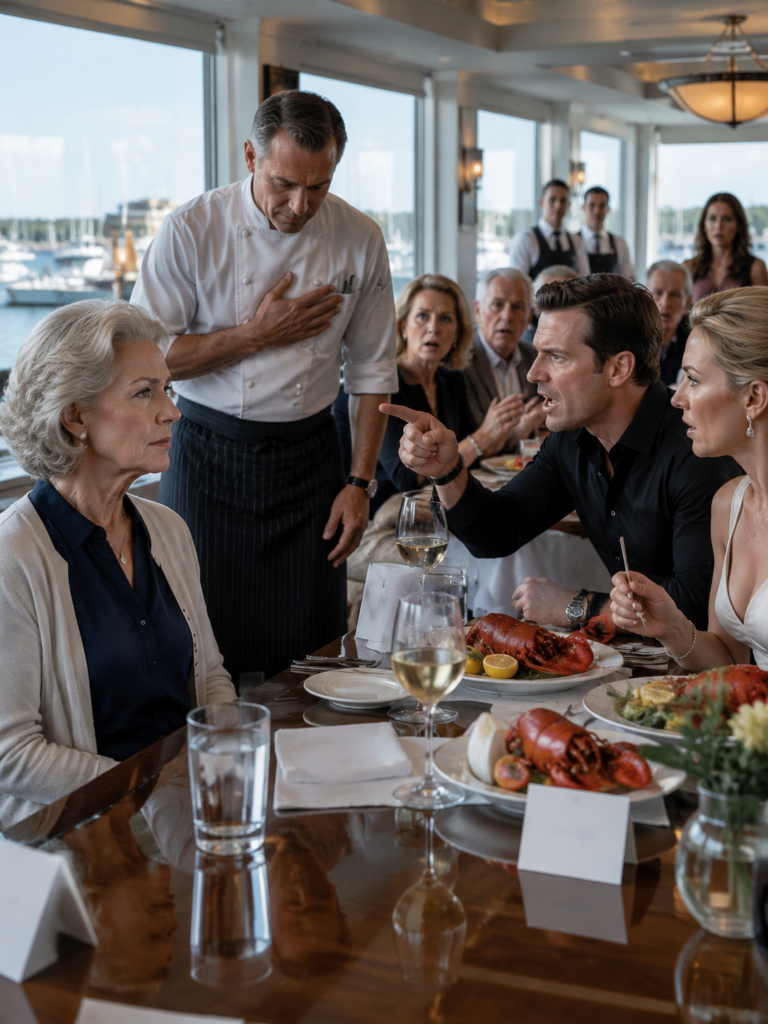
My Daughter-in-Law Served Me Only Water While Her Family Ate $60 Lobsters and My Son Told Me to Know My Place—But When the Chef Walked Out, Bowed, and Called Me Mrs. Helen, They Finally Learned Whose Restaurant They Had Used to Humiliate Me

My Daughter-in-Law Served Me Only Water While Her Family Ate $60 Lobsters and My Son Told Me to Know My Place—But When the Chef Walked Out, Bowed, and Called Me Mrs. Helen, They Finally Learned Whose Restaurant They Had Used to Humiliate Me
“We don’t provide extra food.”
Those were the exact words my daughter-in-law Marlene said as she pushed a glass of water toward me.
Just water.
No bread. No salad. No offer from the menu. Not even the courtesy of pretending there had been a misunderstanding.
Just one tall glass of tap water set carefully in front of me while her entire family devoured fresh lobster across the table—enormous lobsters, the kind that cost sixty dollars each, split open under the restaurant lights with melted butter glowing in tiny silver cups beside them. The smell of butter, garlic, lemon, and sweet shellfish filled the air so thickly that I could taste it even though I had not been allowed to order a thing.
Marlene did not even have the decency to be subtle about it. She did it in front of everyone, wearing that fake little smile she always used when she wanted to humiliate someone without looking like the villain of the story. She slid the glass toward me with two manicured fingers, as if even touching something meant for me might lower the quality of her evening.
And that was not the worst part.
The worst part was seeing my son, Michael, nod his head as if she had just said something reasonable. Something practical. Something fair.
“You should know your place, Mom,” he added without even looking me in the eye.
For a moment, the entire restaurant seemed to fall silent around me, though I knew it had not. Silverware still clicked softly against china. A pianist near the bar played something slow and expensive. Waiters moved between tables with the smooth, trained grace of people who understood that rich people disliked being startled. A woman at the next table laughed over a champagne flute. Somewhere behind me, a cork popped.
Life continued.
Only something inside me stopped.
I stayed silent, not because I didn’t have words. I had them. Plenty of them. I had sixty-four years of words sitting behind my teeth, words sharpened by grief, work, sacrifice, hunger, humiliation, and the long, exhausting education of being underestimated. But something inside me decided to hold them back. To observe. To wait.
So I just smiled slightly and said calmly, “Noted.”
Marlene blinked, confused for a second. I think she expected tears, apologies, maybe a scene. Maybe she expected me to reach for my purse, stand with trembling dignity, and leave so they could tell themselves I had overreacted. Maybe she wanted me to beg my son with my eyes until he gave me a piece of bread and looked generous for it.
But I gave her none of that.
Just one word.
Noted.
Let me explain how I got there, how I ended up sitting in one of the most exclusive restaurants in the city, watching my own family eat lobster while I sat with a glass of water like a punished child. Because this story did not start that night. It started years before, when I decided being a mother meant sacrificing everything.
And boy, did I.
Michael is my only son. I raised him alone after his father walked out when he was five years old. There was no dramatic farewell, no final fight that explained everything cleanly. His father simply packed a duffel bag one Thursday morning, said he needed “space,” and never came home in any way that mattered. He sent two birthday cards the first year, one check the second, and then disappeared into the great American tradition of men calling abandonment a complicated situation.
Michael was too young to understand the legal words and old enough to feel the absence.
He asked for his father at bedtime for almost a year. He asked why Daddy didn’t come to his kindergarten Thanksgiving play. He asked why other boys had men teaching them how to throw a baseball in the park. I told him the gentlest versions of the truth because children should not have to carry adult cowardice before they can tie their shoes.
Then I went to work.
I worked three jobs for years. I cleaned houses in neighborhoods where the bathrooms were bigger than my kitchen. I waited tables in diners where my feet ached so badly at night that I had to soak them in a plastic basin while Michael did homework beside me. I cooked in other people’s kitchens, chopped onions until my hands smelled like them even after three washes, learned how to make sauces, soups, roasted fish, pastry dough, anything that kept a paycheck coming and my son fed.
I worked breakfast shifts, lunch shifts, late shifts. I worked holidays. I worked when I had fevers. I worked when my back hurt. I worked through loneliness so deep that sometimes the sound of my own key in the apartment door made me want to cry.
All so Michael could have what I never had.
Education.
Opportunities.
A future where his hands did not crack from bleach water.
I paid for his entire college education. Every semester. Every book. Every dorm fee. Every lab charge. Every coffee he grabbed with friends while studying because I wanted him to have the ordinary college life I had only seen in brochures left behind on café tables. I supported him when he changed his major twice, first from engineering to business, then from business to communications, because he said he was “finding himself,” and I thought, Let him. I never had the luxury of finding myself. I was too busy finding rent.
I supported him when he met Marlene and told me she was the woman of his life.
The first time he brought her to my apartment, she arrived in a beige coat, pearl earrings, and a smile so polished it did not feel warm. She looked around my small living room, at the old sofa with the faded floral pattern, at the framed school photos on the wall, at the chipped blue bowl I used for keys, and I saw her take inventory.
Not curiosity.
Inventory.
“This is cozy,” she said.
There are some words that become insults depending on who says them.
Cozy was one of them.
Michael did not hear it. Or maybe he did and decided not to.
That would become a pattern.
I supported him even when Marlene started looking at me as if I were an obstacle in her perfect upper-middle-class life. I supported him when she corrected the way I pronounced a French wine at their engagement dinner. I supported him when she suggested I wear “something more neutral” to the wedding because her mother wanted the photographs to have a clean palette. I supported him when he stopped dropping by for Sunday dinner because Marlene preferred “structured weekends.” I supported him when my phone calls turned into short text messages.
Everything good?
Talk later.
Busy week.
I never asked for anything in return.
Well, that’s not entirely true.
I asked for respect.
I asked to be treated like his mother, not like an employee who had already served her purpose. I asked to be allowed to love my son without being treated like evidence of a past he should outgrow. I asked, quietly, to remain part of the family I had nearly broken myself building.
Apparently, that was too much to ask.
The dinner invitation came a week before the lobster.
Michael called me, which was unusual. Lately, he communicated mostly through texts so short they felt written by someone standing in line at a pharmacy.
Everything good?
Can’t talk now.
Maybe next week.
But that afternoon, his voice sounded strangely kind.
“We feel like we’ve been distant, Mom,” he said. “Marlene and I want to fix things. We want to invite you to dinner.”
I remember standing in my little kitchen with one hand on the counter, staring at a bowl of apples I had bought on sale that morning. My first feeling was not suspicion. It was hope.
That embarrassed me later.
Hope is stubborn in mothers. It keeps rising even after being stepped on, because a mother remembers the child before she accepts the adult. I heard Michael’s voice and, for one stupid second, I heard the boy who used to climb into my lap after nightmares, the boy who once cried because he thought I worked too much and told me he would buy me a house someday.
“A dinner?” I asked.
“Yes,” he said. “Somewhere nice. Marlene’s parents will be there too. We thought it would be good for everyone to reconnect.”
Reconnect.
How beautiful cruel people can make their words sound before they sharpen them.
I got dressed in the best thing I had, a pearl gray dress. Simple but elegant. Nothing flashy. I never liked drawing attention to myself. I fixed my hair carefully, used the little silver clips Chloe once told me made me look like “a movie grandma,” and put on a bit of makeup. I wore the pearl earrings I bought myself the year Michael graduated from college. They were not real pearls, not expensive, but they looked real enough under soft light, and I had been proud of them.
I wanted to look good for my son.
I wanted him to see that even though I was sixty-four years old, I was still his mother—the woman who had given everything for him, the woman who could sit in a beautiful room and belong there, even if nobody had ever taught her the rules.
When I arrived at the restaurant, they were all already seated.
Michael.
Marlene.
And to my surprise, her parents.
Four people waiting at a table clearly set for five.
They greeted me with air kisses, the kind that do not touch skin. Marlene smelled like expensive perfume, something floral and sharp that probably cost over two hundred dollars a bottle. She wore a flawless beige dress and jewelry that sparkled so much beneath the chandelier light it nearly blinded me. Her mother, Celeste, looked like an older version of her, only thinner and colder, with the expression of a woman who had spent her entire life deciding whether other people passed. Her father, Grant Whitmore, was heavyset, gray-mustached, and carried himself with the soft arrogance of a man whose money had always arrived before his manners.
“You’re late, Helen,” Marlene said, glancing at her gold watch.
Helen.
Not Mom.
Not even Mrs. Parker.
Just Helen, as if we were friends of the same age, as if there were no family hierarchy between us, as if I had not once held her husband through fevers, scraped knees, nightmares, and disappointments before she knew his middle name.
“The traffic was terrible,” I replied, taking the only empty chair.
The chair was at the corner, slightly angled away from the center of the table, almost as if they wanted me present but hidden. I sat anyway. A woman who has scrubbed grease from restaurant vents at midnight learns how to sit anywhere with dignity.
The restaurant was impressive. High ceilings. Crystal chandeliers. Pristine white tablecloths. Fresh flowers arranged in low glass bowls. Candlelight moving gently over polished silver. The kind of place where every dish cost what some people earned in a week. I recognized some of the patrons: businessmen, local politicians, donors whose names appeared on hospital wings, people with real money and the practiced boredom that sometimes comes with it.
I wondered how Michael could afford it.
As far as I knew, his job at the consulting firm paid well, but not that well. He had a nice title, a downtown office, a company card, and the exhausted look of a man trying to appear more established than he felt. Marlene’s father had connections in his company. That much I knew. What I did not know yet was how much Michael had begun leaning on those connections, or how much those connections had cost him.
The waiter approached with black leatherbound menus.
No prices listed.
That is always the sign that everything is outrageously expensive.
Marlene did not even open hers.
She snapped her fingers.
Actually snapped them.
“Yes,” she said, not looking at the waiter as a person so much as a function. “Five lobster Thermidors, the large ones, and a bottle of your best white wine.”
“Four lobsters,” Michael corrected gently, glancing at me out of the corner of his eye.
Marlene looked at him, confused, then followed his gaze to me.
Then she smiled.
That smile.
The same one she used when she was about to stick the knife in and call it honesty.
“Oh, right,” she said, as if she had just remembered I existed. “Four lobsters.”
She turned to the waiter and added, raising her voice just enough to sound casual but clear enough for everyone at the table to hear, “We don’t provide extra food. Just water for her.”
The waiter blinked, uncomfortable. He looked at me, expecting me to speak, to order for myself, to correct the cruelty disguised as logistics. But before I could open my mouth, Michael intervened.
“It’s just that Mom already ate before she came, right?”
His tone was soft but firm.
It was not a question.
It was a command in disguise.
I felt something break inside me. Not dramatically. There was no sad background music, no slow-motion collapse, no cinematic gasp. Just a silent crack somewhere in my chest where hope had been sitting with its hands folded.
“Of course,” I said finally. “Just water is fine.”
Marlene smiled, satisfied, and leaned back in her chair. The waiter nodded quickly and left, probably relieved to escape the tension.
Marlene’s parents did not seem to notice. Or perhaps they noticed and approved. They were too busy admiring the place, commenting on the chandelier, the linen, the exclusivity, how difficult it was to get a reservation on a Friday night.
And so the dinner began.
Well, their dinner.
I had my glass of water.
Clear.
Cold.
Silent.
Just as I was apparently supposed to be.
The lobsters arrived ten minutes later, four enormous steaming plates carried by two waiters who moved as carefully as if transporting jewels. The aroma of butter and herbs filled the table. Each lobster was split and arranged beautifully, white meat shining, claws cracked just enough to be convenient, tiny roasted potatoes and asparagus spears placed beside them in neat, elegant rows.
The waiter placed one plate in front of Marlene.
One in front of Michael.
One in front of Celeste.
One in front of Grant.
Nothing in front of me.
Not even bread.
Not even an empty appetizer plate to pretend I had been considered.
I remained still.
Marlene was the first to crack a shell. The sound echoed in the awkward silence that had settled over the table. She took a generous piece of white meat, dipped it in melted butter, and brought it to her mouth with deliberate slowness. She closed her eyes as if tasting something divine.
Theatrical.
Everything about Marlene was theatrical.
“Exquisite,” she murmured, dabbing the corner of her mouth with her napkin. “Absolutely exquisite. This place never disappoints.”
Celeste nodded enthusiastically. “It’s the best restaurant in the city. Without a doubt. So exclusive. So refined.”
Michael began to eat too, though I noticed he avoided looking at me. He kept his eyes fixed on the lobster, concentrating on breaking the shell as if it were the most important task in the world.
Coward.
My son—the man I raised to be brave, to stand up for what was right, to thank servers, to hold doors, to never laugh when someone else was made small—had become a coward.
No.
Worse.
He had become polite in the presence of cruelty.
That is how many betrayals happen. Not with shouting. Not with slamming doors. With a man looking down at his plate while the woman who raised him is humiliated three feet away.
I remained seated, hands in my lap, observing. My glass of water sat untouched. I did not even feel like drinking it. It was not about thirst. It was about dignity. And in that moment, I felt as if they had stripped every ounce of it from me and laid it under the tablecloth like something shameful.
Grant Whitmore finally spoke.
“Michael, your mother is very quiet. Has she always been like this?”
He spoke about me as if I were not there, as if I were a topic of conversation and not a real person sitting less than three feet away.
Michael swallowed his bite before answering. “Mom has always been simple, humble. You know, she comes from a different generation.”
“Humble,” Marlene repeated. There was something venomous in the way she pronounced it. “Yes. Definitely humble.”
I wanted to scream that humble did not mean invisible. That simple was not a synonym for stupid. That coming from a different generation did not mean I had agreed to be treated like a chair someone no longer needed but felt guilty throwing away.
But I held back.
Something inside me told me to wait.
To observe.
To let them keep digging.
Celeste poured herself more wine. The bottle was already half empty.
“These must be such difficult times for people your age, Helen,” she said. “With no stable income, not enough savings. It’s a shame the older generation didn’t know how to plan for their future better.”
There it was.
The first direct blow.
Disguised as concern, but a blow nonetheless. Poor Helen. Aging Helen. Unprepared Helen. A woman who had apparently drifted into old age on a raft of bad decisions instead of working three jobs to build a life for the son now pretending she had nothing to offer.
“Mom gets by just fine,” Michael said.
But his tone was defensive, weak, as if he did not quite believe what he was saying himself.
“Of course, of course,” Marlene replied quickly. Her smile said the opposite. “We all do what we can with what we have. Although, well, some of us have more than others.”
Silence.
No one defended me.
No one said, “That was out of line.”
No one even looked uncomfortable enough to be useful.
Marlene continued eating with more enthusiasm. Between bites, she talked about her life, her accomplishments, her plans, everything she had achieved, as if she needed constantly to highlight the difference between herself and me.
“We just closed on the new condo,” she announced, looking at her parents with pride. “Three bedrooms, park view, twelfth floor. It cost four hundred and fifty thousand dollars, but Michael and I decided it was worth the investment.”
Grant raised his glass. “To success. To the future.”
Everyone raised their glasses.
Except me.
I had only water.
“And the best part,” Marlene continued, “is that we’ll finally have the space we always wanted. No interruptions. No unexpected visits. No having to worry about accommodating people who just show up unannounced.”
She looked directly at me when she said that.
Directly into my eyes.
She wanted me to know she was talking about me, telling me without saying it explicitly that I was no longer welcome in their lives.
Michael coughed uncomfortably. “Marlene, I don’t think that’s necessary.”
“Necessary what?” she asked, interrupting him with the fake sweetness she had mastered. “I’m just sharing our good news. Is there a problem with that?”
“None,” he replied, looking down again.
That was when I understood.
My son was not just a coward.
He was an accomplice.
He had chosen his side a long time ago, and that side did not include me.
The waiter returned to clear some empty plates and glanced at me as if wondering why I was still sitting there with nothing. I felt sorry for him. He had probably seen a thousand awkward scenes in that restaurant, but this one had to be in the top five.
“Would you like dessert?” he asked in a professional voice.
“Of course,” Marlene replied immediately. “Bring your best option for four.”
Again.
Four.
Not five.
The waiter nodded and walked away. I remained at the table like a ghost, someone erased from the equation but still occupying a chair.
Celeste leaned toward me with a mix of curiosity and condescension. “Helen, dear, what do you do for work currently? Or are you already retired?”
It was a trap.
If I said retired, I confirmed their story that I was old and useless. If I said I still worked, they could mock the work.
But before I could answer, Marlene spoke for me.
“Helen has done a little bit of everything. Cleaning, cooking, that sort of thing. Honest work. Nothing to be ashamed of, of course.”
The way she said honest work sounded like the opposite.
It sounded like contempt.
It sounded like thank God I never had to lower myself to that.
“Admirable,” Grant said, though his tone was condescending enough to rot the word from the inside. “Hard work should always be respected. Though, of course, we made sure Marlene had every opportunity so she wouldn’t have to go through that.”
I nodded slowly.
Every word that came out of their mouths was another reason to wait.
Michael finally looked at me. For a second, I saw something in his eyes. Guilt, maybe. Shame. The ghost of a boy who knew better. But it disappeared as quickly as it appeared.
“Mom,” he said softly. “Are you okay? You’re very quiet.”
“I’m perfectly fine,” I replied calmly. “I’m just observing.”
Marlene laughed shortly. “Observing. How interesting.”
She turned to her mother. “See? I told you she was quiet.”
The desserts arrived: four plates of tiramisu with edible gold flakes.
Because of course even dessert had to announce itself.
While they ate, I sat motionless with my glass of water. Condensation had formed a small puddle around the base. I watched the drops slide down the glass, slow, like tears I refused to shed. I would not give them that pleasure.
Marlene wiped her mouth with her napkin and sighed, satisfied. “This is definitely my favorite restaurant. The quality is unmatched. Of course, it’s not for everyone’s budget.”
Another jab.
Another stab disguised as casual conversation.
Grant ordered a cognac. Michael ordered whiskey. The women ordered more wine. I still had water. No one offered me coffee. No one asked if I wanted dessert. It was as if they had collectively decided I did not even deserve basic courtesy.
Grant lit a cigar the waiter had brought him and said, “Your wife told us you’re considering that promotion at the company. More responsibilities, right?”
Michael nodded, straightening in his chair. “Yes, sir. Regional manager. A raise of almost forty thousand dollars a year.”
“Impressive,” Grant said, blowing out smoke slowly. “That’s what happens when you marry well. The right connections open doors. My brother is a partner at that firm. A word from me, and that position is yours.”
There it was.
The truth behind Michael’s success.
It wasn’t his talent.
It wasn’t his effort.
It was Marlene’s last name.
Everything I had worked to give him—every hour, every sacrifice, every tuition payment—had been overshadowed by a convenient marriage.
“We are very grateful,” Marlene said, taking Michael’s hand on the table. “Family is the most important thing. Knowing how to surround yourself with the right people makes all the difference.”
She looked at me when she said that.
The message was clear.
I was not the right person.
I was the past.
She was the future.
Celeste joined in. “It’s fundamental to set boundaries, too. Especially when there are people who can become a burden. We can’t let misunderstood feelings stop us from moving forward.”
“Exactly,” Marlene agreed, squeezing Michael’s hand. “That’s why we’ve decided to make some changes—necessary changes—for our well-being and for Chloe’s.”
Chloe.
My four-year-old granddaughter.
The little girl I watched twice a week when they needed time for themselves. The little girl who called me Grandma Helen and made drawings for me in purple crayon. The little girl who once fell asleep on my lap with one hand tangled in the string of my apron. The little girl who loved strawberry cake and insisted I tell her the story of the moon rabbit every time I tucked her in.
Were they going to take her away too?
“What kind of changes?” I asked.
It was the first time I had spoken in almost twenty minutes. Marlene looked surprised, as if she had forgotten I could speak.
“Well, Helen,” she said, “since you’re asking, we’ve decided it’s better for Chloe to spend time with people who can add value to her life. Quality education. Enriching experiences. You know, things that, well, some people just can’t offer.”
The dagger twisted deeper.
She was telling me I was not good enough for my own granddaughter. That my love, my time, my bedtime stories, my pancakes, my scraped-knee kisses, my lullabies meant nothing compared to what she considered value.
Michael said nothing.
He drank his whiskey and avoided my gaze.
“I understand,” I said. My voice stayed calm. Neutral. “Anything else I should know?”
Marlene exchanged a look with her parents.
There was something else.
Of course there was.
This dinner was not reconciliation.
It was a planned execution.
“Well,” Marlene began, playing with her wine glass, “we also want to talk about expectations. Michael and I have built a life of a certain standard. A life that requires maintaining certain standards. And frankly, Helen, some of your appearances have been a bit embarrassing.”
“Embarrassing?” I repeated.
The rage inside me began to simmer, though my face remained serene.
“Don’t take it the wrong way,” Celeste chimed in. “It’s just that when you came to Chloe’s birthday party last month with that old dress and that grocery store cake… well, it made a certain impression on our guests.”
The old dress.
The grocery store cake.
I had worked two extra shifts to buy that cake because I knew Chloe loved strawberries. I had worn my pearl gray dress, the same one I wore that night, because it was the best thing I owned. I had taken two buses to the bakery, carried the cake carefully in my lap, and arrived early so I could help set up. Chloe had screamed “Grandma!” and run into my arms before anyone else could judge the box.
And still, it had not been enough.
“The guests asked who you were,” Marlene continued. “It was awkward having to explain that you were Michael’s mother. Some even thought you were the help.”
Silence.
A silence so heavy it seemed to crush the air at the table.
“And what is your point?” I asked.
Marlene leaned forward. “My point, Helen, is that maybe it’s better if you keep your distance, at least at public events. At least when important people are around. We don’t want them thinking Michael comes from… well, you know.”
“From poverty,” I said.
She did not deny it.
“From a working-class family,” I corrected. “From a mother who broke her back to give him everything.”
Michael finally spoke. “Mom, don’t take it like that. They’re just trying to—”