
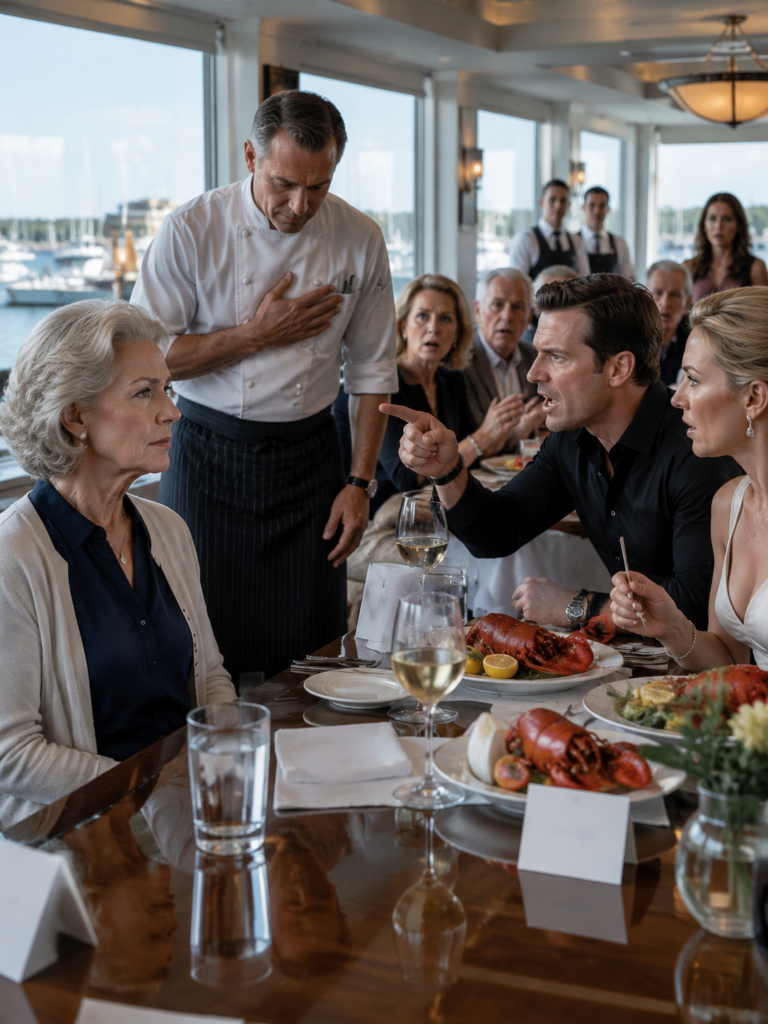
My Daughter-in-Law Served Me Only Water While Her Family Ate $60 Lobsters and My Son Told Me to Know My Place—But When the Chef Walked Out, Bowed, and Called Me Mrs. Helen, They Finally Learned Whose Restaurant They Had Used to Humiliate Me — Part 2

“Trying to what, Michael?” I interrupted, looking directly at him. “Erase me? Make me disappear because I don’t fit into their perfect world?”
He looked down. “It’s not that. It’s just that things are different now. We have to think about our future. About Chloe.”
“We can’t have a poor mother ruining your image,” I finished for him.
Grant tapped the table gently. “Come on, no need to be dramatic. No one is saying you should disappear. Just be more mindful. Understand your position in this new family dynamic.”
My position.
That word echoed in my head.
My position.
As if I were an employee who needed to remember her rank.
As if I were a movable piece on a board they controlled.
Marlene leaned back, satisfied. “Besides, Helen, let’s be honest. What can you really offer this family? Michael is established. We can give Chloe everything she needs. You? Well, you just don’t have the resources, the status, or the connections.”
“I only have love,” I said quietly.
She laughed.
Not loudly.
Almost cruelly.
“Love doesn’t pay for private universities. Love doesn’t open doors in society. Love doesn’t get you a seat at the right table.”
Ironic.
Because I was sitting at their table, but I had no place.
No plate.
No voice.
Just water and an infinite amount of humiliation being served as if it were part of the menu.
The waiter approached with the check and placed it discreetly near Michael in a leather folder.
My son opened it, checked the total, and pulled out his credit card without blinking.
“Seven hundred eighty dollars,” he muttered. “Reasonable for five people.”
Five people.
They had included my spot in the bill.
Even though I had not eaten anything, they had paid for my humiliation. My empty chair. My silence. My water.
Michael signed the receipt and put his card away. Marlene retouched her lipstick with a compact mirror from her designer handbag. Her parents chatted about a trip to Europe they were planning next month.
It was all so normal for them.
So everyday.
As if they had just shared a pleasant dinner and not a psychological torture session.
I remained still, hands in my lap, observing every detail, every gesture, every word, storing it all in my memory as evidence of the night that would change everything.
“Well,” Marlene said, standing and smoothing her dress, “I think it’s time to go.
We have a busy day tomorrow. The meeting with the interior decorator is at nine.”
Everyone began to rise. Michael helped Celeste with her coat. Grant left forty dollars in cash on the table, as if wanting to demonstrate magnanimity even to the service staff.
I stayed seated.
I did not move.
Something in me refused to stand just yet. As if by standing, I would be accepting what had happened. Validating it. Letting the restaurant swallow the scene and polish over the stain.
“Mom,” Michael said impatiently, “let’s go. We have to drop Marlene’s parents at their house.”
“In a moment,” I replied calmly. “I need to use the restroom first.”
Marlene rolled her eyes. “Seriously? Take your purse, then. We’ll meet you outside.”
They wanted to get rid of me quickly, as if my presence were contaminating, as if the longer I remained near them, the greater the risk that someone important might see us together.
I stood slowly, picked up my simple cloth purse, and walked toward the restrooms. I felt their stares on my back. They probably thought I was pathetic, an old, humiliated woman escaping to the bathroom to cry in private.
But I did not go to the bathroom.
I walked down the long hallway that led to the kitchen.
It was a route I knew well.
Very well.
Because I had walked down that hallway hundreds of times over the last ten years.
Ever since I bought the place.
Yes.
That restaurant was mine.
Every table.
Every crystal chandelier.
Every painting on the wall.
Every white tablecloth, every copper pan, every polished wineglass, every staff member in a black jacket moving with quiet precision.
Mine.
The business I had built from scratch after years of hard work, meticulous saving, and smart investments. The restaurant that had made me a successful entrepreneur, even though no one in my family knew it because I had chosen to keep that part of my life private.
Michael knew I worked in restaurants, but he always assumed I was a waitress or a line cook. I never told him the truth. I never told him I owned three establishments in the city, including this one, the most exclusive of them all. I never told him about the bank account with more than two million dollars in it. I never mentioned the properties I owned, the investment accounts, the partnership offers, the private dining contracts, the quiet wealth built from work his wife dismissed as mediocre.
Why?
Because I wanted to see who my son really was without the influence of my money.
Tonight, I had finally gotten my answer.
I entered the kitchen.
Heat hit me immediately. Pans sizzled. Knives struck cutting boards in steady rhythm. Orders were called in Spanish, Italian, and English. The air smelled of butter, garlic, seared fish, fresh herbs, lemon, stock, wine, sugar caramelizing somewhere near pastry. The kitchen was not glamorous in the way the dining room was glamorous. It was hot, loud, disciplined, alive.
My kitchen.
My kingdom.
Julian, my executive chef and general manager, saw me enter. His face lit up. He was a tall man in his fifties with slicked-back black hair, sharp eyes, and an immaculate white apron. He had worked with me from the first day I opened this place, back when the roof leaked over the back pantry and we could afford only eleven tables.
“Mrs. Helen,” he said, approaching quickly. He kept his voice low so the rest of the staff would not hear. “I saw you at table twenty-two. I was going to come out and say hello, but I noticed something wasn’t right.”
“Everything is fine.” I smiled, small but genuine, the first real smile all night. “Julian, everything is perfectly fine. Better than you can imagine.”
He looked confused. “But I saw you sitting there with no food. Just water. Those people with you—they’re family?”
“My son and his wife,” I replied. “And tonight they’ve given me the most valuable gift they possibly could.”
“What gift, ma’am?”
“Clarity.”
Julian did not fully understand, but he nodded. In ten years, he had never questioned my decisions, and he was not going to start now.
“What do you need me to do?” he asked.
“In a few minutes, I’m going back to that table. When I do, I want you to come out of the kitchen. Walk up to me in front of all of them, and call me what you always call me.”
His eyes lit with understanding.
“Mrs. Helen.”
“Exactly.”
A smile spread across his face.
Julian had met Michael once, years ago, when my son came to visit me at work. It had been brief and awkward. Michael had looked around the kitchen with disdain, as if it embarrassed him that his mother worked in a place with heat, noise, and people who used their hands for a living. He had said, “You’re still doing this?” in a tone that made half the prep cooks go silent. Julian had heard it. He never forgot.
“It will be a pleasure,” Julian said, with a glint of satisfaction in his eyes.
I left the kitchen and returned to the dining room.
Table twenty-two was already empty. The waiter was clearing it, picking up used napkins and empty glasses. All evidence of what had happened was being erased.
But not from my memory.
Never from my memory.
I looked around the restaurant: the soft lighting, elegant customers enjoying dinner, the murmur of polite conversations, the piano music playing from hidden speakers. I had built all of it with my hands, my mind, my determination. I had walked through the back door years earlier with a folder of loan papers, a menu draft stained with coffee, and a terror so strong I almost turned around. I had stayed. I had built.
And tonight, finally, I was going to claim my place.
I walked outside through the main entrance. The cold night air hit my face. Michael, Marlene, and her parents stood beside a luxurious black car parked near the valet stand. Marlene was giving the valet instructions about something, because apparently even waiting for a car was an opportunity to supervise the world.
They saw me come out, and Michael raised his hand in a quick wave.
“Well, Mom,” he said, “thanks for coming. It was educational.”
“Very educational,” Marlene agreed, her fake smile plastered on. “I hope you understood everything we talked about tonight. That you’ve understood your position.”
“Oh,” I replied calmly, “I understood it perfectly. The question is, do you understand yours?”
Marlene frowned. “Excuse me?”
“Nothing,” I said, smiling slightly. “Just thinking out loud.”
Grant opened the car door. “Well, it’s been interesting to finally meet you, Helen. Michael talks about you very little, but now I understand why.”
That was the straw that broke the camel’s back.
Not because it made me angry.
Not because it made me cry.
Because it confirmed that what I was about to do was absolutely necessary.
“Before you go,” I said, stopping them, “there’s something I forgot to mention.”
Michael sighed. “Mom, it’s late. It can wait.”
“No,” I said firmly. “It can’t. In fact, I think this is the perfect time. Let’s go back inside for a moment.”
Marlene huffed. “Seriously? Now you’re going to make a scene?”
“Not a scene,” I said, walking back toward the restaurant entrance. “Just a clarification. I’ll wait inside.”
I did not wait for their answer.
I knew curiosity would bring them back.
And I was right.
I heard footsteps behind me, murmurs of confusion and irritation. I walked straight to table twenty-two, which had already been reset for the next guests, and stood beside it.
Michael approached first. “Mom, what are you doing? You’re embarrassing us.”
“Embarrassing you?” I repeated softly. “How interesting that you use those words. Tell me, Michael, how do you think I felt for the last two hours?”
He opened his mouth, but Marlene cut him off.
“Look, Helen, I don’t know what you’re trying to do, but we’ve had enough drama for one night. If you want to play the victim, do it some other time and some other place.”
Her parents approached too, irritation hardening their faces. Grant checked his watch ostentatiously. “We really have to go. We have important engagements tomorrow.”
“This won’t take long,” I said. “I just want to make sure we all understood what happened here tonight.”
“What happened,” Marlene said, “was a family dinner where necessary boundaries were set. Boundaries that frankly should have been set a long time ago.”
“Boundaries,” I repeated. “How interesting. Like the boundary of not giving me food because I’m not valuable enough to share the table.”
Michael blushed. “Mom, I already explained that.”
“You explained nothing,” I interrupted, and for the first time all night, my voice had an edge. “You sat me at a table, gave me water, and let me watch all of you eat lobster while you told me I don’t deserve a place in this family.”
“You’re exaggerating,” Marlene muttered, crossing her arms.
“Exaggerating?” I looked directly at her. “Tell me, Marlene, what do you call it when you invite someone to dinner and deprive her of food? What do you call it when you deliberately humiliate someone in front of others? What do you call it when you tell a mother she isn’t good enough to see her own granddaughter?”
Nearby customers had started watching. The waiter who served us stood frozen near the service station, visibly uncomfortable. Two women at a corner table had stopped pretending not to listen.
Celeste stepped forward. “Look, dear, I understand your feelings are hurt, but sometimes the truth hurts. And the truth is Michael has surpassed his origins. He has built something better. And that requires leaving certain attachments behind.”
“Attachments?” I repeated. “That’s what you call a mother who sacrificed everything for her son?”
“A sacrifice nobody asked you for,” Marlene snapped suddenly, anger flashing through her polished voice. “Nobody forced you to be a single mother. Nobody forced you to work mediocre jobs. Those were your decisions. And frankly, you can’t expect Michael to carry your poverty forever.”
There it was.
The truth without filters.
Raw and cruel.
Michael said nothing.
He stared at the floor like a child waiting for a storm to pass.
“I understand,” I said finally. “So let me ask you something. How do you like this restaurant?”
The question caught them off guard.
Marlene frowned. “What?”
“The restaurant,” I repeated, gesturing around us. “Did you like it? Did you find it high quality? Exclusive enough for you?”
Marlene exchanged a confused look with Michael. “It’s excellent. You know that. It’s one of the best in the city. Why are you asking?”
“Just curious,” I replied. “Because earlier you said I only worked mediocre jobs—cleaning, cooking, that sort of thing. And you’re right. I cleaned houses for years. I worked in kitchens even longer.”
“What are you getting at?” Grant asked, losing patience.
“I’m getting to the fact that I did indeed work in kitchens,” I continued. “Including the kitchen of this restaurant. In fact, I spent many hours in that kitchen developing the menu, training the staff, making sure every dish that went out was perfect.”
Michael looked up, confused. “What are you talking about?”
“I’m talking about my work, Michael. My mediocre job, as Marlene called it. I’m talking about the long hours I spent building something from scratch. Something that is apparently good enough for you.”
Marlene let out a nervous laugh. “Helen, I don’t think you understand. This restaurant is owned by—”
She stopped.
Her face changed.
“You work here?” she asked. “You’re a cook here?”
“I worked here,” I corrected. “But not as a cook.”
At that exact moment, Julian came out of the kitchen.
He wore his immaculate white jacket, his posture straight, his expression professional, with just the slightest glint of satisfaction in his eyes. He walked directly toward us, and every eye in the restaurant seemed to follow him.
He stopped in front of me and bowed slightly.
“Mrs. Helen,” he said in a loud, clear voice, “pardon the interruption. There’s a matter in the office that requires your attention. Could you please review it before you leave for the night?”
The silence was absolute.
Michael blinked.
“Mrs. Helen?”
Julian glanced at him briefly before turning his attention back to me. “Yes. Mrs. Helen. The owner of this establishment.”
Marlene’s jaw dropped.
Literally.
Her mouth opened, her eyes widening as if the chandelier had fallen.
“What owner?” she whispered.
Julian’s expression did not change. “The person who signs my paycheck every month. The person who built this place ten years ago and turned it into what it is today.”
Grant took a step back as if physically struck. Celeste brought a hand to her mouth. Michael stared at me as if seeing me for the first time.
“Mom,” he said. “You?”
“Yes,” I said simply. “Me. The woman who apparently has no resources. The woman who has no status. The woman who embarrasses her family with her old dresses and grocery store cakes. That woman owns the restaurant where you all just spent seven hundred eighty dollars to humiliate me.”
Marlene tried to speak, but no words came out. She opened and closed her mouth several times like a fish pulled out of water.
“Impossible,” she finally muttered. “How?”
“How?” I repeated. “With those mediocre jobs you despise so much. With every dollar I saved for years. With smart investments. With work. With sacrifice. Everything that apparently means nothing to you.”
Julian stood beside me like a silent guardian. Some of the kitchen staff had come out and watched from a distance. The customers nearby were no longer hiding their interest. This had become a spectacle.
Good.
They had wanted a public lesson.
Now we were all learning.
Michael took one step toward me. “Mom, why didn’t you ever tell me?”
I looked at him for a long moment.
Because I wanted you to love me without needing proof I had money.
Because I wanted to know whether the boy I raised could recognize dignity when it came without diamonds.
Because I wanted you to see me, not what I could give you.
But I did not say all of that at once. Some truths deserve to arrive slowly.
“I did tell you,” I said. “You just never listened.”
His face crumpled slightly.
“I told you I was tired from meetings. You assumed I meant shifts. I told you I had business to handle. You assumed I meant somebody else’s business. I told you I was proud of my work. You smiled and changed the subject.”
Marlene recovered enough to fold her arms. “This is absurd. If you own this place, why sit there all night with no food? Why let us order for you?”
I smiled.
“Because I wanted to see how far you would go.”
She looked away.
“And you went very far.”
Grant cleared his throat. “Helen, clearly there has been a misunderstanding.”
“No,” I said. “A misunderstanding is when someone brings the wrong coat from the cloakroom. This was not a misunderstanding.”
He glanced around at the watching diners, suddenly aware of the room’s attention. “Perhaps we should discuss this somewhere private.”
“Why?” I asked. “You had no problem discussing my poverty, my position, and my granddaughter in public.”
Celeste whispered, “This is humiliating.”
“Yes,” I said. “Isn’t it?”
Michael’s voice shook. “Mom, I’m sorry.”
I looked at him.
The apology I had wanted for years finally sat in front of me, pale and shaking, and I discovered something painful.
It was not enough.
“I believe you are sorry right now,” I said. “But I don’t know if you’re sorry for what you did or sorry for who saw it.”
He flinched.
Marlene snapped, “You’re being cruel.”
I turned to her.
“Cruel? You invited me to dinner, denied me food, insulted my work, mocked my dress, called me a burden, and told me I should stay away from my granddaughter because I have no status. But now that you realize you humiliated the owner of the restaurant, I’m cruel?”
Her cheeks flushed.
“You tricked us.”
“No,” I said. “I gave you an opportunity to show me who you were. You took it.”
Grant tried again, his tone shifting into business mode. “Mrs. Helen, I may have spoken too casually. Marlene is protective of her family. We all are. These things happen. Why don’t we start over?”
I laughed softly.
That unsettled him more than anger would have.
“Start over? Grant, five minutes ago you said Michael talked about me very little and now you understood why.”
His face reddened.
“Perhaps that was badly phrased.”
“It was perfectly phrased. That was the problem.”
Marlene’s eyes narrowed. “What do you want? An apology? Fine. I’m sorry your feelings were hurt.”
I looked at Julian.
He looked as if he might personally throw her into the alley if I gave him permission.
I did not.
“My feelings were not hurt,” I said. “My understanding was clarified.”
Michael swallowed. “Mom, please.”
I turned back to him.
“Do you remember when you were nine and I worked the overnight cleaning job at the law office?”
His brow creased, confused by the turn.
“Yes.”
“You hated that job. You said the chemicals made my hands smell strange. One night you waited up for me with a peanut butter sandwich because you thought I didn’t eat enough.”
His eyes filled.
“I remember.”
“I came home at two in the morning, and you were asleep at the kitchen table with your head on your arm. I carried you to bed, and I ate that sandwich standing over the sink because I didn’t want you to wake up and see me cry.”
A tear slipped down his cheek.
“That boy knew how to love,” I said. “I don’t know where he went.”
Michael covered his mouth.
Marlene looked irritated now, as if my grief were inconveniencing her.
“Michael,” she said sharply. “Don’t let her manipulate you.”
I looked at her.
And there it was again.
That wordless arrangement she had made of our family. Michael was clay. I was interference. She was the future.
“Marlene,” I said, “do not speak for him in my restaurant.”
Her mouth shut.
Not because she respected me.
Because the word my landed.
Grant’s eyes flickered. I knew men like him. He was recalculating. The owner of an elite restaurant was not a poor old woman. She was a person with money, reputation, contacts. Someone useful. Someone whose opinion might matter in circles he had not expected me to enter.
“How many restaurants?” he asked.
I smiled. “Three.”
Celeste made a small sound.
“And this one is the flagship,” Julian said with pride. “Though Mrs. Helen is too modest to say so. The governor ate here last month. The mayor’s office hosts private events upstairs. We have a six-month waiting list for Saturday reservations.”
Michael stared.
“Three restaurants?” he whispered.
“And two properties,” I added. “Plus investments. Plus enough savings that I could have retired years ago if I wanted to. But I like working.”
Marlene looked sick.
Not guilty.
Sick because the hierarchy had shifted.
“You let us think you were poor,” she said.
“No,” I replied. “You decided I was poor because my dress was old and my cake came from a grocery store.”
She had no answer.
I continued. “That dress was my best dress. The cake was Chloe’s favorite. You saw poverty because you wanted to.”
Michael whispered, “Why didn’t you tell me about the money?”
“Because I wanted to know what remained when money was not available.”
He lowered his eyes.
“And now you know,” he said.
“Yes.”
The dining room remained silent around us. Even the piano player had stopped. The waiter from our table stood near Julian, his face tight with embarrassment and sympathy.
I turned to him. “Samuel.”
He straightened. “Yes, Mrs. Helen?”
“You did nothing wrong. I saw how uncomfortable you were. Thank you for maintaining professionalism.”
Relief passed over his face. “Thank you, ma’am.”
Then I looked at Julian. “Please prepare one lobster Thermidor, exactly like the ones served at table twenty-two, and one tiramisu. Send them to the office.”
Julian nodded. “Of course.”
Marlene blinked. “You’re ordering food now?”
“Yes,” I said. “For myself.”
Her expression twisted. “That is petty.”
“No,” I said. “Petty would be charging you a humiliation fee.”
A laugh rippled through the nearby tables before people quickly covered it with coughs and napkins.
Marlene’s face burned.
Michael looked at me with something between sorrow and awe. “Mom, can we talk? Privately?”
“Not tonight.”
“Please.”
“Michael, you had two hours to talk to me tonight. You used them to let your wife and her parents explain my position.”
His shoulders folded inward.
Grant stepped in, perhaps sensing the danger of total defeat. “Mrs. Helen, regardless of tonight’s unfortunate tone, Michael remains family. Chloe remains your granddaughter. Surely this can be repaired.”
I looked at him carefully.
“Grant, your brother is a partner at Michael’s firm, correct?”
He lifted his chin, recovering a sliver of pride. “Yes.”
“And that promotion, the one with the forty-thousand-dollar raise, depends on your recommendation?”
Michael looked alarmed. “Mom—”
Grant’s eyes narrowed. “Why?”
“Because my restaurant group received a proposal last month from your brother’s firm. Regional expansion consulting. Operations restructuring. Staffing analytics.” I tilted my head. “I was reviewing whether to sign.”
Grant went very still.
Michael looked as if the floor had dropped beneath him.
“You,” he said. “You were the client?”
“One of them,” I replied. “A large one.”
Marlene whispered, “No.”
“Yes.”
Julian’s mouth twitched.
“I had not decided,” I said. “I knew Michael might be assigned to the account. I thought perhaps it would be good to see how he handled responsibility. How he handled people. How he handled family.”
Michael’s face had gone pale.
“Mom, please don’t do this.”
“I’m not doing anything. You already did.”
Grant’s voice hardened. “Business should remain separate from personal matters.”
“Agreed,” I said. “That is why I will not sign a contract with a firm where decisions are influenced by family favors, contempt for working people, and a regional manager candidate who cannot defend his own mother from public humiliation.”
A sharp silence followed.
Michael looked down as if struck.
Marlene turned to him. “Michael, say something.”
He did not.
That was the first wise thing he had done all night.
I took my purse from the table and held it in front of me.
“Let me make this simple,” I said. “You are all leaving now. You will not return to this restaurant as guests. Michael, I will speak to you when I am ready. Not before. Marlene, you will not use Chloe as punishment. If you do, you will discover very quickly that I have excellent attorneys.”
Marlene laughed shakily. “You’re threatening us?”
“I am informing you.”
Celeste looked faint. Grant had turned an angry shade of red.
Michael whispered, “Mom, I never wanted this.”
I studied my son.
For a second, I saw him at five, standing by the window waiting for a father who would not come. I saw him at nine, asleep beside a peanut butter sandwich. I saw him at twenty-two in a graduation gown, hugging me so hard I could barely breathe. I saw every version of him I had loved.
Then I saw him tonight, telling me to know my place while his wife ordered me water.
“I know,” I said softly. “That’s what makes it worse. You didn’t want it. You allowed it.”
He began to cry then.
Not loudly.
Not dramatically.
His eyes filled and his mouth trembled like he was trying to hold his face together. Marlene looked horrified, not because he was hurt, but because his hurt made them look guilty.
“Michael,” she snapped. “We are leaving.”
He did not move.
She grabbed his arm.
He pulled away.
The whole room noticed.
Marlene stared at him as if he had struck her.