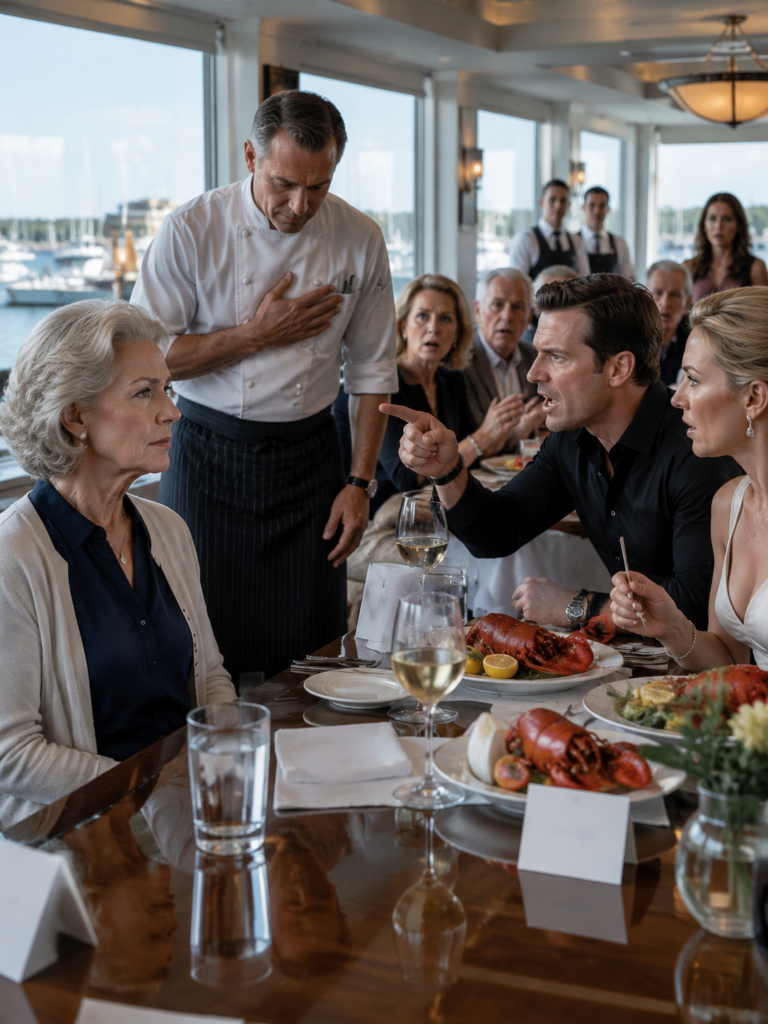
My Daughter-in-Law Served Me Only Water While Her Family Ate $60 Lobsters and My Son Told Me to Know My Place—But When the Chef Walked Out, Bowed, and Called Me Mrs. Helen, They Finally Learned Whose Restaurant They Had Used to Humiliate Me — Part 3

“Don’t,” he said hoarsely.
It was not enough to save him.
But it was the first time that night he had resisted her.
Grant recovered his coat, muttering something about slander and classless theatrics. Celeste gathered her handbag with shaking hands. Marlene turned sharply and walked toward the door, heels clicking like angry punctuation. Her parents followed.
Michael remained.
“Go,” I said.
He flinched. “Mom.”
“I said go.”
He looked at me for a long moment. Then he nodded, wiped his face with the heel of his hand, and followed his wife out.
The front door closed behind them.
The restaurant remained silent for one breath.
Then, somewhere near the bar, someone began to clap.
Just one person.
Then another.
Then the room filled with applause.
I did not smile. Not because I was ungrateful, but because applause is a strange thing after humiliation. It does not erase what happened. It only confirms that others finally saw it. Still, I nodded once, and Julian placed a steady hand near my shoulder without touching me.
“Mrs. Helen,” he said quietly, “your dinner will be ready in ten minutes.”
Only then did I realize how hungry I was.
Not for lobster.
For dignity.
In the office, I sat at the small walnut desk where I had signed payroll checks, vendor contracts, insurance renewals, charity donation forms, and the first partnership agreement that made the restaurant truly profitable. The office was not large. There was a safe in the corner, framed photographs on the wall, a shelf of cookbooks, and a small vase of fresh rosemary Julian insisted on replacing every Friday because he said rosemary meant remembrance.
A few minutes later, Samuel brought the lobster.
He set it in front of me with careful hands.
“Mrs. Helen,” he said, voice thick, “I am sorry.”
“You have nothing to be sorry for.”
“I should have done something.”
I looked at the young waiter, maybe twenty-four, with tired eyes and a kind heart already bruised by service work. “You did your job in a difficult situation. That matters.”
He swallowed. “They were awful.”
“Yes,” I said. “They were.”
He left, and I ate alone.
The lobster was excellent.
Of course it was.
I had approved the recipe myself after twelve attempts and one spectacular argument with Julian about whether the sauce needed more tarragon. It did not. I had been right. He admitted it only after a food critic praised the balance in a review that changed the restaurant’s future.
I ate slowly, not because I wanted to savor victory, but because my hands were shaking too much to move faster.
After the first bite, I cried.
Not loudly. Not dramatically. Just tears slipping down my face while I sat in my own office, eating the food my family had denied me in the restaurant I owned.
It was ridiculous, tragic, almost funny in a way that made the tears come harder.
Julian knocked once and entered with the tiramisu.
He saw my face and stopped.
“Do you want me to leave?”
“No,” I said.
He set the dessert down.
For a while, neither of us spoke.
Finally, he said, “My mother used to say the table shows the heart.”
I wiped my eyes with a napkin. “Your mother was right.”
He sat across from me without asking, because after ten years he had earned that right.
“I knew Michael did not know,” he said. “About all of this.”
“No.”
“But he should have known you.”
That sentence nearly broke me again.
“Yes,” I whispered. “He should have.”
The next morning, the story had already started moving.
Not through newspapers. Not online. Not yet. But through staff, diners, whisper networks, the strange invisible bloodstream of restaurants and rich people. By noon, two members of the city council had called to “check in.” A local food blogger sent an email asking whether it was true there had been “an incident.” Marlene’s mother tried to call the restaurant and ask for me by my first name, as if familiarity could be rebuilt by phone.
Julian told her I was unavailable.
Michael called seventeen times.
I did not answer.
He texted.
Mom, please.
I’m so sorry.
I didn’t know about the restaurant.
I need to talk to you.
Marlene is upset.
That last one made me laugh.
Marlene is upset.
After everything, his instinct was still to report her feelings as if they required my attention.
I put the phone face down and went to the downtown location for lunch service.
Work had saved me before. It saved me again. I checked invoices, tasted soup, approved a wine order, met with a produce supplier, complimented a dishwasher named Luis on his new haircut, and corrected the pastry chef for over-whipping cream. Ordinary tasks. Real tasks. Tasks that did not care whether my son had broken my heart.
At four, Julian called.
“Mrs. Helen, Michael is here.”
I closed my eyes.
“At the restaurant?”
“Yes.”
“Is he causing trouble?”
“No. He is sitting in the lobby. He looks… bad.”
I almost told Julian to send him away.
Instead, I said, “Put him in the private room. No food. Water.”
Julian was silent for half a second.
Then he said, “Understood.”
When I arrived an hour later, Michael was sitting in the small private dining room near the back, the one used for business lunches and discreet celebrations. In front of him sat a single glass of water.
He looked at it as if it had personally accused him.
Good.
He stood when I entered.
“Mom.”
I remained by the door.
He looked wrecked. His shirt was wrinkled, his eyes bloodshot, his hair uncombed in a way Marlene would have hated. He seemed younger and older at the same time.
“Sit,” I said.
He sat.
I took the chair across from him.
For a long moment, neither of us spoke.
Then he said, “The water was Julian’s idea?”
“No. Mine.”
He nodded, tears forming immediately. “I deserved that.”
“No,” I said. “You deserved worse. The water was symbolic.”
His face crumpled.
“I’m sorry.”
“I know.”
“I don’t know how to explain what happened to me.”
“You start with the truth.”
He looked down.
“I was ashamed.”
That surprised me.
“Of me?”
He nodded, then quickly shook his head. “No. Yes. Not exactly. I don’t know. I was ashamed of where I came from. Not because you did anything wrong. Because Marlene’s world made everything look like a test, and I always felt like I was failing before I opened my mouth.”
I listened.
“She would correct me. The way I held wine glasses. The words I used. The shoes I wore. Her father would ask about investments and laugh when I didn’t know something. Her mother once said I was lucky Marlene didn’t mind a man with ‘limited polish.’”
I felt something twist in my chest.
Not sympathy yet.
Recognition.
“So you let them make me the proof you had escaped,” I said.
He closed his eyes.
“Yes.”
There it was.
Ugly.
Honest.
“I hated myself for it,” he whispered. “Every time Marlene made a comment, every time she rolled her eyes after you left, every time she said you were too simple, I told myself it wasn’t worth a fight. Then one day I realized I had started agreeing because it was easier than defending you.”
“Easier for whom?”
“For me.”
I nodded. “Good. Keep going.”
He swallowed hard.
“When she planned that dinner, she said we had to set boundaries. She said you were getting too attached to Chloe and making things confusing. She said her parents thought I still acted like a poor kid desperate for approval. She said if I wanted the promotion, I needed to show I could make adult choices.”
“And denying your mother food was an adult choice?”
His face twisted. “I didn’t know she would do that.”
“But you corrected the order to four.”
He covered his face.
“Yes.”
The word came out broken.
“Yes, I did.”
Silence.
He lowered his hands.
“I thought if I kept it controlled, it would be less cruel. I thought if I said you had already eaten, maybe it wouldn’t look so bad.”
I stared at him.
“Michael, you helped build the lie that made my humiliation possible.”
“I know.”
“Do you? Or do you know because it turned out I owned the room?”
His eyes filled again. “I don’t know yet. I want to know for the right reason. I’m trying.”
That was more honesty than I expected.
It did not heal anything.
But it gave me a place to put the next sentence.
“You are not cut off from Chloe because of Marlene’s threat,” I said. “But I will not be used, insulted, hidden, or summoned. If I see my granddaughter, it will be because you and Marlene understand I am her grandmother, not an embarrassment to be managed.”
He nodded quickly. “Yes.”
“Do not say yes too fast.”
He stopped.
“And Michael?”
“Yes?”
“You will not work on my account. Your firm is not getting my restaurant group’s contract.”
Pain crossed his face, but he nodded. “I understand.”
“Do you?”
“Yes. It would be wrong.”
“That answer matters more than your disappointment.”
He nodded again, slower this time.
I stood.
He stood too.
For one second, I thought he might try to hug me.
He did not.
That was wise.
“I love you,” he said.
The words hurt.
“I love you too,” I replied. “But love will not be used to excuse disrespect anymore.”
He cried then.
Quietly.
I left him in the private room with his water.
A month passed before I saw Chloe.
Marlene fought it, of course. At first, she sent a cold message saying that due to “recent emotional instability,” it would be best for Chloe to have distance. My attorney responded with a letter so elegant and sharp that Julian framed a copy in the office as a joke. The letter noted my established caregiving role, the documented relationship, and the inadvisability of using a child as retaliation following a public humiliation created by Marlene herself.
Marlene stopped using legal language after that.
Michael brought Chloe to my smallest restaurant on a Sunday afternoon.
Not the flagship. Not the place of the humiliation. A little neighborhood spot with red booths, exposed brick, and the best tomato soup in the city. Chloe ran through the door wearing purple boots and carrying a drawing.
“Grandma Helen!”
She hit me like a tiny storm.
I crouched and held her so tightly that Michael looked away.
“I missed you,” she whispered.
“I missed you too, sweetheart.”
She pulled back and held up the drawing. It showed three people at a table: me, Chloe, and a large bowl of soup bigger than all of us.
“This is us eating,” she said proudly. “Daddy said you make the best food.”
I looked at Michael.
His eyes were wet.
“Yes,” I said, smoothing Chloe’s hair. “I do.”
Marlene did not come.
I was grateful.
Over the next year, everything changed slowly.
Slowly is important.
People like dramatic endings because they make pain look efficient. But real repair, when it happens at all, arrives like soup simmering. Low heat. Time. Attention. Occasional bitterness skimmed from the surface.
Michael lost the promotion.
Not because I punished him. Because Grant’s brother decided the family drama made him “unreliable,” which was a polite way of saying Michael had embarrassed the wrong people. For a while, Michael blamed himself. Then he blamed Marlene. Then, finally, in a therapy session he told me about months later, he admitted he had built a life on borrowed approval and was surprised when the lender collected.
He stayed at the firm for six months, then left.
He took a smaller job at a nonprofit business incubator helping first-generation entrepreneurs with operations planning. The salary was lower. The title was less impressive. His first office had a flickering fluorescent light and a desk that leaned slightly to the left. When he told me about it, he smiled in a way I had not seen since college.
“It feels useful,” he said.
“That matters,” I replied.
Marlene hated it.
Their marriage cracked along the fault lines that had always been there. She accused him of choosing poverty. He accused her of confusing money with worth. She said he was becoming weak. He said he was tired of mistaking cruelty for standards.
They separated eight months after the lobster dinner.
By then, Chloe had started spending Saturday afternoons with me again. We made soup, baked cookies, planted herbs in little pots near the window, and told stories about the moon rabbit. She never knew the full details of that night. She did not need to. Children should not carry adult cruelty until they are old enough to name it.
But one afternoon, while cutting dough into stars, she asked, “Grandma, Mommy said fancy people eat lobster.”
I smiled. “Some do.”
“Do we eat lobster?”
“Sometimes.”
“Are we fancy?”
I thought about that.
“No,” I said. “We are full.”
She nodded solemnly, as if that made perfect sense.
It did.
Marlene eventually apologized.
Not at first. Her first apology came by text and was not an apology at all.
I’m sorry you felt hurt.
I did not answer.
Her second came through Michael.
Marlene wants you to know she was under pressure from her parents.
I told him pressure did not order four lobsters.
Her third came in person, almost two years later, after the divorce papers had been filed and Chloe’s life had settled into two households. Marlene asked to meet at the neighborhood restaurant. I agreed because Chloe loved her mother, and because refusing forever would have made Marlene too large in my life.
She arrived without jewelry.
That was the first thing I noticed.
No shining bracelet. No diamond studs. No designer bag placed on the table like a résumé. She looked tired and younger than before, as if the money costume had aged her while she wore it and abandoned her when it left.
“Thank you for meeting me,” she said.
I nodded.
She looked around the restaurant. “I used to think places like this were small.”
“They are,” I said. “Small things can still feed people.”
She flinched, but accepted it.
“I was cruel to you.”
“Yes.”
“I thought if I could separate Michael from where he came from, I could make him into the kind of man my family respected.”
“And did they?”
She laughed once, bitterly. “No. They respected the version of him they could use.”
There it was.
A truth late enough to be useful only for the future.
“I’m sorry,” she said. “Not because you owned the restaurant. I mean, that shocked me. It humiliated me. But that’s not what I’m sorry for now. I’m sorry because even if you had owned nothing, what I did would still have been disgusting.”
That was the first sentence from her I believed.
“I accept that you are sorry,” I said.
Her eyes filled.
“I don’t know if that means forgiveness.”
“It doesn’t have to.”
She nodded.
Before she left, she said, “Chloe talks about your soup all the time.”
“She helps make it.”
“I know.” Marlene swallowed. “Thank you for loving her even when I made it difficult.”
“That was never about you.”
She looked down. “I know.”
After she left, I sat there for a long time with a cup of coffee cooling between my hands.
Julian came over and refilled it without asking.
“You look thoughtful,” he said.
“I’m trying to decide whether people change.”
He shrugged. “In kitchens, yes. Raw things become cooked things every day.”
I laughed.
“That is either very wise or very ridiculous.”
“Both,” he said. “Like most truths.”
Years passed.
The flagship restaurant grew more famous. We expanded the private dining floor, added a pastry program, and started a scholarship for single parents entering culinary school. I named it the Parker Grant, not because Parker was my last name, but because granting someone a chance had been the story of my life before it became a business.
At the first scholarship dinner, I stood before a room full of young cooks, donors, staff, and families, and told the truth publicly for the first time.
“I built this business from jobs other people called small,” I said. “Cleaning houses taught me standards. Waiting tables taught me attention. Cooking taught me discipline. Motherhood taught me endurance. None of that was small. None of it was mediocre. Do not let anyone convince you that the work that keeps people alive is beneath the work that keeps people impressed.”
The applause that night felt different from the restaurant applause after the lobster scene.
That first applause had been witness.
This was recognition.
Michael sat in the back with Chloe, now seven, wearing a blue dress and swinging her feet under the chair. He clapped with both hands. When I stepped down, Chloe ran to me and said, “Grandma, you’re famous.”
“No,” I whispered, lifting her into my arms even though she was getting too big. “I’m fed.”
She did not understand.
One day she would.
Michael and I never went back to what we were.
That may sound sad, but it is not entirely. Some relationships should not return to their old shape because the old shape made room for harm. We built something narrower, sturdier, more honest. He asked before bringing Chloe over. He thanked me when I helped. He corrected people when they called my work lucky. He learned to say, “My mother owns restaurants,” without surprise in his voice or shame in his eyes.
One evening, long after Marlene had moved into a smaller apartment and Michael had settled into a quieter version of himself, he came by the flagship after closing. I was in the dining room, checking table settings for the next day’s charity lunch.
He stood near table twenty-two.
For a moment, neither of us spoke.
The table had been used hundreds of times since that night. Proposals. Anniversaries. Business deals. Birthday dinners. A young couple once sat there and cried with joy over a positive pregnancy test. The world had continued to lay new stories over the old one.
“Do you ever sit here?” Michael asked.
“No.”
“Why not?”
I touched the back of the chair where I had sat with my water.
“Because I don’t need to prove anything to it.”
He nodded.
Then he said, “I’m sorry for saying you should know your place.”
The sentence landed quietly.
Years had passed, but some words do not age.
“I know.”
“I think about it all the time.”
“That sounds painful.”
“It should be.”
I looked at him.
For once, he was not asking me to ease the pain.
Progress.
“My place,” I said, “was never the chair you gave me that night.”
He looked around the restaurant.
“I know.”
“No,” I said gently. “My place was not the restaurant either.”
He frowned.
I smiled.
“My place is wherever I do not have to shrink to be allowed to stay.”
He started crying.
So did I.
This time, when he reached for me, I let him hug me.
Not because everything was healed.
Because some things had been.
Chloe turned ten the year we opened the fourth restaurant.
It was not as fancy as the flagship, not as intimate as the neighborhood place, not as experimental as the downtown kitchen. It was warm, bright, and busy, with big windows, comfortable chairs, and a menu built around food I had cooked when money was tight: roast chicken, vegetable soup, biscuits, tomato pasta, apple cake. Food that did not apologize for being humble because humble did not mean small.
I named it Helen’s Table.
On opening night, Chloe cut the ribbon with giant scissors and took the job very seriously. Michael stood beside me. Marlene came too, standing a little apart, clapping with tears in her eyes. Grant and Celeste were not invited. Grant’s brother had long since retired from the firm after a scandal involving recommendations and favoritism. Some circles call that karma. I call it bookkeeping.
After the ribbon was cut, Chloe tugged my sleeve.
“Grandma, can we eat now?”
I laughed. “Yes, baby.”
“What are we having?”
“Everything.”
Her eyes went wide.
“Everything?”
I looked at the long table inside, where staff had prepared plates for family, friends, scholarship students, cooks, servers, dishwashers, neighbors, and anyone who had helped along the way. Bread baskets. Soup. Roast chicken. Lobster rolls too, because I had a sense of humor after all. Tiramisu without edible gold because I had never liked edible gold.
“Yes,” I said. “Everything.”
She slipped her hand into mine.
Inside, every place was set.
No one had water only.
No one had to prove they deserved a plate.
That, in the end, became the rule of my life.
Not revenge. Not secrecy. Not applause.
A table.
My table.
A place where the people I loved could come, if they came with respect. A place where work was honored, where hunger was answered, where no one used food as a weapon and called it boundaries.
Sometimes, late at night, I still think about that glass of water.
How cold it looked under the restaurant lights.
How the condensation slid down the side like tears I refused to cry.
How my son looked at his plate while his wife erased me.
How one word rose from somewhere deep inside me and held me together.
Noted.
I had meant it.
I had noted everything.
Their contempt. Their assumptions. Their silence. Their hierarchy. Their belief that because I wore an old dress, brought grocery store cake, and loved without an invoice, I had no power.
They were wrong.
But more importantly, I had been wrong too.
I had believed that being a mother meant giving until there was nothing left to defend. I had believed sacrifice would one day be understood without explanation. I had believed love, if patient enough, would teach respect to those who benefited from disrespect.
Now I know better.
Love needs a table.
Respect is the chair.
And dignity is the food no one has the right to withhold.
On the wall of Helen’s Table, near the entrance, there is a framed photograph of me from the early days. I am standing in a kitchen too small for my ambition, wearing a stained apron, hair pulled back, hands on my hips, looking exhausted and entirely alive. Beneath it is a sentence Julian once wrote on a scrap of receipt paper after the lobster night, when he found me in the office eating alone with tears on my face.
The table shows the heart.
Customers ask about it sometimes.
I tell them it means everyone gets fed.
I do not tell them the whole story unless they need to hear it.
Some do.
A young mother applying for the scholarship once asked me how I kept going when people looked down on her work. I took her to table twenty-two, now just an ordinary table under soft lights, and told her about the night my family ordered four lobsters and one glass of water.
She cried.
Then she laughed.
Then she applied.
She got the scholarship.
Years later, she opened a bakery and sent me a strawberry cake on Chloe’s birthday.
Life has a way of returning sweetness when you stop begging bitter people to feed you.
As for Michael, he still carries that night with him. I know because he has never again sat down at a table without making sure everyone has been served. At restaurants, he waits until the server has taken every order. At family dinners, he notices empty plates. At Chloe’s birthdays, he cuts the first slice for me and hands it over with both apology and love in his eyes.
I take it.
Not because cake fixes anything.
Because gestures repeated honestly can become new language.
Marlene, to her credit, never again called me Helen with that old contempt. She calls me Mrs. Parker now, which is formal and a little awkward, but respectful. Chloe calls me Grandma Helen, and that is the name I care about.
One Sunday, Chloe asked why her parents were not married anymore.
Michael froze. Marlene looked at me. I could have said nothing. I could have let them manage it. But Chloe was looking at all of us, and children deserve clean truths in language they can carry.
“Sometimes grown-ups forget how to be kind to each other,” I said. “And sometimes they need separate houses so everyone can learn better.”
Chloe thought about that.
“Did they learn better?”
Michael looked down.
Marlene’s eyes filled.
I squeezed Chloe’s hand.
“They’re trying.”
Chloe nodded solemnly. “Trying is better than pretending.”
Out of the mouths of children.
That night, after everyone left, I sat alone at Helen’s Table with a cup of tea and one slice of strawberry cake. The restaurant was closed. Chairs were stacked on some tables. The floor had been mopped. The kitchen lights glowed faintly through the pass window. Outside, the city moved on, bright and indifferent, full of people eating, arguing, loving badly, loving well, leaving tips, asking for extra bread, celebrating anniversaries, ending marriages, beginning again.
Julian came out of the kitchen, now older, silver at the temples, still wearing a white apron like armor.
“Mrs. Helen,” he said, “you should go home.”
“In a minute.”
He looked at the cake. “Good?”
“Excellent.”
“Better than ours?”
“Different.”
He smiled. “Diplomatic.”
“Ownerly.”
He laughed and left me alone.
I took one bite of cake and thought of the grocery store strawberry cake I had carried to Chloe’s fourth birthday, the one Marlene mocked, the one I had bought with love and two extra shifts. I thought of the woman I was then, still hoping kindness would be recognized if she just offered enough of it.
I wish I could tell her she was not foolish.
She was loving.
The foolishness belonged to those who mistook love for weakness.
I finished the cake, turned off the lights, and locked the door behind me.
The street outside smelled like rain and warm pavement. In the window, my reflection looked back at me: older, yes, but standing straight, pearl gray dress replaced by a black coat, simple cloth purse replaced by a leather one I bought for myself not because it impressed anyone, but because I liked the feel of it in my hand.
I smiled at that woman.
Not because she had won.
Because she had finally stopped waiting to be invited to her own table.
THE END