Mark closed his eyes.
Richard’s face changed so quickly that I might have missed it if I had not been watching. His smile tried to arrive first, but fear beat it there.
“I have no idea what you’re talking about,” he said.
That was the first lie told out loud.
It would not be the last.
My attorney arrived five minutes later.
Paul did not burst in like a television lawyer. Real lawyers, good ones anyway, do not need to perform.
He parked his old brown Volvo beside the mailbox, walked up the deck steps with a leather folder under his arm, and nodded at me as if we had arranged to meet for coffee.
“Eleanor,” he said.
Only then did I realize my hands were shaking.
He saw it and stepped slightly in front of me. Not enough to make me look weak. Just enough to make everyone else understand I was no longer standing alone.
He looked at Mark.
Then Olivia.
Then Richard.
“I think we should continue this conversation inside,” Paul said. “In front of everyone.”
Olivia’s eyes flashed.
“That is not necessary,” she said. “This is a family matter.”
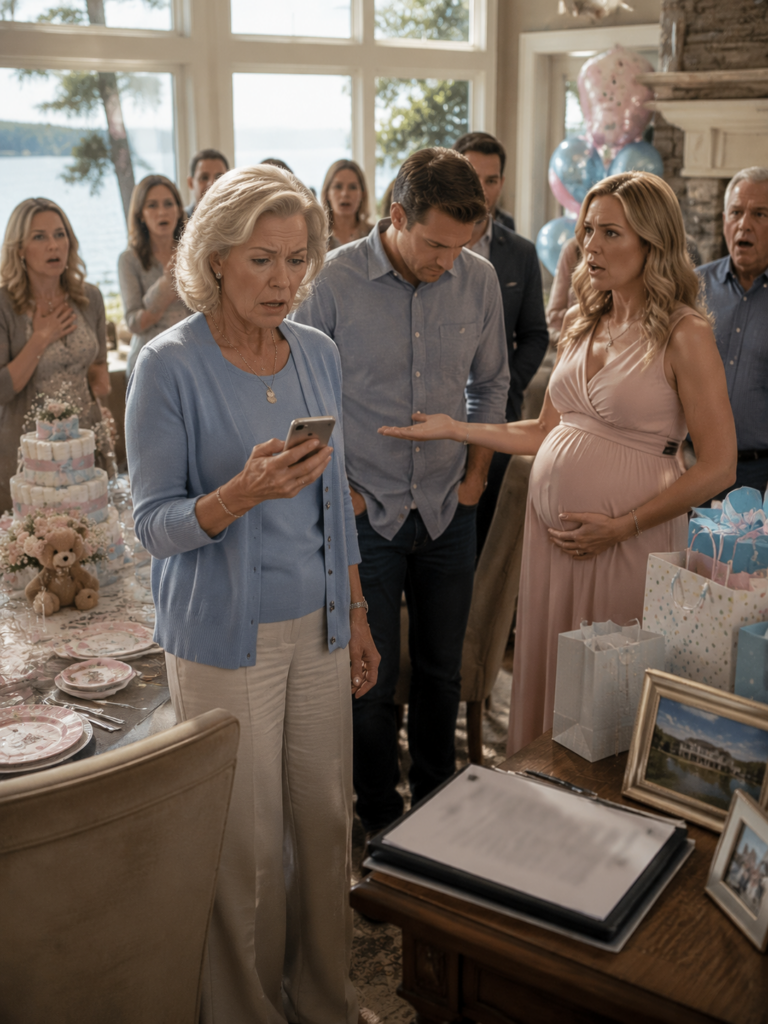
Paul looked past her at the banner above the fireplace, the untouched cake, the guests sitting with pink napkins on their laps.
“Apparently,” he said, “it became a public matter when you announced a property transfer before the owner knew about it.”
No one moved.
Then my neighbor, Mrs. Donnelly, who had lived across the lake for twenty-six years and had never liked Olivia, set her lemonade down with deliberate care.
“I’d like to hear this,” she said.
That gave everyone else permission to stay.
We walked back into the living room.
The balloons still floated. The cake still waited. A baby shower game sat half-finished on the coffee table, little pencils scattered beside cards where guests had guessed the baby’s weight.
Someone had left a tiny pair of socks on the arm of the couch, pale pink and folded together like a promise.
It looked absurd now.
Pretty decorations around an ugly thing.
Paul stood by the fireplace. I sat in George’s old leather chair, the one nobody else ever used because everyone knew. Mark remained near the sliding door. Olivia stood beside the gift table, both hands under her belly as if the baby could shield her from consequence. Richard stayed near the entryway, close enough to leave but not brave enough to run.
Paul opened his folder.
“This morning,” he said, “a quitclaim deed was submitted to the county clerk’s office. It attempted to transfer Eleanor Whitaker’s lake house to Mark Whitaker and Olivia Whitaker.”
A woman gasped.
Olivia’s mother whispered, “Oh my God.”
Olivia lifted her chin.
“That is not true.”
Paul held up one page.
“It is very true.”
Mark’s face had gone gray.
“Mom,” he said, “I can explain.”
I looked at him.
A lifetime can fit inside one word when it comes from your child.
Mom.
I remembered him at four, barefoot on the dock, holding a bluegill in both hands and crying because it was flopping.
I remembered him at ten, asking George if heaven had lakes. I remembered him at thirty-two, calling me after his divorce and saying, “I messed everything up.” I remembered every fever, every school concert, every time he pretended he did not need me and every time he came back when he did.
I had forgiven my son for many things.
But forgiveness is not the same as handing someone the knife again.
“Then explain,” I said.
Olivia spoke before he could.
“We were trying to protect you,” she said, turning toward the guests now, not me. “Eleanor fell last week. She’s alone out here. Mark and I have been worried sick. We wanted to make sure the house stayed in the family if something happened.”
Mrs. Donnelly gave a dry little laugh.
“It was already in the family,” she said. “It was in Eleanor’s hands.”
Olivia ignored her.
“With the baby coming, we all agreed it made sense to start planning.”
“We did not all agree,” I said.
Her eyes snapped back to mine.
“You signed papers.”
“I signed emergency forms.”
“You signed what was in front of you.”
The room went colder.
There it was.
Not concern.
Not misunderstanding.
The truth, dressed in impatience.
Paul’s voice remained calm. “Mrs. Whitaker did not sign a deed in the presence of a valid notary. She did not authorize transfer. She did not receive independent counsel before transferring her primary property. And she had already instructed this office to monitor any filings after suspicious documents were presented to her.”
Richard shifted.
Paul looked at him.
“Mr. Langford, your name appears as notary.”
Richard’s face hardened. “I notarize many documents. I don’t review every family conversation behind them.”
“You are Olivia’s father,” Paul said.
“I am also a licensed professional.”
“Your notary commission expired in February.”
That was when the room truly changed.
Before that, some people had been confused. Some embarrassed. Some waiting for the polite explanation that would let everyone return to cake.
But an expired notary commission was not a misunderstanding.
It was a crack in the floor.
Richard’s mouth opened.
Closed.
Olivia turned on him so fast her earrings swung.
“Dad?”
He hissed, “Not here.”
Paul slid another page from his folder.
“The clerk’s office has already declined to record the deed. They have also preserved the submission record, including time, method, and the person who delivered it.”
Olivia’s face drained of color.
Mark whispered, “Delivered?”
I stared at him.
“You didn’t know that part?”
He rubbed both hands over his face.
“I knew Olivia wanted the paperwork filed,” he said. “I knew she thought it would be easier before Emma came. I thought—”
“You thought what?” I asked.
His voice broke.
“I thought you’d agreed.”
Olivia laughed once. A hard, ugly little sound that did not belong at a baby shower.
“Oh, please, Mark. Don’t start acting innocent now.”
The guests were frozen.
Even the balloons seemed still.
Mark turned toward his wife.
“You told me she understood.”
“She did understand,” Olivia snapped. “She just changed her mind because Paul filled her head with fear.”
I stood.
My legs felt weak, but my voice did not.
“Olivia, I changed my mind before I knew there was a deed. I changed my mind when you sat at my kitchen table and covered the top of a page with your hand.”
No one breathed.
Olivia’s lips parted.
I kept going.
“I changed my mind when my son looked at me like he wanted to apologize but did not have the courage. I changed my mind when you talked about my home as if I were a problem to be moved out before the nursery furniture arrived.”
Her mother began to cry softly into a napkin.
Olivia looked around, realizing too late that the room was no longer hers.
That is the thing about public cruelty. It works only when the crowd believes you are still respectable.
Once they see the machinery underneath, the smile becomes evidence.
Richard stepped forward.
“This has gotten emotional,” he said. “Eleanor, nobody is trying to steal from you. We are talking about a practical arrangement. You are nearly seventy. Lake houses require upkeep. Insurance. Taxes. Maintenance. Mark is your only child. Eventually, the property would come to him anyway.”
Eventually.
That word struck me harder than I expected.
Eventually, George would die.
Eventually, I would sleep alone.
Eventually, my own son would stand in my living room while another family discussed where to put me.
Eventually is the word people use when they are tired of waiting for your life to get out of their way.
I looked at Richard.
“My husband did not build this house for eventually,” I said. “He built it for us. And I am still here.”
Mrs. Donnelly whispered, “Amen.”
Richard’s face reddened.
Paul closed his folder.
“There is more,” he said.
I had not known that.
I turned to him.
Paul met my eyes briefly, asking permission without words.
I gave one small nod.
He removed a second document.
“After Eleanor called me last week, I reviewed not only the county records but also recent mail forwarded from her insurance carrier and utility companies. Someone attempted to change the mailing address for the lake house insurance policy to Mark and Olivia’s home address.”
Mark looked stunned.
Olivia stared at the carpet.
Paul continued, “Someone also requested a payoff statement from Eleanor’s home equity line of credit, which has a zero balance and has been inactive for years.”
I felt the words before I understood them.
Home equity line.
George and I had opened it a long time ago in case the roof failed or medical bills swallowed us whole. We never used it. After he died, I left it open because the bank manager said it did no harm. It sat in the background of my finances like an old emergency flashlight in a drawer, something you hoped you would never need but felt better knowing existed.
Olivia knew about it.
She had seen the statement on my kitchen counter in January and said, “It’s smart to keep options.”
Options.
My stomach turned.
Paul looked at Mark.
“Did you request that payoff statement?”
Mark shook his head slowly.
“No.”
“Did you, Olivia?”
She said nothing.
Richard muttered, “Don’t answer that.”
The room heard him.
Every person heard him.
That was when a younger woman from Olivia’s side stood up and grabbed her purse.
“I’m sorry,” she said, voice shaking. “I can’t be here for this.”
Her departure broke the spell.
Two more guests rose. Then another. Chairs scraped. Gift bags were left untouched. Someone whispered, “This is awful.” Someone else said, “That poor woman.” Olivia’s country club smile had no place to land anymore. Her mother sat with a napkin crushed in her fist, crying without making a sound. The cousins from Mark’s side avoided my eyes, not because they blamed me, but because shame spreads in families like smoke, and everyone had breathed some of it.
Olivia watched them leave with disbelief, as if betrayal had been committed against her.
In less than five minutes, the perfect shower thinned into a room full of evidence and shame.
Only family remained, plus Mrs. Donnelly, who had no intention of missing the end.
Mark walked toward me.
“Mom.”
I lifted my hand.
He stopped.
The look on his face nearly broke me.
Not because he was innocent. He was not. But because he had finally understood that silence does not stay empty. If you leave a silence long enough, someone like Olivia will fill it with signatures.
“I need you to tell me the truth,” I said. “Not the gentle version. Not the version where you were confused. The truth.”
He swallowed.
Olivia glared at him.
“Mark,” she warned.
But he was looking at me.
His mother.
The woman who washed his Little League uniform in the sink because the washing machine broke the night before playoffs. The woman who sent twenty dollars in birthday cards when twenty dollars mattered. The woman who sat beside his hospital bed when he had appendicitis at nineteen, long after he was too old to admit he was scared. The woman who watched him grieve his father and wanted so badly to protect him from loneliness that she had not noticed when his weakness began costing her safety.
He broke.
“She said we were drowning,” he whispered.
Olivia closed her eyes.
Mark kept going.
“The house payment. The baby bills. Her student loans. Her dad said lakefront property was only going up and that if we didn’t secure it now, estate taxes and probate would make a mess.”
Paul said, “There would be no estate tax issue for an estate this size. And probate planning does not require tricking a widow.”
Mark flinched.
“I know.”
“No,” I said quietly. “You know now.”
He nodded, tears standing in his eyes.
“Olivia said you’d be safer in town. She said you’d fight at first because you’re stubborn, but once it was done, you’d adjust.”
Adjust.
To losing my home.
To losing the last place where George’s coffee mug still sat in the cabinet.
To being placed somewhere easier.
Not for me.
For them.
I turned to Olivia.
“And you believed you had the right?”
Her voice came out low.
“I believed this family needed to think ahead.”
“This family?”
She lifted her chin again, but it trembled this time.
“Yes. This family. Mark is your son. Emma is your granddaughter. You’re living alone in a valuable property you can barely manage.”
“I manage fine.”
“You fell.”
“I slipped on a wet step.”
“You’re getting older.”
“So are you,” Mrs. Donnelly muttered.
Olivia shot her a look, then turned back to me.
“Do you know what it feels like to be pregnant and terrified about money? Do you know what it feels like to wonder if your child will ever have a secure home?”
The room went very quiet.
For the first time that afternoon, I saw the fear under Olivia’s polish.
It did not excuse her.
But it explained the shape of the knife.
“I do know,” I said. “I was pregnant with Mark when George got laid off from the mill for eight weeks. We ate casseroles from church ladies and pretended we liked powdered milk. I know exactly what fear feels like. But fear does not give you permission to take what is not yours.”
Olivia blinked fast.
I continued.
“If you had come to me honestly, I might have helped. I have helped. I paid for the crib you told everyone your mother bought. I paid the mechanic when Mark’s truck needed brakes last fall. I put five thousand dollars toward your medical deductible because you said the insurance was confusing. I did it quietly because I thought dignity mattered.”
Mark looked up sharply.
“You paid the deductible?”
Olivia’s face tightened.
I almost laughed.
That small detail wounded her more than the deed.
Because now Mark knew she had not simply been desperate.
She had been arranging the story.
“Yes,” I said. “I paid it. And I never asked for credit.”
Mark turned to Olivia.
“You told me your dad helped.”
Richard snapped, “This is not the point.”
“Oh, I think it is,” Paul said.
I looked at my son and felt something inside me settle.
Not soften.
Settle.
“Mark, I love you,” I said. “I will always love you. But after today, love will no longer mean access.”
He began to cry then, silently, the way grown men cry when they are ashamed of needing their mother after wounding her.
Olivia’s mother stood, pale and shaken.
“Olivia,” she whispered, “what have you done?”
For a second, Olivia looked young. Younger than she was. Cornered. Frightened. Furious that the room would not bend back into admiration.
Then she did what people like Olivia often do when truth removes their costume.
She attacked the wound.
“You’re going to punish your own granddaughter?” she said. “That’s what this is? You’d rather leave a baby with nothing than share a house you can’t take with you?”
I felt every eye move to me.
There it was.
The baby placed on the table like a shield.
I took one breath.
Then another.
“No,” I said. “I am going to protect my granddaughter from learning that love means taking from old women when they are tired.”
Olivia’s mouth shut.
“That house will not be stolen in Emma’s name,” I said. “Not while I’m alive.”
No one spoke.
Outside, a boat motor hummed across the lake and faded.
Paul stepped beside me.
“Eleanor, we should leave now.”
It was strange. This was my home, yet I understood what he meant. The house was full of people who had come for cupcakes and were now standing in the aftermath of attempted theft. I needed air. I needed safety. I needed to decide what came next without Olivia watching my face.
I picked up my purse.
Mark moved as if to help me.
I stepped back.
That small movement hurt him more than any shouting would have.
“Mom,” he whispered.
“Not today,” I said.
Paul drove me to his office because he did not want me alone. On the way, we passed the grocery store, the pharmacy, the bait shop where George used to buy worms and pretend he was only going in for coffee. Normal places. Normal Saturday traffic. The world kept moving, rudely unconcerned that my family had cracked open in my living room.
At Paul’s office, I sat in a chair that smelled faintly of leather and paper while he spoke with the clerk, then with someone from the sheriff’s department, then with the bank. I answered questions. I confirmed dates. I identified which signatures were mine and which were not. Some of the initials looked like mine if you did not love me. That was the thought that kept returning. If you did not know the way my E slanted after my wrist began to ache, if you did not know that I pressed harder on the second half of Whitaker when I was tired, if you did not know that I never crossed a t that way, you might believe those marks belonged to me.
But Paul knew.
George would have known.
I knew.
My wrist ached from gripping my purse.
At some point, Paul’s receptionist, a woman named Marcy, set a cup of tea beside me and said, “You don’t have to drink it. I just thought your hands might like something warm.”
That kindness nearly undid me.
Not the fraud.
Not the humiliation.
The tea.
Sometimes the smallest decent thing reminds you how badly others have behaved.
By evening, the deed filing had been formally rejected. The county preserved the document. Richard’s notary issue was referred for review. The bank froze all requests tied to my property and credit line. Paul drafted a notice revoking any authorization I might have unknowingly signed, and I signed that one after reading every word twice.