I’ve watched my father, Harold, wash aluminum foil and dry it on the dish rack for as long as I can remember.
He pats it flat with his thick, grease-stained fingers and folds it into a neat square for next time.
That’s the kind of man he is.
A man raised by parents who survived the Depression, who taught him that every penny had a pulse and every resource was a gift.
He’s driven the same Mercury Grand Marquis since 2004, a beige boat of a car with 287,000 miles on it.
I asked him once why he didn’t treat himself to something newer, and he just shrugged and said, ‘It still goes.’
His one and only extravagance in this life is name-brand ketchup.
Not the thin, vinegary store brand, but Heinz.
He says the store brand is ‘an insult to the tomato,’ and he will not budge on it.
That’s my father.
But last Tuesday, everything I thought I knew about that quiet, penny-pinching man tilted so hard I nearly fell.
It was around ten in the morning when my phone rang.
The screen said ‘First Midwest Bank, Dubuque,’ and my stomach dropped a little.
I’ve been on my father’s accounts since his bypass surgery two years ago, just as a precaution, so the bank calls me if anything seems out of the ordinary.
I answered, and the branch manager, Mrs. Patterson, came on the line.
She’s a kind woman with a soft voice and careful words, the sort of person who’s seen every facet of small-town financial life and knows how to break difficult news.
‘Louise, honey,’ she said, ‘I need to speak with you about your father.’
Her tone was gentle but weighted, like she was carrying something fragile and didn’t want to spill it.
‘Is he alright?’ I asked, my mind immediately rushing to hospitals, to chest pains, to all the things we fear.
‘Oh, he’s fine physically,’ she said quickly. ‘Very clear-headed, very pleasant. But he came in this morning and made a withdrawal. A large one.’
I waited.
‘Nine thousand dollars,’ she said. ‘In cash.’
My mouth went dry.
‘He asked us for it in an envelope, Louise. And, honey… he was wearing his suit.’
My father’s suit.
I’ve seen him in that dark gray wool suit exactly eleven times in my entire life, and every single one of those times, we were burying someone we loved.
He wears it for funerals and nothing else.
He keeps it in a garment bag in the back of his closet, and once a year he takes it out, brushes it, and hangs it back up.
The idea of him walking into a bank on a random Tuesday in that suit made my blood run cold.
‘I just thought you should know,’ Mrs. Patterson said softly. ‘He was perfectly calm, perfectly himself, but the suit… I’ve seen enough in my years here to know when something is happening that a person hasn’t shared with their family.’
I thanked her and hung up, my hands shaking a little.
I tried to think rationally.
Maybe he was buying something wonderful and surprising for my mother, Eleanor, for their upcoming fiftieth anniversary.
But that didn’t fit.
My father doesn’t believe in grand surprises, and if he were buying a gift, he would never wear that suit.
He’d wear his regular khakis and a plaid shirt, the clothes he’s most comfortable in.
The suit meant ceremony.
It meant weight.
It meant a moment so heavy that only the most solemn thing in his closet would do.
I got in my car and drove straight over to my parents’ house.
The driveway was empty except for the Mercury, parked in its usual spot near the garage.
The garage door was open, and as I pulled up, I could see my father underneath the car on his creeper, only his coverall-clad legs and work boots visible.
He was changing his own oil, because of course he was.
The man is seventy-eight years old, and he still refuses to pay someone else to do what he can do himself.
‘Dad?’ I called, stepping into the cool, oil-scented garage.
He slid out from under the car, a smear of grease on his chin, and looked up at me with those pale blue eyes that have never once lied to me.
‘Louise,’ he said, not a question, just an acknowledgment.
He wiped his hands on a red rag, taking his time, and I saw something flicker behind his eyes.
Something I’d never seen before.
It wasn’t fear, exactly.
It was resolve.
‘Mrs. Patterson called me,’ I said, trying to keep my voice steady. ‘She said you came in this morning and took out nine thousand dollars. In cash. And you wore your suit.’
He didn’t flinch.
He just finished wiping his hands and laid the rag on the workbench.
‘That’s true,’ he said.
‘Dad, what is going on? Are you in some kind of trouble? Is someone trying to scam you?’
I could hear the edge in my own voice, the panic rising.
He looked at me for a long moment, longer than he usually looks at anybody.
My father is not a man of many words, but when he does speak, every syllable has been weighed and measured.
‘It’s not for a scam,’ he said quietly. ‘And it’s not for a boat or a car or anything foolish.’
He paused, and something deep and old moved across his face.
‘It’s a debt, Louise. Something I should’ve paid a very long time ago.’
A debt?
My father has never owed a single dime past the tenth of the month in his entire life.
He pays his credit card balance in full every single time, and when he and my mother bought this house in 1972, he paid off the mortgage in eighteen years instead of thirty by working double shifts at the plant.
He pins his receipts to the calendar in the kitchen.
He does not carry debt.
‘What debt?’ I asked, my voice coming out smaller than I intended.
‘That’s all you get right now,’ he said, and his tone was kind but final. ‘And don’t tell your mother yet.
She’ll get her turn. This is something I have to do alone.’
I stood there, my heart pounding, and he just turned back to his car and slid underneath it again, the conversation closed.
For the rest of the week, I couldn’t stop thinking about that envelope.
I knew it was in his toolbox drawer in the garage.
I knew because, God forgive me, I checked.
On Thursday afternoon, when he was at his weekly coffee klatch at the diner with the other retired men, I slipped into the garage and slid open the top drawer of his red Craftsman toolbox.
There it was.
A plain white bank envelope, thick and fat, tucked under the plastic case that holds his socket set.
It sat there, patient and heavy with mystery, and I didn’t dare touch it.
I just stared at it for a full minute, my mind spinning with terrible possibilities.
Was he sick?
Was he being threatened?
Had he done something in his past that was now coming back to demand payment?
I felt like a traitor for looking, but I couldn’t help myself.
I needed to know that the money was still there, that he hadn’t handed it off to some con artist.
And it was there.
Fat and patient and absolutely terrifying.
Saturday morning arrived gray and cool.
I was at my own kitchen table, drinking coffee and trying to read the newspaper, when my doorbell rang.
I opened the front door and there he was.
He was wearing the suit.
The dark gray wool was brushed perfectly, the white shirt starched, a sober navy tie knotted at his throat.
In his breast pocket, I could see the corner of the white envelope.
My throat tightened.
‘Get your keys,’ he said, and his voice was steady and calm, the voice he used when he taught me to drive, when he talked me through the death of my first dog.
‘We’re taking your car. Mine’s got a slow leak in the rear tire I haven’t fixed yet.’
Even in this moment, he was practical.
I nodded, unable to speak, and grabbed my purse and keys.
He handed me a small piece of paper as we walked to my car.
On it, in his careful, blocky handwriting, was an address.
It was in a town I’d never heard of, two counties over, near the Illinois border.
‘Drive,’ he said, settling into the passenger seat and fastening his seatbelt with the same deliberate care he did everything. ‘And don’t ask yet.’
So I drove.
We pulled out of my driveway and headed west, the familiar streets of Dubuque giving way to open highway.
The sky was a pale, washed-out blue, and the fields on either side were still brown from winter, waiting for spring.
Neither of us spoke.
The silence in the car was not uncomfortable, but it was thick, filled with all the things I couldn’t ask.
I kept glancing at him.
He sat perfectly still, his hands folded in his lap, his eyes fixed on the road ahead.
There was a stillness about him that I had never seen, a deep, settled peace that seemed to radiate from his very bones.
He wasn’t nervous.
He wasn’t afraid.
He was a man who had finally made a decision after decades of carrying something, and the weight was already beginning to lift.
The miles rolled by.
We passed through small towns with names like Elizabeth and Stockton, past silos and barns and fields dotted with cattle.
My father watched it all without comment, but I could see his eyes moving, taking in the landscape as if he were memorizing it.
Finally, after nearly an hour, he pointed to a narrow gravel road coming up on the left.
‘Turn here.’
I turned, and the tires crunched onto the gravel, kicking up a small cloud of dust.
The road wound through a stand of old oak trees and then opened up onto a gentle hill.
At the top of the hill sat a small farmhouse.
It was a modest white clapboard house with a sagging front porch, a rusted tin roof, and an old red pickup truck parked near the barn.
The barn was newer than the house, its wood still a pale, untreated brown, but the house itself looked like it had been standing there for a hundred years, its paint peeling in gentle curls, the screen door slightly askew.
‘Stop here,’ my father said, his voice barely above a whisper.
I pulled the car to the side of the gravel drive and killed the engine, and we just sat there for a moment.
Then my father took a deep breath, squared his shoulders, and opened the car door.
I watched him walk up the uneven stone path toward the front porch, and I followed him, my heart hammering so hard I could feel it in my ears.
He climbed the creaking wooden steps and stood before the screen door.
For a long moment, he didn’t move.
He just stared at the worn brass door handle, and I saw his hand go to his breast pocket, touching the envelope.
Then he straightened his tie, cleared his throat, and knocked.
The sound echoed in the quiet morning.
Inside the house, I heard the shuffle of footsteps, slow and careful.
The inner door creaked open, and an elderly woman appeared behind the screen.
She was probably around my father’s age, maybe a few years older, with silver hair pulled back in a neat bun and a face that was deeply lined but very kind.
She wore a simple floral housedress and held a dish towel in one hand, and she peered through the screen with the slight squint of someone who doesn’t see as well as she used to.
Then she looked at my father, really looked at him, and I watched her face go completely still.
‘Can I help you?’ she asked, her voice polite but uncertain.
My father reached up and removed his hat, pressing it to his chest.
His hands were trembling, I realized.
In all my life, I had never seen my father’s hands tremble.
‘Are you Martha Ellsworth?’ he asked, and his voice cracked on her name.
The woman frowned slightly, studying his face.
‘Yes,’ she said slowly. ‘I’m Martha. Do I know you?’
My father closed his eyes for a brief moment, and when he opened them, they were glistening.
‘You knew my father,’ he said, and his voice was thick. ‘Henry Thompson. My name is Harold. Harold Thompson.’
Martha’s hand went to her throat.
‘Thompson?’ she breathed.
‘Yes, ma’am,’ my father said, and his composure broke.
A single tear slipped down his cheek and got lost in the lines around his mouth.
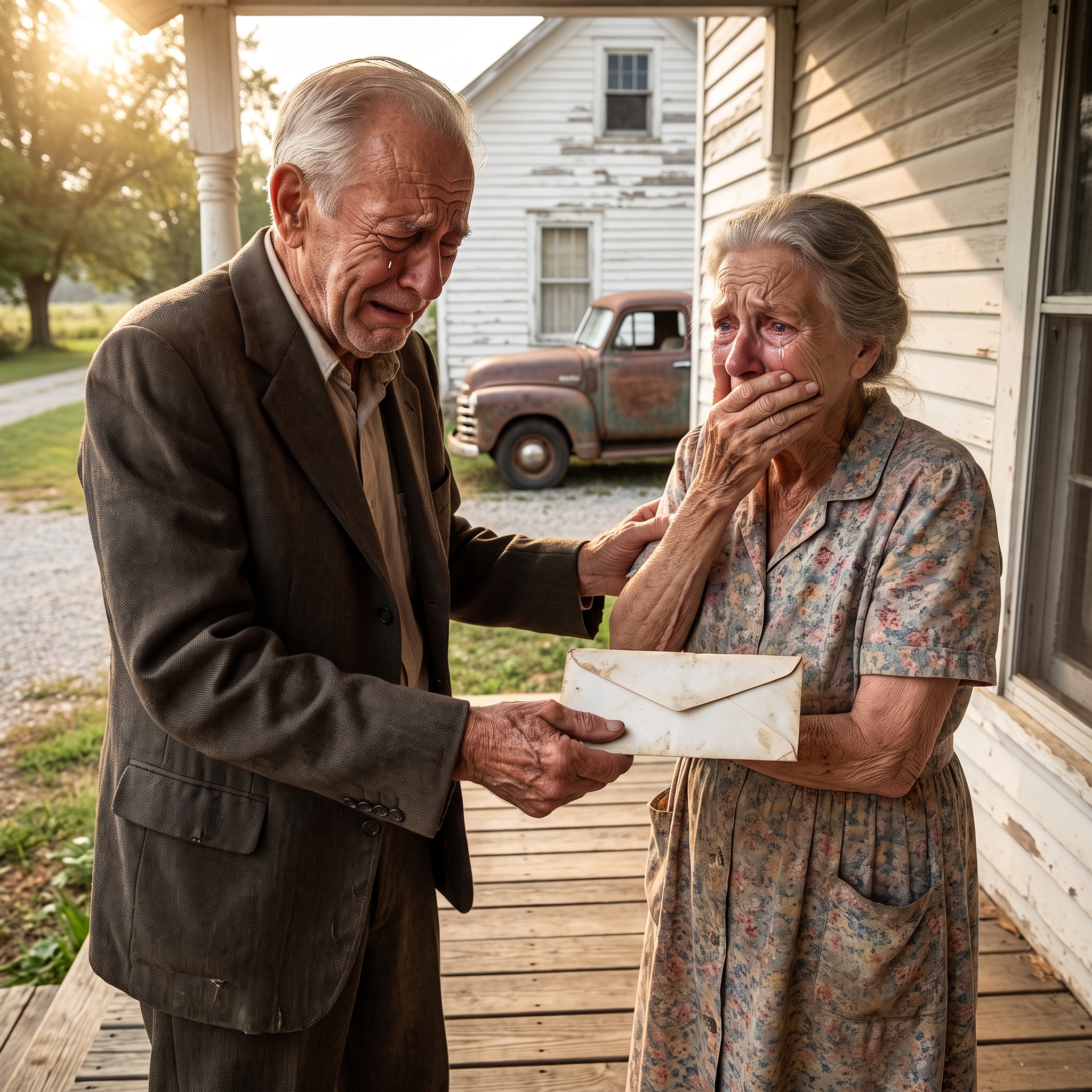
‘I’m here to pay my debt,’ he said, and he reached into his breast pocket and pulled out the white envelope.
He held it out toward her with both hands, like an offering, and I saw the envelope shaking in his grip.
‘I set fire to your barn,’ he said, and his voice was raw and broken. ‘In 1952. I was just fifteen years old, and I was playing with firecrackers behind the hayloft with a friend. We didn’t mean any harm. We were just foolish boys. But one of them sparked in the dry hay, and the whole thing went up so fast. We ran. We ran, and we never told anyone, and I have been carrying that sin on my soul for seventy-two years.’
Martha stared at him, her mouth open, her eyes filling with tears.
‘That was you?’ she whispered.
My father nodded, and now the tears were flowing freely down his weathered face.
‘I lost everything in that fire,’ Martha said, her voice trembling. ‘All our hay, our equipment, the two milk cows we couldn’t get out in time. My father had to take out a loan he never paid off before he died. We almost lost the farm.’
‘I know,’ my father said, and his shoulders shook. ‘I know what I took from you. I’ve read the old newspaper clippings a hundred times. I’ve driven past this farm maybe fifty times over the years, but I could never find the courage to stop. I’m so sorry, Mrs. Ellsworth. I’m so terribly sorry.’
Martha pushed open the screen door and stepped out onto the porch, and she stood there, a small, frail woman in a faded dress, staring at the man who had confessed to a sin that was older than I was.
‘Why now?’ she asked, her voice barely a whisper.
My father took a shuddering breath.
‘Because I’m old,’ he said. ‘I had bypass surgery two years ago, and I realized I’m running out of time. I’ve saved what I could, little by little, from my pension. My wife doesn’t know. My daughter didn’t know until this morning. I withdrew nine thousand dollars. It’s not enough to cover what I did. It will never be enough. But it’s what I had, and I wanted you to have it before I meet my maker.’
He pressed the envelope into her hands.
Martha looked down at it, then back up at him, and then she did something I will never forget as long as I live.
She stepped forward, still holding the envelope, and she wrapped her arms around my father, pulling him into a fierce, trembling embrace.
‘Oh, you foolish, foolish boy,’ she said, and she was crying now, the tears running down her cheeks and into his gray wool shoulder. ‘My father never blamed anyone but himself for leaving that hay so dry. He said it was an accident, a terrible accident, and he never wanted to know who did it. He said holding onto anger was like drinking poison and hoping the other person would die.’
My father’s body sagged against her, and a sound came out of him that I had never heard before, a deep, ragged sob that seemed to come from the very bottom of his soul.
‘I’m so sorry,’ he kept saying, over and over, muffled against her shoulder. ‘I’m so sorry.’
‘You’re forgiven,’ Martha said, her voice strong now, carrying the authority of someone who had lived a long, hard life and learned what truly mattered. ‘You were forgiven seventy-two years ago. You just didn’t know it.’
I stood at the bottom of the porch steps, weeping silently, and I watched my father, the most stoic man I have ever known, weep in the arms of a stranger who wasn’t a stranger at all.
After a long while, Martha pulled back and looked at the envelope in her hand.
‘Harold, I can’t take this,’ she said softly.
‘You have to,’ my father said, wiping his face with the back of his hand. ‘I need you to take it. Please.’
She studied him for a long moment, and then she nodded.
‘Then I’ll take it,’ she said. ‘And I’ll use it to fix the roof on this old house, which has leaked every spring for the last ten years. And every time it rains and I’m dry, I’ll think of you and say a prayer of thanks.’
My father smiled then, a watery, trembling smile, and he took her hand and held it.
‘Thank you,’ he said.
Martha squeezed his hand back.
‘Would you and your daughter like to come in for some coffee?’ she asked. ‘I have some cinnamon rolls I baked this morning.’
My father turned and looked at me, and I nodded, unable to speak.
So we went inside that little farmhouse, with its faded wallpaper and its ancient lace curtains, and we sat at a scarred Formica table while Martha poured coffee into mismatched cups and told us stories about her father, about the farm, about a life lived with grace and hard work.
My father listened, and he smiled, and I watched seventy-two years of guilt and shame fall away from his shoulders like a heavy coat he’d finally been allowed to remove.
When we finally left, hours later, my father and Martha hugged again on the porch, long and quiet, and I saw her slip the envelope into the pocket of her apron without a word.
The drive home was different.
We still didn’t talk much, but the silence was no longer thick.
It was light and clean, like the air after a storm.
At one point, my father reached over and patted my hand.
‘Your mother’s going to be furious when she finds out I had nine thousand dollars socked away,’ he said, and there was a hint of a smile in his voice.
I laughed, and it came out halfway to a sob.
‘You did a good thing today, Dad,’ I said.
He nodded slowly, staring out the window at the passing fields.
‘I did a thing I should’ve done a long time ago,’ he said. ‘That’s not the same as good. But it’s a start.’
We drove on, and the sun came out from behind the clouds, and it felt like a benediction.
That night, I told my mother.
She sat at the kitchen table and listened to the whole story, and when I was finished, she didn’t say anything for a very long time.
Then she got up, walked over to my father, who was sitting in his recliner reading a seed catalog, and kissed the top of his head.
‘You’re a good man, Harold Thompson,’ she said. ‘You always have been.’
And my father, who washes aluminum foil and drives a twenty-year-old car and only splurges on name-brand ketchup, looked up at her with his pale blue eyes, and he smiled the most peaceful smile I have ever seen on a human face.
Nine thousand dollars in cash.
A debt paid after three-quarters of a century.
And a lesson I will carry with me for the rest of my days: that it’s never too late to make things right, and that the heaviest burdens are the ones we carry in secret, and that the only way to put them down is to face them, no matter how much time has passed.
If this story moved you, please take a moment to Like and Follow our page for more real-life stories of quiet heroes and grace in unexpected places. And if you’ve ever witnessed an act of late-in-life redemption that took your breath away, we’d be honored if you shared this story with someone who might need to hear it today. What’s the heaviest burden you’ve had to set down?