My name isn’t important, but I’m a man who’s always found peace in old engines and rusted steel.
I live in a small town in Coffey County, Kansas, where the wind blows through the cornfields and the past feels closer than the future.
I restore old farm trucks as a hobby, so when I saw the estate sale notice in the Burlington Bulletin, I paid attention.
An old Vietnam veteran named Walter Henderson had passed away at the age of seventy-eight, out on a remote homestead past the county line.
He’d been a hermit for decades, the paper said, with no known relatives.
The estate was selling his belongings, including a 1968 Ford F-250 that had been sitting in his barn for years.
The photograph in the ad showed a rusted heap, but I could see the bones of a classic.
I went out there on a cold October morning, the kind that makes your breath hang in the air.
The old farmhouse was sagging, paint peeling, a ghost of a life lived in solitude.
The auctioneer, a brisk man with a clipboard, told me old Walter used to tinker in his shop but rarely spoke to anyone.
“Lived alone since the war,” he said.
“His wife died while he was overseas, they say. Never got over it.”
That hit me in a way I didn’t expect.
I bid on the truck, not because it was valuable, but because something about it felt significant.
I won it for a few hundred dollars and towed it behind my pickup back to my own barn.
The truck was in rough shape—the engine coughed, the tires were rotted, and the bed was a patchwork of rust.
I planned to strip it for parts: the transmission, the axles, whatever was salvageable.
I’m a methodical man, so I started by pulling the flatbed off to get at the frame.
That’s when I noticed something peculiar.
Behind the cab, where an auxiliary fuel tank is usually mounted on these old Ford farm trucks, there was a metal box that looked too clean.
It had a seam running around it, but no fuel lines, no cap.
I tapped it with a wrench, and it echoed hollow.
I slid underneath and shone a flashlight inside the gap—there was no residue of diesel, no smell of fuel at all.
This tank had been meticulously cleaned, cut open, and then welded shut again.
Hidden in plain sight.
Walter Henderson had turned a part of his truck into a secret vault.
My heart started pounding a little faster.
I’m not a man who chases mysteries, but I had to know what was inside.
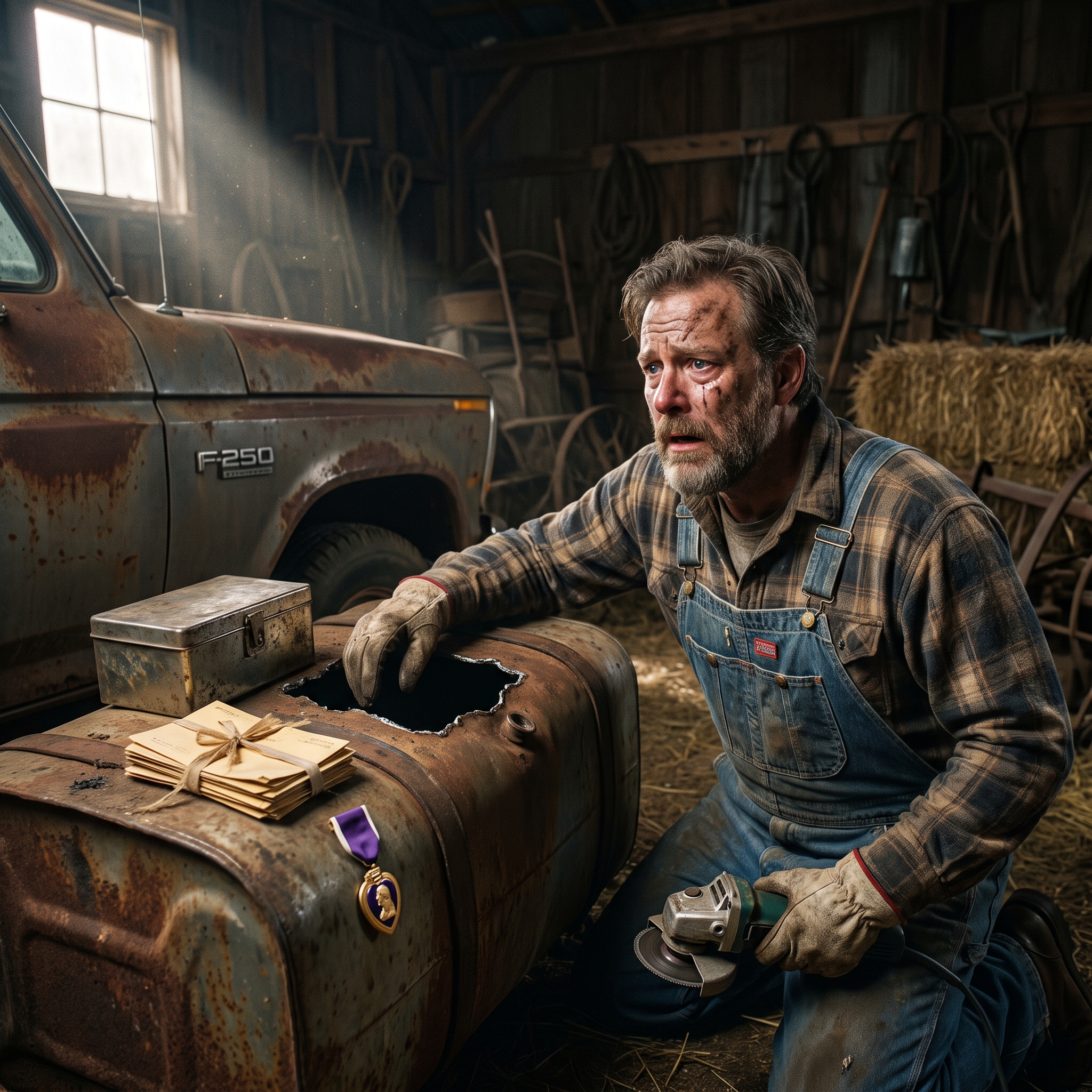
I pulled the truck deeper into my barn, closed the big sliding door, and got out my angle grinder.
The noise of the grinder filled the space as I cut along the old weld seam.
Sparks flew, and the metal groaned.
When I finally breached the seal, I shut the grinder off and just stared.
The tank opened up like a time capsule.
Inside, nestled on a bed of old burlap, was a small metal box—the kind that once held ammunition or tools.
It was dented and painted olive drab, with a rusty latch.
I wiped the sweat from my brow, my hands trembling a little, and lifted it out.
Placing it on my workbench, I unlatched it carefully.
The hinges creaked as I opened the lid.
What I found inside stole my breath away.
A stack of letters, yellowed and fragile, tied together with a pink silk ribbon that had faded to almost white.
A Purple Heart medal, its ribbon frayed but the heart itself still gleaming with a somber dignity.
And a black-and-white photograph of a young woman with kind eyes and a gentle smile, her hair curled in the style of the 1960s.
My throat tightened immediately.
I sat down on an old crate, my legs suddenly weak.
The letters were addressed to Walter Henderson, APO San Francisco, from someone named Eleanor.
The postmarks spanned the months of 1968.
With infinite care, I untied the ribbon and opened the first envelope.
The handwriting was elegant, the paper thin as onion skin.
The words hit me like a physical blow.
“My dearest Walter,” it began.
“I miss you more than words can say. The baby is kicking now.
I talk to it every night, telling it about its brave daddy fighting so far away. I pray God brings you home to us.”
I had to set the letter down because my eyes were blurring with tears.
He had a child on the way.
And he’d been in Vietnam, fighting a war, while his young wife carried their baby alone back home.
I read the next letter, and the next.
They were filled with love and hope and the small details of daily life on a Kansas farm.
She wrote about the garden, the weather, her dreams for their future.
“I’ve painted the nursery a soft yellow,” she wrote in one.
“I can’t wait for you to see it. Please be careful, my love. Come back to me.”
The dates grew later, and the tone shifted slightly—a hint of worry, a note of weariness.
She was getting close to her due date.
And then I reached the final letter, but it was not from Eleanor.
It was a telegram from the Department of the Army, dated October 15, 1968, addressed to Specialist Walter Henderson.
It was brief and brutal: “Deeply regret to inform you that your wife, Eleanor Henderson, passed away on October 14 due to injuries sustained in a motor vehicle accident.
The infant, a girl, was delivered but remains in critical condition. Further details will follow. Our deepest condolences.”
I read it three times before the words sank in.
He’d received this in the middle of a war zone.
His beloved wife, dead.
His newborn daughter, fighting for her life.
What kind of torment must he have endured?
I sat there in my barn, the weight of a stranger’s grief crushing my chest.
It explained everything—why Walter Henderson came back from the war and became a ghost.
He must have buried his pain so deep that he sealed it inside a hollow tank on a truck he never drove.
The Purple Heart told me he’d been wounded himself.
Perhaps he felt guilty for surviving when she didn’t.
Perhaps that box was the only way he could keep her—and the memory of the family he lost—close without facing it.
I don’t know how long I sat there, but the light in the barn shifted to a deep gold sunset before I moved again.
I carefully placed everything back in the metal box and locked my shop.
That night, I couldn’t sleep.
I lay in bed, staring at the ceiling, thinking about that little girl.
She’d be in her fifties now—if she survived.
The telegram said she was in critical condition.
What happened to her?
Was she adopted? Did she ever know about her father?
The next morning, I started researching.
I’m no detective, but I felt a profound responsibility to honor Walter’s hidden treasure.
I drove to the county courthouse and combed through old records.
I learned that Eleanor Henderson was buried in a small cemetery outside Burlington, under a simple headstone that read “Beloved Wife and Mother.” The grave had fresh flowers on it, I noticed later, though I never discovered who placed them.
I found the baby’s birth certificate filed under the name Mary Eleanor Henderson, born October 14, 1968.
Then I hit a wall for weeks.
The adoption was sealed long ago.
I put a notice in the local paper and posted in historical groups online, hoping someone might know something.
Finally, a retired nurse from the old county hospital called me.
She remembered the case vaguely: a tiny baby girl had been gravely injured in the crash that took her mother, but she pulled through after months in an incubator.
She was adopted by a loving couple from Wichita, the nurse recalled, who renamed her Abigail. She didn’t know the last name.
But she gave me the name of the attending physician, now deceased, and I eventually tracked down a record of the adoption through his old files, donated to a historical society.
The adoptive family was named Thompson.
Through a DNA registry, I found a match: a woman named Abigail Thompson, now married with the surname Miller, living in Topeka.
I’ll admit, I was terrified to call her.
What if I was opening a wound she’d rather keep closed?
But I felt like Walter’s secret had been entrusted to me somehow.
I dialed her number on a Tuesday afternoon.
A warm voice answered.
“Hello?”
“Ma’am, my name is Jim,” I said, my voice unsteady.
“You don’t know me, but I believe I have something that belonged to your birth father.”
There was a long pause.
“My parents died years ago,” she said gently.
“I was adopted.”
“I know,” I said.
“But your biological father was a man named Walter Henderson. He served in Vietnam. He passed away recently, and I found a box hidden in his truck. It contains letters from your mother and a medal. And I think… I think he loved you very much.”
She began to cry softly on the phone.
I told her everything.
She agreed to meet me at a diner in town a week later.
When Abigail walked in, I saw the woman from the photograph immediately—the same kind eyes, the same gentle curve of her mouth.
She was a grandmother now, her hair silver, but she carried herself with a quiet dignity.
We sat across a Formica table, and I slid the metal box toward her.
Her hands shook as she opened it.
She read every letter, tears streaming down her face, her shoulders heaving with silent sobs.
I waited, my own throat tight.
When she finished, she picked up the Purple Heart and held it to her chest.
“I always felt like something was missing,” she whispered.
“My adoptive parents were wonderful, but I never understood my own story. Now I have it. Thank you.”
We talked for hours.
I learned that her adoptive parents had told her very little—only that her birth mother died and her father was declared a casualty of war, mistakenly believed dead.
But the truth was, Walter had come home, broken and lost, and never sought her out.
Maybe he thought she was better off without his ghosts.
Maybe he couldn’t bear to face the child he felt he’d failed.
Abigail decided to visit his grave, to place the Purple Heart there, along with a single white rose.
I went with her.
Standing in the quiet cemetery under a gray November sky, I watched her kneel at the grave of a man she never knew but who had carried her memory sealed in steel for over five decades.
“I forgive you, Daddy,” she said, and the wind seemed to carry her words away.
In the months that followed, I finished restoring that old Ford truck, though I could never bring myself to sell it.
I donated it instead to the Kansas Veterans Museum in Wichita, with a small plaque that tells the story of Walter Henderson and his hidden box of love and sorrow.
Abigail and I still exchange Christmas cards.
That experience changed me.
It taught me that sometimes the most profound treasures aren’t gold or jewels, but the fragile echoes of love that people hide away to protect their hearts.
Walter Henderson’s secret wasn’t a mystery to be solved; it was a legacy to be honored.
And I was blessed to be the one who found it.
If this story touched your heart, I kindly ask you to like our page and follow it for more stories like this.
And if you would be so generous, please share it with someone who might need a reminder that even the deepest wounds can heal when love is finally brought into the light.
Thank you for reading, and may God bless you and your loved ones.