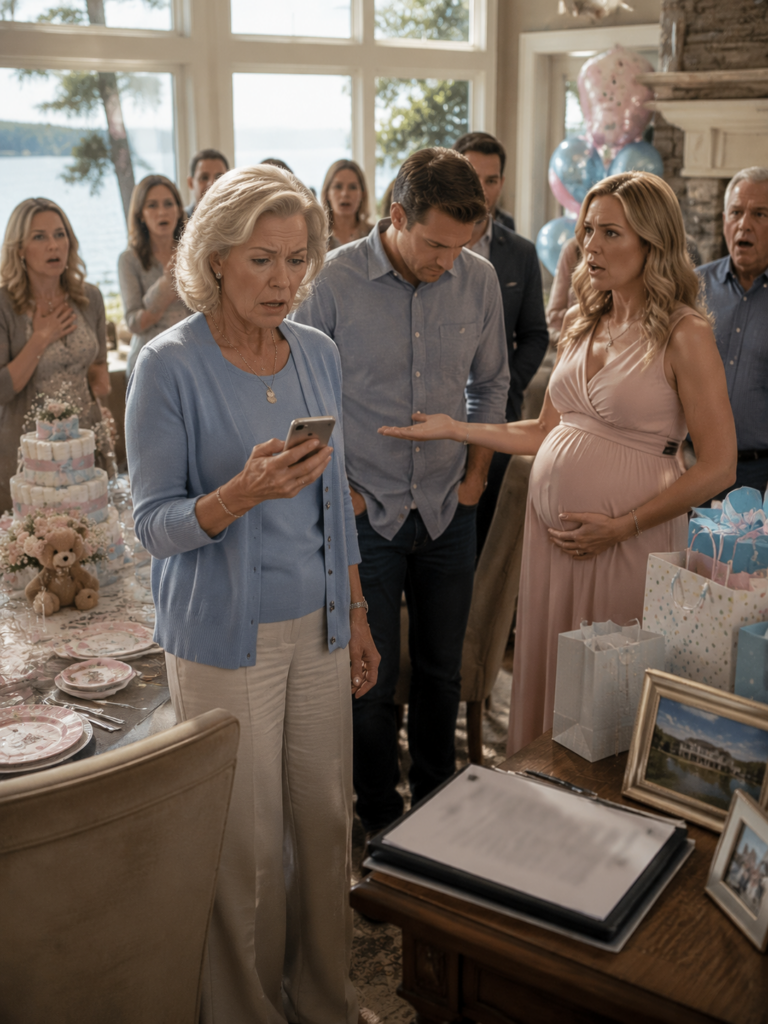
Then he placed another folder in front of me.
“This is the part I want you to think about carefully,” he said.
I looked at him.
“We need to update your estate plan.”
I almost said, “Not tonight.”
I almost said, “I can’t.”
But George’s face rose in my mind. Not the sick face. The strong one. The man on the dock, squinting in the sun, telling me, “Ellie, never leave a loose board where somebody can trip after you’re gone.”
“What are my choices?” I asked.
Paul explained them plainly.
I could keep the house solely in my name, with added fraud alerts and a transfer-on-death deed to whomever I chose. I could create a trust. I could appoint a professional fiduciary instead of family. I could restrict Mark’s access. I could leave the house to Emma someday under conditions. I could leave it to a charity. I could sell it and move on my own terms.
My own terms.
Those three words felt like oxygen.
“I don’t want Emma punished,” I said.
Paul nodded. “She doesn’t have to be.”
“I don’t want Olivia rewarded.”
“She doesn’t have to be.”
“And I don’t want Mark controlling anything until he learns what courage costs.”
Paul’s expression softened.
“That can be arranged.”
It took two weeks.
Not because Paul was slow. Because I refused to move like a frightened woman. I wanted every page correct. Every line clear. Every loose board nailed down.
During those two weeks, Mark called twenty-seven times.
I answered once.
He cried.
He apologized.
He said he had been weak. He said he had been overwhelmed. He said Olivia made everything sound urgent and reasonable. He said Richard kept telling him, “Men provide. Men secure the future. Men don’t let old property sit idle.” He said he had convinced himself the house would come to him eventually and that moving paperwork around was not the same as stealing. He said he had not really thought of me as losing anything because I would still be there until I moved.
That was when I stopped him.
“Mark, listen to yourself.”
The line went quiet.
“You decided I could keep living in my home until other people decided I should leave it.”
He began to cry harder.
“I didn’t mean it like that.”
“No,” I said. “You did not have to mean it that way for it to be that way.”
“I’m sorry.”
“I know.”
“Do you believe me?”
“I believe you are sorry now.”
That was not the answer he wanted.
It was the answer I had.
He said Olivia had pressured him. He said Richard had made everything sound practical.
He said Olivia’s pregnancy had changed everything and he was terrified. He said he did not know how to be a father when he still felt like he had failed as a son.
I listened.
Then I said, “Mark, the problem is not that you were pressured. The problem is that you let pressure aim you at me.”
He had no answer.
Good.
Some silences are finally useful.
Olivia texted me too.
At first, the messages were polished.
Eleanor, I hope we can talk when emotions have settled.
Then defensive.
You know I only wanted what was best for everyone.
Then angry.
You are tearing this family apart over paperwork.
I did not reply.
There is great peace in not feeding a performance.
Richard never contacted me directly. His attorney did. Paul handled that.
The baby shower became the kind of story small towns pretend not to enjoy repeating. By Tuesday, someone at church had heard “a deed situation.” By Wednesday, the pharmacist touched my hand when giving me my prescription and said, “I’m sorry you had trouble, Mrs. Whitaker.” By Friday, Mrs. Donnelly brought banana bread and stayed for two hours, mostly to “check on me,” partly to confirm every detail she could.
I let her.
After a while, shame stops belonging to the person who was wronged.
On the fifteenth day after the shower, Paul came to the lake house with final documents.
I had cleaned before he arrived. Not because he cared, but because I did. I opened the windows. I made coffee. I set George’s mug on the counter and then, after a long pause, used it myself.
It felt strange.
It felt right.
Paul spread the papers across the kitchen table.
The lake house would remain mine for the rest of my life. No one could transfer it without my direct, verified consent and attorney review. If I became incapacitated, a professional trustee, not Mark, would manage the property. Mark would not receive ownership. Olivia would receive nothing.
But Emma would not be left out.
When Emma turned thirty, if she had no involvement in pressuring me or challenging the trust, she would have the right to use the lake house for two weeks each summer. Not own. Use. If she grew into someone who loved it, respected it, and understood where it came from, the trustee could consider a later transfer.
If not, the house would go to the George Whitaker Memorial Outdoor Fund, a small scholarship I created for local kids who wanted to attend summer camp but whose parents could not afford the fee.
George would have liked that.
He believed every child should know how a lake smells at sunrise.
I signed each page slowly.
My signature looked steadier than I felt.
When it was done, Paul gathered the documents and said, “George would be proud of you.”
I looked out the window.
A heron stood near the dock, still as a thought.
“No,” I said softly. “George would be furious first.”
Paul smiled.
“Then proud.”
I laughed for the first time in weeks.
Two days later, Mark came to the house.
He did not bring Olivia.
I watched his truck pull into the gravel drive and felt my body react before my heart did. Tight shoulders. Cold hands. That is another thing betrayal leaves behind. Your own home starts asking whether it is safe.
He got out carrying nothing.
No flowers.
No apology gift.
Good.
Gifts can become little bribes when words are not finished.
I met him on the porch.
He looked thinner. Tired. His beard had grown in uneven patches. For a second, I saw the boy who used to run barefoot across that same porch with a towel around his shoulders.
“Can I sit?” he asked.
I opened the screen door and pointed to the porch chairs, not the kitchen.
Not yet.
We sat facing the lake.
For a while, neither of us spoke.
Then Mark said, “Olivia’s at her mother’s.”
I said nothing.
“She says I betrayed her.”
I looked at him.
“Did you?”
He stared at the water.
“I don’t know anymore.”
“That means yes, in some way.”
He nodded slowly.
“She’s angry about the trust.”
“She knows about it?”
“Her father’s attorney told her enough.”
I folded my hands in my lap.
“Then she knows more than she is entitled to know.”
He swallowed.
“Mom, I’m not here to ask for the house.”
“I’m glad.”
“I’m not here to ask you to forgive Olivia.”
“I’m glad about that too.”
His eyes filled.
“I’m here because I don’t know how I became someone who stood there while my wife talked about moving you out of Dad’s house.”
That was the first honest sentence he had given me.
I let it sit between us.
A speedboat crossed the far side of the lake, leaving a white line behind it that slowly broke apart.
“When your father was dying,” I said, “he made me promise not to turn you into a replacement husband.”
Mark looked at me, startled.
“I never knew that.”
“No. You were not supposed to. He said, ‘Ellie, let the boy be your son. Not your handyman. Not your banker. Not the man of the house. Your son.’”
Mark wiped his face.
“I failed him.”
“Yes,” I said.
He flinched.
I did not soften it.
“You failed me too.”
“I know.”
“But you are not finished being my son unless you choose to be.”
He looked at me then, really looked, as if I had opened a door he did not deserve.
“I don’t know how to fix this,” he said.
“You start by telling the truth even when it costs you.”
He nodded.
“You start by getting your own finances in order instead of looking at mine.”
Another nod.
“And you start by understanding that I am not a bridge between your problems and my property.”
He broke then.
Not loudly.
Just bent forward, elbows on knees, both hands over his face, crying like a man finally old enough to see the child he had been.
I wanted to reach for him.
I did not.
Not because I did not love him.
Because he needed to feel the full shape of what he had done without my comfort rushing in to make it smaller.
After a while, he said, “Can I still see you?”
“Yes.”
“Can I bring Emma when she’s born?”
“If you come alone at first.”
He looked pained, but he did not argue.
That mattered.
“And Mark?”
“Yes?”
“You will not have a key.”
His face tightened.
Then he nodded.
“I understand.”
I went inside and came back with a small brass key on a faded blue keychain. The old house key. The one he had carried since college, the one I had told myself meant he always had a place to come home to.
He stared at it in my palm.
For a moment, I thought he might refuse.
Then he took it off his ring and placed it in my hand.
It weighed almost nothing.
It felt like a door closing properly.
Emma was born six weeks later.
Seven pounds, eight ounces. Pink cheeks. A serious little mouth. Mark texted me a photo from the hospital.
For a long time, I did not answer.
Not because I did not care. I cared so much it frightened me. That baby had done nothing wrong. She had arrived in the middle of a family storm and opened her tiny fist to a world already arguing over what she represented.
Finally, I typed, She is beautiful. I hope Olivia is recovering well.
That was all.
It was enough.
Two months later, Mark brought Emma to the lake house by himself.
He carried her in a gray car seat, moving carefully as if the whole world had become breakable. He stood on the porch and waited for me to invite him in.
I did.
He did not comment on the changed lock.
He did not look toward the desk where the trust papers were kept.
He did not ask for coffee until I offered.
Progress, sometimes, is simply a person not repeating the old harm.
Emma slept through most of the visit. Tiny eyelashes. Little fists. A soft cap with yellow ducks on it. I held her in George’s chair and felt grief and love move through me together, braided so tightly I could not separate them.
Mark watched me.
“She has Dad’s chin,” he said.
“She has your ears,” I replied.
He smiled, then looked down.
“Olivia wants to apologize.”
“No, she wants access.”
He did not deny it.
“Maybe both,” he said.
“Maybe. But I am not ready to find out.”
He accepted that too.
Months passed.
The legal matter with Richard did not become the dramatic courtroom scene people imagine. Real consequences are often quieter and more thorough. His notary privileges were investigated. His real estate office distanced itself. People stopped inviting him to speak at local property seminars. He did not go to jail, but he lost something he valued almost as much as money.
Reputation.
Olivia and Mark separated for a while. Then they tried counseling. Then they separated again. I did not ask for details unless Mark offered them. I had learned the hard way that a mother can love her son without climbing into the middle of his marriage and calling it help.
Olivia sent one letter.
A real letter, not a text.
It arrived in a cream envelope with my name written in careful handwriting.
I let it sit on the kitchen counter for three days.
When I finally opened it, the first paragraph was terrible. Defensive. Full of phrases like “high stress” and “miscommunication” and “different expectations.” It was the sort of apology that still tried to leave room for the person apologizing to climb out clean.
I almost stopped reading.
Then, halfway down the second page, the letter changed.
She wrote, I saw you as an obstacle because I was scared. That does not excuse what I did. I treated your life like something already over because mine was beginning a new chapter. I am ashamed of that.
I read that sentence three times.
Then I folded the letter and placed it in a drawer.
I did not call her.
Some apologies need to live quietly for a while before they are asked to carry weight.
A year after the baby shower, I hosted Emma’s first birthday at the lake house.
That surprises people when I tell them.
They expect a clean ending. They expect me to cut everyone off and sit on the porch polishing my victory. But life is messier than a good revenge story. Families do not heal because one person wins. Sometimes they heal because one person finally builds a fence and lets others decide whether to approach it respectfully.
The party was small.
No forty guests. No country club friends. No banner over George’s fireplace.
Just Mark, Emma, Olivia, Olivia’s mother, Mrs. Donnelly, Paul and Marcy because by then they felt like family, and two cousins who had behaved decently through the whole mess.
Richard was not invited.
Olivia arrived carrying a homemade cake that leaned slightly to one side. She looked different. Less polished. Her hair was pulled back simply. She wore flats. She stood on the porch holding the cake and did not step inside until I opened the door wider.
“Thank you for having us,” she said.
Not sweetly.
Not performatively.
Carefully.
I nodded.
“You can put the cake in the kitchen.”
She walked past me, then stopped by the fireplace.
Her eyes moved to the stone hearth, then to George’s photo on the mantel.
“I’m sorry,” she said quietly.
No audience.
No speech.
No attempt to explain.
Just those two words, placed where they belonged.
I looked at her for a long moment.
“I know,” I said.
It was not forgiveness.
Not exactly.
But it was a start that did not insult either of us.
Later, after Emma smashed cake into her own hair and Mark laughed so hard he had to wipe his eyes, I stepped onto the deck alone.
The lake was gold in the late afternoon. The wind chime moved softly. Behind me, the house was full of small sounds again. A baby squealing. Dishes clinking. Mark asking where I kept the paper towels, then stopping himself and saying, “May I get them?”
That made me smile.
Manners are not small when respect has had to be rebuilt.
Olivia came out after a while and stood a few feet away.
“I know I may never be welcome here the way I was before,” she said.
“You were not welcome here before,” I replied. “You were tolerated.”
She gave a small, surprised laugh, then looked ashamed.
“I deserved that.”
“Yes.”
She nodded.
“I’m trying to become someone Emma won’t be embarrassed by one day.”
I looked through the glass at my granddaughter in Mark’s arms, frosting on her cheeks, one sock missing.
“That’s a better inheritance than a house,” I said.
Olivia wiped at her eyes.
“I know that now.”
Maybe she did.
Maybe she was still learning.
So was I.
Before everyone left that evening, Mark found me by the kitchen sink.
“Mom,” he said, “thank you for today.”
“You’re welcome.”
He hesitated.
Then he said, “I went by Dad’s grave last week.”
I turned off the faucet.
He looked out toward the darkening window.
“I told him what I did. Out loud. I probably looked crazy.”
“No,” I said. “You looked accountable.”
His mouth trembled.
“I told him I was sorry.”
“What did he say?”
Mark gave a sad little smile.
“Mostly he let the geese yell at me.”
That made me laugh.
George would have liked that too.
After they drove away, I walked through the house turning off lights.
The gift bags were gone. The balloons were gone. The banner was gone.
The fireplace remained.
The lake remained.
So did I.
I stood by the hearth and rested my hand on the stones George had carried one by one before any of us knew how much a house could be loved, or envied, or defended.
For a long time after he died, I thought keeping the house meant keeping him.
I was wrong.
Keeping the house meant keeping myself.
Not as a widow waiting to be moved somewhere easier.
Not as a mother whose love could be used as a signature.
Not as an old woman taking up valuable space.
As Eleanor Whitaker.
Owner.
Mother.
Grandmother.
Still here.
And the next morning, when I opened the front door, there was a small envelope tucked under the mat.
No return address.
Inside was a photograph.
George and me, young and sunburned, standing in front of the unfinished fireplace. Mark was a toddler between us, holding a plastic hammer. I had forgotten the picture existed.
On the back, in Mark’s handwriting, were seven words.
Dad built it. You kept it standing.
I sat on the porch steps with that photograph in my hand while the lake brightened in front of me.
For once, I did not cry because something had been taken.
I cried because something had been returned.
THE END
✅ End of story — Part 3 of 3
← Read from Part 1