Clara let out a sound that was half a gasp, half a sob, pressing her free hand over her mouth to muffle the noise. My knees instantly turned to water. I wanted to drop to the floor and weep with relief, but even indulging in my own emotional release felt incredibly selfish right now.
The doctor wasn’t smiling. He continued speaking, his tone measured, explaining the severe risks, the need for overnight observation, and the list of possible complications. He used terrifying, clinical terms like subchorionic hematoma, threatened miscarriage, and strict bedrest.
Nothing was certain yet. Not a devastating loss. But not absolute safety, either. We were trapped in a fragile, terrifying present.
Clara stared at the screen as if blinking might make the tiny, flickering heartbeat disappear forever.
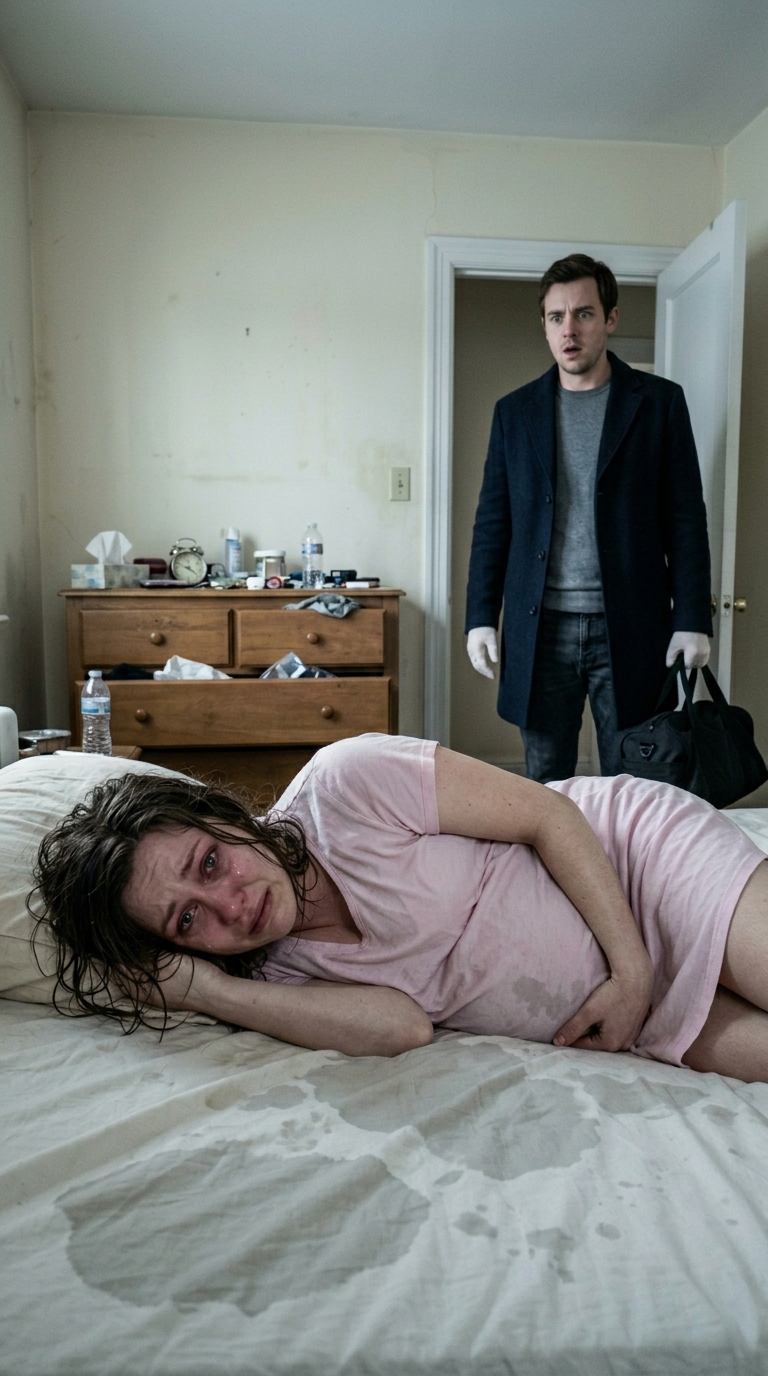
I stared at her. At the cold sweat dampening her hairline. At the seams of the backward nightgown still visible beneath the heavy winter coat.
I was looking at the woman I had almost entirely destroyed with my suspicion, at the exact moment she had most desperately needed my unwavering belief.
After the grueling examination, the orderlies transferred Clara to a private observation room with a single, narrow window.
Dawn had just begun to paint the sky over the hospital parking lot in dull shades of gray and bruised purple. The overnight nurse quietly checked Clara’s IV lines and kindly suggested I go to the cafeteria to get some coffee, take a deep breath, and sit down before I collapsed from adrenaline withdrawal.
I did none of those things.
I stood rigidly by the side of the hospital bed while Clara rested, her eyes closed, one hand still resting protectively over her belly. My phone remained powered off in my jacket pocket, feeling as heavy as a brick.
When Clara finally opened her eyes again, the small room was filled with the pale, fragile light of early morning. She looked incredibly young in that light. And impossibly distant.
“Ethan,” she said, her voice raspy. “I need you to tell me something.”
I leaned closer, gripping the metal rail of the bed. “Anything. Whatever you need.”
She studied my face for a very long time. Her gaze was analytical, stripping away all the history and affection, searching only for the bare truth.
“If your mother demands scientific proof,” Clara asked slowly, “will you ask for it with her?”
The question didn’t shock me this time. It acted like a scalpel, stripping away the absolute last place I could hide my cowardice.
Because if I were entirely honest with myself, some weak, frightened part of my brain had already imagined the scenario. I had imagined the DNA tests, the timeline calculations, the desperate reassurances I would use to quiet a doubt that should never have been fed in the first place.
Outside the quiet room, wheels squeaked along the linoleum corridor. A nurse laughed softly at the charting station. The intrusion of ordinary, everyday sounds made Clara’s question feel even harsher.
I thought of my mother, sitting alone in her immaculate apartment, waiting for my obedience, disguising her toxic control as maternal concern.
Then I thought of Clara, alone in our bed, writhing in pain, calling my phone twenty times while I was busy planning a surprise.
I thought of the baby’s tiny, rapid heartbeat flickering on that dark screen, asking absolutely nothing from me except protection and honesty.
“No,” I said.
The word came out low, but it possessed a strength I hadn’t felt in years. It did not shake.
Clara kept watching me, waiting.
So I said it again, louder this time. “No. I won’t ask for a test. And I should have told her absolutely not, long before tonight.”
Clara’s eyes filled with tears slowly. It wasn’t a look of immense relief. It was something far more complex and heartbreaking. It was grief. Because the right answer, when given far too late, still arrives carrying the heavy damage of its delay.
I reached for the blue medical folder sitting on the plastic visitor’s chair and placed it gently on the bed beside her hand.
“I believed something incredibly ugly for a moment when I walked into the apartment,” I confessed, forcing myself not to look away from her eyes. “I will not insult you by pretending I didn’t.”
Her jaw tightened visibly.
“And I let my mother’s poisonous words live rent-free in my head because it was simply easier than confronting her,” I continued, the shame burning my throat.
Clara turned her face away, looking out the narrow window. A thin, warm ray of morning sunlight rested on her pale cheek.
“I don’t know what that makes us, Ethan,” she whispered into the quiet room.
Neither did I. That was the brutal truth. We weren’t broken completely beyond repair. But we certainly weren’t safe. We weren’t innocent anymore. We were something messy in between, standing in a sterile hospital room, waiting to see what could possibly survive the wreckage.
Then, my phone vibrated once against my ribs.
I had turned it off. It might have been a phantom vibration, a trick of the mind. Or perhaps it was just guilt physically manifesting itself.
I reached into my pocket, pulled the heavy black rectangle out, and placed it face down on the rolling tray table without pressing the power button.
Clara saw the gesture. This time, she didn’t nod in approval. But she didn’t look away, either.
After several long minutes of heavy silence, she spoke without looking at me.
“When they finally discharge me and we leave this hospital,” Clara said, her voice carrying an iron resolve, “I absolutely refuse to go home to a house filled with her voicemails and text messages.”
I understood exactly what she was really asking. She wasn’t talking about checking our answering machine. She wasn’t talking about digital clutter.
She was asking if I would finally, definitively stand like a brick wall between her and the monster I had spent years calling ‘harmless.’
I looked at the black phone resting on the table. Then I looked down at my own hand, noticing the faint, crescent-shaped bruises my own fingernails had left in my palm during the blind panic earlier that night.
“I will call her right now, from this room,” I stated. “And you won’t have to say a single word.”
Clara closed her eyes again. Her hand moved in a slow, protective circle over her belly.
The hallway outside brightened fully with the morning sun. Somewhere nearby, an IV machine began to beep in a steady, reassuring rhythm.
I picked up the phone. I held the power button down until the Apple logo glowed white against the black screen.
And before the cellular network even finished connecting, before the first message could even load, I already knew that the words I was about to speak would permanently cost me my mother.
The notifications flooded the screen the instant the phone connected to the network.
The preview of the first unread text message loaded before I had time to mentally brace myself.
Ethan, I know you are probably angry with me, but a mother has the absolute right to protect her son from a mistake.
I stared at the sentence until the glowing letters stopped feeling like language and morphed into something toxic and cold.
Clara didn’t ask what the message said. She didn’t have to. She simply watched my face, and her quiet restraint was infinitely more powerful than any screaming demand.
There were six more text messages queued up after that one. I opened the thread. Each text was carefully dressed up as maternal concern, yet each one carried the exact same lethal poison.
She is highly emotional right now. Do not let her panic dictate your future.
A paternity test would legally protect everyone involved.
You deserve absolute certainty before you attach yourself financially and emotionally forever. Call me immediately.
I read every single one of them. Not because I wanted to absorb the poison. I read them because looking away now, ignoring them, would only be another cowardly version of the exact same passivity that had put my wife in a hospital bed.
My thumb hovered above the green call button at the top of the screen.
For years, I had answered my mother’s intrusions with soft explanations, gentle deflections, and pathetic little compromises. I had constantly negotiated for my wife’s dignity instead of demanding it.
That morning, standing under the harsh fluorescent lights of the hospital room, I realized that offering my mother an explanation was just another way of asking Clara to endure more abuse.
I pressed the call button and put the phone on speaker.
My mother answered on the second ring. She sounded breathless, eager, as if she had been sitting in the dark with the phone clutched in her hand all night.
“Ethan! Finally!” she exclaimed. “Listen to me before she fills your head with tears and manipulates you—”
I closed my eyes, drawing in a deep, fortifying breath of sterile hospital air.
“No,” I said. My voice wasn’t loud, but it possessed a terrifying, vibrating density that commanded absolute silence. “You are going to listen to me.”
The line went instantly dead quiet. I could actually hear my mother’s sharp intake of breath, deeply offended before any formal accusation had even reached her ears.
“Clara is lying in a hospital bed,” I stated, staring directly into my wife’s eyes as I spoke. “She almost lost our baby tonight. And your vicious, toxic words helped put her here.”
“Ethan, how dare you!” my mother gasped, shifting instantly into the victim role. “I was only looking out for you! You can’t blame me for her medical issues! You have no idea if that child is even—”
“If you finish that sentence,” I interrupted, my voice dropping to a glacial chill that froze the line, “I will ensure you never see me, or my child, for the rest of your natural life.”
The silence that followed was absolute.
“You planted a disgusting lie in my head,” I continued, unleashing the anger I should have shown weeks ago. “And because I was too weak to shut you down, I brought that poison into my home. I looked at my terrified, suffering wife tonight and I doubted her. That is my failure as a husband. But I am correcting it right now.”
“Ethan, please, you’re not thinking clearly…” she tried to soothe, her voice trembling slightly now.
“I am thinking clearer than I ever have,” I said firmly. “I am the father of this child. Clara is my family now. My only priority. You will not call her. You will not text her. You will not ask for tests, or explanations, or apologies. If you cannot respect my wife with absolute, unconditional dignity, then you do not get to be a part of our lives. Are we perfectly clear?”
“You’re choosing her over your own mother?” she cried, playing her final, desperate card of guilt.
“I am choosing my family,” I replied without a second of hesitation.
I didn’t wait for her to formulate another defense. I didn’t wait for her to cry. I pulled the phone away from my face and hit the red End Call button. The screen went dark.
I placed the phone back on the tray table, pushing it away from me.
The heavy, oppressive weight that had been sitting on my chest for years didn’t just lift; it shattered.
I looked back at the hospital bed.
Clara was weeping. The tears she had stubbornly held back all night were finally falling, tracking silently down her pale cheeks. But she wasn’t looking away from me anymore. She reached her hand out across the white hospital blanket, her palm open, waiting.
I walked over, took her hand, and fell to my knees beside the bed. I buried my face in the blankets near her chest, inhaling the scent of her skin, and for the first time since I walked through our apartment door, I let myself cry.
I cried for the horrific mistake I had made. I cried for the terrifying fragility of the tiny life flickering on a screen. And I cried because the boy who had tried to appease everyone was finally dead, and the man who was ready to protect his family had just been born.
Clara’s fingers gently stroked my hair. We didn’t exchange any grand promises. We didn’t pretend that the road ahead would be easy, or that the wounds I had caused were magically healed.
But as the morning sun fully breached the horizon, filling the small hospital room with a brilliant, blinding light, I knew one thing for certain.
The floor was finally solid beneath my feet again.
If you want more stories like this, or if you’d like to share your thoughts about what you would have done in my situation, I’d love to hear from you. Your perspective helps these stories reach more people, so don’t be shy about commenting or sharing.
✅ End of story — Part 3 of 3
← Read from Part 1