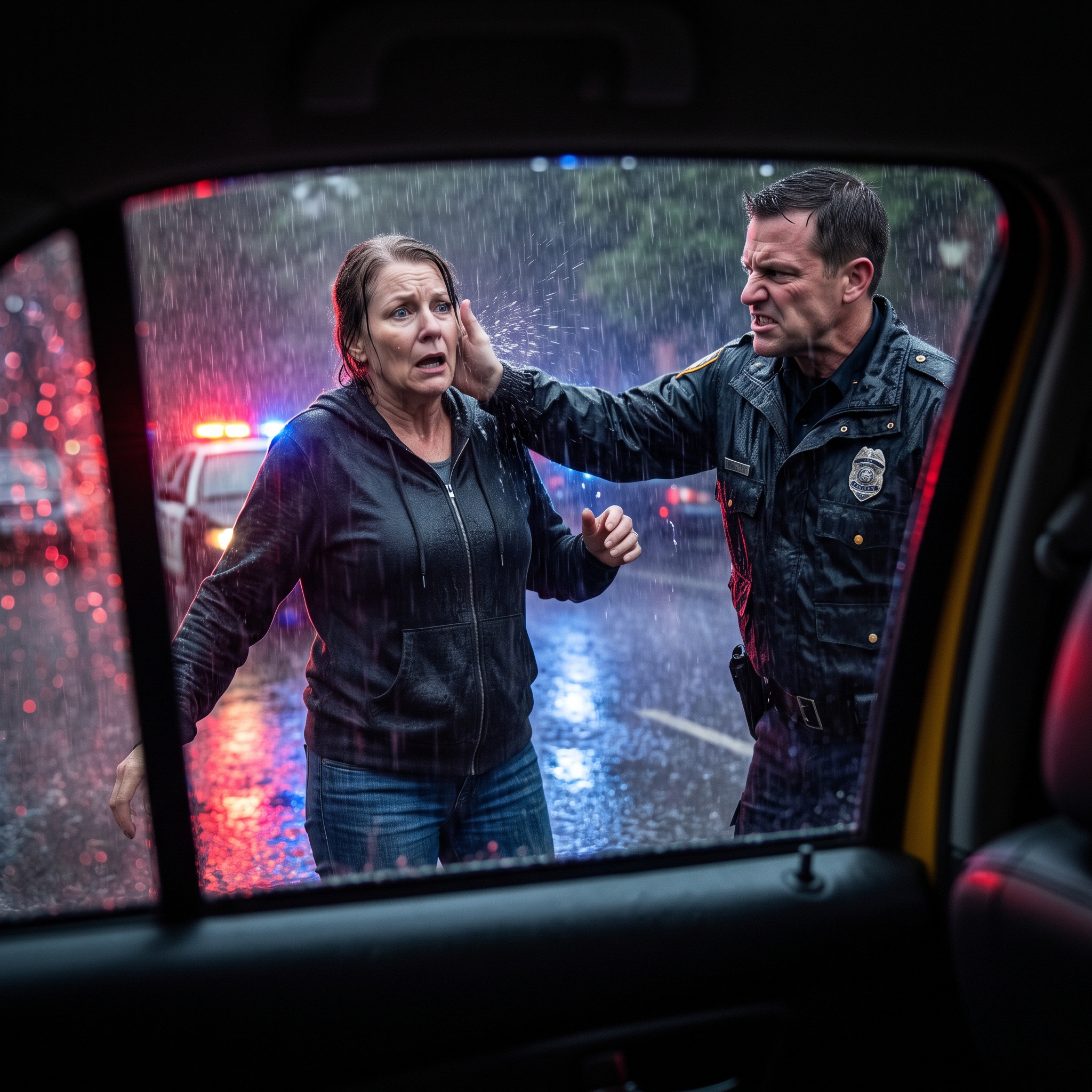
The rain was coming down in sheets that night in Chicago, the kind of cold October rain that seeps into your bones.
My sister Emily and I had planned a simple evening—just a taxi ride from my apartment in Lincoln Park to Michigan Avenue for a bit of window shopping and a warm meal.
I was off duty, dressed in old jeans, a faded Northwestern hoodie, and sneakers.
My hair was pulled back in a messy ponytail, no makeup, no badge, no gun.
To anyone looking through the taxi window, I was just another middle-aged woman headed downtown.
That was the mistake he made.
Officer Jack Dalton made the biggest mistake of his life when he assumed I was nobody.
Our taxi driver, a kind older gentleman named Mr. Kowalski, was telling us about his granddaughter’s first piano recital when we saw the checkpoint.
Flashing red and blue lights cut through the rain like knives.
Orange cones funneled traffic into a single lane on LaSalle Street.
Police cruisers sat angled across the road, and uniformed officers waved flashlights, barking orders at drivers.
I felt a knot tighten in my stomach.
Not fear—I’ve been in law enforcement for over twenty-five years.
But a deep, weary disappointment.
I know what these checkpoints can become when the wrong officer is put in charge.
Emily grabbed my hand. “Sarah, what’s going on?”
“Just a routine stop,” I said calmly, but I was watching the lead officer intently.
He was a tall, broad-shouldered man with a square jaw and eyes that looked like they hadn’t smiled in decades.
His badge glinted under the lights: Dalton.
He swaggered between cars like he owned the street, his hand resting on his holster, his mouth twisted into a permanent sneer.
When he reached our taxi, he tapped the window with his flashlight so hard I thought the glass might crack.
Mr. Kowalski rolled it down, his hands trembling. “Good evening, Officer. Is there a problem?”
“License and registration,” Dalton barked, ignoring the greeting completely.
As Mr. Kowalski fumbled for his documents, Dalton peered into the back seat.
His flashlight beam landed on Emily first, then on me.
I met his eyes without flinching.
“What are you looking at?” he snapped.
“Nothing, Officer,” I replied evenly. “Just waiting to be on our way.”
He grunted.
Then he did something that made my blood run cold.
He opened the rear door and grabbed my arm.
“Step out. Both of you,” he ordered.
Emily gasped. “Why? We haven’t done anything!”
“Don’t make me repeat myself,” he growled.
I squeezed Emily’s hand and whispered, “Stay calm. Do as he says.”
We climbed out into the freezing rain.
The drops soaked through my hoodie in seconds.
Dalton stood over me, his chest puffed out, rain dripping off the brim of his hat.
“You got some kind of attitude,” he said, pointing a finger in my face. “I’ve seen your type before. Think you’re too good to show some respect.”
I kept my voice level. “Officer, I’ve said nothing disrespectful. We are simply passengers. May I ask what the issue is?”
His eyes narrowed.
He was the kind of man who mistook calmness for defiance.
The kind of bully who saw polite words as a challenge.
And in that moment, I knew trouble was coming.
“You want to know the issue?” he sneered. “The issue is I don’t like your tone. I don’t like the way you’re looking at me. And I really don’t like people who don’t know their place.”
Then he drew his hand back and slapped me across the face.
The sound echoed in the rain like a gunshot.
My head snapped to the side.
Pain exploded through my jaw, hot and sharp.
I tasted blood.
Emily screamed. “Sarah!”
Mr. Kowalski yelled, “Officer, what are you doing?!”
Dalton ignored them both.
He leaned in close, his face inches from mine, and whispered, “That’s for mouthing off.
Now get back in the cab and shut up, or next time it’ll be a lot worse.”
I straightened up slowly.
My left cheek was on fire.
My ear was ringing.
But I didn’t cry.
I didn’t shout.
I didn’t give him what he wanted.
I simply looked at him—calmly, deliberately—and read his badge number aloud.
“Officer Jack Dalton. Badge 2417. 17th District.”
He froze.
For just a second, something flickered in his eyes.
Unease.
But then he laughed, a harsh ugly sound.
“Yeah, memorize it. File a complaint. See where it gets you. Nobody’s going to believe two women and a cab driver over a decorated officer.”
He slammed the door shut and waved the taxi through.
Emily was sobbing as Mr. Kowalski drove away.
“Sarah, your face! We have to call the police!”
“I am the police,” I said quietly, pressing a tissue to my bleeding lip.
She stared at me, her eyes wide with confusion.
“What do you mean?”
“I mean, Emily, that Officer Dalton has made a very, very serious error.”
I didn’t sleep that night.
I sat in my apartment, an ice pack pressed to my swollen cheek, staring at my reflection.
The bruise was already forming, dark and ugly.
But the real pain wasn’t in my face.
It was in my heart.
I thought about all the good officers I’ve worked with over the years.
Men and women of honor who would never raise a hand to a civilian.
And then I thought about Jack Dalton.
A man like him doesn’t become a bully overnight.
He’s been doing this for years, protected by a code of silence, insulated by a system too slow or too scared to hold him accountable.
But not anymore.
At six o’clock the next morning, I made a phone call.
My first call was to my personal physician, Dr. Helen Park.
I asked her to document every inch of my injuries.
She arrived within the hour, took photographs, wrote a detailed medical report, and looked at me with such sadness.
“Sarah, I’m so sorry. Who did this to you?”
“An officer assigned to the 17th District,” I said. “And by noon, he’s going to regret it.”
At eight o’clock, I made the second call.
It was to the Superintendent of the Chicago Police Department, Robert Hayes.
We’ve known each other for nearly fifteen years, ever since I was a young sergeant rising through the ranks.
Now, I hold the rank of Deputy Commissioner of Professional Standards.
In plain language, I’m the one who investigates officers accused of misconduct.
And right then, I was the victim.
“Bob,” I said when he answered, my voice steady as steel. “I need to report an assault on a police officer.”
There was a pause.
“Sarah? What happened? Are you okay?”
“I was struck in the face by an officer at a checkpoint last night. The officer is Jack Dalton, Badge 2417, 17th District. I need an immediate investigation. I have a medical report, a witness—my sister—and I’m certain the taxi’s dashcam recorded everything.”
I heard him take a long, slow breath.
“I’ll have Internal Affairs on this within the hour. Where are you?”
“My apartment. But Bob, I want to be clear. I am not just filing a complaint. I am ordering a full inquiry. I want his personnel file, every complaint ever filed against him, every incident report. And I want him removed from active duty immediately.”
“Consider it done, Sarah. I’m so sorry. We’ll take care of this.”
When I hung up, the weight of what had just been set in motion settled over me like a heavy coat.
I knew that Jack Dalton’s life was about to unravel.
And I felt not revenge, but a profound sense of justice.
This was never about payback.
It was about making sure he could never hurt anyone else again.
Two hours later, my phone buzzed with a message from Internal Affairs.
They had retrieved the taxi’s dashcam footage.
I didn’t watch it.
I didn’t need to.
I lived it.
But I knew that anyone who saw it would see the unprovoked, violent slap delivered to a calm, respectful woman.
They would see Officer Dalton’s arrogance.
They would see the terror in my sister’s eyes.
And they would see that not once did I raise my voice or resist in any way.
When the investigators interviewed Mr. Kowalski, he cried.
“That poor woman,” he told them. “She was so polite. She never did anything wrong. That officer is a monster.”
Emily gave her statement, still shaking with anger and fear.
“He hit her like she was nothing,” she said. “Like she was less than human. And my sister just stood there and took it, because she knew, even then, that justice would come.”
At eleven o’clock that morning, Officer Jack Dalton was called into his captain’s office.
I later learned every detail of that meeting.
Captain Patricia Morales—a no-nonsense woman I’ve always respected—was waiting with two Internal Affairs investigators.
When Dalton walked in and saw them, his face went pale.
“What’s this about?” he asked, his voice already defensive.
“Sit down, Dalton,” Captain Morales said, her tone ice cold.
She pressed a button on her laptop, and the dashcam footage began to play.
He watched himself yank open the taxi door.
He watched himself grab my arm.
He watched himself deliver that vicious slap.
His mouth opened and closed like a fish.
When the video ended, Captain Morales said, “That woman you struck last night is Deputy Commissioner Sarah Mitchell. She heads the very office that investigates officers like you.”
The silence in the room was deafening.
Dalton’s face crumpled.
“I didn’t know,” he whispered. “I didn’t know she was…”
“It shouldn’t matter who she is,” Morales cut him off. “The fact that you think it does tells me everything I need to know. You are suspended without pay, effective immediately. Your badge and weapon will be surrendered now.”
He didn’t argue.
He couldn’t.
One of the investigators told me later that as they escorted him out, Dalton’s hands were trembling so badly he could barely unclip his holster.
The swagger was gone.
The bully had been broken.
Over the following weeks, the investigation unearthed a mountain of complaints against Jack Dalton.
Twelve civilian complaints in five years.
Excessive force, verbal abuse, intimidation.
Each one had been dismissed or swept under the rug by a system that too often protects its own.
But this time, there was no rug big enough.
The dashcam footage was irrefutable.
The victim was the Deputy Commissioner herself.
The weight of the department came crashing down on him.
Within a month, Dalton was formally terminated.
The Cook County State’s Attorney’s office reviewed the case and charged him with aggravated battery.
I received dozens of letters from people who had suffered at his hands and never had the power to fight back.
One letter, from a young man named Marcus, made me weep.
“He broke my arm during a traffic stop two years ago,” Marcus wrote. “He called me terrible names. I tried to file a complaint, but nothing happened. When I saw the news about what happened to you, I cried. Finally, someone believed us.”
I framed that letter and hung it in my office.
Not as a symbol of victory, but as a reminder of why I do what I do.
Because for every Jack Dalton out there, there are thousands of good people who trust the badge.
And it is our duty—my duty—to protect that trust.
Emily came to stay with me for a while after it all came out.
We sat on my balcony one evening, watching the sun set over the Chicago skyline.
“I had no idea you were such an important person,” she said softly.
“It’s not about importance,” I replied. “It’s about accountability. He thought he could do anything because he wore a uniform. He forgot that the uniform doesn’t give power—the people do. And when you betray that power, you lose everything.”
“I’m proud of you, Sarah.”
I took her hand. “I’m proud of us. You were so brave that night, Em. You kept your head when everything was chaos.”
She laughed a little. “I was terrified. But you were so calm. I kept thinking, ‘How is she staying so calm?'”
I smiled. “Twenty-five years on the force teaches you that losing your temper is losing the battle. The real victory comes from being steady and waiting for the right moment to act.”
And act I did.
In the months that followed, I used my position to push for reforms.
Mandatory dashcams in every patrol car.
Stricter oversight of use-of-force complaints.
Anonymous reporting systems for officers who witness misconduct.
None of it would have happened if I had just screamed and fought back that rainy night.
Sometimes the quietest response is the most powerful one.
Jack Dalton’s trial lasted three weeks.
I testified, my voice unwavering, as the courtroom watched the dashcam footage in horror.
When the jury found him guilty of aggravated battery, a collective sigh of relief seemed to fill the room.
The judge sentenced him to two years in prison and five years of probation.
When the gavel fell, I felt no joy.
Only the quiet satisfaction of justice served.
On the day he was sentenced, Dalton turned to me as he was led away in handcuffs.
His eyes were full of something unexpected.
Not hatred.
Regret.
“I’m sorry,” he mouthed.
I didn’t respond.
Some apologies come too late to matter.
But I hope, deep down, that his regret was genuine.
I hope he spends his time in prison understanding what he did wrong.
And I hope he comes out a changed man.
Because if we don’t believe in redemption, then what’s the point of justice at all?
Still, I will never forget that slap.
The sting of it.
The taste of blood.
The sound of my sister screaming.
But I will also never forget the power of one quiet phone call.
The way it set everything right.
That night in the rain, Officer Jack Dalton thought he was untouchable.
He thought his badge was a shield.
But he was wrong.
A badge is not a shield.
It is a promise.
And when you break that promise, the very system you serve will hold you accountable.
Sometimes it takes a slap in the face to remind the world of that truth.
I am Deputy Commissioner Sarah Mitchell.
And I will spend the rest of my career ensuring that no one—no matter how ordinary they look sitting in the back of a taxi—ever has to endure what I endured.
Because everyone deserves to be seen.
Everyone deserves respect.
And no uniform gives you the right to take that away.
If this story spoke to your heart, please take a moment to Like our page and Follow for more true stories of courage and justice.
And if you believe that no one is above the law, please Share this with someone who needs to hear it today.
Together, we can remind the world that kindness and accountability still matter.