You never imagine that your own child could become a mystery to you.
But life has a way of teaching lessons you never wanted to learn.
My name is Margaret, and I live in a quiet suburb of Springfield, Illinois. I was married to David for seventeen years before the cracks became too deep to ignore.
The divorce was not loud or cruel—just sad, like a slow fade. We had one child together, our son Ethan, who was fourteen at the time the papers were signed.
I remember the day he told me he wanted to live with his father.
It was a Tuesday afternoon. He came home from school, dropped his backpack by the door, and looked at me with those serious blue eyes that always seemed older than his years.
“Mom, I’ve been thinking,” he said, his voice so steady it broke my heart in advance.
I set down my coffee cup. “What is it, sweetheart?”
“I want to live with Dad after the divorce.”
I felt the air leave the room. My chest tightened, and for a moment, I couldn’t speak. I just stared at my son, this boy I had carried inside me, nursed through fevers, taught to ride a bike.
“Why?” I finally whispered.
“He needs me,” Ethan said. “Dad’s been really sad. I think I can help him feel better. And he has that big house with the game room. He said I could have my own space.”
I could have fought it. I could have hired an attorney and made a case that a boy needs his mother. But what would that do to Ethan? I have seen too many children torn apart by custody battles, forced to choose, forced to feel guilty. I loved my son more than my own pride.
So I nodded, tears burning behind my eyes. “If that’s what you truly want, and if it makes you happy, then I won’t stand in your way. But you must promise me something.”
“What?”
“Promise me you’ll call me every single day. Even if it’s just to say goodnight. And if anything—anything at all—doesn’t feel right, you come to me immediately.”
He promised. He hugged me, and I held on a little too long, memorizing the way he smelled, the feel of his shoulders under my hands.
The first few weeks after he moved were hard, but I kept myself busy. I called him every evening, and he always answered with a cheerful “Hey, Mom!” He told me about school, about the new video game his dad bought him, about the pizza they ordered. I allowed myself to believe he was thriving.
But then the calls started to change.
At first, he would rush off the phone quickly, saying he was tired. Then he began missing my calls altogether. When I asked, he’d say he forgot his phone in his room. I didn’t push. Teenagers need space, I told myself.
Then the first call from the school came.
It was Mrs. Patterson, Ethan’s English teacher, a woman I had met at parent-teacher conferences. She had always spoken highly of Ethan, saying he was bright and engaged.
“Mrs. Collins?” she said, her voice careful. “I’m a little concerned about Ethan.”
My heart lurched. “What’s wrong?”
“His grades have dropped significantly in the last month. He seems distracted in class, and he’s been falling asleep at his desk. Yesterday, I noticed he looked pale and thinner. I asked if he was feeling well, and he just shrugged. I tried calling his father, but I haven’t been able to reach him. I thought you should know.”
I gripped the phone so hard my knuckles turned white. “Thank you for telling me, Mrs. Patterson. I’ll look into it right away.”
I hung up and immediately dialed David. No answer. I called again and again. Voicemail every time.
A terrible feeling began to rise in my stomach, cold and sharp.
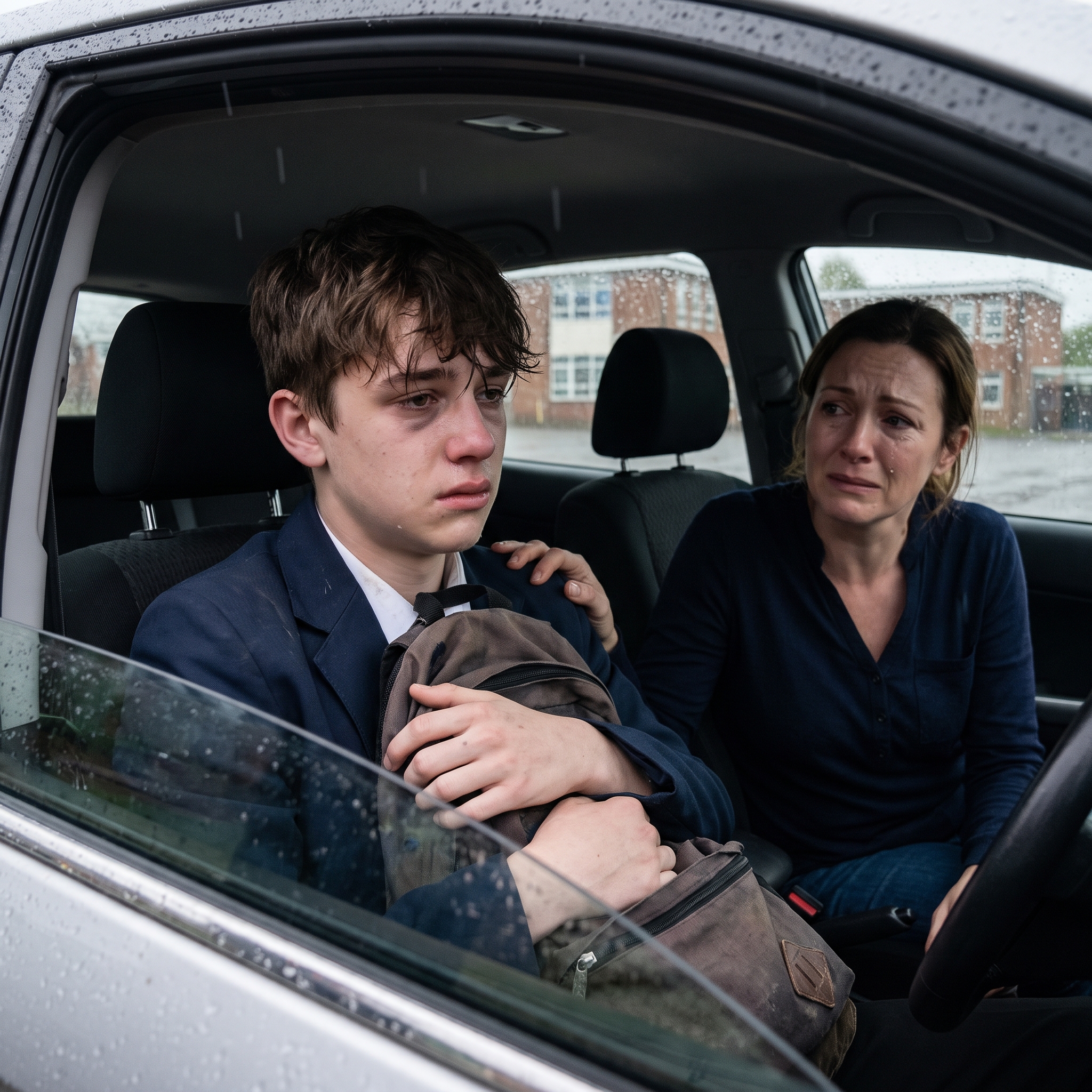
The next day, I didn’t call ahead. I got in my car and drove straight to Ethan’s school. I arrived just as the final bell rang, and I saw him walking out the front doors, shoulders hunched, backpack dragging.
He looked so small.
I rolled down the window and called his name. When he saw me, his face went through a rapid series of emotions: first surprise, then what looked like relief, and then something else—shame.
He climbed into the passenger seat and closed the door. The silence was heavy. I looked at him, and my heart shattered into a thousand pieces.
He looked exhausted. There were dark circles under his eyes like purple bruises. His clothes—the same jeans I had bought him last month—were hanging off him. His hair was unwashed, matted. He smelled faintly of sweat and something stale.
“Ethan,” I breathed, reaching out to touch his cheek. He flinched, and that flinch nearly destroyed me.
“What’s going on?” I asked, my voice trembling despite my effort to stay calm. “Your teacher called me. She said you’re failing classes, falling asleep. And you look… sweetheart, you look like you haven’t eaten or slept in days.”
He wouldn’t look at me. He stared out the window, his jaw clenched. I waited, my heart pounding so loud I was sure he could hear it.
Finally, a tear slipped down his cheek.
“Mom,” he whispered, and his voice cracked. “I didn’t know who else to tell.”
I took his hand. It was cold and bony. “Tell me everything. I’m here. No matter what it is, I’m here.”
The story that came out over the next ten minutes was the most painful thing I have ever heard.
“Dad… he’s not okay,” Ethan began, his voice shaking. “At first, it was fine. He was home every night. We played games. But then he started going out after work. He said he was meeting friends. Then he’d come home late, smelling like beer. Sometimes he didn’t come home at all.”
I felt a cold dread spreading through my veins. “How often does he leave you alone?”
“A lot,” he admitted. “Last week, he was gone for four days straight. He left me a hundred dollars on the counter and said to order pizza. But the money ran out. I had to eat cereal for two days. There’s no food in the fridge, Mom. Just old takeout containers.”
Tears were running freely down my face now. “Why didn’t you call me? Why didn’t you tell me sooner?”
“I was embarrassed,” he sobbed. “I asked to live with him. I thought I could help him. I thought he’d get better. But he doesn’t care. He doesn’t ask about my homework. He doesn’t wash my clothes. I had to wear the same shirt three days in a row. Kids at school made fun of me.”
I pulled him into my arms, and he didn’t resist. He wept into my shoulder, his small body shaking.
“And there’s more,” he said, pulling back slightly. “One night, he came home really late and angry. He yelled at me for leaving a light on. He grabbed my arm and shook me. It left a bruise.”
I felt a white-hot fury rise inside me, a mother’s rage that knows no bounds. I wanted to drive straight to David’s house and confront him. But I knew my son needed calm right now.
“Show me,” I said softly.
He pulled up his sleeve, and there on his upper arm were the fading yellow marks of fingerprints. My vision blurred with tears.
“This is not your fault,” I told him firmly. “Do you hear me? None of this is your fault. You are a child. You are not responsible for taking care of a grown man. He is the parent. He should be taking care of you.”
Ethan nodded, but I could see the guilt still weighing on him. It would take time to undo that damage.
“You’re coming home with me,” I said. “Right now. We’ll get your things later. But you are not spending another night there.”
“What about Dad?” he asked, and even after everything, there was still a tiny note of concern for his father in his voice. That’s the kind of boy I raised—too kind for his own good.
“You let me handle your father,” I said. “You’ve carried this burden alone for too long. Now it’s my turn.”
I drove us to a diner first. I ordered Ethan a full meal—pancakes, eggs, bacon, hot chocolate. He ate like a starving animal, and I had to look away several times to hide my tears.
While he ate, I made calls. I called my attorney, a sharp woman named Patricia who had handled my divorce. I explained the situation in hushed tones. She listened without interrupting.
“Margaret, based on what you’ve told me, we can file for an emergency custody hearing. Neglect, lack of supervision, the bruise—this is serious. I’ll start the paperwork today.”
“Do it,” I said. “Whatever it takes.”
Next, I called the school. I spoke to the principal and explained that Ethan would be absent the next day for a medical appointment—which was true, because I intended to have a doctor document his condition and the bruise.
Finally, I called my sister, who lived nearby. I asked if Ethan and I could stay with her for a few days while things settled. She didn’t ask questions; she just said, “The door is always open.”
That night, after we arrived at my sister’s house and Ethan was tucked into a clean guest bed, asleep for the first time in what must have been weeks of restless nights, I sat in the dark living room and cried.
I cried for my son’s pain. I cried for the trust he had placed in his father that was so cruelly broken. I cried for my own guilt—the guilt of having let him go, even though I had done it out of love.
But when the tears dried, I felt a steely resolve settle into my bones. I would fight for my son with everything I had. I would rebuild his health, his confidence, his smile.
The next weeks were a whirlwind of court dates, social worker visits, and tense conversations. David tried to fight the custody change at first. He claimed I was exaggerating. He said he had been “going through a rough patch” but loved his son.
But the evidence was clear. The teacher’s testimony, the doctor’s report, and Ethan’s own brave statement to the judge—where he said, in a trembling voice, “I want to live with my mom. I don’t feel safe with my dad anymore.”
The judge granted me full custody immediately.
The first month back home was delicate. Ethan was quiet, withdrawn. He jumped at loud noises. He had nightmares that left him screaming in the dark. I would rush to his room and hold him until he calmed down, just like when he was little.
I got him into counseling with a wonderful therapist named Dr. Morgan. Slowly, the light began to return to his eyes.
The school was wonderful as well. His teachers offered extra help, and his friends rallied around him. I made sure he had three solid meals a day, clean clothes, and a predictable routine.
One evening, about three months after he came home, Ethan sat beside me on the couch while I was reading.
“Mom?” he said.
I put down my book. “Yes, sweetheart?”
“I’m sorry I chose Dad over you,” he said, his voice barely above a whisper. “I was so stupid.”
I cupped his face in my hands. “You were not stupid. You were a child who loved his father and wanted to help him. That is a beautiful thing. It was not your fault that he failed you. You have nothing to apologize for.”
He hugged me tightly, and I felt the last piece of my heart click back into place.
Today, Ethan is sixteen. He’s on the honor roll, he plays guitar in a band with his friends, and he laughs easily again. The bruises—both inside and out—have faded.
We don’t talk much about David. He moved out of state not long after the custody hearing. He sends a birthday card most years, but Ethan usually just hands it to me without opening it.
I know the journey isn’t over. There will be more challenges, more memories that resurface. But I also know this: my son knows where home is now. He knows he is loved unconditionally. And he knows that no matter what choices he makes, I will always be here.
This experience taught me that sometimes the bravest thing a parent can do is let go, and the strongest thing is to be ready to catch them when they fall.
Thank you so much for reading my story. If it touched your heart, I would be deeply grateful if you would tap the ‘Like’ button below. Please ‘Follow’ our page for more stories of hope and resilience, and if you know a mother who might need to hear this today, I encourage you to ‘Share’ it with her. Your support means the world to us.