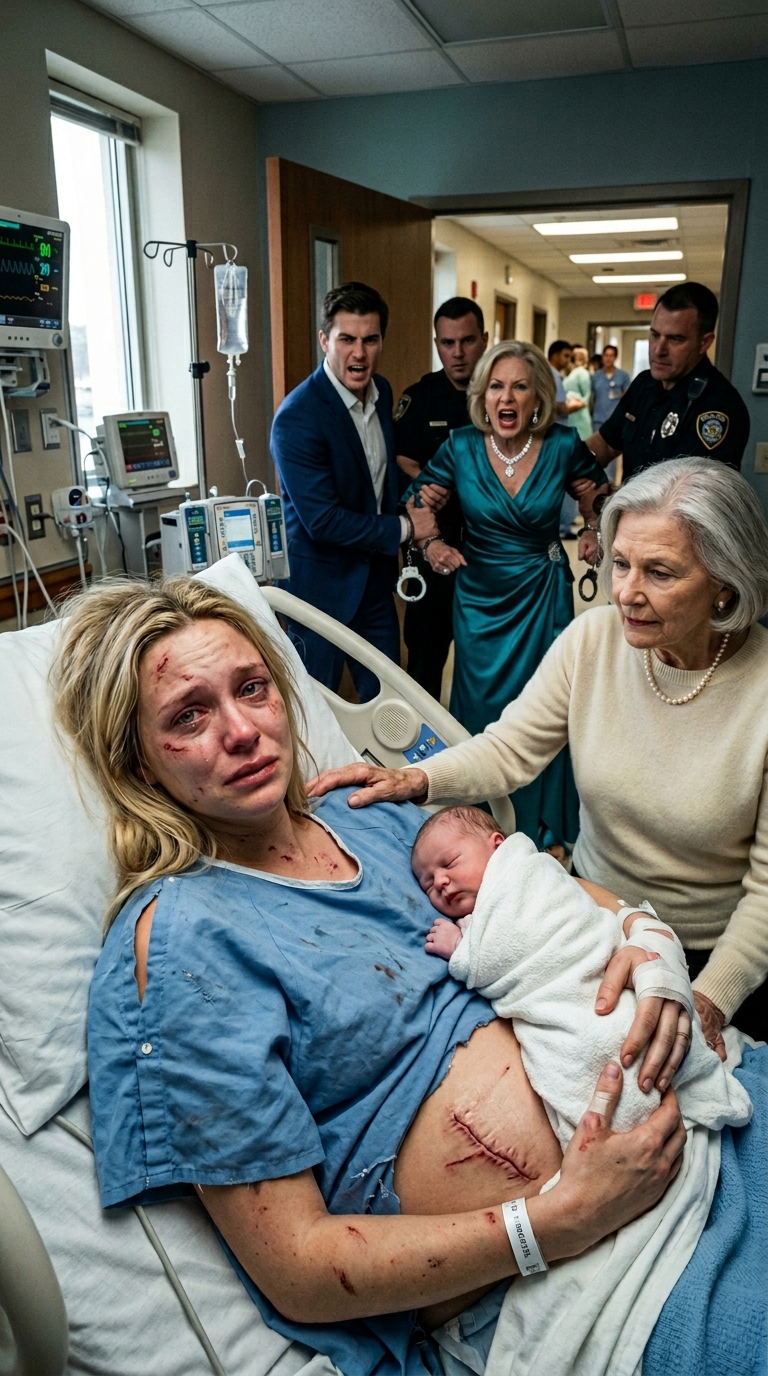
“Was three hundred thousand a month not enough?”
My grandmother asked it from the doorway of my hospital room while I was holding my newborn daughter against my chest. I was wearing the same faded gray sweatshirt I had slept in for two nights, having convinced myself that physical comfort was a luxury we could no longer afford.
For a second, I thought the exhaustion had finally broken my mind.
I had been awake for nearly forty hours, drifting in and out of a shallow, medicated haze between nurse checks, feeding attempts, the hum of blood pressure cuffs, and the tiny, startled sounds my daughter made whenever the plastic hospital bassinet squeaked.
The room smelled of antiseptic, warm plastic, and sour milk. Rain tapped softly against the windowpane. A muted television on the wall played a cooking segment no one was watching. The hospital billing envelope lay folded face down on the side table beneath a magazine because I had looked at it three times already, and each time, my heart had hammered wildly in my throat.
My daughter, Chloe, slept on my chest. One tiny fist was tucked beneath her chin, her entire body no heavier than a promise.
My grandmother, Margaret Harrington, did not look at her first. She looked at me.
She took in the old sweatshirt, the frayed cuff around my wrist, the stretched leggings with washed-out knees, the cheap overnight bag I had packed myself because Liam said hospital extras were “where places like this really get you.” She looked at the generic lip balm by my water cup, the declined lactation upgrade form peeking out of a folder, the way I had shifted the bill beneath the magazine as if paper could hide a mounting debt.
Then she stepped fully into the room and asked again, her voice slower, sharper.
“Was three hundred thousand a month not enough?”
I stared at her. My throat felt like sandpaper. My body felt as though it had been split open and sewn back together wrong.
There was a deep, hollow ache low in my abdomen, a soreness radiating through my hips, a profound tenderness in places I did not have the energy to name. My hair was matted against the back of my neck. My baby’s cheek was a warm anchor against my skin.
“Grandma,” I whispered, “what are you talking about?”
Margaret Harrington was not a woman who startled easily. She had built Harrington Storage Group from a regional warehouse business into a private holding empire that owned industrial properties, medical buildings, cold-storage facilities, and massive land parcels across three states. She had sat across the table from ruthless bankers, union negotiators, governors, and men who genuinely believed wealth made them immune to consequences. She did not raise her voice because she never needed to. She had that old-money gift of making absolute stillness feel like a loaded weapon.
But in that hospital room, something in her face shifted. It wasn’t shock.
It was structure. I saw it happen in real-time. Her expression went dead calm in a way that frightened me far more than any screaming match ever could. Anger would have meant she was merely reacting. This absolute zero meant she was already arranging facts into a firing squad.
“I have wired three hundred thousand dollars on the first business day of every month since your wedding,” she said evenly. “I assumed you were choosing to live simply. I assumed you were saving, investing, building something prudent. I did not assume this.”
Her eyes darted across the room again, resting briefly on the hidden hospital bill.
Three hundred thousand dollars. Every month. Since my wedding.
Chloe shifted against me and made a soft, mewling sound. I placed one trembling hand on her fragile back because some primal, animal part of me believed that if I held her firmly enough, the earth could not open up and swallow us.
“I never received a single dollar,” I said.
There are moments when your life does not explode in a ball of fire. It simply shifts one inch to the left, and suddenly, nothing ever lines up again.
My grandmother did not gasp. She did not rush to the bed. She did not say my name in a voice soaked with pity. She simply opened her designer handbag, pulled out her phone, and dialed.
“Susan,” she said when the line connected. “I need you at St. Jude’s right now. Bring everything you can pull in the next hour. No, not tomorrow. Now.”
She listened for perhaps three seconds.
“Yes,” she said. “The Sterling account.”
Another pause.
“All of it.”
Then she hung up.
I looked down at Chloe. Her face was impossibly small. There was a paper bracelet around her wrist with her name printed in stark black ink: Chloe Grace Sterling. Mine had Clara Sterling on it, though for the first time since my wedding day, that name felt less like a shared life and more like a barcode someone had slapped on me without my consent.
“Grandma,” I choked out, “what account?”
Margaret came to the side of the bed and pulled the vinyl chair closer, but she did not sit immediately. She looked at Chloe then, properly, and the glacial severity in her face fractured just enough for a profound, aching love to shine through.
“She is beautiful,” she whispered.
I nodded because if I tried to speak, I might make a sound that would wake the baby and shatter whatever fragile reality I was still clinging to. Only then did my grandmother sit.
“Clara,” she said, her voice dropping into a register of deadly serious business, “when you married Liam, I established a household support transfer. Not a trust, which in hindsight was a catastrophic mistake on my part. A monthly transfer to an account designated specifically for household use. The purpose was simple: mortgage, staff if needed, medical expenses, childcare, savings, investments, freedom. I wanted you to never have to ask anyone’s permission to protect your own life.”
My fingers dug into the thin hospital blanket wrapped around Chloe. “Liam said cash flow was tight.”
My grandmother’s eyes hardened into polished flint. “Did he.”
“He said his deals were delayed. He said we needed to be incredibly careful until the next quarter closed. He said I needed to stop thinking like a single person and understand how capital moved.”
Margaret said nothing, but the silence radiating from her seemed to sharpen the very air in the room. I kept talking, because once the truth begins moving, it violently drags everything else out into the light.
“I picked up overnight inventory shifts. At a pharmacy chain downtown. Just twice a week at first, then sometimes three. I stopped last week because my doctor told me my blood pressure was dangerously high. I thought we desperately needed the money.”
My grandmother closed her eyes. When she opened them, she looked older. Not weaker. Older in the way a mountain looks old—weathered, immovable, enduring.
“How much access did you have to this household account?”
I swallowed hard. “I had a debit card.”
“A login?”
“At first.”
“At first?”
“Liam changed the password because there was some kind of security breach. He said he would reset it for me when things settled down at the firm.”
“When was that?”
I looked toward the rain-streaked window, trying to count backward through months of swollen ankles, meticulous budget spreadsheets, and the thousand little humiliations I had packaged and sold to myself as marital discipline. “Maybe a year ago.”