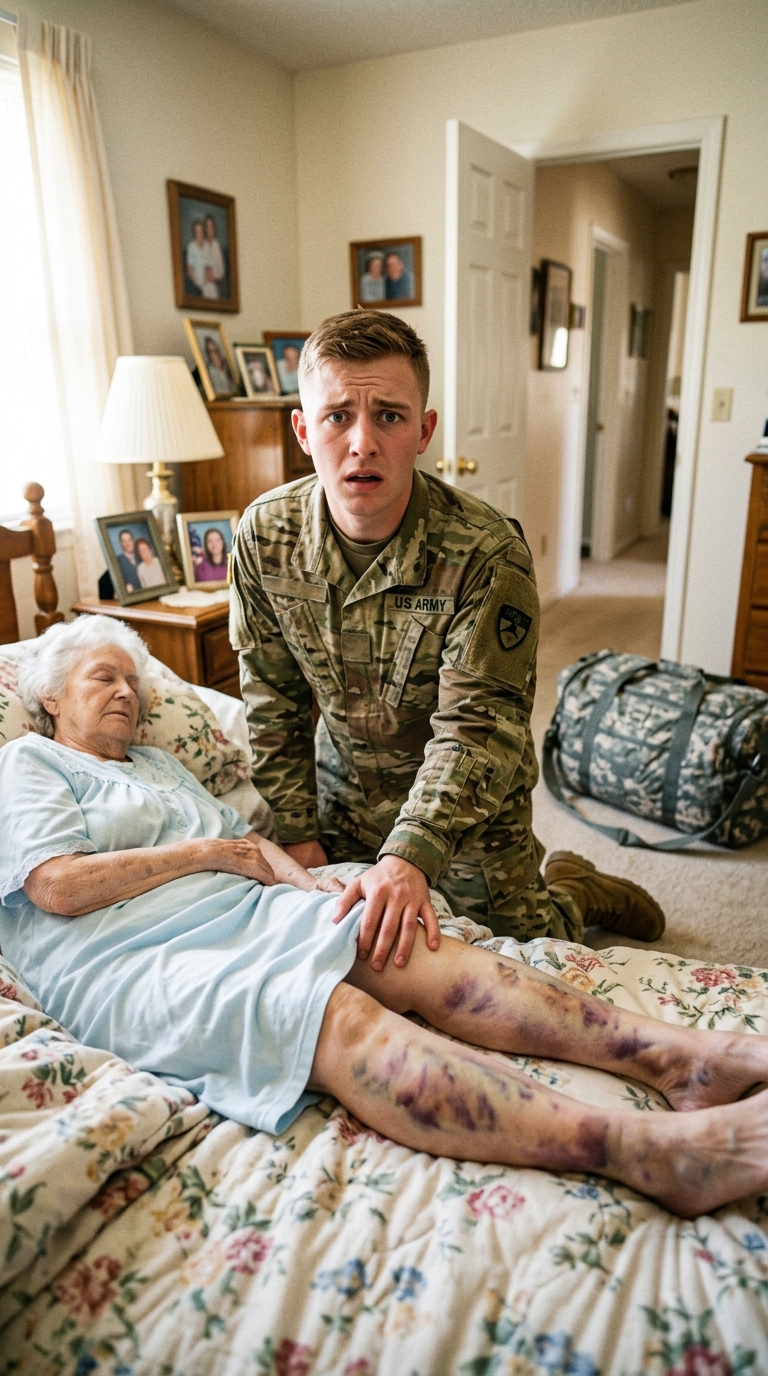
At 8:30 AM, I escorted my mother to the car. She walked with a slow, dragging gait, staring blankly at the driveway. I opened the back door of my sedan for her.
Laura slid into the passenger seat, adjusting her pearls in the sun visor mirror. She looked radiant, practically buzzing with adrenaline. She believed she was attending the funeral of my mother’s independence, and she was dressed for the reading of the will.
I put the car in drive. The silence in the cabin was thick, suffocating.
“Don’t argue with the doctor today, Evelyn,” Laura called over her shoulder, her tone sickly sweet. “If you get confused, just stay quiet. Confusion can make you aggressive, remember?”
Evelyn gazed out the window at the passing trees. Her jaw tightened for a fraction of a second. “I’ll remember that,” she whispered.
I glanced at the rearview mirror. Evelyn caught my eye. Slowly, deliberately, the confused, vacant stare melted away. The old woman in the backseat offered me a sharp, lucid, and utterly predatory wink.
We pulled into the parking lot of the psychiatric clinic. Standing by the front doors, leaning against a concrete pillar with a coffee in his hand, was Marcus. He wore a somber suit, looking every bit the supportive family friend.
As we walked up, Marcus placed a heavy hand on my shoulder. “Danny. Good to have you back, brother. I’m so sorry it’s under these circumstances. If you need anything—anything at all—I’m here.”
I looked at the hand on my shoulder. I thought about the bullets we had dodged together, and then I thought about the poison in my wife’s vanity.
“I appreciate that, Marcus,” I said smoothly, stepping out from under his grip. “Let’s go inside. It’s time to get everything out in the open.”
The waiting room smelled of stale magazines and antiseptic. Laura handed a thick manila folder to the receptionist. I knew what was inside: a meticulously curated fiction of my mother’s “decline,” complete with forged incident reports and the fraudulent Power of Attorney paperwork just waiting for a medical signature.
“Dr. Shaw will see you in room three,” the receptionist murmured, pointing down a sterile white hallway.
We filed into the room. It was a standard examination office with a desk, two guest chairs, and a small examination table. Sitting behind the desk was a tall, broad-shouldered man with salt-and-pepper hair, wearing a white coat over a sharp suit. He was reading a file.
Laura stopped in her tracks, her polished smile faltering. “Excuse me,” she said, her voice tight. “We had an appointment with Dr. Miriam Shaw. A female geriatric psychiatrist.”
The man looked up, his eyes hard and analytical. “Dr. Shaw had a family emergency this morning. I am Dr. Aris Thorne. I will be conducting Mrs. Hayes’s evaluation today. Please, have a seat.”
Laura looked at Marcus, a flicker of panic passing between them. Marcus gave her a subtle nod, a silent command to stick to the plan. A doctor was a doctor. They just needed a signature.
“Of course,” Laura recovered, taking the seat closest to the desk. She placed her folder in front of ‘Dr. Thorne’. “Doctor, my mother-in-law has been deteriorating rapidly. Severe memory loss, paranoia, violent outbursts. We fear for her safety.”
Dr. Thorne didn’t touch her folder. Instead, he pulled out a thick, black binder from his own briefcase. My binder.
“I see,” Dr. Thorne said smoothly. He turned his gaze to my mother, who was sitting slumped in the second chair, her hands folded limply in her lap. “Evelyn. Can you tell me today’s date?”
Laura leaned forward to interject, “She usually doesn’t—”
“I asked the patient, Mrs. Hayes,” Dr. Thorne snapped, his voice cracking like a whip. Laura snapped her mouth shut.
Evelyn slowly lifted her head. She blinked, looking around the room as if she had just woken from a long nap. She rolled her shoulders back, her spine straightening with absolute dignity.
“Today is Tuesday, October 14th,” Evelyn said. Her voice was no longer a croak. It was clear, resonant, and dripping with authority. “The President is Mitchell. We are at 442 West Elm Street. And my current blood pressure is 120 over 80, because unlike the woman sitting next to me, I actually take care of my heart.”
Laura practically shot out of her chair. “She’s having a manic episode! This is what I was talking about. She rehearses things to sound sane, but—”
“Sit down, Laura,” I commanded. I didn’t shout, but the absolute zero temperature of my voice made her freeze.
Dr. Thorne opened the black binder. “Evelyn, can you explain why you have severe bruising on your wrists, consistent with physical restraint?”
Laura went pale. “She falls! She thrashes in her sleep!”
Evelyn ignored her completely. She reached into the pocket of her robe and pulled out a small, crumpled piece of plastic. She slammed it onto the glass surface of the desk with a sharp clack.
It was the empty blister pack of Promazine I had fished out of the trash in the garage that morning.
“She doesn’t just restrain me, Doctor,” Evelyn said, her eyes locked on Laura with the intensity of a sniper. “She locks me in a room where the door only opens from the outside. She crushes heavy antipsychotics into my drinking water. And when I refuse to drink it, her accomplice there,” Evelyn pointed a steady finger at Marcus, “holds me down while she forces it down my throat.”
“This is insane!” Marcus bellowed, stepping forward, his face flushed red. “Danny, are you going to let your crazy mother talk about us like this? She’s out of her mind! You need to sign the commitment papers right now!”
“Why would I do that, Marcus?” I asked softly, taking a step toward him. “So you can push the deed through to your LLC and sell my family home to Victor Hale’s commercial development firm for an eight-hundred-thousand-dollar profit?”
Marcus stopped dead. The color drained from his face so fast he looked like a corpse. “How…”
“Deployment taught me a lot of things, Marcus,” I said, pulling my phone from my pocket. I tapped the screen. The audio recording I had captured from the stairs the night before filled the sterile room.
“…As soon as Dr. Shaw signs the incompetency evaluation tomorrow… we walk away with four hundred grand each…”
Laura pressed her hands over her ears, her breath coming in short, hyperventilating gasps. “No, no, no. That’s fake. That’s AI! He hates me! Daniel, he’s trying to set me up!”
Dr. Thorne stood up slowly. He took off his glasses and folded them into his breast pocket. He wasn’t looking at them like a doctor assessing patients. He was looking at them like a hunter looking at a trap that had just snapped shut.
“Laura Hayes and Marcus Vance,” Dr. Thorne said, reaching into his jacket and pulling out a gold badge that caught the fluorescent light. “I am Special Agent Thorne with the State Attorney General’s Office, Elder Abuse and Fraud Division. And you are both under arrest.”
The door to the examination room swung open, and three uniformed officers stepped inside, blocking the exit.
Marcus made a sudden, desperate move toward the door, his military instincts kicking in. But I was faster. I stepped into his path and drove my heel hard into his knee, the exact spot where he had taken shrapnel years ago. He buckled instantly, hitting the linoleum floor with a grunt of pain.
“You betrayed your unit, you betrayed my family, and you tried to murder my mother’s mind,” I whispered down to him as the officers wrenched his arms behind his back. “You’re lucky the police got to you before I did.”
Laura didn’t fight. She collapsed into her chair, sobbing hysterically, blaming Marcus, blaming the housing market, blaming the stress of being a military wife. Every pathetic excuse was recorded by the body cameras of the arresting officers.
Dr. Thorne walked around the desk and gently placed a hand on my mother’s shoulder. “Mrs. Hayes, are you alright?”
Evelyn looked at Laura being handcuffed, her face a mask of ruined makeup and shattered arrogance. Then, she looked at me.
“I am perfectly competent, Agent Thorne,” Evelyn said softly. “But I would very much like to go home and bake a pie.”
The legal fallout was swift and brutal. The evidence was insurmountable: the physical lock on the door, the toxicology report on the water glasses, the digital footprint of the forged deed, and the recorded confessions.
Laura took a plea deal to avoid a public trial, resulting in a ten-year sentence for conspiracy, elder abuse, and attempted fraud. Our divorce took exactly fourteen minutes before a judge. She left the marriage with nothing but a mountain of legal debt and a felony record.
Marcus fought the charges, arrogant to the end. The jury deliberated for less than two hours. Because he had utilized his shell company to attempt similar predatory land grabs on other vulnerable veterans’ families, federal charges were added. He was sentenced to twenty years in a maximum-security federal penitentiary.
Eight months later, the Virginia autumn had turned the trees around our house into pillars of gold and crimson.
The heavy oak door to the guest room had been removed entirely. The room was flooded with natural light, the walls painted a soft, calming pale blue. Evelyn had turned it into a reading room. She sat by the window in a plush armchair, a new tablet resting in her lap, sipping from a porcelain teacup.
I stood in the doorway, wearing my dress uniform. My leave was over. I was shipping out again, but this time, the house was secure. I had installed a state-of-the-art security system, hired a trusted, vetted live-in companion for the days Evelyn felt tired, and transferred the deed of the house into an ironclad trust.
“You look sharp, Daniel,” she said, looking up from her book.
“Are you sure you’re going to be alright here, Mom?” I asked, the lingering ghost of guilt still tugging at my chest.
Evelyn smiled. It wasn’t the terrified, drugged smile of a prisoner. It was the fierce, unyielding smile of a survivor. She reached out and patted the space on the table next to her, right beside a framed photograph of my late father.
“I survived a war inside my own home, Danny,” she said softly. “I think I can handle the neighborhood watch.”
I walked over, kissed her forehead, and turned to leave. Just as I reached the hallway, she called out to me.
“Daniel?”
“Yes, Mom?”
“If that new home health aide tries to give me decaf coffee,” she warned, her eyes sparkling with mischief, “I’m putting a lock on her door.”
I laughed, a genuine, heavy sound that echoed through the peaceful house. Outside, the security cameras blinked a steady, silent green. The perimeter was secure. The siege was over.
If you want more stories like this, or if you’d like to share your thoughts about what you would have done in my situation, I’d love to hear from you. Your perspective helps these stories reach more people, so don’t be shy about commenting or sharing.
✅ End of story — Part 3 of 3
← Read from Part 1