The chronicle of my own coup d’état did not begin with a grand declaration or a sudden burst of violent rebellion. It began in the suffocating silence of a mahogany-paneled living room, governed by the quiet, terrifying hum of a dying battery.
My twin sister, Clara, and I were seventeen. We possessed the kind of identical features that made strangers do double-takes, yet to Arthur Vance, our stepfather, we were entirely distinct. He never confused us because he studied us the way a predator memorizes the habits of its prey.
He knew Clara’s tells—the slight tremor in her hands, the way her eyes darted to the floor. And he knew mine: the cold, unyielding stare that I used as a shield, the silence that he hated more than anything else in the world.
Arthur never struck us because he lost his temper. Rage is sloppy. Arthur was a man of immaculate control. He chose the hour, meticulously closed the heavy velvet drapes, carefully removed his gold wedding band, and calmly instructed our mother, Margaret, to turn up the volume on the television. Then, he would make Clara and me stand shoulder to shoulder, prolonging the agonizing silence while he decided which of us would serve as his evening’s lesson in obedience.
He thought he was the architect of our despair. He did not know that for the past three months, I had been building a guillotine in the dark.
I had found an old smartphone discarded in a dusty box of holiday ornaments.
The screen was spider-webbed with cracks, but the microphone was flawless. I hid it beneath a loose floorboard near the heating vent in the study, a room where Arthur conducted his most private and sinister conversations. I had configured the device to automatically upload its audio recordings to a hidden cloud server—a digital vault set up years ago by our late father, Thomas Sterling, a brilliant forensic accountant who had left his vast estate and company shares in a trust for Clara and me, payable on our eighteenth birthdays.
But an old phone has a weak battery. It required charging.
Every seventy-two hours, I played a lethal game of Russian roulette. I had to wait until Arthur was deeply engrossed in his evening scotch, slip into the study, retrieve the phone from beneath the floorboard, plug it into a concealed outlet behind a heavy bookshelf, and wait for it to gather enough life before hiding it again.
It was a terrifying dance. If he walked in, if the floorboard creaked, if he noticed the faint glow of the charging screen, I knew exactly what he would do to us.
On a rainy Thursday night, the game finally unraveled.
Arthur had been pacing the hallway, agitated by a phone call from his lawyers regarding our impending eighteenth birthdays. He ordered us into the study. Margaret stood by the door, her face a mask of practiced apathy, her hands clutching her silk shawl. Arthur began his psychological torment, circling us, detailing how incompetent and mentally unstable we were, how we needed him to manage our “burdensome” inheritance.
Suddenly, a sound pierced the heavy air.
Beep. Beep.
It was muffled, coming from beneath the floorboard. The phone’s battery was critically low, crying out in the silence of the room.
Arthur froze. His head snapped toward the vent. His eyes narrowed, a dangerous, calculating glint flashing in the dim light. He took a slow step toward the corner. He was going to find it. Everything—the three months of agonizingly collected evidence, our only ticket to survival, our father’s legacy—was about to be unearthed and destroyed.
I didn’t think. I acted.
I stepped out of line, deliberately knocking over a heavy brass lamp. It shattered against the hardwood. Arthur whipped around. I looked him dead in the eye, wearing a smirk I didn’t feel, and said the one thing guaranteed to break his iron control.
“You’re pathetic, Arthur. My father was twice the man you’ll ever be, and you’re just a parasite feeding on his ghost.”
The silence that followed was absolute. Clara gasped. Margaret stepped back. Arthur’s face drained of color, then flushed with a terrifying, unadulterated fury. He didn’t walk toward me; he lunged.
The first blow sent the room spinning into a chaotic blur. I fell, the taste of copper flooding my mouth, but through the ringing in my ears, I heard nothing but his rage. The phone’s dying beeps were drowned out entirely by the violence I had invited upon myself.
I embraced the darkness, praying the battery would just die.
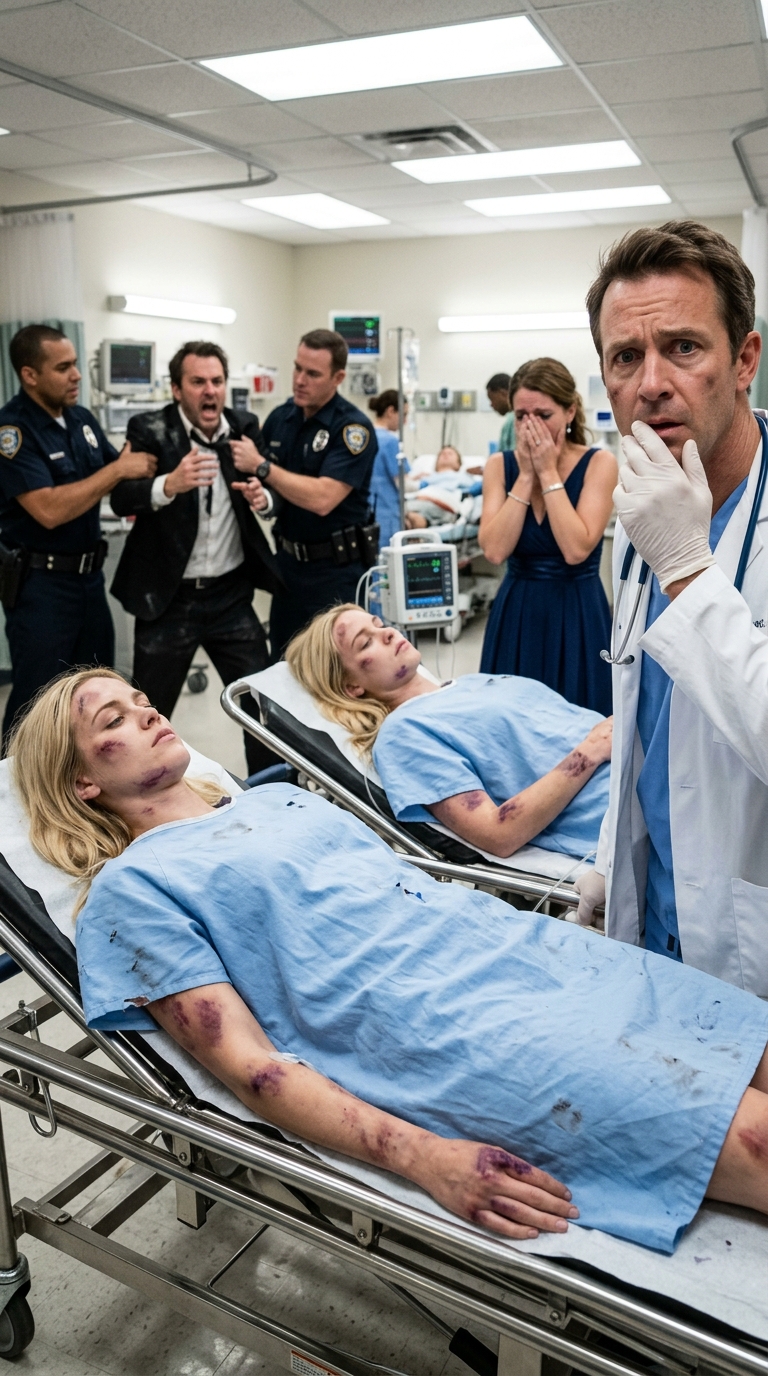
When I finally clawed my way back to consciousness, the harsh, sterile glare of fluorescent lights burned through my eyelids. The smell of antiseptic and stale linen filled my nose. I was in St. Jude Medical Center.
I turned my head, fighting a wave of nausea. Clara lay unconscious in the adjacent bed, a nasty bruise blooming across her cheekbone. Arthur stood near the privacy curtain, calmly washing his hands at the small sink, adjusting his cuffs with the meticulous care of a man preparing for a board meeting. Margaret sat rigidly in a plastic chair, her designer purse clutched to her chest, whispering to the emergency room physician, Dr. Harrison.
“It was so dark,” Margaret was saying, her voice trembling with manufactured distress. “They were arguing, as teenagers do. They tumbled down the grand staircase together. It was horrifying.”
Dr. Harrison, a man with sharp eyes and deep lines etched around his mouth, approached my bed. He examined the dark, distinct finger marks bruising my upper arms, then glanced at the similar, though older, faded marks on Clara’s wrists. His expression tightened.
“Both girls fell the exact same way?” Dr. Harrison asked, his voice low, lacking any inflection of belief. “And sustained defensive wounds from a staircase?”
Arthur dried his hands and stepped into the light. “Teenagers are clumsy and prone to dramatic fabrications, Doctor. They need rest and a psychiatric evaluation. Just treat them.”
Dr. Harrison didn’t flinch. He stepped back and looked at the security guard standing near the hallway. “Call the police. Now.”
Arthur let out a sharp, condescending laugh. He stepped into Dr. Harrison’s personal space, radiating menace. “Do you have any idea who you are accusing, Harrison? I sit on the board of directors for this hospital. I funded the new pediatric wing. One phone call, and you’ll be practicing medicine in a free clinic out of the trunk of your car.”
Dr. Harrison hesitated. The heavy weight of power and money hung in the air, a physical force pressing down on the room.
He’s going to fold, I thought, panic rising in my chest like bile. Arthur is going to walk us out of here and we will never be seen again.
I needed to give the doctor the password to the cloud account, but Arthur’s lawyer had just arrived, his expensive shoes clicking sharply against the linoleum. The doorway was blocked. Margaret, sensing the tension, suddenly stood up.
“They are clearly agitated and need rest,” she declared, stepping toward our IV poles. “I have the medical proxy. I insist on administering a mild sedative. For their own good.”
She reached into her purse, pulling out a small vial. She was going to knock us out before we could speak to the police.
I tried to sit up, but my ribs screamed in agony. I looked at Clara. Her eyes were barely open, but she saw Margaret. With a sudden, desperate surge of energy, Clara kicked her leg out, hooking her foot around the heavy metal base of her IV pole. She violently yanked it down.
The pole crashed into a tray of surgical instruments with a deafening, metallic clatter. Needles, clamps, and steel bowls scattered across the floor. Everyone spun around, startled. Arthur cursed. Margaret shrieked and dropped the vial.
In that split second of chaotic distraction, I acted.
My knuckles were scraped raw and bleeding from where I had hit the floor at the house. I bit my lip to stifle a groan, reached over to a small stack of sterile gauze pads on the bedside table, and pressed my bleeding knuckles against the rough white fabric. With trembling, agonizing precision, I used my own blood to hastily smear a sequence of letters and numbers onto the pad.
When Dr. Harrison rushed to my side, instinctively checking if I had been injured by the falling debris, I grabbed his wrist. My grip was weak, but desperate. I shoved the bloody gauze into his palm and closed his fingers over it.
I locked eyes with him, projecting every ounce of terror and determination I possessed. Look at it, I prayed silently.
Arthur turned back around, his face a mask of fury. “Sedate them now, or you’re fired!” he roared.
Dr. Harrison slowly stood up, slipping his hand into his lab coat pocket. He looked at Arthur, then down at me. The silence stretched until it felt like a physical thread, pulled to its absolute breaking point.
“Security,” Dr. Harrison said, his voice completely steady now. “Lock this ward down. No one leaves.”