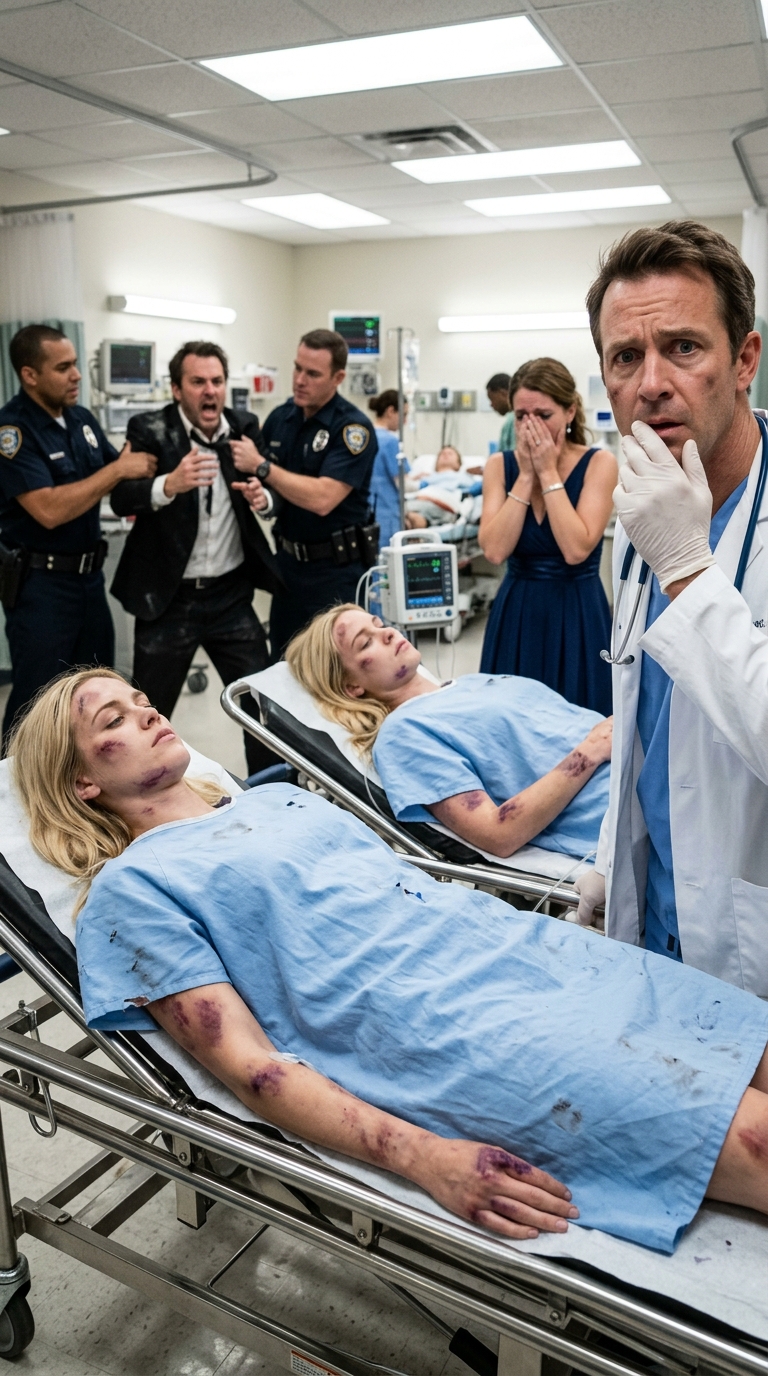
Within an hour, the sterile white walls of the hospital room were replaced by the sharp, authoritative presence of Detective Miller. She was a woman who looked like she had seen every shade of human cruelty and was utterly unimpressed by Arthur’s tailored suit or his blustering threats.
The police had separated us. Arthur and his lawyer were confined to a waiting room down the hall, flanked by officers. Margaret was pacing in another room, weeping loudly enough for the entire floor to hear.
Detective Miller sat beside my bed, a sleek silver laptop resting on her knees. Beside her stood Dr. Harrison, the bloody gauze pad sealed safely in an evidence bag on the table.
“I accessed the drive using your… unconventional note,” Detective Miller said gently. “There are eighty-seven audio files here, Eleanor. That’s a lot of data. Where do you want me to start?”
“Play file number eighty-seven,” I whispered, my throat dry. “And then… play file number seventy-two.”
She clicked the trackpad. The room filled with the ambient static of our study, followed by the terrifyingly clear audio of the incident from three days prior. The recording captured everything: Arthur’s degrading monologues, his explicit threats regarding our trust fund, the sound of the lamp shattering, my defiant words, and then… the sickening thuds of his fists.
Detective Miller’s jaw locked. Her hand hovered over the keyboard, her knuckles white. Dr. Harrison closed his eyes, taking a deep, shuddering breath.
“That’s enough to arrest him for aggravated assault and coercion,” Miller said, her voice a low growl. “He’s done.”
“It’s not just him,” I said, a cold numbness spreading through my veins. “Play number seventy-two.”
She clicked the file. It was dated a week earlier. Arthur and Margaret were alone in the study.
“The petitions for their medical incompetence are ready,” Arthur’s recorded voice purred smoothly. “The judge is a friend. Once they turn eighteen next week, the trust transfers to my control as their permanent guardian. We just need them to seem… sufficiently unstable during the evaluation.”
Then, another voice spoke. It was calm, practical, and utterly devoid of warmth. It was my mother.
“Just make sure it’s clean, Arthur,” Margaret’s voice echoed through the hospital room, chilling the air. “The trust opens on Thursday. Do whatever you have to do to break them by Wednesday, but don’t get blood on the new Persian rug. The cleaners charge a fortune for stains.”
A suffocating silence descended upon the hospital room. I had known Margaret was weak, complicit in her silence, perhaps even terrified of Arthur herself. But hearing the calculated, fiscal cruelty in her voice—prioritizing a carpet over the lives of her daughters—shattered something foundational inside me. It wasn’t weakness; it was a partnership.
“My god,” Dr. Harrison whispered.
Detective Miller didn’t say a word. She gently closed the laptop, stood up, and adjusted her belt. She walked out of the room with terrifying purpose. Through the slightly ajar door, I heard the commotion. I heard Arthur shouting about his lawyers, about his rights, about his status. I heard the distinct, metallic click of handcuffs snapping shut.
When they led him past my door, Arthur twisted his body, fighting the officers to glare into my room. He didn’t look defeated. He looked enraged.
“You think you won, you little brat?” he spat, his veneer of sophistication completely destroyed. “You have nothing! I planned for this!”
He was dragged away, his laughter echoing down the corridor. I lay back against the pillows, the victory feeling hollow, coated in the ash of my mother’s betrayal.
Later that evening, after Clara had awakened and we had held each other in a long, silent embrace, the police returned with my laptop, recovered from our house. They needed me to log in to verify some local files.
As I stared at the screen, a nagging thought—a ghost of my father’s teachings—began to itch at the back of my mind. Arthur was too confident, I thought. He said he planned for this.
I opened the network logs. While Arthur had been focused on his physical violence, I had been learning how to trace digital footprints. I bypassed his flimsy local security and accessed the mirrored backup of his primary hard drive, which the police had just seized.
I spent hours sifting through shell companies, forged medical documents, and offshore wire transfers. But then, buried deep within a nested folder disguised as tax receipts, I found an encrypted directory.
The password prompt blinked.
I tried his birthday. Margaret’s birthday. The date of their wedding. Nothing. Then, my hands trembling, I typed in my father’s name: Thomas_Sterling.
Access granted.
I opened the first document, expecting to find more financial fraud. Instead, my blood ran cold, freezing in my veins.
The file wasn’t about our trust fund. It was a detailed, meticulously cataloged ledger of medical research. Chemical compositions. Half-lives of toxins. Specifically, it was a profound study of a rare, untraceable heavy metal poison that mimicked the exact symptoms of the sudden, aggressive heart failure that had killed my father five years ago.
And at the bottom of the document, an email exchange between Arthur and a foreign pharmaceutical supplier, dated three months before my father died.
My father hadn’t succumbed to an illness. They had murdered him.
The courtroom was a theater of polished wood and hushed, venomous whispers. Six months had passed since that night in the hospital. The assault charges had been the anchor, but the encrypted folder I had unsealed unleashed a leviathan.
Arthur and Margaret sat at the defense table. They looked diminished, the arrogant sheen of their wealth scrubbed away by months in county lockup. Their high-priced attorneys had tried to suppress the audio recordings, arguing they were manipulated, an illegal wiretap orchestrated by a traumatized, vindictive child.
They hadn’t anticipated that I would take the stand not just as a victim, but as the architect of their ruin.
“Miss Sterling,” Arthur’s lead counsel sneered, pacing before the jury box. “You expect this court to believe that a seventeen-year-old girl single-handedly unraveled a complex financial and medical conspiracy? Isn’t it more likely that you, angry at your mother’s remarriage, fabricated these ‘encrypted files’ to steal the spotlight and early access to your trust?”
I sat up straighter. I was wearing a tailored suit, projecting the very image of the calm, calculating professional my father had been.
“I didn’t fabricate anything,” I replied, my voice carrying clearly across the silent room. “I simply followed the numbers. Numbers don’t lie, sir. Only people do.”
The prosecutor stepped forward, projecting the contents of the encrypted folder onto the large screens for the jury. He didn’t start with the poison. He started with the money.
He detailed how Arthur had systematically siphoned funds from Sterling Holdings while my father was allegedly bedridden. But the true masterpiece of the prosecution’s case was the revelation I had pieced together in the long nights following the arrest.
“Let’s look at the offshore accounts, shall we?” the prosecutor said, turning to Margaret. She looked up, her eyes wide, confused.
The screens changed, displaying a complex web of wire transfers moving millions of dollars to a bank in the Cayman Islands.
“Mr. Vance claimed to be securing the family’s future,” the prosecutor continued. “But tell me, Miss Sterling, as you audited these accounts, who was the sole beneficiary of the Cayman trust?”
“Only Arthur Vance,” I answered steadily. “My mother’s name was entirely scrubbed from the final beneficiary documents three weeks before the assault. He was draining her personal accounts as well. He planned to take the girls’ trust, liquidate the remaining assets, and leave the country. Alone.”
A sharp, ragged gasp echoed through the courtroom. It came from Margaret.
She turned to Arthur, her face contorted in a mask of absolute horror and dawning comprehension. The alliance they had built on the grave of my father, the partnership cemented by their willingness to sacrifice Clara and me, instantly shattered.
“You…” Margaret choked out, oblivious to the judge’s gavel banging for order. “You took my money? You promised we were leaving together!”
Arthur didn’t look at her. He stared straight ahead, his jaw clenched so tightly a muscle ticked violently in his cheek. His mask of control had finally slipped, revealing the terrified, cornered rat beneath.
The prosecutor then delivered the final, fatal blow. He brought Dr. Harrison to the stand, followed by a toxicologist who testified that, based on the ledgers found on Arthur’s computer and the specific timeline of my father’s rapid decline, an exhumation and autopsy had been quietly conducted.
Traces of the heavy metal had been found in Thomas Sterling’s bone marrow.
The jury deliberated for less than four hours.
Guilty on all counts. Aggravated assault, child endangerment, massive financial fraud, and conspiracy to commit murder in the first degree.
As the judge read the sentence—life in prison without the possibility of parole for Arthur, and thirty years for Margaret’s complicity and fraud—the courtroom erupted.
Arthur was aggressively yanked to his feet by the bailiffs. He fought them, his eyes wildly searching the gallery until they locked onto mine. There was no smugness left, only the raw, chaotic terror of a man who had lost his kingdom.
Margaret collapsed into her chair, a hollow, destitute shell. She reached out a trembling hand toward me as I sat in the gallery with Clara.
“Eleanor… please,” she mouthed, tears cutting tracks through her makeup. “I’m your mother. I have nothing.”
I stood up, adjusting the cuffs of my suit. I looked at the woman who had cared more about her Persian rug than my life.
“You haven’t been my mother for a very long time,” I said, my voice low but carrying the heavy weight of finality. “And you’re right. You have exactly what you deserve. Nothing.”
Clara and I turned and walked out of the courtroom, leaving the echoes of their ruin behind us.