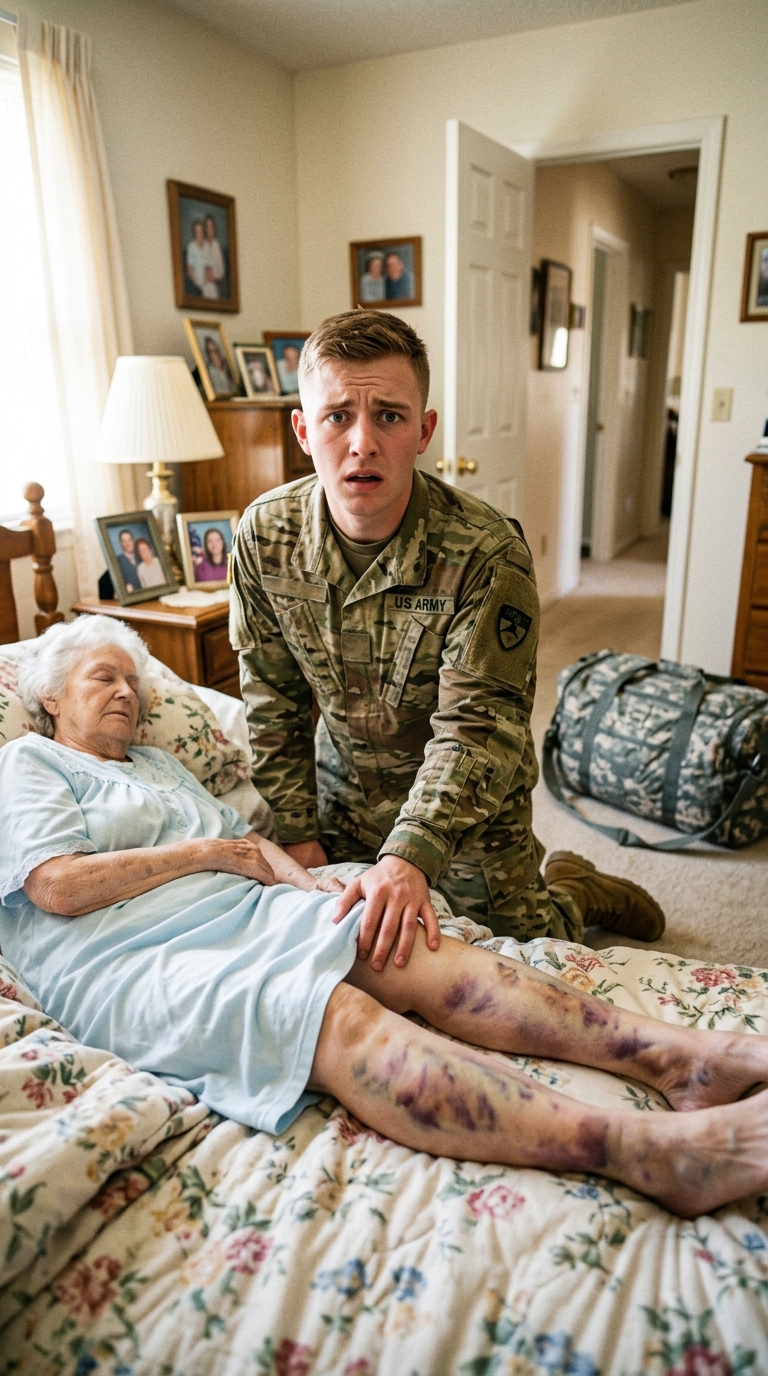
Every war teaches you that the most dangerous territory is the one you think you already control. For me, that territory was a two-story colonial in the suburbs of Virginia. This is the chronicle of my own coup d’état, a quiet, desperate war fought not with artillery, but with effervescent vitamins, hidden microphones, and a mother’s iron will.
Sixteen hours earlier, I had been in the belly of a military transport plane, imagining the simple comforts of home: hot black coffee, my mother’s legendary lemon pie, and my wife, Laura, running into my arms.
Instead, the first sound that greeted me when I stepped out of the taxi wasn’t laughter. It was Laura standing on our porch in a pristine cream dress, speaking in a hushed, tragic tone to our neighbor, Mrs. Calder.
“Her dementia is progressing so fast,” Laura was saying, her hand resting delicately on her collarbone. “Sometimes she gets confused. Sometimes she hurts herself. We’re arranging professional care.”
The second sound was a dull, rhythmic thud. It was coming from the second floor. It was the sound of my mother’s fist striking the inside of a solid oak door.
“Daniel!” she cried out, her voice muffled but laced with a terror I had never heard before. “Please don’t leave me in here.”
I dropped my duffel bag. The heavy canvas hit the concrete driveway with a dead thud. Laura turned, her eyes widening in a flawless imitation of pleasant surprise. She glided down the steps and threw her arms around my neck, smelling of expensive jasmine perfume and something metallic—like nervous sweat masked by floral spray.
“You’re home early,” she breathed into my ear.
I hugged her back, but my eyes were locked on the upstairs window. The heavy curtain twitched.
“Why is Mom’s door locked, Laura?” I asked, keeping my voice perfectly even. Deployment had taught me that panic only ever announced your position to the enemy.
Laura’s spine went completely rigid. “For her safety, Danny. She wanders at night. She almost fell down the stairs twice last week.”
“Of course,” I smiled, pulling back to look into her eyes. They were wide, blue, and utterly unblinking. “Safety first.”
I carried my bag inside, playing the role of the exhausted, compliant soldier. I waited patiently until Mrs. Calder shuffled back to her own yard, then I walked into the kitchen. The house felt sterile, stripped of the warmth my mother, Evelyn, usually brought to it. I knew where Laura kept the spare keys. They were hidden in the false bottom of her jewelry box in the master bedroom.
It took me thirty seconds to retrieve the brass key to the guest room.
When I turned the lock and pushed the door open, the smell hit me first. It wasn’t the scent of illness or old age; it was the sharp, chemical tang of a hospital ward mixed with stale sweat. The room was shrouded in darkness, the blinds drawn tight. There was a stripped mattress on a metal frame, a plastic cup of lukewarm water, and my mother.
She was sitting on the floor against the far wall, wearing clothes I recognized from a photograph Laura had sent me three days ago. Her phone was nowhere to be seen. But what stopped the breath in my throat wasn’t the stark conditions. It was her physical state. Her hands were trembling violently, and dark, purple bruises formed tight bands around both of her wrists.
“Mom,” I whispered, dropping to my knees beside her.
Evelyn stared at me. Her pupils were blown wide, her breathing shallow, but behind the chemical haze clouding her eyes, there was a furious, piercing clarity.
“I am not losing my mind, Daniel,” she rasped, her voice catching on the dry air.
“I know,” I said, gently touching her bruised wrist. “Who did this?”
She leaned in, her breath smelling faintly of chalk and bitterness. “She doesn’t just lock the door. She makes me drink it. The bitter water. If I don’t, he holds me down.”