Captain Jonathan Morgan.
My father.
For a long moment, I could not speak.
He did not look like a shadow. He did not look like a villain. He looked like a Marine.
Walter waited.
Finally, I asked, “Why me?”
“Because General Morgan followed your career.”
I stared at him. “He what?”
“Quietly. Through public military records, through private contacts, through awards, assignments, fitness reports where available. He knew you joined the Marine Corps after college. He knew you deployed. He knew you became a logistics officer. He believed you carried your father’s integrity.”
A strange anger moved through me.
“He watched my life from a distance while my mother sold jewelry to pay pharmacy bills?”
Walter looked down. “Yes.”
“And I’m supposed to feel honored?”
“No,” he said. “You are supposed to know the truth.”
He handed me a sealed envelope bearing Arthur Morgan’s signature.
“General Morgan left personal conditions attached to the estate. Before accepting the inheritance, he asked that you review certain family records.”
“Why?”
“Because he believed you deserved the whole story before carrying the name.”
“I don’t carry the name.”
Walter’s gaze held mine.
“Blood has carried it for you.”
I opened the envelope.
The handwriting inside was firm but uneven with age.
Emily,
If you are reading this, then I failed to fix what my family destroyed. You are the last honest Morgan left.
I stopped reading.
The words blurred.
Last honest Morgan.
I did not know these people. I did not know their houses, their scandals, their sins, their habits, their dead.
I did not know what kind of man Arthur Morgan had been in private, except that he had known I existed and left me to grow up believing I had been abandoned.
But that sentence reached across all my anger and touched something buried.
I read on.
Your father tried to do what I should have done. He believed duty meant more than loyalty to power. I taught him that, then failed him when he lived by it. I cannot undo what happened to Jonathan. I cannot return the years stolen from you and your mother. What I can do is put the last thing I control into the hands of someone who still understands service.
Do not trust Richard.
Do not trust the family story.
Walter has the records.
A.M.
Walter placed another folder on the table. Inside were copies of defense contracts, financial records, classified excerpts with redactions, old letters, private journals, and newspaper clippings spanning three decades.
Richard Morgan’s name appeared again and again. Morgan Strategic Systems. Meridian Defense Group. Overseas supply contracts. Congressional testimony. Missing equipment. Internal inquiries closed without findings. My father’s name appeared too, then disappeared from the record like a line scratched out by someone powerful enough to make absence official.
I looked up slowly.
“What exactly did this family do?”
Walter answered carefully.
“Enough that your grandfather spent his final years trying to make peace with God.”
That night, alone in a luxury hotel room overlooking Zurich, I read until dawn.
I read about defense suppliers overbilling the government for equipment that never reached deployed Marines. I read about shell logistics contracts, falsified delivery records, missing field medical kits, spare parts billed twice, armored vehicle components listed as delivered to units that never received them. I read about officers who raised concerns and found their careers damaged. I read about private companies that profited while service members improvised with shortages that should never have existed.
Around three in the morning, I found the letter.
It was from my father to my mother.
Unopened.
Claire,
If anything happens to me, promise me you will keep Emily away from the Morgan family. There are things my father allowed that he can never undo. Richard is worse than Arthur knows. I am gathering enough to testify. If I vanish, it will not be because I left you. I love you and our daughter more than my own life.
Jonathan
I read those lines until morning light came gray through the curtains.
My father had not abandoned us.
Someone had made sure we never heard from him again.
When I returned to the bank later that morning, Walter took one look at me and said, “You did not sleep.”
“My mother lied to me my entire life.”
“Your mother was frightened.”
“That does not excuse it.”
“No,” he said quietly. “It does not.”
The honesty steadied me more than defense would have.
I sat across from him and opened the file again.
“What was my father trying to expose?”
“In the early 1990s, Jonathan discovered evidence that military suppliers were overbilling the government through fraudulent overseas contracts.”
“That happens.”
“Yes. But this involved senior officials, private defense companies with political protection, and members of the Morgan family.”
“My family.”
Walter nodded once.
I leaned back, feeling suddenly colder than the room.
I had spent my adult life believing honor mattered. Duty, integrity, sacrifice. Those were not words painted on recruiting posters to me. They were the reason Marines lost holidays, marriages, sleep, health, and sometimes parts of themselves in places most Americans could not find on a map. Now I was learning my own bloodline might have used patriotism as a business model.
“So my father threatened them.”
“He intended to testify.”
“And then he disappeared.”
“Yes.”
“You keep saying believed. Intended. Possibly. Why?”
“Because the proof was buried. Because men like Richard rarely sign their crimes clearly. Because your grandfather had power, but not enough courage when it mattered.”
He handed me Arthur Morgan’s private journal.
The first page I opened had only one line.
I failed my son.
Beneath it, in shakier handwriting:
I taught my children discipline, but not morality.
I closed the journal.
An old man had written those words while sitting on one of the largest private military fortunes in America. Money had not protected him from regret. It had merely given regret larger rooms to echo in.
“What happens if I refuse the inheritance?” I asked.
Walter looked genuinely surprised.
“You would walk away from sixty million dollars?”
“I’m asking.”
“If you refuse, the estate would likely revert to Richard Morgan and other surviving family members.”
I thought of my mother counting pills in a plastic organizer because insurance delayed another approval. I thought of my truck overheating near the base gate. I thought of my father writing letters that never reached us while Richard Morgan built a fortune on the language of service.
“No,” I said quietly. “That’s not happening.”
Walter gave a small approving nod.
For the first time since landing in Zurich, I thought maybe there was a little Morgan in me after all.
That afternoon, Walter arranged a secure video call with the American estate attorney in Washington.
Richard Morgan appeared on the screen from what looked like a paneled office. He had silver hair, a square jaw, and the relaxed posture of a man who believed anger became more dignified when delivered quietly.
“You should have stayed in California,” he said.
No greeting. No introduction.
I sat straight in the leather chair. “You should have told the truth thirty years ago.”
His expression darkened. “You know absolutely nothing about this family.”
“I know my father wrote letters my mother never received.”
Richard exhaled through his nose. “You think Jonathan was some hero?”
“He was a Marine.”
“He was naive,” Richard snapped. “He thought exposing corruption would purify the world.”
I noticed Walter watching silently beside me.
“Did you love him at all?” I asked.
The question hit Richard harder than I expected. For one second, his mask slipped. He looked older, tired, almost human.
Then it returned.
“If you challenge this family publicly, your life will become very unpleasant.”
I almost smiled. “I’m a Marine, Mr. Morgan. Unpleasant is usually before breakfast.”
Walter muted the call before Richard could answer.
For a few seconds, the room stayed silent.
Then Walter chuckled.
“Your grandfather would have enjoyed that.”
I smiled too, but it did not last.
Because underneath the tension, another realization had begun settling inside me. This was no longer only about money. It was about humiliation. My mother had struggled for decades while these people built reputations on honor. My father had died branded reckless while others profited from silence. And now they expected me to become another quiet woman managed by the Morgan machine.
That evening, in my hotel room, I stood by the window watching lights ripple across Lake Zurich.
For most of my life, I thought revenge belonged to angry young men in movies.
That night, I understood how revenge actually begins.
Not with violence.
Not even with rage.
With grief deep enough to harden into purpose.
And for the first time in my life, I wanted the Morgan family to hurt the way my mother had hurt for thirty years.
When I landed back in the United States, everything looked offensively normal.
People rushed through Reagan National with coffee cups, backpacks, rolling suitcases, crying toddlers, and boarding passes clenched between teeth. Television screens played weather reports nobody watched. A man complained into his phone about rental car upgrades. Somewhere near baggage claim, a family argued about who had packed the stroller.
Meanwhile, I carried enough family secrets to crack open a military dynasty.
Walter had warned me that General Arthur Morgan’s memorial service would be less a funeral than a political event. He was right. The service was held at a private chapel outside Arlington under a cold autumn rain. Black SUVs lined the road for half a mile. Men with earpieces stood near the entrance pretending not to be security. Retired generals, defense executives, senators, cable news hosts, and polished family friends filled the pews beneath stained glass and carved wood.
I wore my Marine dress blues.
The uniform felt like armor, and I needed armor.
The moment I stepped out of the rental car, conversations nearby slowed. People recognized me already. The forgotten granddaughter. The surprise heir. The scandal. A few looked curious. Some looked sympathetic. Others looked at me the way people look at a crack in expensive glass.
An older Marine standing near the entrance saw my uniform and nodded.
“Morning, Captain.”
“Morning, sir.”
Inside, the chapel smelled of lilies and old wood. Large photographs of Arthur Morgan stood near the front: beside presidents, beside troops, beside foreign dignitaries, beside flags. America had loved the man in those pictures. Judging by the tension in the front pews, his family had not.
Richard Morgan found me before I reached the guest book.
“You should not have come,” he said quietly.
“He was my grandfather.”
“He was manipulated by opportunists at the end of his life.”
“That’s interesting. Walter Brenner described him as lucid.”
Richard’s jaw tightened. “You have no understanding of what you are walking into.”
“I understand my father died while your family got richer.”
That landed hard.
For one second, Richard looked genuinely shaken.
Then the anger returned.
“Jonathan destroyed himself.”
“He was trying to expose corruption.”
Richard stepped closer, lowering his voice. “You think the world rewards honesty? Grow up.”
That sentence told me more about the Morgan family than any legal file.
Before I could answer, another voice cut in.
“Richard.”
An older man in a Marine colonel’s uniform stepped beside us. He was tall despite his age, white hair cropped short, blue eyes sharp beneath heavy brows. Richard immediately stepped back.
“Colonel Harris,” he said stiffly.
The colonel ignored him and turned to me.
“You must be Emily.”
“Yes, sir.”
He shook my hand. His grip was firm.
“I served with your father.”
Everything inside me froze.
Richard muttered something and walked away.
Colonel Harris watched him go. “That family still thinks money can outrank consequences.”
“You knew my father well?”
“Well enough to know he’d be proud of you standing here.”
I nearly lost my composure.
We sat together near the back before the service. While senators delivered polished remarks about Arthur Morgan’s patriotism and sacrifice, Colonel Harris spoke quietly, filling in pieces of Jonathan Morgan the files could not hold. My father had been brilliant, stubborn, funny when tired, terrible at poker, loyal to junior Marines, impatient with political cowards, and too honest for his own safety.
“He believed Marines were supposed to protect people,” Harris said. “Even when those people never knew your name.”
“What exactly did he uncover?”
Harris glanced toward the front where Richard sat beneath television cameras.
“Defense contractors were billing the government for equipment that never reached deployed units.”
“Theft.”
“Yes.”
“And my family covered it up.”
“Some of them.”
“How deep did it go?”
His face hardened.
“Deep enough that good men got buried.”
Outside, military honors took place beneath a gray sky. A bugler played taps while cold wind swept across the cemetery lawn. I watched Richard shake hands with senators and executives, smiling for cameras, accepting condolences as if grief were another form of public relations.
Not once did he look toward me.
It should have made me feel invisible.
Instead, it made me feel dangerous.
That night, Walter arranged for me to stay temporarily at one of the Morgan properties in northern Virginia. Calling it a house was ridiculous. It was an estate: stone walls, iron gates, long drive, columns, staff entrances, a library larger than my duplex, portraits of stern men who looked like they believed power belonged naturally to them.
I wandered the hallways alone after midnight.
In Arthur Morgan’s private office, I found the photograph.
My father holding me as a baby.
I stopped breathing for a second.
He looked younger than in the military file, softer somehow, smiling down at the infant in his arms with the stunned tenderness of a man meeting a person who had already changed him. Beside him stood General Arthur Morgan, not smiling exactly, but watching us both.
My grandfather had known me since infancy.
For thirty-two years, the truth had existed behind walls like these while my mother rationed medication and I built Father’s Day cards for an absent man who had not abandoned me.
The rage that rose in me was cold, controlled, Marine-trained.
Not chaos.
Purpose.
That was the night I stopped thinking about surviving the Morgan family and began thinking about dismantling them.
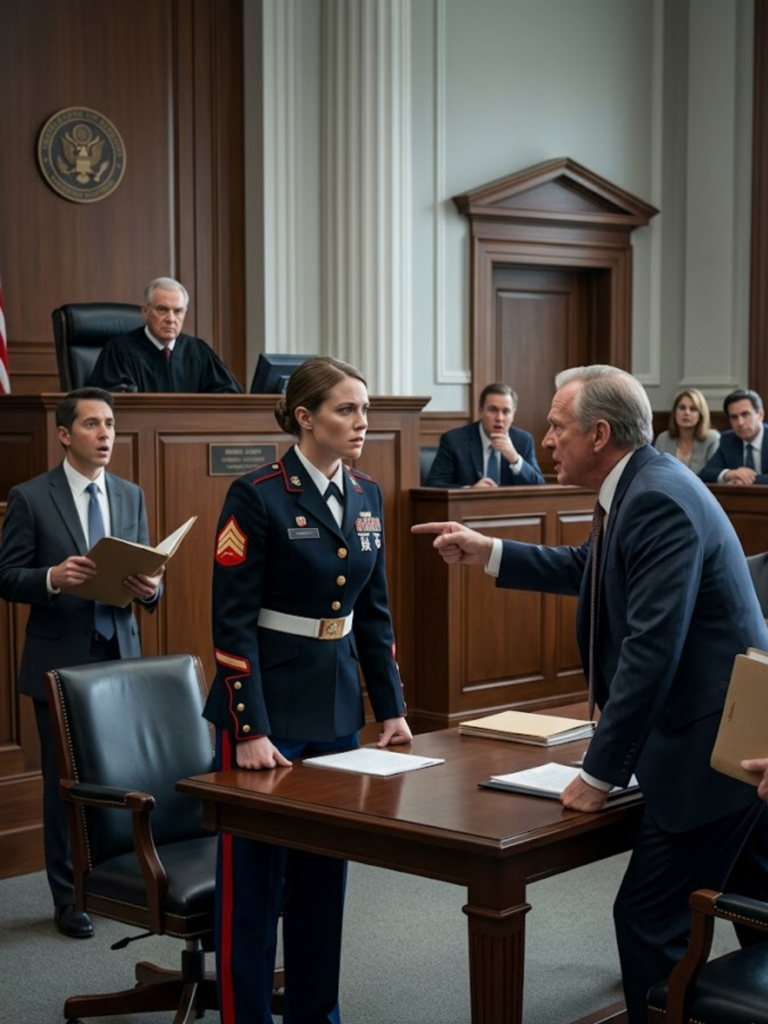
The hearing began on a rainy Monday morning in Washington, D.C.
By then, my face had appeared on cable news often enough that strangers stared at me in hotel elevators. The forgotten Morgan granddaughter. The Marine heiress. The woman challenging America’s most powerful military family. The media loved neat labels. Real life felt uglier and less convenient.
I stood outside the federal courthouse in my dress uniform while reporters shouted questions from behind barricades.
“Captain Carter, did General Morgan secretly support you for years?”
“Are you planning to sue the Morgan family?”
“Do you believe your father was murdered?”
Flashes exploded. Microphones pushed forward. I ignored all of it and walked inside beside Walter Brenner and my American attorney, Linda Carver, a sharp-eyed woman in her sixties who spoke as if every word had passed through legal review before leaving her mouth.
“You’re doing well,” she said while we waited at security.
“I feel like I’m going to throw up.”
“That means you still understand consequences. Good.”
Richard was already seated when we entered the courtroom, surrounded by three attorneys and two aides. For the first time since I had met him, he looked tired. Not weak. But worn down. The past few weeks had damaged him. Financial journalists were investigating Morgan Strategic Systems. Veterans groups were demanding answers about old defense contracts. Political allies had stopped returning calls. The family that once controlled rooms now looked defensive everywhere it appeared.
Richard glanced at me.
There was hatred in his eyes.
And fear.
The hearing began with estate law. Competency. Jurisdiction. Swiss trusts. American probate. Asset transfers. Letters of intent. Medical records. For hours, lawyers argued over documents complicated enough to make my head ache. I sat quietly, listening to strangers discuss my life like it was a business transaction.