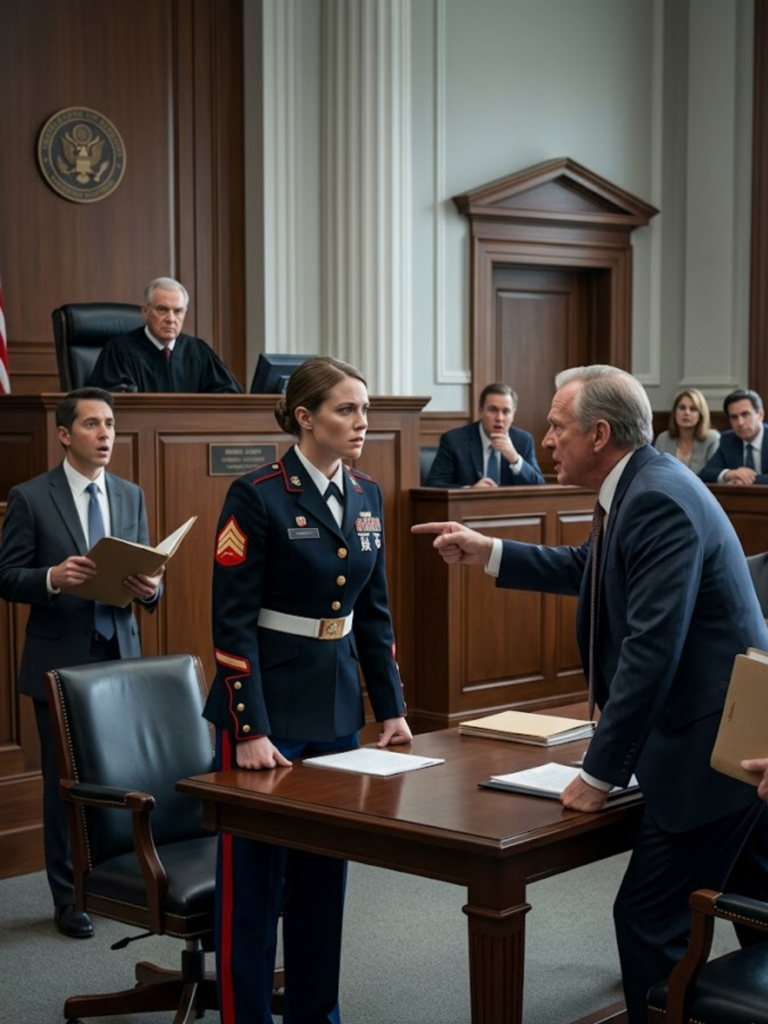
I was standing in a federal courtroom in Washington, D.C., wearing my Marine dress blues, when my uncle pointed straight at me and called me a thief.
“That woman stole sixty million dollars from a dying old man,” Richard Morgan said.
The room went silent in a way I had only heard twice before in my life: once before a mortar round hit the far side of a supply yard in Helmand, and once in a hospital room when a doctor paused too long before telling my mother her cancer had spread.
Reporters lowered their pens. A woman in the back actually gasped. Even Judge Hollander leaned back in his chair and studied my uncle as if he had just decided the afternoon was going to take longer than expected.
Richard Morgan stood at the petitioner’s table in a tailored gray suit, his silver hair perfectly combed, his shoulders squared under the courtroom lights. He was sixty-eight years old, but wealth had preserved him in that polished, expensive way certain men manage when they spend their lives surrounded by people paid to smooth their edges. His cufflinks flashed when he pointed at me. His face carried the righteous fury of a man accustomed to being believed before evidence ever entered the room.
To everyone watching, he looked like the respectable son of an American military dynasty.
I looked like the scandal.
I remember smoothing my hands over the front of my dark blue Marine Corps dress coat just to keep them still. My heartbeat was so loud I could feel it in my throat. The medals on my chest suddenly felt heavier than they had that morning. I had spent twelve years in uniform, endured inspections, deployment briefs, command reviews, divorce proceedings, my mother’s oncology appointments, and the particular exhaustion of being the only woman in too many rooms that assumed I was there to take notes.
But nothing had prepared me for standing in open court while my father’s brother accused me of stealing from a grandfather I had not even known existed until three months earlier.
Richard’s voice sharpened.
“She is not a Morgan,” he snapped. “She never was.”
That was the moment I stopped being afraid of him.
Not because the words did not hurt. They did. They struck somewhere old and unarmored in me, a place shaped by childhood questions my mother never answered and by Father’s Day school projects I pretended not to care about. But beneath the sting, something steadier rose.
Because by then I knew what his family had done to my father.
I knew what they had done to my mother.
And I knew exactly how badly they had underestimated me.
Three months earlier, I had been stocking medical inventory at Camp Pendleton and worrying about whether my truck would survive another Southern California summer.
That was the whole shape of my life then. Logistics reports, supply chain issues, readiness spreadsheets, overdue bills, bad coffee, and a 2009 Ford Ranger with an air conditioner that worked only when the temperature was under eighty degrees, which in Oceanside felt like an insult from the machine itself.
My name is Emily Carter. At the time, I was thirty-two years old, a Marine Corps logistics officer, divorced, tired more often than I admitted, and still paying off debt from helping my mother through three rounds of cancer treatment. My life was not tragic. It was not glamorous either. It was a life built out of duty and small repairs. I lived in a rental duplex with thin walls and a lemon tree in the yard that produced more leaves than fruit. Most nights, I came home from base, microwaved leftovers, answered emails I should have ignored until morning, and fell asleep in front of old reruns because silence felt too large.
No one who saw me in those days would have imagined I was connected to one of the wealthiest military families in America.
I would not have believed it myself.
The call came on a Tuesday afternoon.
I was in a storage bay doing a physical count of medical inventory that refused to match the digital system because Marines can maintain aircraft in combat zones but apparently cannot always scan gauze correctly. My phone buzzed against the metal shelf beside me. International number.
I almost let it go to voicemail.
Something made me answer.
“Captain Emily Carter?”
The man’s voice was polished, careful, European in the way Americans imagine all expensive legal trouble sounds.
“This is Captain Carter.”
“My name is Walter Brenner. I am calling from Keller and Vogel International Legal Services in Zurich, Switzerland.”
I actually laughed a little. Not loudly. Just enough that Staff Sergeant Lewis, who was carrying a crate of field dressings nearby, glanced over.
“I think you’ve got the wrong number,” I said.
“No, ma’am. I am looking for the granddaughter of General Arthur Morgan.”
That name hit me like cold water.
Even ordinary Americans knew who Arthur Morgan was. Decorated combat commander. Defense consultant. Cable news military analyst. Author of two memoirs about service and sacrifice. One of those old men who appeared in patriotic documentaries while flags moved in slow motion behind him and senators quoted him at hearings. He had died two weeks earlier. I remembered seeing a headline on a television screen in the chow hall.
My mother hated him.
That was about all I knew.
“Sir,” I said carefully, “there’s been a mistake.”
There was a pause. Not uncertain. Measured.
“Your grandfather, General Arthur Morgan, left you sixty million dollars.”
I leaned against the supply cabinet because my knees suddenly did not feel reliable.
Around me, Marines kept moving crates, checking lists, arguing about pallet labels. The world continued behaving as if it had not just split open.
“You have the wrong person,” I said.
“I do not.”
“My father’s name was Jonathan Carter.”
“No,” Walter Brenner said softly. “Your father’s name was Captain Jonathan Morgan.”
The storage bay seemed to tilt.
For thirty-two years, my mother had told me my father left before I was old enough to remember him. She said he was brilliant, reckless, and selfish. She said some men love the idea of family better than the daily work of staying. When I was little, I imagined him as a shadowy figure driving away in a truck. When I was older, I stopped imagining him at all. My mother’s silence made questions feel disloyal, so I learned not to ask them unless I wanted to see pain move across her face.
Now a stranger in Zurich was telling me my father had a different name.
“Captain Carter,” Walter said, “fly to Zurich. Say your father’s name. Do not ask questions by phone.”
Then he hung up.
Just like that.
No explanation. No reassurance. No sales pitch.
I stared at the phone until Staff Sergeant Lewis came back around the shelving unit.
“You okay, ma’am?”
“Yeah,” I lied. “Weird phone call.”
That night, I drove to see my mother.
She lived in a small assisted-living apartment outside San Diego, the kind of place that tried hard to look cheerful with framed watercolor prints and seasonal wreaths on every door. The building always smelled faintly of coffee, old paperbacks, and antiseptic. My mother, Claire Carter, sat near the window in her recliner with a knitting project in her lap, though her fingers had become too stiff to knit for long. Her hair had grown back after chemo thinner than before, silver at the temples, still pinned the way she had worn it when I was a child.
She smiled when I walked in.
“You’re early.”
“I got a call today.”
Her needles moved once more, then stopped.
“From who?”
“A lawyer in Switzerland.”
Her hands froze completely.
I noticed that immediately.
“Emily,” she said, and my name came out like warning.
“He said he represented Arthur Morgan’s estate.”
My mother’s face hardened in a way I had not seen since I was a teenager and asked too directly why there were no photographs of my father in the house.
“That family has nothing to do with us.”
“Then why did he say Arthur Morgan was my grandfather?”
The room changed.
It did not become louder. It became smaller.
My mother looked toward the window. Outside, an old man in a navy cardigan walked slowly through the courtyard with a caregiver at his elbow.
“You are not going to Zurich,” she said.
“That is not an answer.”
“You are not going.”
“Why?”
“Because those people ruin lives.”
I sat across from her. “All my life, you told me my father abandoned us.”
“That is what I believed was safest.”
“Safest?” My voice sharpened before I could stop it. “Not true. Safest.”
Her eyes filled, but she did not cry. My mother was not an easy crier. She had survived single motherhood, medical debt, late shifts at a hospital billing office, and cancer with a kind of stubborn dryness that made tears feel like something she allowed only under medical supervision.
“What did the lawyer say?” she asked.
“He said Arthur Morgan left me sixty million dollars.”
She went pale.
Not surprised.
Afraid.
That frightened me more than the number.
“Mom,” I said slowly, “what did they do?”
She closed her eyes.
“I tried to keep you away.”
“From what?”
“From all of it.”
“That is still not an answer.”
“No,” she whispered. “It isn’t.”
The conversation ended with both of us angry and neither of us satisfied. She told me again not to go. I told her I was done living inside explanations that did not explain anything. She turned her face toward the window and said, “You have his stubbornness,” in a voice that did not sound like an insult or a compliment, but an old wound reopening.
I left around nine and drove home through coastal fog so thick the headlights seemed to push through cloth.
Two days later, my half-brother Daniel showed up at my duplex uninvited.
Daniel came from my mother’s second marriage, the one that lasted eight years and produced the closest thing I had to a sibling. He was ten years older than me, owned luxury car dealerships in Arizona, and wore expensive watches even to casual lunches. He loved me, in his way, but his way often came wrapped in condescension and a credit score.
He walked into my duplex, glanced at my thrift-store coffee table, the stacked bills on my counter, and the laundry basket by the hall, then said, “So this is where America’s newest millionaire lives.”
I crossed my arms. “Mom told you.”
“Mom called me crying. That usually requires investigation.”
“She had thirty-two years to tell me the truth.”
Daniel sighed like I was a dealership customer rejecting a reasonable warranty package. “Emily, you’re chasing some fantasy because an old rich guy died.”
I handed him the business card Walter Brenner had emailed me after the call.
Daniel looked at it.
His expression changed slightly.
“That’s real,” he admitted.
“I checked too.”
He handed it back. “That doesn’t mean you should go.”
“Why not?”
“Because rich families like that don’t suddenly hand money to strangers.”
“I’m not a stranger if he was my grandfather.”
Daniel laughed bitterly. “You really believe that?”
That irritated me more than I expected. “You know what, Daniel? Some people don’t spend their whole lives measuring worth by money.”
“And some people,” he snapped, “don’t know when they’re being manipulated.”
The argument went in circles until he left. Afterward, I sat on the living room floor beside an old wooden box my mother had given me when she first got sick. She said it held things from before. I had never looked too closely because I thought before meant pain she was finally ready to set down. Now I opened it with hands that did not feel like mine.
Inside were newspaper clippings, old photographs, military patches, and one torn picture of my mother standing beside a Marine officer whose face had been ripped away.
As a child, I thought she destroyed the photograph because she hated him.
Now I wondered if she had done it because she feared someone would recognize him.
Three days later, I requested emergency leave.
The following Sunday, I boarded a flight to Switzerland carrying one duffel bag, my dress uniform, my father’s torn photograph, and more questions than I knew how to hold.
As the plane lifted over the California coast, I looked down at the fading shoreline and had the strange feeling that the woman leaving America would not be the same one coming back.
The bank in Zurich did not look like a bank.
After an eleven-hour flight and a sleepless connection, I expected marble columns, gold lettering, maybe guards standing outside in the theatrical way wealth likes to display secrecy. Instead, the building sat quietly on a narrow street near Lake Zurich, tucked between a watchmaker’s shop and a boutique displaying handbags that looked too expensive to contain practical items. No large sign. No flag. Just gray stone, dark windows, and a brass plate beside the door with three initials engraved so small a person had to step close to read them.
It looked less like a financial institution and more like a place powerful people went when they did not want to be seen arriving.
Inside, the lobby was silent except for soft piano music. Everything smelled faintly of leather, polished wood, and old money. Men in tailored suits moved quietly through hallways carrying paper folders instead of laptops. A young receptionist greeted me in flawless English.
“May I help you?”
Suddenly, I felt ridiculous. I had crossed an ocean on the word of a stranger. I stood there jet-lagged, wrinkled, holding a Marine duffel bag, wearing civilian clothes that had been slept in over the Atlantic, trying to claim a connection to a dead general whose family probably owned rooms like this by habit.
“I’m here to meet Walter Brenner.”
She typed. “Do you have an appointment?”
“I believe so.”
“Your name?”
“Emily Carter.”
She typed again. Her smile became sympathetic.
“I’m sorry. I do not see an appointment.”
Of course not.
For one second, I nearly turned around.
Then I remembered Walter’s instruction.
My voice came out quieter than I intended.
“My father’s name was Captain Jonathan Morgan.”
Everything changed.
The receptionist froze.
Not confusion.
Recognition.
She stood so abruptly her chair rolled backward.
“One moment, please.”
Within thirty seconds, two older men in dark suits appeared from a hallway. One approached me carefully, almost respectfully.
“Miss Carter?”
“Yes.”
“Please come with us.”
No more questions. No appointment issue. No sympathetic smile.
They escorted me to a private elevator that required a key card and fingerprint scan. As the doors closed, I caught my reflection in the mirrored walls: thirty-two-year-old Marine officer from Oceanside, hair pulled into a practical bun, dark circles under my eyes, boots worn by base life, face pale from too little sleep and too much revelation.
I did not belong in that place.
But the elevator kept rising anyway.
Walter Brenner met me on an entire private floor overlooking Lake Zurich. He was in his mid-seventies, thin, with white hair, wire-rimmed glasses, and blue eyes that had the gentle weariness of someone who had spent his life keeping other people’s secrets and knew exactly what they cost.
“Captain Emily Carter,” he said, extending his hand. “Thank you for coming.”
“You really knew my grandfather?”
“For over forty years.”
He led me into a conference room with floor-to-ceiling windows overlooking the lake. Coffee arrived immediately in porcelain cups so delicate I held mine with both hands. Walter opened a thick folder, then studied me in silence.
“You resemble your father more than I expected,” he said.
That sentence hurt more than the inheritance.
No one had ever told me I resembled my father because no one talked about him long enough to compare.
“What really happened to him?” I asked.
Walter folded his hands.
“Your mother told you he abandoned the family.”
“Yes.”
“That was not true.”
I kept my face steady because the Marine Corps had taught me how to remain still while absorbing impact. Inside, something began cracking open.
“Captain Jonathan Morgan served in Marine intelligence during the 1990s,” Walter said. “Officially, he died during a classified overseas operation.”
“Officially.”
“Yes.”
“What does that mean?”
“It means there was never a body.”
The room went very quiet.
“My mother knew?”
“I believe your mother knew enough to be afraid and not enough to feel safe.”
“Safe from who?”
Walter’s jaw tightened.
“Possibly members of Jonathan’s own family.”
I laughed once under my breath. Not because it was funny. Because it sounded impossible. But then again, four days earlier I believed I had no grandfather.
Walter slid several photographs across the table.
The first showed General Arthur Morgan standing beside a young Marine officer in desert utilities. The officer was tall, dark-haired, serious, with my eyes, my jawline, and the same unsmiling expression I had seen in every military ID photo I had ever taken.