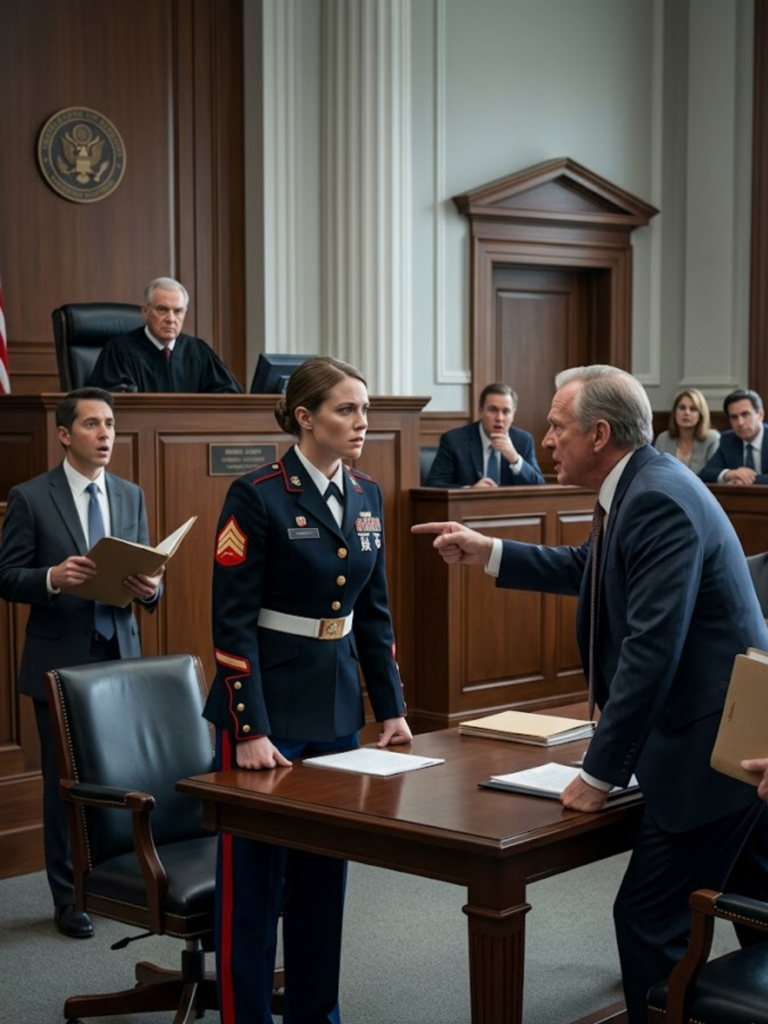
Then Richard’s attorney called me to testify.
I walked to the witness stand with the controlled posture I used during inspections.
Calm breathing.
Steady hands.
Never show weakness publicly.
“Captain Carter,” the attorney began smoothly, “before last month, you had never met General Morgan personally, correct?”
“Correct.”
“And yet you expect this court to believe he left you the majority of his estate.”
“I did not ask for it.”
“But you accepted it.”
“I accepted the truth.”
Reporters looked up.
His smile tightened. “Isn’t it true you were experiencing financial hardship before learning of this inheritance?”
“Yes.”
“So this money would dramatically improve your life.”
“That is generally how sixty million dollars works.”
A few quiet laughs moved through the courtroom.
The attorney’s smile disappeared.
“You claim General Morgan admired your military service.”
“I don’t claim it. His letters say it. Those letters were verified.”
He shifted.
“Captain Carter, are you aware your father was investigated for misconduct before his disappearance?”
Linda stood. “Objection.”
Judge Hollander allowed limited questioning.
The attorney turned back to me. “Answer the question.”
“Yes,” I said. “I am also aware those accusations conveniently protected several defense contractors connected to the Morgan family.”
The courtroom went quiet.
Richard stared at me.
The attorney’s voice sharpened. “You are suggesting a conspiracy involving respected military and business leaders.”
“No, sir,” I said. “I am suggesting greed.”
That landed harder.
People understand greed.
Even judges and polished lawyers understand greed.
Colonel Harris testified that afternoon.
Richard’s attorneys underestimated him because he was old. That was a mistake. He sat straight in the witness chair and spoke plainly, calmly, like a man too old to be intimidated by expensive suits. He described fraudulent military contracts, missing equipment, internal complaints, delayed investigations, and the destruction of Jonathan Morgan’s reputation after he attempted to report corruption through official channels.
Then he looked toward Richard.
“I watched good Marines bury your family’s lies for thirty years.”
Richard’s face drained of color.
Outside the courthouse, reporters erupted into chaos. Questions flew from every direction. I answered none of them.
Because something had begun changing in me during the hearing.
Watching Richard sit there, pale and exhausted, I saw him differently. Not as a towering villain. Not as the dark center of every stolen year. He looked haunted. Cornered. Human in the worst possible way.
And for the first time since Zurich, revenge no longer felt satisfying.
It felt heavy.
I won the case three weeks before Christmas.
There was no dramatic applause. No music swelling like a movie. Just Judge Hollander removing his glasses and speaking calmly.
“The court upholds the validity of General Arthur Morgan’s final will and testament.”
That was it.
Sixty million dollars. Multiple properties. Trust accounts. Investment holdings. Control of family assets Richard had expected to inherit.
The Morgan legacy, at least the part Arthur still controlled, now legally belonged to me.
Reporters rushed out to break the news. Attorneys shook hands. Linda Carver squeezed my shoulder.
“You did well,” she said.
“Did I?”
She studied me. “That depends on what you wanted.”
I did not know anymore.
Outside the courthouse, microphones crowded the barricade despite freezing rain.
“Captain Carter, are you taking over Morgan Industries?”
“Will you pursue criminal investigations?”
“Do you intend to dismantle the Morgan empire?”
For the first time, I stopped walking and answered.
“My father believed service mattered more than profit,” I said. “That is all I am interested in honoring.”
Then I left.
No speech. No revenge performance. Just exhaustion.
Back at the Virginia estate, silence filled the rooms. Most staff had been dismissed during the legal battle. The mansion felt less like a seat of power now and more like a museum dedicated to loneliness. I wandered to the library and picked up the photograph of my father holding me as a baby.
For thirty-two years, I believed he abandoned me.
Then I believed the Morgan family destroyed him.
Now, after testimony and records and private journals, the truth had become more complicated. Jonathan Morgan tried to expose corruption. Richard and others protected the family empire. Cowardice ruined everything. But cowardice and murder are not always the same thing.
That distinction mattered.
Late that evening, Walter Brenner entered the library carrying two glasses and a bottle of bourbon.
“You should sleep,” he said.
“I don’t think I can.”
He handed me a drink. “You resemble your grandfather tonight.”
“That is not comforting.”
“No,” he said. “It rarely was.”
We sat by the fire in silence.
Finally, I asked, “Did Arthur love my father?”
“Yes.”
“Then why didn’t he stop any of this?”
Walter stared into the fire. “Because powerful men often confuse control with wisdom.”
I thought about that for a long time.
My grandfather had spent his life commanding soldiers, influencing politicians, building wealth, and shaping national conversations about honor. Yet he failed at the one thing that mattered most: protecting his own family when truth became inconvenient.
The next morning, I asked Walter to arrange a private meeting with Richard.
He looked concerned. “Emily, are you sure?”
“No. But I need to hear it from him.”
Richard was staying at a private medical residence outside Georgetown after what newspapers politely called exhaustion. When I entered his room, he looked twenty years older than he had in court. Gone was the polished executive from television. He was simply an aging man sitting beside a window, watching winter rain.
“You came,” he said quietly.
“Yes.”
He nodded toward a chair.
For several moments, neither of us spoke.
Finally, I asked, “Did you kill my father?”
Richard closed his eyes.
“No.”
I believed him.
Not because he was honorable.
Because he sounded ashamed.
“What happened?”
He stared out the window. “Jonathan threatened to expose the contracts.”
“Yes.”
“There were senators involved. Contractors. Military officials. Too much money. Too many reputations.”
“And you protected them.”
“We protected the family.”
“At the cost of his life?”
Richard swallowed. “We thought they would discredit him. Remove him from operations. Quiet him. We never believed he would disappear.”
The room went silent except for rain against glass.
“You abandoned him,” I said.
Richard nodded once.
“Yes.”
No excuse. No manipulation. Just truth.
Then, to my surprise, the old man began to cry. Silent tears. Exhausted tears. Tears from a man who had spent three decades mistaking pride for structure until it finally collapsed on top of him.
“Your grandfather hated himself for it,” he whispered. “He spent thirty years trying to buy forgiveness.”
That sentence explained everything.
The inheritance. The journals. The private investigation. The will.
None of it was really about money.
It was guilt, generational guilt wrapped inside wealth, patriotism, and late-stage regret.
“I know you hate me,” Richard said.
I thought carefully before answering.
“No,” I said. “I think you’re weak.”
That hurt him more than yelling would have.
Before leaving, I stopped near the door.
“One thing I don’t understand. Why leave everything to me?”
Richard looked up. His tired eyes softened slightly.
“Because you became the person this family pretended to be.”
I drove away from Georgetown through slow evening traffic feeling strangely lighter. Not healed. Not peaceful. But clearer.
For months, revenge had fueled me forward. Now I understood something older people probably learn if life gives them enough pain and enough time: most revenge ends with sadness because no victory can return the years stolen from you.
A week later, Daniel came to the estate.
For once, he arrived without expensive confidence or sarcastic jokes. He stood in the doorway of Arthur Morgan’s library looking uncomfortable in a room designed to impress men like him.
“I owe you an apology,” he said.
I raised an eyebrow. “That’s new.”
“I was jealous.”
“Of what?”
“You,” he said, and gave a weak laugh. “You spent your life actually serving people. I spent mine chasing money and calling it success. Then you inherited more than I could imagine and still looked miserable because you understood what it cost.”
I did not know what to say.
He continued, “Mom gave me letters.”
My breath stopped.
“From my father?”
He nodded. “She had more than the ones I gave you at court. She kept them hidden because she was terrified the Morgans would take you. She thought if you knew he loved you, you’d go looking for him. And if you went looking, they’d find you.”
Anger moved through me again, but weaker this time. Tired anger. Grief wearing an old uniform.
“She let me believe he abandoned me.”
“I know.”
“Did she read them?”
Daniel looked down. “Some.”
That hurt.
But I was beginning to understand that fear can make people commit smaller betrayals in the name of preventing larger ones. It does not make the betrayal harmless. It only makes the person harder to hate.
I visited my mother in San Diego in January.
She looked smaller than when I had left for Zurich. Illness had returned lines to her face, but guilt had done more damage than cancer. She sat by the window, knitting untouched in her lap, and when I entered, she began crying before I said a word.
“I’m sorry,” she whispered.
I stood near the door, suddenly twelve years old again, wanting answers and afraid of hurting her by asking.
“Why didn’t you tell me he loved me?”
She covered her mouth.
“I thought if you knew, you would want them.”
“I did want them. I wanted my father.”
“I know.”
“Mom.”
She looked at me.
“Did you keep the letters from me because you were scared or because it was easier?”
The question landed hard.
She closed her eyes.
“Both.”
At least it was true.
She told me what she could. Jonathan had written after his disappearance began, from safe houses, from military contacts, from places she could not pronounce. At first, she believed he would return. Then letters arrived less often. Then warnings came. Men outside the apartment. A call from someone who knew where I went to daycare. A message telling her that if she wanted her daughter safe, she would stop asking questions. She tore photographs. Moved twice. Changed my last name legally to Carter. Married Daniel’s father partly because stability looked like camouflage.
“By the time the danger faded,” she said, “the lie had become your life. I did not know how to hand you the truth without destroying what I had built to protect you.”
I sat beside her.
“You destroyed it anyway.”
She nodded.
“I know.”
For a long time, we cried quietly together.
I did not forgive her that day. Not fully. Forgiveness is too often demanded as immediate payment for confession. But I held her hand. That was what I could give.
The sixty million dollars settled into my control by spring.
I did not buy a yacht. I did not move into the Virginia estate. I did not become the kind of woman who suddenly pronounced house staff normal. I sold two properties, kept one small farmhouse near Quantico that had belonged to my father briefly before his disappearance, and placed most of the estate into a trust.
The Jonathan Morgan Service Foundation began with three purposes: legal aid for military whistleblowers, emergency support for families of service members harmed by contractor fraud or institutional retaliation, and scholarships for children of Marines who died under classified or disputed circumstances and were left with too many unanswered questions.
Walter helped structure it. Linda Carver built the legal framework. Colonel Harris joined the advisory board. Daniel surprised me by donating the proceeds from the sale of one of his dealerships, saying only, “I am trying to become useful before I become old.”
The first scholarship recipient was a nineteen-year-old woman named Talia Ruiz whose father died in a training accident that took seven years to investigate properly. At the ceremony, she shook my hand and said, “People stopped returning my mom’s calls. Your foundation didn’t.”
I had to step outside afterward because I could not breathe.
That was when I understood what my father had been trying to protect.
Not money.
Not reputation.
People who get crushed when institutions choose comfort over truth.
I remained in the Marine Corps for another year, then transferred into the reserves and began working full-time with the foundation. Leaving active duty was harder than I expected. The Corps had given me structure when my life had none, purpose when anger might have swallowed me, and a family more honest in its flaws than the bloodline I inherited. On my last day at Camp Pendleton, Staff Sergeant Lewis handed me a small plaque that said, “Unpleasant Before Breakfast.”
I laughed so hard I cried.
Richard Morgan died two years after the court case.
He left me a letter.
Emily,
I will not ask for forgiveness. Men like me ask for too much and give it noble names.
You were right. I was weak.
Your father was better than I deserved as a brother. You are better than I deserved as a niece.
If there is any mercy left in the Morgan name, it will come through what you build, not what we preserved.
Richard
I read it once, then placed it in the foundation archive beside Arthur’s journals and Jonathan’s letters. Not because Richard deserved honor. Because records matter. Because the truth, even late and insufficient, belongs somewhere.
My mother lived long enough to visit the foundation office.
She walked slowly with a cane through the lobby where my father’s photograph hung beside a simple brass plaque: Captain Jonathan Morgan, United States Marine Corps. Service Before Profit. Truth Before Comfort.
She stood before it for a long time.
“He looked so happy holding you,” she whispered.
“I know.”
“I should have let you know that sooner.”
“Yes.”
She nodded, tears in her eyes.
“I am proud of you, Emily.”
That sentence, from her, in that room, did not fix my childhood.
But it entered the record.
She died the following winter with me beside her, Daniel on the other side, and one of Jonathan’s letters folded beneath her hand. In the end, she asked me to bury her under the name Claire Carter, not Morgan, not anything borrowed from men who had frightened her.
I did.
I still think about that courtroom sometimes.
Richard pointing at me. Reporters lowering their pens. The judge leaning back. My hands smoothing my uniform. That sentence ringing out for everyone to hear.
“She’s not a Morgan. She never was.”
He meant it as erasure.
It became liberation.
Because he was right in the only way that mattered. I was not a Morgan in the way Richard understood the name. I did not worship legacy. I did not confuse loyalty with silence. I did not believe money could launder cowardice into honor. I had not grown up inside their mansions learning how to protect the family story at any cost.
I grew up with a frightened mother, missing letters, medical bills, base housing, cheap dinners, and a uniform I had to earn every day.
I became a Marine.
I became my father’s daughter.
And maybe that is why Arthur chose me.
Not because I was the last Morgan.
Because I was the first one in a long time who knew the difference between inheritance and duty.
My name is Emily Carter. I stood in a federal courtroom while my uncle called me a thief and told the world I did not belong to his family. He was right about one thing.
I did not belong to the lie.
I belonged to the truth my father died trying to tell.
And once I finally had the power to choose what to do with sixty million dollars of guilt, I did the only thing that felt worthy of the uniform on my back.
I turned it into service.
THE END
✅ End of story — Part 3 of 3
← Read from Part 1