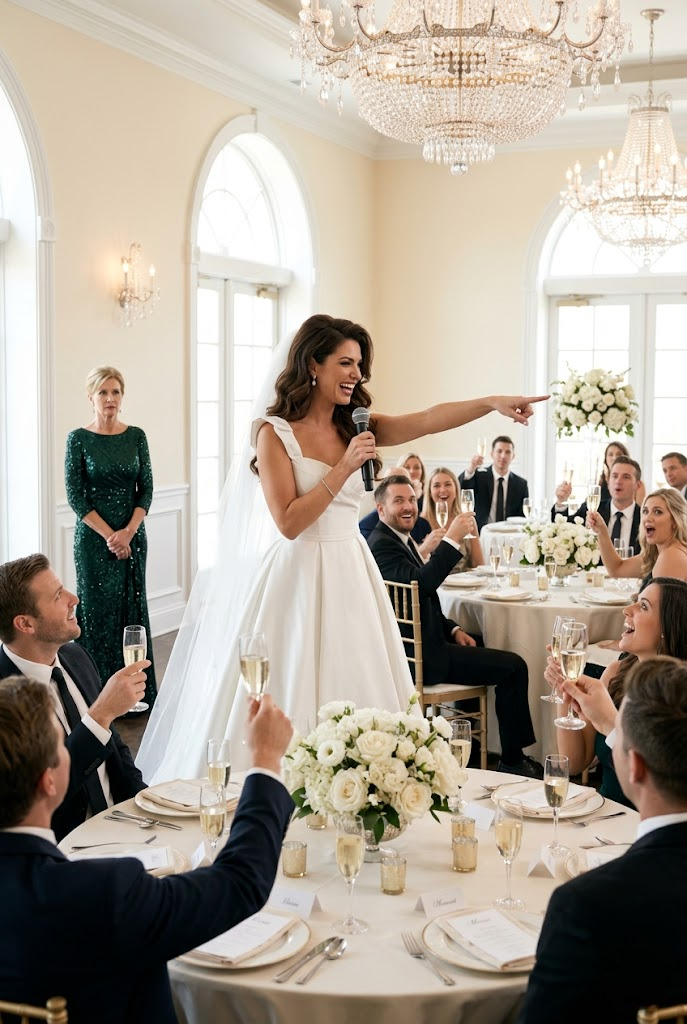
“We’re thinking next spring. Mom…” He paused, and I could picture him rubbing the back of his neck the way he always did. “Look, I know weddings are expensive. Meline’s always dreamed of something, you know, elegant. Like her sister’s wedding at the Beaumont? Remember that hotel I told you about, with the rooftop garden?”
“The one with the glass dance floor?” I said dryly. “Hard to forget.”
He chuckled, but it faded quickly. “Yeah, that one. Anyway, their packages are… they’re not exactly cheap.
And we want to invite everyone. Mom, I… we were wondering how much you might be able to help.”
There it was.
“How much help are you hoping for?” I asked, keeping my tone gentle, neutral.
He hesitated. I could almost hear him doing the math in his head. “Maybe… I mean, if it’s possible… two hundred thousand?” he said, the number tumbling out in a rush. “Maybe three, if that’s not… insane.”
Silence rang louder than any shout. I let it stretch for a moment, staring at the closed blinds across the room. Two hundred thousand dollars. Three.
I thought of all the nights I’d worked double shifts, of the way I’d scraped together college tuition when his scholarships fell a few thousand short. I thought of my modest retirement account, of the carefully planned investments I’d nurtured over decades. I thought of the fact that Mark had never gotten to walk Andrew down an aisle, and how I had promised myself that when the day came, I would do everything I could to make it beautiful for him.
“Mom?” Andrew said, his voice tightening. “Are you still there?”
“Yes,” I replied. “I’m here.”
I could have said no. I could have insisted on something smaller, something within the bounds of sanity. I could have told him that love is not measured in the height of a cake or the thread count of tablecloths. But love, especially maternal love, has a way of making generosity feel like breathing. You do it instinctively, without counting the cost, until one day you realize you’re light-headed from giving away too much air.
“All right,” I said softly. “I’ll help.”
Relief flooded his voice like a dam breaking. “Mom, thank you. You have no idea—”
“I have some idea,” I said, and he laughed, the boy in him surfacing for a moment. “We’ll sit down and go over the numbers. I want to see the contracts. If I’m paying for it, I need to know what I’m signing.”
“Of course,” he said quickly. “You’re the best. Really, Mom. I promise this will be worth it. You’ll be proud of us.”
I thought I already was. But I kept that to myself.
I did not know then that my yes would be the seed of a night where I would stand under crystal chandeliers and listen to people laugh at me.
On the morning of the wedding, the city woke gentle and bright. Chicago sunlight spilled across my balcony like unrolled gold leaf, coating the small potted plants in a honeyed glow. I stood in front of my bedroom mirror, fastening the pearl clasp behind my neck. For a moment, my fingers struggled with the tiny hook, my knuckles stiff with age. I took a slow breath and tried again, letting muscle memory guide me.
In the reflection, an older woman looked back—not the plump young mother with tired eyes who’d chased a six-year-old through playgrounds, but someone with silver threading through her hair and the faint map of years etched at the corners of her eyes and mouth. There was softness there, yes, but there was also something solid. Survival leaves its own kind of beauty, if you know how to look.
At the cathedral, the stone steps rose in elegant curves, flanked by trimmed hedges dusted with the last frost of early spring. Guests moved up the stairs in clusters, the women’s dresses flashing color beneath coats, the men adjusting ties and glancing at their phones. Inside, sunlight streamed through stained glass, painting the pews in pools of blues and reds.
Andrew met me near the front, in a small side room where the priest kept his vestments. He stood before a long mirror, fumbling with his bow tie, his fingers clumsy.
“Come here,” I said, smiling, and crossed the room.
He turned, relief flooding his features. “Mom. Thank God. I can’t get this thing to cooperate.”
I swatted his hands gently away and took over, the motions familiar. They were not so different from tying his shoelaces when he was five, his tiny foot wiggling in my hand. I could still remember his small fingers clutching my shoulder for balance.
“Thank you for everything,” he murmured, his eyes fixed on my hands. “For this. For the wedding. For… all of it.”
His eyes flickered upward briefly, then away, as if the weight of those words embarrassed him.
“You’re welcome,” I said simply.
The ceremony was flawless. Meline floated down the aisle on her father’s arm, her dress a swirl of white satin and lace, the train trailing behind her like a small, obedient cloud. The string quartet played something ethereal; people turned in their seats, whispering at how beautiful she looked. Andrew’s eyes shone with unshed tears as he watched her approach. I dabbed at my own eyes behind a lace handkerchief, emotion swelling tight in my throat.
For a while, sitting in that wooden pew with sunlight warming my hands, I allowed myself to believe that everything would be all right. They said their vows with trembling voices, slipped rings onto each other’s fingers, sealed it all with a kiss that made the younger guests cheer.
At the door of the cathedral afterward, as people filed out to line up for photos, I hugged my son.
“Be good to each other,” I whispered into his shoulder.
“We will,” he replied. I wanted to believe him.
The reception hall at the Beaumont gleamed like something out of a glossy magazine. Staff moved with the choreographed precision of dancers, carrying trays of champagne and hors d’oeuvres, their black uniforms crisp against the gold and cream décor. A massive floral installation hung over the dance floor, roses and hydrangeas and greenery cascading like a captured garden.
I wandered among the guests, accepting compliments on how beautiful everything was, how generous I’d been, how lucky Andrew was.
“You must be so proud,” an aunt from Mark’s side said, her hand warm on my arm.
“I am,” I replied. “He’s worked hard.”
She nodded, though I could tell she thought this wedding had very little to do with work and everything to do with the Coopers’ money. People believed what they wanted to believe.
It wasn’t until later that I learned how wrong they were about who had really paid for the spectacle.
The day after the wedding, when the flowers were already wilting in their vases and my feet were still sore from dancing, I opened an email from the chair of Cooper Holdings’ board. The subject line was simple: “Welcome.”
Fifteen years of work and patience had led me to that moment.
After Mark died, I’d started small—contracting with mid-sized companies that needed help untangling their finances. I had a knack for seeing patterns, for spotting waste and potential. Word spread quietly. A client recommended me to someone on the board of a shipping company; that contract led to an introduction to Cooper Holdings, a family-owned conglomerate that had grown lazy on its own success.
They brought me in as a consultant initially, someone to clean up inefficiencies and recommend restructuring. It didn’t take long to see the core problem: a sprawling network of relatives drawing inflated salaries and offering little in return. Departments run as personal fiefdoms. Talent leaving because there was no path upward past the family ceiling.
I delivered my report without sugarcoating it. I expected to be thanked politely and then ignored.
Instead, the board called me back.
“We need real change,” the chair told me, an older woman with sharp eyes and a dry sense of humor. “Gregory is… comfortable. Too comfortable. We’ve been thinking about our succession plan.”
“Succession?” I had raised an eyebrow.
“Yes. We can’t keep doing business as a family hobby. We need leadership that will protect this company for the next fifty years, not just the next holiday season. We want you to come on as COO. And… there are shares involved. Over time, if we all agree this is a good fit…”
I’d gone home that night with a folder of documents and a head full of possibilities. It wasn’t just about the salary, though it was generous. It was about leverage, about being in a position to make the kinds of changes I’d always urged from the outside. I reviewed the stock purchase options, the voting rights, the buy-in plan. I hired my own attorney to comb through every clause.
For fifteen years, I played the long game. I reinvested, acquired shares when prices dipped, built alliances within the company. I listened more than I spoke, made myself indispensable, and never confused proximity to power with having it. Slowly, quietly, the percentage of Cooper Holdings I owned ticked upward, unnoticed by a family too busy attending galas and planning beach vacations.
And then, three weeks before the wedding, the board convened one last time behind closed doors.
Half an hour into the meeting, the chair slid a single sheet of paper across the table toward me. “As of next Monday,” she said, “if you accept, you will own fifty-one percent of Cooper Holdings’ voting shares. And you will be our chief executive.”
I stared at the number, at the neat percentage and the signatures beneath it.
“You’re sure,” I said. It wasn’t really a question.
She smiled, a little. “We’re very sure. The question is, are you?”
I thought of Andrew and Meline. Of the way Gregory sometimes blinked in meetings when I spoke, as if startled that the woman his daughter’s future mother-in-law could string sentences together, much less strategies. Of all the employees who had stopped me in hallways to ask for five minutes of my time because I was the only one who listened.
“Yes,” I said. “I am.”
On Monday morning, one week after the wedding, Chicago woke under a sky the color of clean steel. The air had the crisp bite of early autumn, sharp enough to make you breathe deeper. I rose before the sun, showered, and pulled my hair back into a smooth twist. The pearls stayed in their box; today called for something different.
I chose a charcoal suit that fit my body like it had been made for it—which, in truth, it had. The tailor had been meticulous, pinning and adjusting until the jacket flowed neatly over my shoulders and the pants skimmed the tops of my shoes. When I looked in the mirror, I didn’t see someone playing dress-up in power. I saw someone who had earned it.
At nine o’clock sharp, I walked through the glass doors of Cooper Holdings’ headquarters. The lobby gleamed with polished stone and chrome accents, the kind of minimalist opulence that says We make more money in a month than you’ll see in a lifetime. A receptionist in a chic black dress looked up, her polite expression shifting into vague surprise.
“Good morning,” she said. “Can I help you?”
“Yes,” I replied, offering a small, professional smile. “I’m Ellenor Whitford. I’m here for the board meeting.”
Her eyes widened a fraction. “Of course, Ms. Whitford. They’re expecting you. The elevator to the twenty-fourth floor is on your right.”
As I crossed the lobby, a young man in a Cooper Holdings badge nearly ran into me, then stopped short. “Oh, sorry, ma’am,” he said, flustered. “I didn’t see you.”
“It happens,” I said, stepping aside.
But it wouldn’t happen much longer.
The boardroom was a glass-walled rectangle overlooking the city, its long table shining under recessed lights. Gregory was already there when I entered, standing by the window with his hands clasped behind his back. He turned at the sound of the door, his eyes flicking to my suit, my briefcase, the easy way I walked to the head of the table.
“Ms. Whitford,” he said, his voice strained. “Thank you for coming.”
“Of course,” I replied, setting down my case. “We have much to discuss.”
The other board members trickled in, exchanging greetings. The chair took her place, shuffled her papers, and the meeting officially began. We moved briskly through the initial agenda items, the formal approval of my appointment, the acknowledgment of the stock transfer that tipped the balance firmly into my hands.
When it was time to speak privately with Gregory, the others filtered out, leaving us alone in the vast room. The city hummed beyond the glass, cars threading through streets far below like bright insects.
“I wanted to clarify our respective positions,” I said, opening my leather portfolio. I slid a stack of documents across the table toward him. “These are the finalized figures. As of last Monday, I hold fifty-one percent of Cooper Holdings’ voting shares. That gives me controlling ownership.”
He stared down at the papers, his mouth parting slightly. “Fifty-one,” he repeated, as if saying it would alter the reality. “I thought… I didn’t realize you had acquired so much.”
“You were busy,” I said mildly. “And I was… practical.”
His throat worked. “What do you want?” he asked at last, the bravado slipping from his voice. It came out not as a challenge but as a plea.
“First,” I said, “I want to modernize employee benefits. Full health coverage for all staff, including mental health services. Improved retirement contributions. You have over three hundred employees who have kept this company functioning through lean years and crises. They deserve security, not scraps.”
His jaw tightened. “That will cost millions.”
“It will cost less than losing them,” I countered. “Turnover costs, recruitment, training… The math is very clear. We implement the new package by Thursday. I already have drafts prepared.”
He looked at me for a long moment, then nodded, the movement heavy. “All right,” he said quietly. “What else?”
“Internal salaries,” I said. “Currently, there are significant discrepancies tied to family membership rather than performance. That ends now. Compensation will be tied to role and contribution, not bloodline. Those who wish to keep their high salaries will need to justify them with actual work and measurable results.”
“You would remove my relatives?” he asked, a spark of defensiveness igniting.
“I would require them to earn their place,” I replied. “Some may rise to the challenge. Others may not. That will be up to them.”
The silence that followed was taut, stretched thin as wire. Gregory stared at his hands, then out the window, then back at me.
“And Andrew?” he asked finally, as if the question had been chewing at his insides. “Your son. Does he… join us?”
“Yes,” I said. “He starts Wednesday as a junior analyst.”
“A junior—”
“Everyone starts somewhere,” I interrupted. “He will have the same expectations as any other analyst. He will be required to attend training, meet his targets, and adhere to company policies. His marriage to your daughter does not grant him privileges here. If he succeeds, it will be because he has earned it.”
Gregory exhaled, a rough sound. “He will not be happy.”
“He will adapt,” I said. “Or he will not. That, too, is his choice.”
I gathered the documents, sliding them back into my portfolio. I could feel Gregory’s gaze on me, weighing, measuring, perhaps remembering his daughter’s words at the wedding.
“Please tell Meline,” I added as I stood, “that I expect a sincere apology. Not for my ego. For her own character. Accountability shapes people more than comfort ever will.”
He nodded slowly, something like shame flickering over his features. “I will speak with her,” he said.
“At some point,” I said, pausing at the door, “you may realize that what feels like punishment now is actually protection. For your employees. For your company. Even for your family. You may not think so today. But time has a way of clarifying things.”
Then I left, my heels ticking steadily against the polished floor.
Power, I was learning, did not thrill me the way it seemed to thrill others. It did not make me feel invincible. It made me feel… clear. Like standing at the top of a mountain and finally, after years of climbing in fog, seeing the whole landscape.
But clarity did not protect me from what came next.
It was a quiet Wednesday when Andrew knocked on my door. The sky outside had shifted to the muted grays of late afternoon, and I’d been reading over a stack of performance reports, red pen in hand. I recognized his knock immediately—three quick taps, then a pause.
When I opened the door, he stood in the hallway looking like someone who had slept badly for weeks. His hair was slightly disheveled, his eyes shadowed. He held a manila envelope tucked under one arm, his knuckles pale against the yellow paper.
“Hey, Mom,” he said.
“Come in,” I replied, stepping aside.
He sat at the dining table, the same one where we’d sorted scholarship forms years before. I poured coffee without asking and set a mug in front of him. He wrapped his hands around it but didn’t drink.
“Can we talk?” he asked.
“We are,” I said gently. “What’s wrong?”
He swallowed, his Adam’s apple bobbing. For a moment I saw him at eight years old, sitting at this same table, eyes brimming with tears because another boy had called him a name at school. Back then, he’d thrown himself into my arms and let me soothe him.
Now, he kept his shoulders stiff, as if bracing for impact.
“It’s about the job,” he began. “And… and some other things. I wanted to be honest with you before… before you found out from someone else.”
There is a particular kind of dread that curls cold fingers around a mother’s heart when her child says those words. I nodded, keeping my face neutral.
He slid the envelope across the table toward me. It made a faint scraping sound against the wood.
“What is it?” I asked.
“Just… just look,” he said, his voice raw.
I opened it. Inside were papers—bank statements, loan documents, credit card summaries. My name appeared on every page, printed neatly at the top.
But the signature at the bottom of each form was not mine.
My signature, after decades of signing checks and forms, ran in a steady, looping script. The signatures on these documents were close, but not quite. The loops were a little tight, the slant slightly wrong. To a banker skimming a stack of paperwork, it would look genuine. To me, it screamed its falseness from the page.
“Andrew,” I said slowly, forcing each word to be calm. “What am I looking at?”
He sucked in a breath, his shoulders sagging. “I… I forged your name,” he whispered. “On the loan applications. And some of the cards. I thought… I thought I’d be able to cover it before you ever knew. I just needed time.”
“How much time?” I asked.
His eyes filled with tears. “I don’t know. It… it got away from me.”
He began to talk then, the words spilling out in a jagged stream. Six months earlier, he’d been fired from his job for falsifying expense reports—padding them slightly at first, then more, convincing himself he’d pay it back. When his manager confronted him, he panicked, lied, then was caught in the lie. His dismissal had been quiet but firm, his references tarnished.
“I didn’t tell you,” he said miserably. “I didn’t want you to know I’d failed.”
He’d kept up appearances, dressing each morning as if going to work, spending hours in coffee shops sending out résumés that rarely led to interviews. Bills piled up. His lifestyle, inflated over the years by the salary he’d once had, became impossible to sustain. Rent, car payments, dinners with Meline and her friends who never seemed to consider the cost of a night out—it all added up.
“When her sister got married at the Beaumont,” he said, “I saw the way she looked at that wedding. The way she talked about it like it was the standard. I wanted to give her that. To give her the life she expected. I thought if I could just get through the wedding, get a better job after… We’d be fine.”