He had applied for loans in my name—small ones at first, then larger, spread across different banks and credit unions. He’d forged my signature, using copies of old forms I’d left in the file cabinet in his childhood bedroom closet. The lenders had looked at my credit score, saw years of consistent payments and stable accounts, and said yes.
The total amount owed glared up at me from the last page.
One hundred and twenty thousand dollars.
He watched me as if I were a bomb he’d just set down, not sure when or how it would detonate.
“I am so sorry, Mom,” he said, his voice cracking. “I didn’t mean for it to get this bad.
I thought I could fix it before you ever had to know. And then it just kept… growing. And when Cooper Holdings offered me the analyst job, I thought… finally. A way out.”
I sat very still, the papers in my hands.
“You told Meline,” I said quietly, “that I controlled you with money. That I used my financial support to keep you dependent on me. That I meddled in your decisions.”
He flinched. “She… she told you that?”
“No,” I said. “She didn’t have to. I’ve heard enough comments. I’ve seen the way you look at me when she complains about ‘helicopter parents.’ You spoke of me like a burden you had to escape.”
He squeezed his eyes shut, tears spilling down his cheeks. “I was ashamed,” he whispered. “I didn’t want her to know I needed you. It was easier to pretend you were the problem, not me.”
The truth settled in my chest like a stone dropped into deep water. It didn’t explode like the insult at the wedding had. It sank slowly, pulling at memories as it went—every time I’d written him a check to “help him through a rough patch,” every instance where I’d let him gloss over details, every conversation where I’d sensed something off and chosen to trust his reassurances.
“I did this to myself,” I realized aloud as much as to him. “I kept rescuing you. I kept stepping in. I taught you that you didn’t have to face the consequences of your choices because I would always break your fall.”
“I thought I could make it right,” he said, his words tumbling over each other. “With the new job, I can pay it back. I will pay it back. I swear, Mom, I’ll—”
“Yes,” I said, cutting him off gently but firmly. “You will.”
He looked up, startled.
“Tomorrow,” I continued, “we’ll go see my attorney. Together. We’ll disclose everything.
We’ll find out exactly what legal trouble you’re in and what can be done about it. You will take responsibility. You will sign whatever you need to sign to ensure that this debt is yours to pay back, not mine.”
His lip trembled. “Will you… forgive me?”
Forgiveness. The word hung between us, heavy and familiar. I had forgiven him minor sins his whole life—from the broken vase he’d blamed on the cat to the missed curfew he’d lied about in high school. Back then, forgiveness had always come wrapped in comfort—a hug, a soothing word, a promise that everything would be okay.
Now, I chose my next words carefully.
“Forgiveness,” I said, “is not the same as rescue. I love you. That does not change. But I will not protect you from the consequences of what you’ve done. That era is over.”
His breathing hitched. He reached across the table, but I did not take his hand.
For the first time in thirty-one years, I did not move to cushion his fall.
On Saturday, I set my dining table for three.
Old habits die hard. I ironed the tablecloth, polished the silverware, set out my good crystal glasses—the ones Mark’s parents had given us as a wedding gift, back when we were young and thought the future would be long and kind. I prepared a simple but elegant meal: roast chicken, rosemary potatoes, sautéed green beans, a salad with toasted almonds. The food warmed under linen covers on the sideboard, sending a comforting aroma through the apartment.
If the bones of my past were going to be broken, I decided they would be broken with dignity.
Andrew and Meline arrived right on time. He wore a crisp shirt but looked hollowed out around the eyes, as if sleep had been a stranger all week. She looked more fragile than I’d ever seen her—less polished, as if she’d rushed through her makeup, her hair pulled back in a hasty ponytail instead of the elaborate styles she favored. There was a tightness to her mouth, a wary flicker in her gaze.
“Thank you for having us,” she said politely as I let them in.
“Of course,” I replied. “Come, sit.”
The first fifteen minutes were filled with small talk. Weather. Work. A remark about the wedding gifts still needing to be organized. It felt like tiptoeing across a minefield while pretending to admire the scenery.
Halfway through the main course, I set my fork down. My hands were steady. My voice, when I spoke, was clear.
“Andrew,” I said. “We need to talk honestly.”
He froze, his fork midway to his mouth. He swallowed, then lowered it slowly.
“I know,” he said.
Meline’s eyes darted between us, alarmed. “Is this about—”
“Yes,” I said. “It’s about the loans. And it’s about the stories Andrew has told you about me.”
Her cheeks flushed. “He… he said you were upset about helping with the wedding. That you made him feel guilty for accepting your money. That you got involved in things that weren’t your business.”
I met Andrew’s gaze. “Did you tell her that I control you with money?” I asked. “That I meddle? That I use my support to keep you dependent?”
His shoulders sagged. “I… I might have said some things like that,” he admitted. “I was… embarrassed. I didn’t want Meline to know how much you were helping. It made me feel like less of a man. It was easier to act like you were pushing it on me, instead of admitting I asked.”
I nodded once. “Thank you for the honesty. At last.”
I turned to Meline.
“I have helped Andrew financially many times,” I said. “With tuition, with rent when he was between jobs, with the wedding. I did it because I love him. Because I wanted his life to be easier than mine was.”
She stared at me, her expression complicated. “He never… He always made it sound like you were interfering,” she said slowly. “That you insisted on being involved. That you didn’t trust him.”
“I didn’t trust him…” I let the sentence hang. “Because he gave me reasons not to. And now, with these forged loans, he has given me more.”
Her eyes widened, flicking to Andrew. “Forged… what?”
He hadn’t told her.
Of course he hadn’t.
He paled under her gaze. “Mel, I was going to explain. I just needed time—”
“How much?” she demanded, her voice rising. “How much time? How much money?”
“One hundred and twenty thousand,” I answered, not allowing him to hide behind vagueness. “Taken out in my name. Without my consent.”
The color drained from her face. “You’re lying,” she whispered.
“I’m not,” I said calmly. “I have the documents. We met with my attorney on Thursday. The signatures are forged. The accounts are real.”
She pushed back her chair and stood abruptly, the legs scraping against the wood floor. She walked a few steps away from the table, then turned back, breathing hard.
“You… you told me your mother was controlling,” she said to Andrew. “You said she used money to keep you tied to her. You painted her as… as the villain.”
He stood too, hands outstretched. “I… I was wrong. I didn’t want you to think less of me. I—”
“You let me humiliate her,” she snapped, her voice cracking. “At our wedding. You sat there and let me do that. Knowing she had sacrificed for you, knowing you had stolen from her. What kind of man does that?”
Tears spilled down his face. “I was ashamed,” he said, over and over, like a mantra. “I was ashamed.”
“Shame,” I said quietly, “is a poor excuse for cruelty.”
Silence descended, heavy and immediate. Meline sank back into her chair, trembling. Andrew stood there, his shoulders shaking.
“When did my support become a burden to you?” I asked him, my voice softer now. “At what point did my love become something you resented?”
He looked at me helplessly. “I don’t know,” he whispered. “I guess… I wanted independence, but I also wanted—needed—your help. It made me feel small. So instead of doing the hard work to actually become independent, I blamed you for making it easier to depend on you.”
I nodded, hearing the hard truth threaded through his words.
“You wanted my money, not my presence,” I said. “You valued what I gave more than who I was. And you called that love.”
No one spoke for a long time.
Finally, I drew in a deep breath.
“Here’s what will happen,” I said. “There will be no more financial support from me. No more quiet loans, no more last-minute bailouts. No more rescues. My attorney is drawing up a repayment plan for the one hundred and twenty thousand. Eight years. Monthly installments. It will be tight, but it’s your responsibility.”
Andrew looked stricken. “Mom, please. That’s… that’s too much. I can’t—”
“You can,” I said. “You will. It will hurt. It should. You will also attend mandatory financial counseling. Not because you are stupid, but because you have used money to build a fantasy instead of a life. That stops now.”
Meline, to my surprise, nodded slowly.
“That’s fair,” she said quietly.
Andrew stared at her as if she’d betrayed him. “You’re on her side?” he asked, incredulous.
“I’m on the side of reality,” she replied. “I married you because I thought you were honest. Hardworking. Maybe a little directionless, but fundamentally good. I didn’t marry a man who steals from his own mother and lets me humiliate her in public.”
He flinched as if struck.
“I am still your mother,” I added. “I still love you. That does not mean I will continue to cushion you from your own choices. I would rather see you break and rebuild than live the rest of your life as a man who hides behind lies and other people’s sacrifices.”
He sank back into his chair, sobbing openly now. I let him cry. I did not reach out.
Somewhere between his first breath and this moment, I had confused love with endless protection. It was time to correct that mistake.
The phone rang the next afternoon. Meline’s name flashed on the screen.
For a moment, I considered letting it go to voicemail. I was tired, emotionally scraped raw. But avoidance had never been my way.
“Hello,” I said.
“Mrs. Whitford,” she said, her voice shaking. “Do you have a minute?”
“Yes,” I replied. “I do.”
“I… I found something,” she said. “In Andrew’s desk. At the apartment. I think you need to see it.”
An hour later, she stood in my office at Cooper Holdings, clutching a folder so tightly her knuckles were white. Her makeup was smudged, her eyes red. She looked younger than I had ever seen her.
“I’m sorry to come here,” she said, glancing around. “I know you’re working, but I… I didn’t know where else to go.”
“It’s all right,” I said, gesturing to a chair. “Sit.”
She sank down, then opened the folder with shaking hands. Inside were photocopies of the loan documents. She pointed at the signatures.
“I looked at the checks you wrote for the wedding,” she said. “The ones you wrote to the florist, the venue, the planner. Your signature is… well, it’s this.” She tapped one of the checks. “But on the loan documents, it’s just slightly different. The L is a little longer. The loop on the W is tighter. I thought maybe I was imagining it, but the more I looked…”
Her voice broke. “He forged your name,” she whispered. “On everything.”
“Yes,” I said. My tone was not unkind, but it was firm. “He did.”
Tears spilled down her cheeks. She wiped at them impatiently.
“I feel so stupid,” she said. “I believed him. I believed everything he told me about you. I thought you were… overbearing. Controlling. I thought you were trying to keep him tied to you. Every time he mentioned money, it was always about how you used it to guilt him. I joined him in resenting you. I mocked your practicality. I… I let myself think I was better than you because I had more… polish.”
She laughed bitterly at the word.
“The man I married,” she continued, “lied about his job. Lied about his finances. Lied about who was paying for what. And worse… he lied about you to protect his pride. And I helped him. I laughed at his jokes. I laughed at you.”
She pressed the heels of her hands into her eyes for a moment, then looked at me directly.
“You were never the pig,” she said. “You were the backbone.”
The sentence landed somewhere deep inside me, touching an old bruise I’d long stopped acknowledging. It wasn’t flattery. It was recognition.
“I owe you an apology,” she said. “Not the kind you give because you’re supposed to. A real one.”
I waited, saying nothing.
“I am sorry,” she said slowly, carefully. “For every time I rolled my eyes when your name came up. For believing the worst about you without ever bothering to see for myself. For standing in a room full of people and calling you something vile. For laughing with them.”
She swallowed hard. “I am sorry for being cruel when you had done nothing but give. You didn’t deserve that.”
I nodded once, accepting the words without absolving her of their weight.
“What will you do?” I asked her gently. “About Andrew? About your marriage?”
She let out a shaky breath. “I don’t know,” she admitted. “Right now, I’m staying with my parents. I told Andrew I needed space to figure out who I am when I’m not standing next to him at a party pretending everything is perfect.”
She looked down at her hands, twisting them together.
“I love him,” she said quietly. “Or at least, I loved the version of him I thought was real. Maybe I still do. But love isn’t supposed to look like this. It isn’t supposed to be built on lies and half-truths and someone else’s bank account.”
I remained silent. It wasn’t my place to advise her one way or the other. Her journey, like Andrew’s, would be shaped by the choices she made now.
“As for you,” she added, lifting her gaze to mine, “I don’t expect your forgiveness. I think I need to work on forgiving myself first. But I want you to know that… I see you now. I see what you’ve done. Who you are. And I’m… I’m sorry I couldn’t see it sooner.”
“Thank you,” I said. “That matters.”
She stood, smoothing her skirt. At the door, she paused.
“You deserved better than what we gave you,” she said softly.
Then she was gone.
The weeks that followed were not easy. Change never is, not for companies and not for families.
At Cooper Holdings, the restructuring began in earnest. Titles shifted. Some salaries were adjusted downward, others upward. A few of Gregory’s cousins resigned in a flurry of offended dignity when it became clear their positions would require actual work. Department heads who had been stifled under nepotism suddenly found themselves able to promote talent based on merit.
I spent my days in meetings, listening more than I spoke. I walked through departments unannounced, pausing to ask front-line staff what they needed, what wasn’t working, what no one had bothered to fix. At first, they looked suspicious—as if a trick were being played. But as small changes took root, trust began to grow, hesitant but real.
Andrew showed up on his first day as a junior analyst in a gray suit, his shoulders stiff. I saw him only briefly that morning, in the elevator, surrounded by other staff. He nodded to me, his expression solemn.
“Ms. Whitford,” he said.
“Mr. Whitford,” I replied.
We were not strangers. But we were no longer playing the same roles.
His first repayment transfer arrived on the first of the month. It was not large, not in the context of his debt. But it was his. I watched the number appear in my account and felt something shift—a small, tentative step toward something like balance.
He started financial counseling, as agreed. He did not complain about it to me. I heard about his progress secondhand, through our attorney, who reported that Andrew was finally confronting his spending habits with uncomfortable honesty.
As for Meline, she called once more, weeks later. The conversation was short.
“I’m still figuring it out,” she said. “Who I married. Who I am. Who I want to be. I know I have my own growing to do. But I wanted you to know… I haven’t forgotten what you said. About accountability. About character.”
“I’m glad,” I said.
“I hope,” she added, “that someday, I can be someone you might actually want in your family. Whether or not I stay married to your son.”
The admission was raw, vulnerable. It surprised me, and yet it didn’t. Pain has a way of cracking people open. Sometimes what spills out is ugliness. Sometimes it’s the beginnings of depth.
“I wish you well,” I told her. “Truly.”
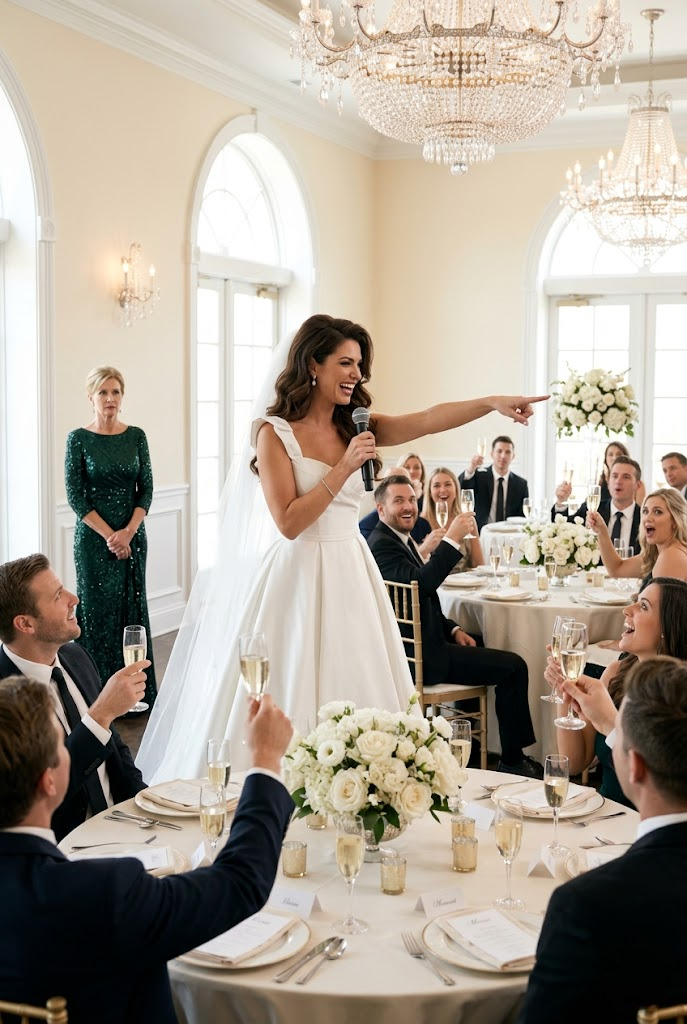
Some nights, when the city lights flickered on one by one outside my window, I found myself thinking back to the wedding. To the sound of laughter ringing like broken glass. To the way my pearls had felt against my skin, cool and familiar as I stood there, refusing to shrink.
They had tried to make me small. To turn me into a caricature, an amusing detail in someone else’s story.
Instead, that moment had lit a fuse.
Not a fuse of vengeance in the melodramatic sense—not a burning desire to destroy. Rather, it ignited a slow, steady realization: I had been living as if I owed people my silence, my sacrifice, my endless patience. I had been treating my own dignity as negotiable, something I could bargain away in exchange for love or acceptance.
That night under the chandeliers, with champagne glasses poised and eyes gleaming with mean amusement, I understood something that took me sixty-two years to fully grasp.
I did not need anyone’s permission to be worthy of respect.
In the months that followed, I carried that knowledge with me like a quiet flame. I let it guide the boundaries I set—with Andrew, with Cooper Holdings, even with myself. There were days when it felt heavy, when old habits tugged at me, urging me to give in, to smooth things over, to step into the familiar role of savior.
But I held firm.
We teach people how to treat us. It had taken a public insult and a private betrayal to realize I’d been teaching the wrong lesson.
So I started again.
If you have ever been laughed at, belittled, reduced to a cruel joke in a room full of people, hear this: their laughter does not define you. Their failure to see your worth does not erase it. You are not small because someone else needs you to be. You are not an accessory in someone else’s story unless you choose to stand in the background and never speak.
Respect begins with boundaries. Love without respect is just dependency dressed up in prettier clothes.
They called me a pig that night to make me feel less than human. But I learned to become something else instead. Not vengeful. Not obsessed with proving anyone wrong.
Simply, unapologetically awake.
I will not pay to be tolerated. I will not dim my light so others can feel comfortable in their shadows. I will not keep rescuing those who refuse to learn how to stand.
My name is Ellenor Whitford. I am sixty-two years old, a widow, a mother, a CEO. I have made mistakes—more than I can count. I have also survived more than I once thought I could.
And if my story does anything for you, let it do this: let it remind you that your dignity is not a luxury. It is not something to be traded for a seat at someone else’s table. It is the table.
Stand up. Straighten your spine. Look around the room, no matter how elegant or cruel it may be, and remember:
Your worth is not negotiable.
THE END
✅ End of story — Part 3 of 3
← Read from Part 1