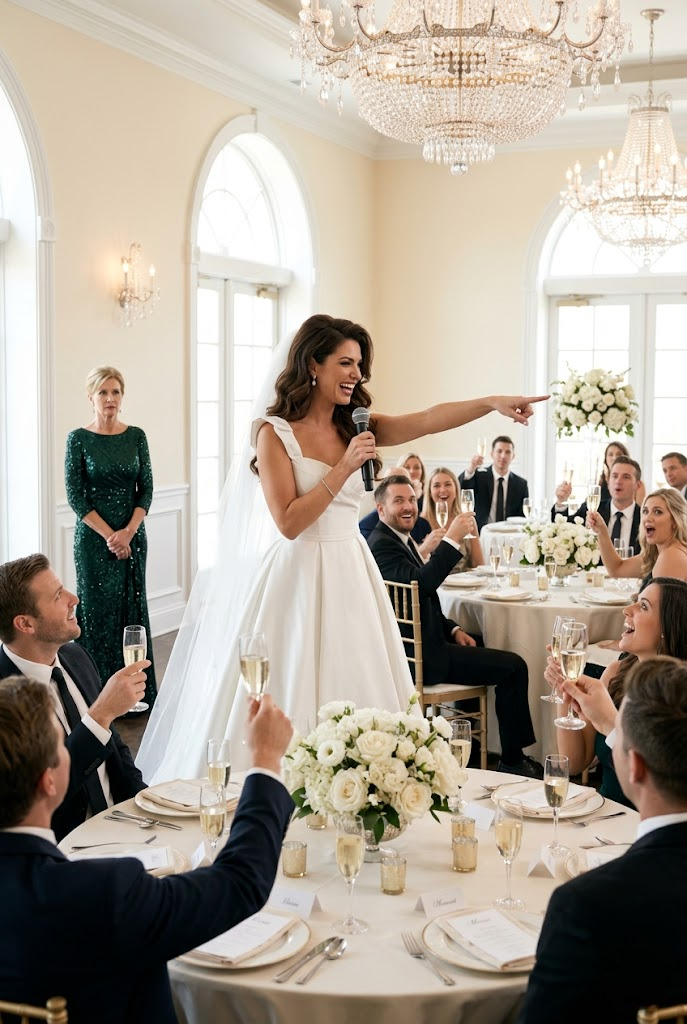
My name is Ellenor Whitford, and I was sixty-two years old the night my son’s bride raised her glass, smiled into a microphone, and called me a pig.
I remember the room the way some people remember a car crash: every detail caught in sharp, terrible focus. Light glittered off crystal chandeliers in the vaulted ceiling, scattering across gold-trimmed drapery and high walls the color of warm cream. Hundreds of white roses spilled out of tall vases like frozen waterfalls, perfuming the air with a sweetness that made guests sigh whenever they stepped into the hall.
A jazz quartet played in one corner, the saxophone pouring honeyed notes over the low rumble of conversation and clinking glassware.
It was everything my son Andrew had ever wanted—no, everything he’d convinced himself he needed in order to feel successful, enviable, beloved. Twenty-eight round tables draped in ivory linen, each set with gold-rimmed plates and cut crystal stemware. A bar that stretched the length of the back wall. A cake near the center that rose taller than the average man, tier stacked upon tier like a tower of sugar and pride.
Three hundred thousand dollars.
I knew the number the way I knew my own reflection. I had wired the deposits, signed the contracts, responded to the frantic emails from wedding planners who wrote as if the fate of the world depended on whether the napkins were cream or bone. I had made it happen. I had written those checks the way I had once packed lunches and hemmed pants, with the quiet certainty that this is what mothers do.
I stood near one of the pillars, my emerald dress skimming my ankles, its fabric catching the light and turning it into something rich and deep. The dress had cost a fraction of the floral budget, but I wore it with a straight spine and calm face. Around my neck, under the delicately pinned twist of my silvering hair, I fastened a familiar clasp: my pearl necklace, the one my husband had given me on our tenth anniversary. Andrew had tugged at those pearls when he was small, his baby fingers fascinated by their cool smoothness. My husband had traced them once with a thumb, just before he went into the hospital for the last time.
I wore them that day for memory, not for display.
When the toasts began, the hall settled into a kind of reverent hush. Speeches are an expected ritual at a wedding, like the cutting of the cake and the first dance.
I had one folded neatly in my clutch, a short, simple thing about love and endurance and the way children grow into people you never quite expected but love all the more for it. I wasn’t sure I would give it. The day already belonged so completely to Andrew and his bride, Meline.
I watched them now at the sweetheart table, framed in a garland of roses and fairy lights. Andrew was handsome in his fitted navy tux, his dark hair smoothed back, his jaw clean-shaven. His smile was wide, but there was a tightness around his eyes I recognized—a tension he tried to hide with laughter. Next to him, Meline sat like a photograph from a bridal catalog brought to life: sleek dark hair pinned in a low chignon, skin glowing with makeup that had cost more than any lipstick I had ever owned, a gown that fitted her narrow frame like poured silk. A diamond bracelet encircled her wrist, catching the light with every movement.
When she reached for the microphone, the room cheered. She laughed, waving a hand as if to say oh, you shouldn’t, though it was clear she adored being the center of attention. The microphone squealed faintly, and then her voice flowed through the speakers: bright, smooth, effortless.
“I just want to thank everyone for being here tonight,” she began, her eyes shining. “This is the wedding I’ve dreamed of since I was a little girl, and it wouldn’t have been possible without our families.”
She turned to her parents first. Gregory and Diane Cooper sat at the front table, their posture straight, their smiles politely satisfied. Old money, though their fortune was not ancient enough to be jaded. Gregory’s suit was bespoke, his watch understated but undeniably expensive. Diane’s dress shimmered in soft champagne tones, her blond hair perfectly arranged in waves that looked accidental and took three hours at a salon to achieve.
“Mom, Dad,” Meline said, her voice emotional enough to be convincing, “thank you for everything you’ve done for me. For us. For making me the woman I am today.”
There was applause, the respectable kind, measured and decorous. Gregory lifted his glass, his smile gentle, his eyes moist.
“And of course,” she continued, turning toward where I stood, “we have to thank Andrew’s mom.”
My heart, traitorous organ that it is, leapt. This was not necessary; no one had insisted she acknowledge me publicly. Andrew had thanked me that morning in the quiet of the cathedral sacristy, his hands shaking as I straightened his bow tie. But perhaps, I thought, perhaps she wanted to thank me of her own accord. Perhaps all the small sharpnesses I’d sensed beneath her politeness were misread. I wanted to believe that. Mothers are skilled at wanting to believe in the best version of the people their children choose.
Meline turned back to the guests, her smile widening, mischief sparking in her dark eyes. She lifted her champagne flute, the diamond bracelet at her wrist glinting like a blade.
“And here,” she said brightly, “is the old fat pig we all have to tolerate.”
It took a heartbeat for the words to register. Another for them to land.
Then laughter.
Not the nervous, oh-dear kind that stumbles out when people don’t know how to react. No. This was full, delighted laughter from her table—her friends, her cousins, people who had known her since childhood and understood her sense of humor and found it perfectly acceptable. Even a few others at nearby tables joined in, a ripple of amusement spreading like oil.
I stood very still.
The emerald fabric of my dress suddenly felt heavier, as if it had turned to stone that clung to my ribs. The pearls at my throat cooled to ice. I felt my cheeks flush and fought it, willing my body not to betray me. I kept my posture straight, my face composed. I had learned years before that dignity is often nothing more than refusing to flinch when someone wants to hurt you.
Across the room, I heard a bark of laughter that made my skull vibrate. It came from one of Meline’s friends, a woman in a sequined dress two sizes too small who had already had too much champagne. At the sweetheart table, Meline’s friends doubled over, covering their mouths with manicured hands, eyes wide with shocked pleasure.
The microphone picked up a second burst of laughter, this one softer, closer to home. I recognized it. My son’s.
It was quick, hardly more than an exhale of surprise, the kind you give when you’re startled and trying to pretend you’re not. But I heard it. A mother hears everything her child does, no matter how old he is.
Meline giggled into the microphone. “Oh, come on,” she said, tossing her hair, as if we were all in on some private, harmless joke. “She knows I’m kidding. We love you, Ellenor.”
My name sounded wrong in her mouth, like a borrowed word she didn’t quite respect enough to pronounce with care.
I suppose that was the moment something inside me shifted. Not broke—that implies fragility. What cracked that night was not my spirit but an old, hardened shell I’d wrapped around myself over decades of being “the strong one,” the widow who carried everything quietly, the mother who gave and gave and convinced herself it was enough to be tolerated in the background.
I felt an old, buried part of me stir. Not rage, exactly. Something colder. Cleaner. A deep, rooted certainty I hadn’t let myself feel since before my husband died.
They think I am powerless.
I let the thought settle, tasting its truth. They believe they are laughing at a harmless old woman—a prop, a checkbook, an accessory to their spectacle. They have no idea.
Not yet.
The laughter began to die down, the jazz musicians shifting awkwardly on their little stage, unsure whether to start playing again. The wedding planner hovered by the DJ booth, panic flickering across her face. This was not in the script, you could see it in the way her fingers fluttered over her clipboard.
And then, like a second storm breaking over the first, the hall went very quiet.
I saw the change sweep across Gregory Cooper’s face, starting at his eyes. A moment before, they had been amused, indulgent—a father watching his daughter bask in her moment. Now his gaze had drifted past her, over the crowd, and landed on me. Really landed, as if he was seeing me for the first time. His mouth went slack. The color drained from his cheeks.
His fingers, which had been loosely wrapped around his glass, tightened and then loosened, as if he’d suddenly forgotten how to hold it.
He looked, oddly, like a man at the moment of recognizing his own handwriting on a confession he never meant to sign.
He rose from his chair slowly, ignoring the questioning look from his wife. The music had not yet started again; the room was suspended in a strange, brittle silence. Glasses hovered in midair. Waiters froze in the act of pouring champagne.
Gregory moved through the tables with the cautious politeness of a man approaching a wild animal—except the fear in his eyes wasn’t the fear of being mauled. It was the fear of consequences.
He stopped in front of me, his shoulders rigid, his eyes too wide. Up close, I could see the faint tremor in his right hand, the way a muscle in his jaw twitched.
“Mrs. Whitford,” he stammered, his voice pitched a little too high. “I… We… I had no idea you were… I mean, you are—”
He swallowed, then forced the words out as if they tasted like rust.
“You are Ellenor Whitford, the new Chief Executive Officer of Cooper Holdings.”
The words fell into the silence like a stone dropped in still water.
There are moments when a room seems to inhale all at once. This was one of them. I could feel hundreds of eyes pivoting toward us, conversations dying mid-sentence. Chairs creaked as people shifted for a better view. Even those who had no idea what Cooper Holdings was or why it mattered could sense something had shifted beneath their feet.
I allowed myself a small smile, barely there, more a suggestion at the corner of my mouth than an expression. Enough for Gregory to see. Enough for any careful observer to feel.
“Yes, Gregory,” I said calmly. “I begin next week. Your board approved the appointment unanimously.”
A soft gasp came from somewhere behind him. I didn’t have to look to know it was Diane. To my left, I saw Meline stiffen in her seat, the practiced smile on her lips faltering. Her arm, still holding the microphone, lowered a fraction. Her eyes locked onto mine, flickering with confusion that quickly shifted into something else—fear, dawning realization, the sudden awareness that the “old fat pig” might be standing on her family’s dining table, metaphorically speaking.
A bubble of nervous laughter attempted to rise from someone at her table, then choked itself into silence.
I did not raise my voice. I did not demand an apology. I did not even address what she had just called me.
Humiliation gives people an excuse to act foolishly. Power, when you know you have it, gives you the luxury of choosing restraint.
“I look forward to working with you,” I said to Gregory, my tone cordial, businesslike. “I’m sure we will have much to discuss.”
He nodded too quickly, bobbing his head like a man trying to appease a judge whose sentence he hadn’t expected to face in a ballroom. “Of course, of course,” he murmured. “We… we’re honored. Truly. I… I apologize, I had no idea you were—”
He cut himself off, his eyes flicking toward his daughter, who still sat frozen, the microphone forgotten in her hand.
I didn’t make it easier for him. I didn’t rescue him with graciousness. I simply held his gaze for a heartbeat longer, then turned slightly toward the band in the corner.
“Please,” I said quietly to the bandleader, who had been watching with his saxophone cradled in his hands, his brow creased. “Continue.”
He nodded gratefully and signaled his musicians. The saxophone cried out a smooth, low note, the piano picked up a rhythm, and within seconds the jazz flowed back into the hall, filling the space where laughter had died.
People began to move again. Conversations resumed, though at a lower volume, their edges cautious. The waitstaff, trained to adapt to anything, resumed their choreography, gliding between tables with polished professionalism.
Yet the energy in the room had changed. I could feel it pressing against my skin, a subtle shift in the way people’s eyes followed me as I moved. A minute before, I had been the butt of a cruel joke, an easy target for mockery in a world that treats older women like punchlines. Now, as I walked to the bar and ordered a glass of red wine, napkins rustled and whispers followed in my wake.
“That’s her? The new CEO?” someone breathed.
“At Cooper Holdings? That Cooper Holdings?” another hissed back.
“I thought she was just—”
Just. That word hangs heavy when people use it to cut you down to size. Just a widow. Just the groom’s mother. Just the woman who paid for everything.
They had never imagined I could be the woman who might one day sign their paychecks.
As I lifted my glass to my lips, I caught my reflection in the polished mirror behind the bar. The pearls glowed softly at my throat; my eyes looked sharper than they had in years. A stranger might have thought I was unruffled, untouched. They would not have seen the way the insult had slid under my ribs, slicing at old insecurities, stirring ghosts of every time I had been dismissed, ignored, underestimated.
But the sting did not break me. It woke me up.
That night, as the wedding carried on—dancing, more speeches carefully devoid of jokes at my expense, the cake cutting captured from every angle by a videographer—I moved through the hall like a different version of myself. I still smiled when people approached me. I still hugged relatives and thanked old friends for coming. But beneath every polite exchange, there was a new, quiet resolve taking root.
I will never again pay to be insulted.
That was the moment everything truly began.
Eighteen months earlier, I had been sitting alone in my living room on a rainy Tuesday evening, the sounds of Chicago muted by heavy clouds and the steady patter of water against the windows. My small condo was tidy, the kind of neatness that comes from habit rather than obsession. A half-finished glass of merlot rested on a coaster beside my laptop, where spreadsheets glowed in neat rows. Numbers had always made sense to me. People, less so.
The phone rang, and Andrew’s name lit up the screen.
“Hey, sweetheart,” I answered, already smiling. There is a particular warmth that lives in a mother’s voice when her child calls; it arrives before words, like the glow of a lamp switched on in a dark room.
“Mom,” he breathed, sounding breathless and bright. “She said yes.”
For one wild second, I thought he meant a job offer. Andrew, at thirty-one, had bounced between positions in finance and marketing, never quite settling, always looking for the next role that would finally make him feel important. But then it clicked.
“Meline?” I asked, my heart doing a little skip in my chest.
“Yes. She said yes. Mom, she—” He laughed, the sound tumbling over itself. “She cried. Right there in the restaurant. Everyone was staring. She was shaking so much I could hardly get the ring onto her finger.”
I sank back into my chair, closing the spreadsheet with a tap. Outside, the rain streaked the glass in thin silver lines. “Tell me everything,” I said, letting the words wrap around him like a blanket.
He did. He described the candlelit table by the window overlooking the river, the way he’d tucked the ring box into his jacket pocket and kept touching it every few minutes like a nervous tic. He told me how the waiter had brought out dessert with “Will you marry me?” scrawled in chocolate, and how Meline had slapped a hand over her mouth and burst into tears before she even saw the ring. He described the ring in detail: a cushion-cut diamond in a halo of smaller stones, the band delicate but firm.
“She kept saying ‘forever,’” he murmured. “She whispered it into my neck, like… like she meant it.”
I listened, smiling, my thumb tracing the rim of my glass. I pictured my son—my lanky boy who’d once scraped his knees learning to ride a bike in the cracked sidewalk outside our old apartment—kneeling in a restaurant in a tailored suit, offering his heart to a woman he believed would guard it. I could hear the hope in his voice, the tremor of fear beneath it.
For thirty-one years, I had played both mother and father. When Andrew was six, my husband, Mark, had been diagnosed with an aggressive cancer that devoured him in less than a year. I remember hospital corridors that smelled of antiseptic and something sourer beneath it, the ding of elevator doors, the way fluorescent lights flattened everything into shades of gray. I remember signing forms with shaking hands and then going home to pack school lunches, to sit through parent-teacher conferences, to clap at recitals and help glue macaroni to construction paper for art projects.
I worked nights back then, managing accounts for a mid-sized logistics company by day and doing freelance consulting after Andrew went to sleep. We filled out scholarship applications together at the kitchen table when he was seventeen, his brow furrowed as I explained interest rates and loan terms. I watched him go off to college with a suitcase, an old laptop, and a determination to make something of himself.
His voice full of joy on that rainy Tuesday cut through all of those memories like sunlight. It made every sacrifice feel worth it.
“I’m happy for you,” I told him, and it was true. “You deserve someone who loves you that much.”
He exhaled, and for a moment the only sound on the line was the quiet rush of his breathing. “Thank you, Mom. I… I know you’ll love her once you get to know her. She’s… she’s special.”
I wanted to believe that. I wanted, more than anything, for my son to have a partner who saw him the way I did, who would cherish his kind heart, his tendency to overthink, his habit of overpromising and then scrambling to deliver. So I agreed to every dinner, every brunch, every opportunity to see them together.
Meline, on the surface, was everything he’d described. She was quick with a joke, confident in the way of people who had never truly had to wonder where their next meal was coming from. She spoke about her job in corporate communications at Cooper Holdings with an easy familiarity, sprinkling in names and projects as if they were part of a language everyone spoke. She knew which wine to order without looking at the menu. She picked at her food in a delicate way, always leaving a little on her plate, laughing about needing to fit into sample sizes for events.
She was polite to me—never openly rude. But there was a coolness beneath it, a faintly patronizing edge, as if I were someone she would have been kind to at a charity event but not necessarily spoken to for long. She complimented my dress once and then laughed lightly when I mentioned I’d bought it on sale.
“You’re so practical,” she said, her tone somewhere between admiration and faint mockery. “Andrew says you’re amazing with money. I told him he’s lucky to have you—my parents would never look at a price tag.”
Andrew laughed along, his arm around her shoulders, his eyes flicking toward me in a way that made my stomach twist.
A month after the proposal, he called again.
“Hey, Mom,” he began, clearing his throat. I could tell immediately he wanted something. He had that particular hesitation, the one that slid into his voice whenever he needed something expensive.
“How’s the wedding planning?” I asked, giving him the opening.
“It’s… it’s going well,” he said. “Her parents booked the cathedral already, and I think we found a band we like. We’re looking at venues for the reception now.”
“That’s good,” I replied, glancing at the notepad on my coffee table where I’d been scribbling figures related to a consulting project. “Have you picked a date?”