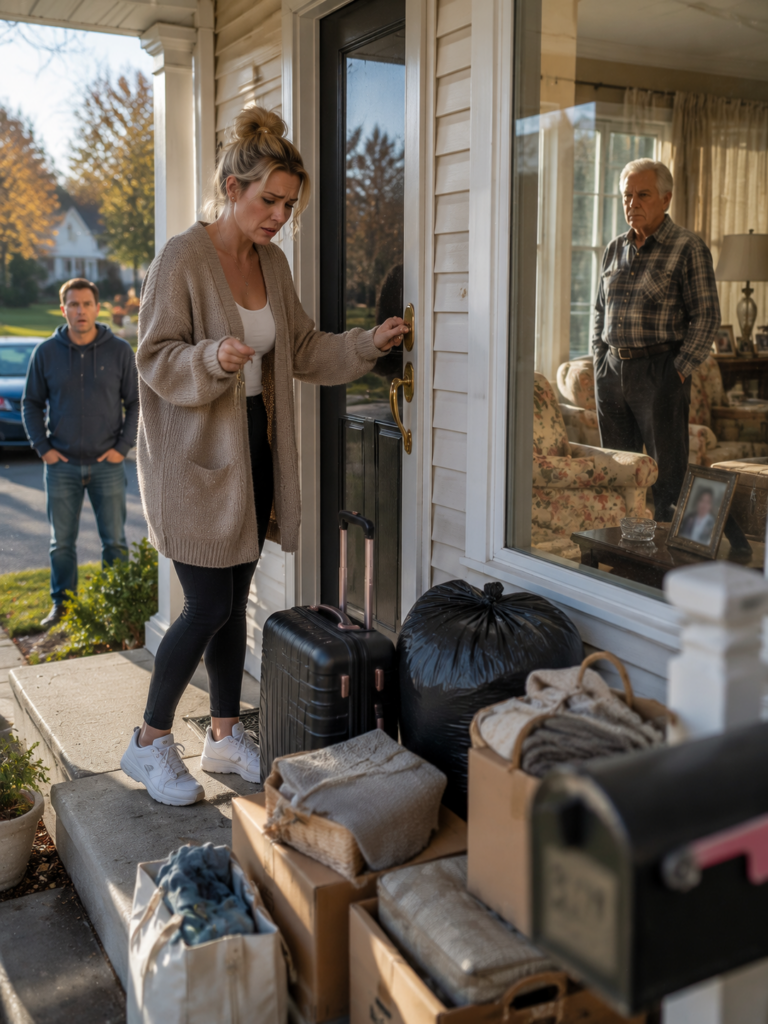
I stood there still holding my work gloves, looking around my own living room like I had walked into the wrong house.
Renee came out of the kitchen carrying a sparkling water.
“Oh good,” she said brightly. “You’re home. What do you think?”
“Where’s the table?”
“In the garage,” she said. “It was making the room feel dark.”
I looked at her.
She took a sip and added, “This setup is much more open.”
Open.
That was one of her words. Open. Light. Fresh. Intentional. Elevated. She had many words for making my home feel less like the life I had lived and more like a photograph in an online listing.
“My chair,” I said.
“It’s still here.”
“It’s in the corner.”
“It balances the room.”
I set my gloves on the couch because the table was gone and walked out to the garage without answering. I found Carol’s table pushed between paint cans and a folded ladder, one leg touching the concrete floor at an angle that made something in my chest tighten. I dragged it back myself. It was heavier than I remembered, or I was older than I wanted to admit. Maybe both. By the time I got it back into the living room, my back hurt and Renee had disappeared.
I put the table where it belonged.
That night I heard muffled voices from the guest room, hers clipped and fast, Kyle’s lower and tired. Twenty minutes later, he came down the hall and stood in the doorway of the den with the expression of a man sent to negotiate terms he did not fully believe in.
“She just wants to make it feel homey, Dad,” he said.
“It already is homey,” I said. “It’s a home.”
He shifted his weight. “I’m just saying maybe give her a little room with the common areas.”
I looked at him long enough that he glanced away first.
“This house has felt like a home for thirty-two years,” I said. “It doesn’t need staging.”
He did not push.
But Renee heard enough.
After that, something in her changed. Not openly. Not dramatically. It was subtler than that. Warmth became performance. Gratitude became management. Every room she entered began to feel as if it were being evaluated for what still belonged to me.
By the third month, she had taken over the kitchen.
Not officially. That would have at least been honest.
She simply started buying groceries, reorganizing cabinets, labeling containers, moving tools of daily life to places that made sense only if you assumed the house had been waiting for her all along.
My cast-iron skillet, the one I had used nearly every week of my adult life, was taken off the hook above the stove and tucked beneath the island where you had to crouch to reach it.
I put it back.
The next morning, it was under the island again.
I moved it back.
She moved it again.
We did this without ever discussing it directly, which I understand now was the whole problem. I thought I was keeping the peace. She understood, correctly, that I was avoiding conflict. And avoiding conflict is an engraved invitation to people who like control.
Then she started taking client calls in the living room.
She had a perfectly good office with a desk, a printer, and a door. But suddenly the light in there was not right, or the internet signal was inconsistent, or the background looked better by the front windows. Which meant from nine in the morning until noon, sometimes later, I could not use the main room in my own house without being made to feel like I was intruding on someone’s workplace.
I adjusted.
I watched the news in my bedroom.
I drank coffee at the kitchen table in silence while she talked in her smooth professional voice about payroll records and bookkeeping timelines and tax documentation. The strange thing about disrespect, when it first begins, is that it rarely looks like meanness. It looks like inconvenience. Then a pattern. Then a message.
And the message was plain enough by then.
You are being moved.
Kyle, to his credit or shame—I still cannot decide which—noticed some of it.
Once, after Renee moved the skillet again and I returned it again, he stood in the kitchen doorway watching me hang it back on the hook.
“She likes organized cabinets,” he said.
I looked at him. “It was organized.”
“She means, you know, more modern.”
“Kyle.”
He looked away.
That was the whole conversation.
He knew.
Maybe not all of it, maybe not in words he would say out loud, but he knew the way a man knows a floor is soft under the carpet and still keeps walking because tearing it up would mean admitting there is rot.
The smoking was what turned a pattern into a line.
Before they moved in, I had said one thing clearly: no smoking inside.
Kyle had smoked on and off for years, never heavily, and he had always taken it outside. Renee smoked more. Not constantly, but enough. At their old apartment, she smoked on the balcony and called it her thinking time. When they moved in, I told them both at the kitchen table, “I don’t care what you do outside, but no cigarettes in the house.”
Renee agreed right away.
“No problem,” she said.
The first time I smelled smoke inside, I thought maybe it had drifted in from outside. It was faint, just a stale trace in the hallway near the office room. I opened a window and told myself not to become the kind of old man who went hunting for reasons to complain.
The second time, I found a ceramic ramekin on the kitchen windowsill with ash in it. I stood there looking at it for almost a minute. It had once held Carol’s crème brûlée, back when she got ambitious after watching some cooking show and bought a little torch that scared me more than any power tool I owned. Now it had gray ash and a cigarette butt smashed into its white surface.
I emptied it, washed it, and put it back in the cabinet.
The third time, I walked into the living room and found Renee on my couch with a lit cigarette between her fingers, a glass of white wine on Carol’s coffee table, and some loud reality show playing on television.
The smoke was already in the curtains.
I stopped in the doorway.
“Renee,” I said. “We talked about this. No smoking in the house.”
She looked up slowly, like I had interrupted her rather than the other way around.
“It’s freezing outside, Walt.”
I kept my voice even. “I understand that. But this is my house, and I asked that smoking stay outside.”
She held my gaze for a long second.
Then she made a little sound—not quite a laugh, not quite a scoff—and turned her eyes back to the television.
That moment still embarrasses me.
And I think it should.
Because I stood there.
I did not raise my voice. I did not turn off the television. I did not take the cigarette from her hand or tell her to pack her bags. I just stood there with my own rule hanging in the air like something small and pathetic, and then I walked away.
That night, I lay in bed staring at the ceiling fan.
The house smelled faintly of smoke even upstairs.
I thought about Carol.
I thought about something she used to say whenever one of the kids tried to push too far: The only thing worse than a fight you had is a fight you keep postponing.
And I thought about my son, asleep down the hall, who either did not see what was happening or saw it and preferred not to name it. Those are not the same thing, but the damage comes out looking pretty similar.
Sometime around five in the morning, while the first light was just beginning to gray the windows, I realized something painful and simple.
I had not been generous.
I had been surrendering.
One inch at a time. So gradually, so politely, I had nearly convinced myself it was not happening.
The next morning, I called Philip Darden.
Phil had handled property matters for me for fifteen years. He had the kind of office on Main Street that smelled faintly of paper, leather, and old air conditioning, and he wore striped shirts so crisp they looked ironed by a person with a grudge. He was not a dramatic man. That was why I liked him. He treated other people’s emergencies like puzzles he had no intention of letting win.
I told him the situation.
He listened without interrupting. I started with Kyle’s layoff, their moving in, the original understanding, the rearranged rooms, the smoking, the way I had begun avoiding my own living room. I heard myself saying these things and realized, with a kind of miserable clarity, how weak some of them sounded in isolation.
A moved lamp.
A cigarette.
A kitchen cabinet.
A chair.
But Phil did not dismiss any of it. He wrote notes in block letters on a yellow legal pad, then leaned back in his chair and folded his hands.
“Walter,” he said, “because they have been in the house more than thirty days, they likely qualify for tenant protections whether you intended that or not.”
“Even family?”
“Especially family,” he said dryly. “Family is how half the messes in my office start.”
He explained every step.
I listened to every word.
I could not simply change the locks. I could not toss their things into the driveway. I could not do what angry people on the internet like to imagine a man can do when his own child has overstayed his welcome. In Tennessee, once people have established residence, the law cares less about the story than about the fact of occupancy. If I wanted them out and wanted to stay clean legally, I had to give written notice. Thirty days. Properly dated. Properly delivered. If they did not leave, I would have to file for eviction through the court.
When he finished, I sat there for a moment and looked out the window at the courthouse flag across the street.
“I should have stopped this earlier,” I said.
“Yes,” Phil said. “But that’s not where you are now.”
He helped me draft the notice.
Clear. Formal. No insults. No emotional paragraphs. No accusations about cigarettes or chairs or a coffee table in the garage. Just facts.
I, Walter Greer, owner of the property located at…
Thirty days’ notice to vacate…
All personal property to be removed by…
Failure to vacate may result in formal eviction proceedings…
My hand shook when I signed it.
Not from doubt.
From grief.
Because putting a boundary on paper made it real in a way thinking about it had not.
After I left Phil’s office, I drove to the diner on Main Street, ordered coffee and bacon I did not really want, and sat in a booth for nearly an hour thinking through what I was about to do. At the counter, Earl Finney was working on his second breakfast and his first opinion of the day. Earl had known me since high school, which is to say he had earned the right to not ask certain questions. He glanced back once, saw my face, and wisely left me alone.
When I got home, I waited until Kyle and Renee were both in the kitchen.
Kyle came in first, hair damp from a shower, carrying his phone charger. Renee followed in one of those satin robes she had started wearing through the common rooms as if the house were a boutique inn she had booked by the week.
I slid the envelope across the table.
Kyle frowned. “What’s this?”
“I need you to read it.”
He opened it. I watched his face while he read.
Confusion first.
Then comprehension.
Then that expression people get when they step where they thought there was pavement and find air instead.
“Dad,” he said slowly, “you’re asking us to leave?”
“I’m giving you thirty days’ notice,” I said. “Yes. I need my home back.”
Renee set down her mug with careful precision.
She looked at me in a way I had never seen before—cold, clear, and entirely unperformed.
“You can’t do this,” she said. “We don’t have anywhere to go.”
“I understand that this is hard,” I said. “But this is my home, and I need to live in it on my own terms.”
Kyle pushed back from the table. “This is insane. You’re kicking out your own son.”
“No,” I said. “I am giving my adult son and his wife lawful notice to find other housing.”
Renee gave a sharp, clipped laugh.
“Fine,” she said. “Fine. Let’s see how that works out for you, Walt.”
She picked up her mug and walked out.
Kyle stayed a moment longer. He looked at the notice again, then at me, and in that face I could see almost every version of him that had ever existed: the little boy with skinned knees; the teenager shining his first truck every Sunday afternoon; the young man trying to look competent when life had gotten ahead of him.
“Dad,” he said quietly, “seriously?”
“Yes,” I said.
He stood there another second, then followed his wife down the hall.
The thirty days that followed were the longest of my life.
They did not leave.
They did not search in any urgent way that I could see. Kyle printed resumes. Renee took more calls. If anything, the behavior got worse. She smoked more often indoors, usually late afternoon when the house held heat and the smell clung to the drapes. She invited two friends over on a Wednesday and hosted what looked like a wine-and-cheese afternoon in my living room while I sat in the back bedroom listening to women laugh in the house where my wife had once folded laundry and hummed hymns under her breath.
A person can be made to feel homeless without ever leaving his own address.
That is what those weeks felt like.
I stayed careful.
That was Phil’s word.
“Careful,” he told me when I called after Renee hosted her friends. “Document. Do not argue. Do not threaten. If she smokes in the house, photograph the ashtray. If they damage property, photograph it. If they refuse to discuss departure, write down dates. Keep communication in writing when possible.”
So I documented.
I took pictures of ash on the porch table, then ash on the living room windowsill, then ash in a coffee mug that had once belonged to Carol. I wrote down every incident in a notebook. Date. Time. What happened. Who was present. I felt ridiculous doing it. Then I felt steadier. Proof has a way of giving shape to what other people want you to call overreaction.
Four days before the notice expired, Kyle knocked on my bedroom door.
He found me folding laundry. My laundry. One basket. One man’s clothes. The kind of chore that had become strangely peaceful since I had stopped sharing detergent with a woman who sorted whites by fabric quality and called my undershirts “aggressively practical.”
“Can we talk?” he asked.
I nodded toward the chair by the window.
He sat in the chair Carol used to sit in when she read on stormy afternoons and rubbed both hands down his face.
“I need more time,” he said. “I’m close on a job. Two more weeks, maybe three.”
I looked at him.
There are moments when love asks one thing of you and wisdom asks another. A younger version of me, or maybe just a weaker one, would have chosen love as permission to keep avoiding what needed doing.
But love without limits is not love.
It is enabling with better public relations.
“The thirty days stands,” I said.
His face went still.
“Dad.”
“I am not saying this to hurt you.”
“It hurts anyway.”
“I know.”
He looked at the floor.
“Renee says you were always waiting for a reason to kick her out.”
I almost smiled, though nothing was funny.
“Renee says many things.”
“She thinks you never really liked her.”
“I liked her fine when she respected my home.”
He looked up then, and anger finally showed.
“So this is about a coffee table? A cigarette? Some furniture?”
“No,” I said. “It is about the fact that you just reduced months of disrespect to furniture because that is easier than facing what you allowed.”
The sentence hit him hard enough that his mouth opened and closed once.
“I didn’t…” He stopped.
I waited.
He found no better ending.
“I need more time,” he repeated, but softer now.
“The thirty days stands.”
He nodded once and left.
On the morning the notice expired, I drove to Phil Darden’s office and filed for formal eviction.
He had the paperwork ready.
He asked how I was doing.
I told him I was all right, and I mostly was, though the night before I had sat on the back porch listening to the creek and asking myself whether I had somehow failed as a father to reach this point. Not legally. Legally I knew where I stood. I mean morally. Whether there had been some earlier moment when a quieter correction, a firmer word, a less delayed line would have spared us all the ugliness of attorneys and process servers and court dates.
The answer was yes.