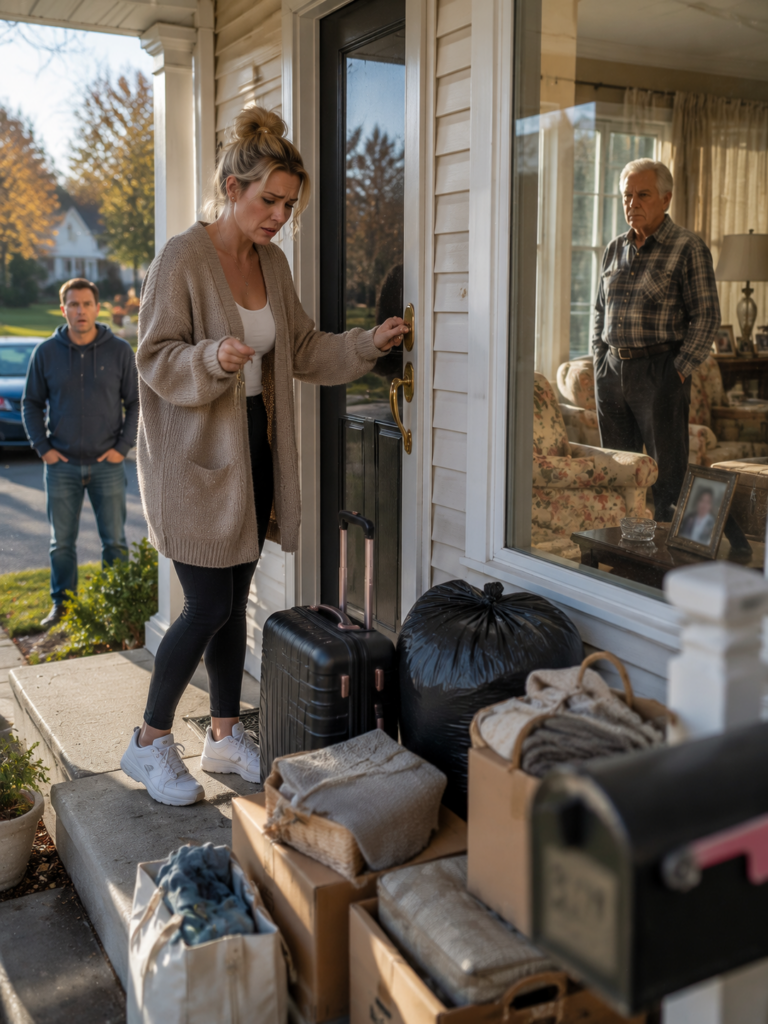
My Daughter-in-Law Moved Into My House, Smoked in My Living Room, Rearranged My Late Wife’s Furniture, and Treated Me Like an Unwanted Guest in the Home I Built—But When Her Key Suddenly Stopped Working, She Found Her Belongings Waiting on the Porch, the Locks Changed, and a Lesson About Boundaries, Respect, and Ownership That Neither She Nor My Son Ever Expected
The truck door slammed at 11:47 on a Friday night, and I knew, before the first key scraped uselessly against the new lock, that my son’s wife had come back expecting the house to still belong to her.
I know the exact time because I was sitting alone in the kitchen with a cup of coffee I had not touched, watching the green numbers on the microwave the way a tired man watches something when he cannot sleep and cannot think of one useful thing to do instead.
Outside the windows, the night lay heavy over the yard, soft and black beyond the porch light, the oak tree throwing long crooked shadows over the gravel drive. A thin moon hung above the creek line. The spring air had cooled after sunset, and for once the house smelled only like itself again: old wood, coffee, lemon oil, cedar from the hall closet, the faint mineral dampness that always came from the creek after dark.
Then came the slam.
Metal against silence.
I did not move at first. I set my mug down on the kitchen table and listened.
Footsteps on gravel. A pause at the porch. The small metallic scrape of a key going into a lock it no longer recognized. Then another scrape, harder this time, as if maybe the lock was the one making the mistake. A muttered word through the door. The handle rattled once.
I stayed where I was.
I had been waiting for that sound for four months.
When the pounding started half a minute later, it did not make me jump.
Nothing in me jumped anymore. I simply sat in the quiet kitchen and let the sound come through the walls. Whoever has never had their own home slowly taken from them—not with one great act of betrayal, not with a moving truck and a signature, but with a hundred small acts of assumption—probably imagines a moment like that feels triumphant.
It did not.
It felt hollow.
Not anger. Not satisfaction. Just that deep, exhausted quiet that comes after something has been broken for a long time and you finally stop pretending it is still whole.
“My son’s wife is at the front door,” I said out loud to nobody.
My voice sounded strange in the kitchen. Too calm. Too old. Too aware of the cost of reaching that sentence.
Then I stood up, turned off the kitchen light, and walked toward the living room.
By the time I reached the foyer, the porch light had come on automatically.
Through the beveled glass beside the door, I could see Renee standing stiffly on my front porch in a camel coat and heeled boots, one hand still on the doorknob, the other gripping the strap of her purse like she might strangle it. Her hair was pulled back into a sleek knot, but the wind had loosened several strands around her face. Her mouth was tight. Her eyes held the offended shine she wore whenever the world failed to arrange itself in the order she preferred.
Behind her, under the oak tree, a rental truck idled in the driveway.
I looked at the truck first.
Then at her.
Then at the dark yard beyond her shoulder, where the edge of the creek caught the moonlight in a thin silver line.
The deadbolt was new. The strike plate was longer. The whole frame had been reinforced that afternoon. Legally done. Cleanly done. Exactly the way my attorney had told me to do it.
I did not open the door right away.
That bothered her more than anything else ever could.
“Walter,” she called again, sharper this time.
A pause.
Then the brittle laugh.
“You cannot be serious.”
I almost said, Oh, I am very serious.
But the truth was, to understand why I stood there with my hand resting on the inside of the door and no intention of simply letting her in, you would have to understand the four months that came before that Friday night. You would have to understand my wife, my house, my son, and the dangerous things that happen when a decent man mistakes silence for kindness.
My name is Walter Greer. I am sixty-three years old. I spent thirty-one years in construction in central Tennessee, building custom homes for people with more money than patience until my knees told me they were done climbing ladders for a living. I raised two children in the same four-bedroom Craftsman house on a little over two acres outside Cooperville, the kind of place with a deep front porch, a gravel drive, and a creek along the back property line that gets loud after a hard rain.
My father left that house to me.
That sentence sounds simple. It is not.
He bought the place in 1978, back when Cooperville was more fields than subdivisions, when the road out front still turned muddy after storms and everybody knew whose dog had gotten loose before the owner did. The house had good bones then, but good bones do not mean easy living. My father spent weekends under the porch replacing rot. My mother scraped wallpaper from the upstairs bedrooms until her hands blistered. I was sixteen the summer we moved in, old enough to complain and young enough to feel secretly proud when my father handed me a hammer and trusted me to use it.
Years later, when he died, the house became mine. I put my own work into it after that. New trim. New gutters. A roof in 2021. Porch railings I rebuilt myself. A mudroom bench I made out of old church pew wood. Six rocking chairs I built one summer when my wife, Carol, was still alive and the evenings still felt long in a good way.
My wife, Carol, died eight years ago of breast cancer at fifty-four.
She never once asked, “Why me?”
Not one time.
Even at the end, when every movement cost her something and the hospital hallway smelled like bleach and bad coffee and fear, she still had enough grace left to ask the night nurse whether her shift had been long. That was Carol. She had a quiet way about her that made other people lower their voices without even noticing they were doing it. She could calm a crying baby by humming off-key. She could make biscuits without measuring. She remembered birthdays, shoe sizes, which neighbor’s husband had a bad back, which church lady did not eat onions, and whether our daughter preferred peach cobbler hot or cold. She laughed with her whole face, but she cried privately, never because she thought tears were shameful, but because she believed grief deserved room and dignity.
After she died, the house changed.
Not physically at first. The same walls. The same floors. The same cedar smell in the hall closet. The same kitchen windows that caught morning light. But it became too large for one man overnight. I rattled around in it the way a marble rattles in a coffee can. I would walk into the pantry and forget what I came for because I expected to hear her voice from the laundry room. I would catch myself buying the brand of tea she liked, then stand in the grocery aisle holding the box like a fool. Her garden gloves stayed by the back door for almost a year before I moved them, and when I finally did, I sat on the porch steps with them in my lap until the mosquitoes ran me inside.
I kept the house up anyway.
Painted every few years. Cleaned the gutters. Pruned back the crepe myrtles. Vacuumed the runner in the hall. Repaired the loose screen door. Oil on hinges. Leaves out of drains. Grass cut. Fence boards replaced. Creek bank cleared.
I kept the place in order because taking care of that house was the closest thing I had left to taking care of her.
That matters.
People hear a story about property and think it is about square footage or money or pride. Sometimes it is not about any of those things. Sometimes a home is just the physical shape of a marriage that ended too soon.
My son, Kyle, was thirty-six when he called me that Tuesday in February.
I was in the garage sharpening mower blades. It had rained the night before, and the air still smelled like wet dirt and metal. My phone buzzed on the workbench beside an old coffee can full of screws. His name lit up the screen.
“Hey, Dad,” he said when I answered.
I knew before he said anything else.
A father knows certain things through the muscles. Something in his voice sat wrong. Too flat. Too careful. Men do not like telling their fathers when life has knocked them flat. Not grown men, anyway. Not when they have wives and bills and something to prove.
“What happened?” I asked.
There was a pause. A small breath.
“The company cut my position.”
I leaned one hand on the bench.
Kyle worked for a logistics firm in Nashville. Mid-level operations manager. He had been there seven years, long enough to think he was safer than he was and short enough to be reminded that companies do not love anybody back. He had bought decent work shirts, talked about quarterly numbers, and once explained to me the difference between “supply chain optimization” and “warehouse scheduling” while I nodded like I understood.
“They said it was restructuring,” he continued. “Not performance.”
“It never is,” I said.
He gave a short humorless laugh.
“I’ve got some severance. I’m applying already. Renee still has her bookkeeping clients, but…” He trailed off.
“But rent is rent,” I said.
“Yeah.”
I could hear the humiliation in him. He was trying to sound practical, but embarrassment sat under every word like a stone in a shoe.
Then came the ask.
“Dad, I hate to even bring this up.”
“You and Renee can come here.”
He went silent.
I said it before he had to ask. Of course I did. That is my son.
“It would only be a couple months,” he said quickly. “Until we get back on our feet.”
“The guest room is ready,” I told him. “The small room across the hall can be an office if Renee needs one.”
“Dad, are you sure?”
“I wouldn’t say it if I wasn’t.”
“We don’t want to be a burden.”
I looked around the garage, at the tools, the old riding mower, the shelves Carol and I had painted together years earlier. “You’re not.”
On the second thank-you, his voice cracked a little. After we hung up, I stood in the garage a long while, the mower blade still clamped to the bench, feeling oddly grateful for the chance to be useful to somebody again.
When they moved in that Saturday, I helped carry boxes.
Renee arrived first in her white SUV, wearing dark jeans, a green sweater, and sunglasses pushed up into her hair. Kyle followed in a rented van with most of their things: clothes, two monitors, file bins, a printer, suitcases, a few boxes labeled KITCHEN though I had told them they did not need to bring much. They had put most of their furniture in storage. Renee said it made more sense until they knew where they would land.
“Walter,” she said, hugging me lightly at the porch steps, “thank you. Really. I know this is a lot.”
“It’s family,” I said.
She looked up at the porch, the swing, the railings, the rocking chairs, the front door Carol had painted a deep blue the year before she got sick.
“This house has so much character,” Renee said.
I believed her.
I want to be fair about that.
I do not like stories where a person is painted rotten from page one because that is not how real trouble usually arrives. Real trouble walks in smiling. It thanks you for the guest room. It praises your cooking. It says it admires your wife’s flower beds while quietly measuring how much of the yard could be improved if only you got out of the way.
In the beginning, I liked Renee.
She was sharp and quick and funny when she wanted to be. She dressed well without looking like she tried too hard, and she had a way of making Kyle seem more grounded, more adult. At their wedding seven years earlier, I had stood beside my son in a rented suit, trying not to cry and mostly failing. Carol had already been gone by then, but I remember thinking, She would like seeing him this happy. I remember Renee’s hand tucked into Kyle’s arm, her smile bright and confident, his face softer than I had seen it in years.
Good, I thought then. He found somebody. He is going to be okay.
What I did not understand then was the difference between a person showing you who they are and a person showing you what they know you want to see.
That difference reveals itself eventually.
It always does.
The first month went fine.
Kyle was up early most mornings on his laptop, sending out applications from the kitchen table before Renee took over the small office. Renee worked with her bookkeeping clients from that office room, door half-closed, speaking in a polished professional voice about quarterly filings, payroll records, invoice reconciliation, and tax extensions. They kept mostly to themselves. We ate together two or three nights a week. They were respectful about noise. They stacked their shoes by the mudroom bench. Renee asked before using the washer. Kyle even helped me replace a warped fence board one Saturday morning, and for an hour or so it felt like old times, the two of us side by side with a level and a box of screws while the dogs across the road barked at nothing.
That day, we finished the fence board and leaned our elbows on the top rail, looking out toward the creek.
“You doing all right, Dad?” Kyle asked.
I glanced at him.
It was the first time in months he had asked without needing something.
“Most days,” I said.
He nodded. “I still miss Mom.”
“Me too.”
His mouth tightened. “Sometimes I feel like I didn’t grieve right.”
“There’s no right.”
“You always say that.”
“Because it’s true.”
He smiled faintly.
For a moment, he was ten again, standing beside me with sawdust on his cheek, proud of being useful.
Then Renee called from the back door that lunch was ready, and the moment ended.
Still, for a while, the house felt fuller in a way I did not hate.
There was movement again. Voices. Coffee cups in the sink. Mail on the table. Footsteps upstairs. The guest room light glowing under the door at night. I told myself maybe this was good for all of us. Maybe the house had been too quiet. Maybe this was one of those second chances life gives in an ugly wrapper. Maybe a son coming home after a setback was not failure. Maybe it was family.
Then, sometime in the second month, the whole thing began to tilt.
Not all at once.
Just enough that you noticed the angle without being able to say exactly when it changed.
Renee started “improving” things.
First it was a lamp moved from the living room to the hallway.
I noticed it because Carol had bought that lamp at a flea market outside Franklin. It had a cream shade, a brass base, and a pull chain that stuck if you yanked too hard. Carol loved it because it made the living room glow warm in the evenings, especially in winter when dark fell too early. Renee moved it beside the hall mirror because, she said, the hallway “needed softness.”
I said nothing.
Then there were new hand towels in the downstairs bathroom, folded like display pieces in a home goods store. The old towels—plain white, clean, useful—vanished into a lower cabinet. Then decorative baskets appeared on the kitchen counter where I had always kept fruit and mail. The baskets held rolled cloth napkins, two ceramic jars no one opened, and a wooden sign that said gather.
I hated that sign more than reason allowed.
None of it seemed worth a discussion.
That is how these things begin.
A lamp is not worth fighting over. Towels are not worth tension. Baskets are harmless. A sign is a sign. You tell yourself a young woman probably wants to feel settled somewhere after losing her apartment. You tell yourself temporary arrangements deserve grace. You tell yourself that if Carol were here, she would be kinder than you are being in your own head.
I told myself a lot of things in those weeks.
Nearly all of them were wrong.
One afternoon, I came in from clearing brush along the creek bank and found my living room rearranged.
The couch had been moved to the opposite wall. My armchair, where I sat every evening to watch the local news and sometimes fall asleep before the weather, had been shoved into the corner at an angle that let me see half the television and most of a floor lamp. Carol’s oak coffee table—the one we found at an estate sale in Gallatin twenty years ago, heavy as sin and twice as solid—was gone.