Of course there had.
The first lamp.
The first ash dish.
The first time my chair was moved like my habits were clutter.
That was where I should have drawn the line.
But late is not never.
And a late boundary still counts.
The summons was served two days later.
I made sure I was in town when it happened. I went to the hardware store and spent twenty minutes comparing screws I did not need. Then I went to Earl’s diner and ordered coffee while Earl looked at me and said, “You finally doing it?”
“Doing what?”
He snorted. “Walter Greer, I’ve known you since 1975. Don’t play dumb near breakfast.”
I stirred my coffee.
“My son and his wife are moving out.”
“By choice?”
“Legally encouraged.”
Earl nodded and went back to his eggs.
After a moment, he said, “Your home is not a favor you owe anyone.”
I looked at him.
He did not look back.
“It’s the place you built your life,” he continued. “Don’t apologize for wanting it back.”
I did not answer. I threw cash on the counter, more than the coffee cost, and left before he could say something else true.
When I came back that evening, the house had the strange stiffness of a place where everybody knows the truth and nobody wants to say it aloud. We had not eaten together in weeks. Kyle found me after dinner and asked if we could talk.
We sat at the kitchen table.
This time there was no accusation in him, just fatigue.
“Dad,” he said, “I want to understand. What did we do that was so bad?”
There are questions you can answer with examples and questions you have to answer with the pattern itself.
“It wasn’t one thing,” I said. “It was every small thing added together until I realized I was living in a corner of my own life. This house is not spare space to me. Your mother and I built a life here. I have kept it up for years. And I watched it get taken apart one decision at a time. Every time I said something, the problem somehow became me.”
He stared at the wood grain in the table.
“Renee didn’t mean it that way,” he said.
“I know you believe that,” I said quietly. “I believe you believe it.”
He had nothing to say after that.
Three days before the court date, I came home from a hardware run and found the house empty.
Their truck was gone. The rooms they had occupied were half-cleared. Clothes still in the closet.
Toiletries in the bathroom. Renee’s monitor and file bins still in the office. But no people. I made a sandwich, turned on the evening news, and sat in my chair—still slightly out of place because I had stopped putting things fully right until this was over.
At nine that night, Kyle called.
“We found a place,” he said.
His voice was flat in a way I had not heard before.
He told me they were staying with Renee’s cousin in Murfreesboro while they figured things out.
“We’ll come Saturday and get the rest,” he said.
“What time?”
“Around noon.”
Then a pause.
“I’m angry at you, Dad.”
“I know.”
“I might need some time.”
“You take it,” I said. “The door’s open when you’re ready.”
That Saturday, I got up early and walked through the house with a notepad, taking stock before they arrived.
By ten-thirty, I had put Carol’s table back in the center of the room, rehung the landscape print in the hall where Renee had moved it, and returned my cast-iron skillet to its hook. At eleven-fifteen, I called the locksmith and confirmed the afternoon appointment.
Two o’clock.
That timing mattered.
Kyle and Renee arrived at eleven-forty in a rental truck.
They were businesslike. Kyle carried boxes. Renee directed. The tone between them was sharp, clipped, and tired. Whatever version of united front they had been presenting for months had cracked somewhere off my property, and I could see the strain in the way they avoided each other’s eyes.
For forty-five minutes, they moved through the rooms gathering what was theirs. Clothes, bathroom items, electronics, client files, shoes, decorative bins, the sleek little gadgets and objects that had followed Renee into my house and tried to rename it.
I stood mostly in the living room and watched.
More than once, I caught myself hoping Kyle would say something. Not an apology even. Just something in his real voice. Something that sounded like my son rather than a man speaking from inside an argument he had not won and did not know how to leave.
At the door, when the last box was loaded, he stopped.
He looked at me.
In that look sat everything between us: love, resentment, confusion, shame, history, pride.
“I’ll call you,” he said.
“I know you will.”
Renee did not say goodbye.
She was already in the passenger seat, looking at her phone with her mouth set in a hard line. Kyle climbed in. The truck backed down the gravel drive, turned at the road, and disappeared past the mailbox.
I stood in the doorway until the sound was gone.
Then I went to the kitchen, poured out the cold coffee, and made a fresh pot.
At two o’clock sharp, the locksmith pulled in.
He replaced the front lock, the back deadbolt, and the side mudroom lock. While he worked, I sat at the kitchen table with every window in the house cracked and a legal pad full of things to restore.
Drapes.
Vents.
Wall wash.
Mattress.
Paint.
Because the smoking had done what smoke always does.
It had settled everywhere.
In the curtains. In the upholstery. In the hallway runner. In the air vents. A house absorbs what happens inside it. That is true emotionally, but it is also true in the plain practical sense. Nicotine leaves a yellow film. Fabric holds stale air. Even the walls can carry what people think will disappear if they just open a window.
I took the next week and reclaimed the place the way a man might reclaim a field gone wild.
I washed every hard surface in the living room, kitchen, hall, and guest rooms with white vinegar and warm water until the rags stopped coming up yellow. Then I did a second pass with trisodium phosphate cleaner. Gloves on. Windows open. Radio low in the background. I threw away the old curtains and bought new ones in a soft blue I knew Carol would have liked. I hired a company from town to clean the ductwork because smoke in vents will keep introducing itself long after the smoker is gone. I steam-cleaned the couch and the carpets. The guest-room mattress went to the dump. Charcoal packets went into every room for two weeks.
Little by little, the house came back.
The smell changed first.
It stopped smelling like old smoke and perfume and somebody else’s life layered over mine. It started smelling like clean wood, coffee, lemon oil, cedar in the closet, fresh paint in the guest room. It started smelling like itself again.
That mattered more than I can explain.
I painted the small office a warm white and put a shelf on the wall with three of Carol’s books, first editions she loved though none of them were worth much. I set my armchair back where it belonged—angled just right so I could see both the television and the front window. I put the hand towels back in the bathroom the way Carol used to fold them: plain, practical, nothing fanned out or arranged for effect.
Phil called to tell me the eviction matter would be dismissed since they had vacated voluntarily before the hearing date.
“Good,” I said.
I filed the letter in my desk and closed the drawer.
For six days after that, the house was exactly what I needed it to be.
Quiet.
Orderly.
Mine.
Then Friday night came.
Which brings me back to the pounding at the front door.
When I finally turned the deadbolt, I did not open the door all the way. Just enough to stand there with one hand on the edge of it.
Renee’s face was flushed from anger or the night air. Maybe both.
“What is this?” she snapped. “Why doesn’t my key work?”
“Because it isn’t your key anymore.”
She stared at me.
The porch light caught the hard shine in her eyes. Behind her, the rental truck idled. I noticed then there was no Kyle in it.
Just her.
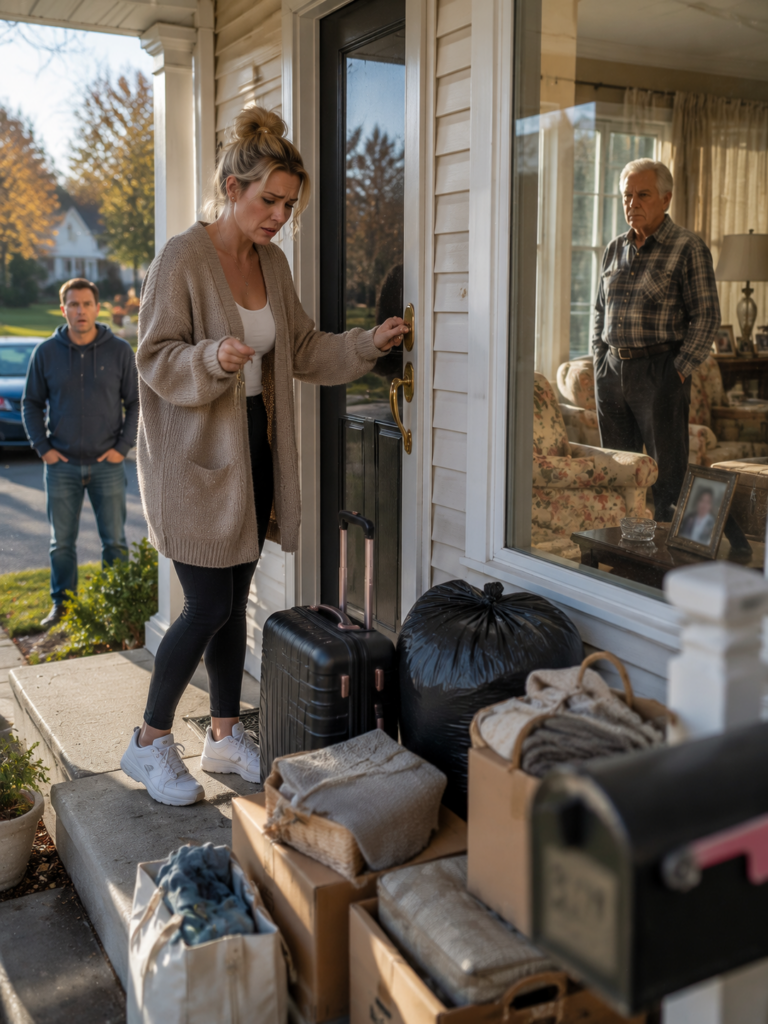
“I left things here,” she said.
“You left one file box and two garment bags after telling Kyle you had everything. They’re on the porch bench.”
She turned and saw them for the first time: a labeled banker’s box, neatly taped, and two garment bags hanging from the porch swing hook to keep them off the floor. On top of the box sat a manila envelope with her name on it. Inside was a copy of the inventory list Phil had told me to make and the certified letter I had mailed that morning documenting the remaining property transfer.
Everything clean.
Everything dated.
Everything impossible to argue with in any useful way.
Her face changed.
Not because of the box. Not even because of the paperwork.
Because over my shoulder, through the open slice of the doorway, she could see the living room.
She could see Carol’s oak table back in the center where it belonged. She could see my chair returned to its old place. The throw pillows she had bought were gone. The brass tray she had put on the mantel was gone. The air itself looked different, cleaner, settled, like a house that had rejected an infection.
For the first time since I had known her, Renee looked unsure.
“You changed everything back,” she said.
“No,” I said. “I put it back.”
She drew herself up. “Kyle said the door was always open.”
“For Kyle,” I said.
That landed.
She looked at me as if she had only just understood that not every courtesy extended to a son automatically covered the woman standing beside him.
“You’re unbelievable,” she said.
“No,” I said quietly. “I was unbelievable four months ago when I let this go on as long as I did.”
Her mouth tightened.
For one strange second, I thought she might cry. Not from remorse. More likely from the shock of finding a limit where she had expected another negotiation. Some people cannot tell the difference between kindness and access until access is taken away.
She pointed toward the file box.
“I need my things.”
“They’re right there.”
“I mean inside.”
“No.”
“Walter—”
“I’m not discussing this on my porch at midnight.”
She looked over my shoulder again. I knew what she was seeing now that her eyes had adjusted: the lamp back by the window, the floors cleared, the framed photograph of Carol and me on the shelf where Renee had once replaced it with a ceramic vase.
Houses speak.
People forget that.
Restore the right objects to the right places, and a house tells the truth about who belongs inside it.
“I can’t carry all that by myself,” she said.
“I’ll set the box closer to your truck.”
That answer offended her more than refusal would have. It gave help without surrender. It recognized effort without regranting entry.
I stepped out, pulled the box to the top of the steps, and kept my body between her and the doorway the entire time. Up close, I could smell cigarette smoke on her coat.
From somewhere down the road came the low hum of a pickup passing in the dark. The night insects were loud in the grass. The creek moved softly out back.
“You really think you’re the victim in all this?” she said.
“No,” I said. “I think I’m the homeowner.”
She had no reply ready for that.
For a long second, neither of us spoke. Then she snatched up the envelope, grabbed one garment bag, and marched to the truck. She came back for the box with visible effort and made a point of bumping it against the porch rail. I did not react. She loaded the last of it, slammed the passenger-side door harder than necessary, and sat there a moment staring straight ahead.
I waited.
Finally, the truck reversed down the drive, brake lights washing red over the mailbox before disappearing into the trees.
Only then did I go back inside and lock the door.
The quiet after that was unlike any quiet the house had held in months.
Not empty.
Not lonely.
Restored.
I checked the deadbolt once more, turned off the foyer lamp, and went back into the kitchen. My coffee had gone cold again, so I poured it out and made another pot. There was something almost funny about that, how many times in one season a man can stand over a sink letting cold coffee go and decide to begin again anyway.
Kyle called six weeks later on a Sunday evening.
That is the day he has always called, though I do not think he has ever realized it. Even in college, when his schedule made no sense and his laundry smelled like a biology experiment, Sunday evening was when the phone would ring.
“Hey, Dad.”
“Hey.”
We talked twenty minutes. Work. Football. Weather. The ordinary scaffolding men use when they are trying to rebuild a bridge without staring at the water below it.
He had found a job in Murfreesboro, good enough money, decent benefits. He said things at home were “complicated.” I did not ask what complicated meant. A father can love his son without demanding the private inventory of his marriage.
Right before he hung up, he said, “I’m sorry it went the way it did.”
I sat there with the phone in my hand and looked into the living room where the lamp glowed warm against the new curtains.
“Me too,” I said.
A pause.
Then he said, “I should’ve handled it differently.”
“We both should have,” I said. “But here we are.”
Another pause, lighter this time.
“I’ll come by sometime,” he said. “See the house.”
“Anytime,” I told him. “Door’s open.”
And I meant it.
For him, I meant it.
After we hung up, I poured a small glass of bourbon and sat in my chair in its proper place. Outside, dusk was settling over the tree line. The creek made its low familiar sound. The porch light clicked on by itself, same as always. Somewhere in the side yard, tree frogs had started up, steady as old machinery.
I thought about what Earl Finney had said to me at the diner during the worst of it.
Your home is not a favor you owe anyone.
At the time, I had just nodded, thrown cash on the counter, and left. But sitting there that evening in my own chair, in my own living room, with my wife’s picture back where it belonged and the house smelling like itself again, I finally understood what he meant.
A home is not a favor.
It is not a resource to be distributed to whoever reaches for it with enough confidence. It is not proof of your generosity if you let people erase you inside it. A home is the physical shape of a life. The walls holding years. The floors remembering footfalls. The porch where you drank coffee with your wife. The back room where your son did algebra homework badly and your daughter practiced clarinet worse. The kitchen where grief sat down with you after the funeral and stayed so long you learned to live around it.
That kind of place is worth protecting.
Not because you are cruel.
Not because you are stubborn.
Because clarity is not cruelty.
And because love without limits turns sour in a hurry.
If I could go back, I would change the beginning, not the end. I would draw the line the first week. The first lamp. The first cigarette. I would say, kindly and plainly: I am glad you are here. I want to help you. And here is what being here means.
I would understand sooner that boundaries are not hostility. They are structure. They are respect made visible. They are the beams inside the walls.
But life does not give many do-overs. It gives you consequences, and if you are lucky, it gives you enough honesty to learn from them.
So that is what I learned.
Draw the line early.
Not loudly. Not meanly. Not with speeches and threats and all the grand theater people mistake for strength. Draw it quietly. Draw it clearly. Draw it with the calm certainty of a person who knows what belongs to him and what does not.
The clearest love I know now is the kind that says: I’m glad you’re here. And here are the terms. They are not punishment. They are not negotiable. They are simply the shape of a life already built.
That night I finished my bourbon while the last of the daylight thinned behind the trees. The house settled around me the way a faithful thing settles when it recognizes the hand that has come back to it. And for the first time in a long time, everything in it was exactly where it was supposed to be.
THE END.
✅ End of story — Part 3 of 3
← Read from Part 1