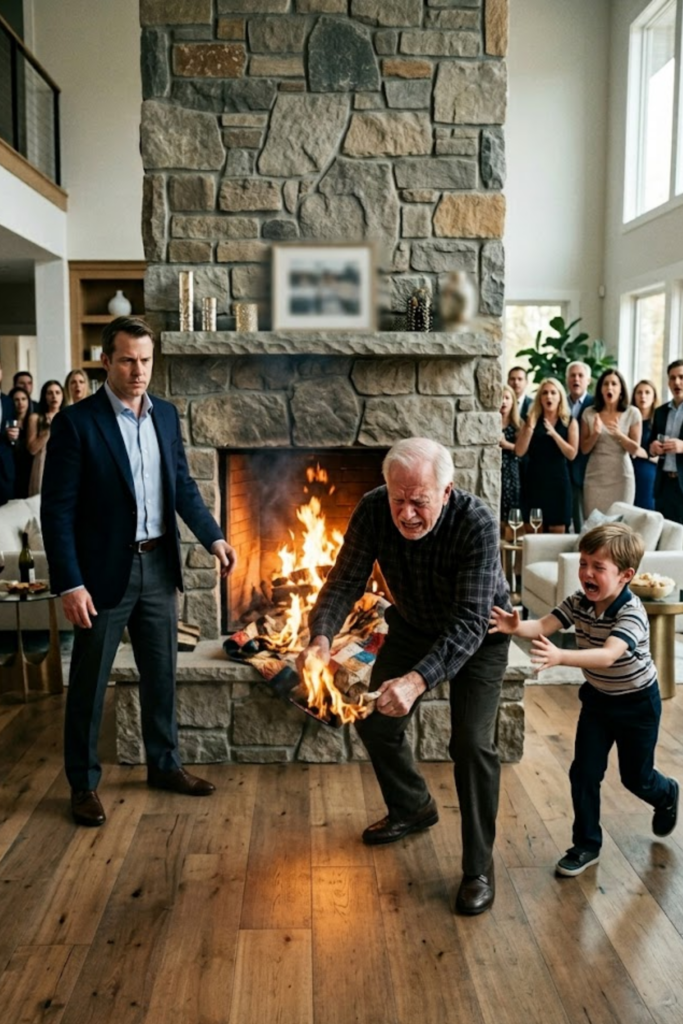
The moment my son threw his mother’s quilt into the fireplace, I learned there are fires that burn cloth, and there are fires that show you exactly what a man has become.
I was standing in the middle of James’s new living room, surrounded by sixty people who smelled like expensive cologne, champagne, and polished money, holding the last thing my wife Dorothy had sewn before pancreatic cancer took the strength from her fingers. The quilt was folded across my forearms, heavy with cotton batting, blue-and-white stars, and the kind of love that cannot be bought because it takes a lifetime to stitch.
My grandson Noah was eight years old. He stood ten feet away from me in a little navy blazer, his hair combed too neatly, his shoes too stiff, his brown eyes fixed on the quilt like he had been waiting his whole short life for it. He had Dorothy’s eyes. That was the thing that hurt me most. Not just the color, though that was there, but the way they held feeling without apology. Dorothy could look at you and make you remember the truth you had been trying not to say. Noah had that same gift, though at eight he did not yet know it.
My son knew it.
That was why he tried so hard to train it out of him.
James Brannigan was forty-four that year, chief of orthopedic surgery at Dallas Metropolitan, owner of a four-million-dollar mansion outside Dallas, and a man who had learned to speak in a tone so smooth people often mistook cruelty for confidence.
He stood beneath a crystal chandelier with a bourbon glass in one hand and a surgeon’s smile on his face, the same smile I had seen him use in hospital fundraisers, magazine photographs, and Christmas cards where his wife Claire looked perfect and his son looked quietly afraid.
The housewarming party was supposed to be a celebration. That was what the invitation said, anyway. Heavy cream card stock. Gold lettering. An embossed return address I had read twice because I still could not believe my son lived behind iron gates on six acres of land while the little yellow kitchen where he had learned to spell his name still had the same worn linoleum Dorothy and I laid down in 1987.
I had driven from Fort Worth in my old pickup wearing my good flannel shirt, the one Dorothy had ironed the night before she went to the hospital for the last time.
The shirt smelled faintly of cedar because I kept it in the chest at the foot of our bed, wrapped in tissue paper like something sacred. I knew it was foolish to wear flannel to a mansion full of surgeons, donors, pharmaceutical executives, and women who carried handbags worth more than my truck, but I was seventy-one years old and had spent forty-three years building things with my hands. At a certain point, a man stops trying to look like he belongs in rooms built to make him feel small.
Besides, Dorothy had liked that shirt.
She said it made me look like the man she married.
That had been enough.
The mansion sat at the end of a curved driveway lined with small imported trees that probably had Latin names and a monthly maintenance bill. The front doors were taller than any door had a right to be. Inside, the foyer opened into a living room of marble floors, glass walls, white furniture nobody’s child should be allowed to touch, and a fireplace built from gray stone that rose two stories high. A decorative fire burned behind a glass screen even though it was warm outside, because rich people like to pay for the idea of coziness without needing it.
I had carried the quilt inside myself.
Dorothy had made me promise that.
“Don’t mail it,” she had whispered from the hospital bed we had set up in our living room because she wanted to die where the morning light came through the kitchen curtains. “Don’t hand it to James. Give it to Noah yourself. Directly. Promise me, Walter.”
“I promise, Dot,” I told her.
Her hand had closed around my wrist with surprising strength for a woman whose body had been reduced by illness to angles and pain. “Not to James. To Noah. That matters.”
I had not understood why then.
I understood part of it when James saw the quilt.
He spotted me from across the living room near the catered bar. His smile changed before his mouth did. I knew that expression. A father knows the first shadows of his child’s face better than his own. James had looked like that as a boy when he broke something and tried to decide whether lying would be worth the risk. As a man, that calculation had become colder and faster.
“Dad,” he said, crossing the room with his bourbon glass held low. “What is that?”
“Your mother’s quilt,” I said. “For Noah.”
The air around us shifted.
A few guests kept talking. A few turned slightly, drawn by the tone beneath our words. Claire, my daughter-in-law, stood near the staircase in a pale silk dress, one hand resting on Noah’s shoulder in a way that looked protective until you noticed he did not lean into it. Her blond hair was pulled back perfectly, her diamonds small enough to seem tasteful and large enough to announce themselves. She watched the quilt as if I had brought roadkill into her marble living room.
Noah broke free before she could stop him.
“Grandpa!” he shouted, and for one second the whole house became bearable.
He ran across the room, thin legs flashing, face lit with the kind of joy children offer before adults teach them to measure it. I bent down carefully, because my knees were not what they had once been and because I wanted my eyes level with his.
“Hey, buddy.”
“Is that Grandma’s blanket?” His voice trembled with hope. “The one with the stars?”
“She made it for you,” I said. “Every single stitch.”
Noah reached out with both hands.
Claire arrived first.
“Noah, sweetie,” she said, placing her hand back on his shoulder, “that’s very old.”
The way she said old made it sound contagious.
Noah frowned. “Grandma made it for me. She promised.”
“I know,” Claire said, not like she knew at all. “But we have beautiful Egyptian cotton bedding upstairs. Much nicer.”
Much nicer.
I looked down at Dorothy’s quilt.
It was blue and white, her favorite star pattern, the points sharp and clean even after years of her hands growing weaker. The fabric came from dresses she had worn, shirts James had outgrown, scraps from curtains she made in our first house, and pieces she had saved from quilts she gave away to every baby, widow, and sick friend within twenty miles of our kitchen. It was not fashionable. It was not modern. It did not match James’s white furniture or Claire’s museum-like rooms.
It was love made visible.
James stepped closer. I could smell the bourbon then. Expensive, yes. But bourbon at three o’clock in the afternoon is still bourbon at three o’clock in the afternoon.
“Dad,” he said, lowering his voice just enough to pretend this was private while ensuring the nearest guests could hear if they wanted to. “Mom’s gone. It’s been two years. You can’t keep showing up with her things like she’s still here. It isn’t healthy. For you or for Noah.”
Dorothy had been gone two years, one month, and six days.
I knew because time had stopped being a straight road after she died. It became a house full of rooms I entered without warning. Some days I lived in the present. Some days I was back in the hospital bed beside her, counting the seconds between her breaths. Some days I was forty years younger, watching her laugh at a county fair because powdered sugar from a funnel cake had landed on my nose.
“She wanted him to have it,” I said.
“And I want my son to have the best of everything.”
There it was.
The sentence that explained my son better than any diagnosis could have. The best of everything, by which James meant the most expensive version of everything. The house. The cars. The private school. The clothes. The vacation photos. The kind of childhood designed to impress other adults more than comfort the child living it.
“Grandma’s quilt is the best,” Noah said quietly.
James looked down at him.
I saw the boy shrink.
It was small. A barely noticeable drawing inward of his shoulders, a quick lowering of his eyes. But I had built houses long enough to know a foundation crack when I saw one, and in that second I saw a fracture running through my grandson that no child should have had.
“Don’t be dramatic,” James said.
He took the quilt from my arms.
Not asked. Not accepted. Took.
For a second I was too stunned to resist. That is the truth I have had to live with. I let go because my mind had not caught up with what my body understood too late. James held Dorothy’s quilt away from himself, pinched between both hands as if it smelled bad.
“This ratty old blanket doesn’t belong in this house,” he said.
The room went quiet.
Not fully silent. Parties rarely stop all at once. A glass clinked somewhere. Ice shifted in a bucket. Someone gave a nervous little laugh and then swallowed it. But the current changed. People turned. Noah’s face went pale. Claire’s lips parted, though whether in surprise or calculation I could not tell.
“James,” I said.
He did not look at me.
He walked three steps to the fireplace.
The fire behind the glass screen was meant to be decorative. Neat logs. Controlled flames. Something for guests to admire while standing too close to marble. James opened the screen with one hand and threw the quilt into the fire.
Noah screamed.
Not a tantrum.
A wound.
“Daddy, no! Grandma made that! She promised me!”
The corner caught first.
Blue fabric curled black. White stars darkened. Flame moved along the edge with greedy little tongues. Smoke rose, carrying with it the smell of cotton, batting, and something older than grief.
For a few seconds I heard nothing.
Not Noah screaming. Not Claire saying his name in a sharp whisper. Not James turning back toward the guests with that practiced smile and saying, “Kids get attached to the strangest things. More champagne, anyone?”
I heard Dorothy.
“Anger wasted loud is anger wasted twice,” she used to say.
She usually said it when I wanted to shout at a crooked supplier or a county inspector who thought a carpenter was a man to be talked down to. Dorothy had a temper of her own, but she believed anger should be used like a good blade: sharpened, aimed, not swung around the room until everyone bled.
So I did not shout.
I walked to the fireplace.
I opened the glass screen.
And I reached into the flames with my bare hands.
Pain is a clean thing when it first arrives. Honest. Immediate. Fire bit into my palms and fingers as I grabbed the quilt and pulled it free. A woman behind me gasped. Someone said, “Oh my God.” Noah was sobbing now. The quilt smoked in my hands, embers glowing along one corner. I dropped it onto the marble floor and smothered the flames with my sleeves, pressing down until the fire died.
My hands were burning.
I did not look at them.
I looked at my son.
He stood near the bar, face tight, eyes narrowed, embarrassed less by what he had done than by the fact that I had made everyone see it. There was a time when those eyes had looked up at me from a little league field, searching for approval after a hit. A time when those hands had held mine crossing busy streets. A time when he had cried against Dorothy’s shoulder because a stray dog we found on the road could not be saved.
Somewhere between his first scalpel and his first Mercedes, I had lost him.
“Your mother left Noah more than a blanket,” I said.
The words came out quiet, but the room heard them.
James’s expression changed.
“What are you talking about?”
I did not answer.
I wrapped the damaged quilt carefully, tucking the burned edge inside so Noah would not have to see it again. Then I knelt in front of my grandson. He was crying into Claire’s dress, but Claire was not holding him. She was checking her phone, thumb moving across the screen as if the worst thing happening in the room was an inconvenience she needed to schedule around.
“Noah,” I said softly.
He turned toward me.
His face was wet. His mouth trembled.
“Grandpa’s got the quilt safe,” I told him. “Just like Grandma wanted.”
“Is it ruined?” he whispered.
“No, buddy. It’s hurt. Hurt is not the same as ruined.”
He stared at me, breathing hard.
“Can I still have it?”
I glanced at James, then back at Noah.
“You will.”
James made a sound under his breath.
I stood, tucked the quilt under my arm, and walked out.
Nobody stopped me.
That may be the part that shames me most when I think back on that room. Sixty adults. Doctors, lawyers, hospital administrators, donors, neighbors, people who knew how to speak at charity dinners about compassion and community. They watched a man burn his dead mother’s last gift in front of his child, and most of them looked away because looking away is easier when the house is expensive enough.
The front doors closed behind me.
The Texas afternoon hit my face, bright and indifferent.
I walked to my truck with the quilt under my arm and my hands throbbing in time with my heartbeat.
The drive back to Fort Worth took forty-five minutes on I-35, but it felt like forty-five years.
The quilt sat on the passenger seat, smelling of smoke and heartbreak. I kept glancing at it like it was a wounded animal. My hands were starting to blister. Every time I flexed my fingers, pain shot up my wrists. I should have gone to urgent care. I should have called someone. I should have done a lot of things old men with sense do.
Instead, I drove home to the yellow kitchen.
My house on Elm Street is nothing special to anyone but me. Three bedrooms, one bathroom we remodeled in 1998, a small porch, a detached workshop out back, and a kitchen Dorothy painted yellow because she said yellow kitchens made food taste better. I had argued for white. She had ignored me. She was right, as she was about most things.
I carried the quilt inside and laid it across the kitchen table.
Then I went to the sink and ran cold water over my hands.
The pain sharpened under the water until my knees felt loose. I leaned against the counter and breathed through my teeth. Second-degree burns on three fingers, blisters rising on the heel of one palm, red streaks across my knuckles. I had gotten worse injuries on job sites, though not many. Pain did not scare me. The reason for it did.
When the sting settled into something I could think around, I wrapped my hands in clean dish towels and went back to the table.
The quilt lay there under the overhead light.
One corner was blackened, a few patches singed, the binding scorched along one edge. But most of it had survived. Dorothy had used thick batting and tight stitching. She built things to last. I had taught her how to square a cabinet door once, and she had repaid me by teaching me that cloth could be architecture if the hands were patient enough.
I spread the quilt carefully across the table.
The blue-and-white stars seemed to move in the light. Dorothy’s specialty. She used to say stars were promises the dark could not keep hidden. I ran one bandaged finger along the center star, then stopped.
It felt wrong.
Heavier.
Thicker than the rest.
At first I thought it was fire damage. Then I pressed another section. No. The center star had always been thicker. I simply had never noticed because I had never gone looking.
A memory came back so suddenly I sat down hard.
Dorothy in the hospital bed in our living room.
Late afternoon light. The air smelling faintly of antiseptic, lavender lotion, and the chicken soup Mrs. Ramirez from two doors down insisted on bringing even after Dorothy could no longer eat more than a spoonful. The oxygen machine hummed beside the sofa. Rain tapped against the kitchen window. Dorothy’s hands lay on top of the quilt she was still trying to finish even when holding a needle made her wince.
“Walter,” she whispered.
I leaned close.
“I’m here, Dot.”
“I need you to give this quilt to Noah.”
“I will.”
“Not to James.”
Her eyes opened wider then, fierce despite the pain. “To Noah directly. Promise me.”
I tried to smile. “You think James won’t let his own boy have a quilt?”
She tightened her fingers around my wrist.
That was when I understood she was not drifting in and out the way the hospice nurse said she might. She was clear. More clear than anyone else in the room.
“James has forgotten what matters,” she said. “And if he has forgotten, he will throw away anything that reminds him of who he used to be.”
I swallowed.
Dorothy had never spoken of our son that way before, not even during the worst arguments, not even after he stopped visiting as often, not even after he told her the experimental treatment in Houston was not worth the financial risk.
“This quilt is Noah’s protection,” she said.
“Protection?”
“There’s more in it than stitches. You’ll understand when the time comes.”
“What does that mean?”
She closed her eyes, exhausted.
“Promise me.”
“I promise.”
She died four days later at 5:17 in the morning, holding my hand while rain fell on the roof of the house she had loved for thirty-eight years.
Now, two years later, in the yellow kitchen, I finally understood the first part of her warning.
James had thrown the quilt away.
The second part still sat hidden beneath my hands.
“There’s more in it than stitches,” I said to the empty room.
Dorothy’s photograph hung on the wall near the pantry. She was smiling in that picture, standing in our backyard beside a table full of tomatoes from the garden, one hand on her hip like she had personally negotiated with the sun. I looked at her face and felt the old ache open again.
“What did you do, Dot?”
The next morning, I drove to Maggie Chen’s quilting shop on West Magnolia with my hands wrapped in gauze and Dorothy’s quilt folded carefully in a clean sheet.
Maggie had been Dorothy’s quilting partner for more than twenty years. The two of them met at a church craft sale and became inseparable in the specific way women do when they recognize each other’s competence. Maggie was ten years younger than Dorothy, sharp-eyed, small-framed, and capable of saying “bless your heart” in a tone that could peel paint off a door. Her shop smelled of cotton, steam, and old wood. Bolts of fabric lined the walls like a library of color.
The bell above the door chimed when I entered.
Maggie looked up from her cutting table.
Her scissors froze mid-snip.
When she saw the quilt in my arms, her face changed.
“Oh, Walter,” she said softly. “It happened?”
I stopped.
“What do you mean?”
She set down the scissors.
“Dorothy told me this day might come.”
My heart thudded once.
“What day?”
Maggie came around the table and touched the sheet wrapped around the quilt. “The day someone tried to destroy it.”
The room seemed to tilt slightly.
“You knew?”
“Not everything.” She looked at my bandaged hands. “Sit down before you fall down.”
“I’m not going to fall.”
“Walter Brannigan, you are seventy-one years old, burned, grieving, and stubborn. Sit.”
I sat.
Maggie closed the front door and turned the sign to Back Soon. Then she spread the quilt across her work table, her hands moving over it with the reverence of a woman touching another woman’s last words. She inhaled sharply at the burned corner.
“James?” she asked.
I nodded.
Her mouth tightened.
“Dorothy was right to worry.”
For several minutes, she said nothing more. She pressed along seams, measured thickness with her fingers, bent close to inspect stitching. Watching her work reminded me of watching a surgeon, which nearly made me laugh in a bitter way I would not have enjoyed explaining.
Maggie stopped at the center star.
“This batting is wrong.”
“What does that mean?”
“Dorothy never used uneven batting unless she had a reason.” She pulled a seam ripper from a drawer. “Standard cotton batting compresses about a quarter inch. This section is over an inch.”
My hands hurt. My chest hurt worse.
“Should we be cutting it?”
Maggie gave me a look. “I am not cutting anything. I am opening what Dorothy designed to be opened.”
She worked along one seam of the center star with delicate precision. Thread lifted. A small hidden pocket loosened. She reached inside and pulled out a clear plastic sleeve.
I stood so fast the chair scraped behind me.
Inside the sleeve were documents.
Not photographs.
Not recipes.
Not a letter.
Documents with seals, signatures, notary stamps, and the kind of official formatting that makes a room suddenly feel too small.
Maggie opened the sleeve and laid the first page flat.
Property deed.
Travis County, Texas.
Two hundred twelve acres along the Colorado River, approximately twelve miles southeast of Austin.
Held in trust for Noah James Brannigan.
Dorothy Elaine Brannigan, grantor.
My wife’s signature sat at the bottom, dated March 2019.
I stared at it until the words blurred.
Maggie pulled out the second document.
Another deed.
One hundred forty adjoining acres.
Same trust.
Same beneficiary.
Same signature.
The third document was a letter from a real estate attorney confirming the trust structure and appraised value as of 2021.
Three hundred fifty-two acres.
Noah James Brannigan, sole beneficiary.
Walter Thomas Brannigan, trustee.
My name.
I gripped the edge of the table.
“What is this?”