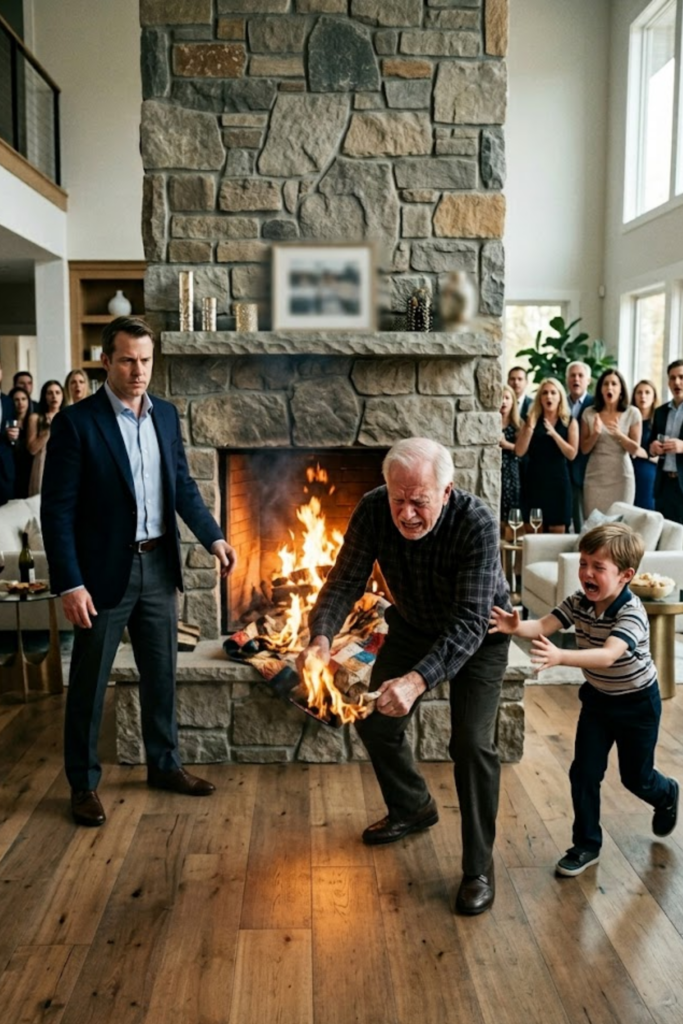
Maggie was already pulling out her phone.
“Land near Austin,” she murmured. “Along the Colorado River. Walter, do you know what that corridor is worth now?”
I shook my head.
I knew lumber prices. Concrete prices. What a decent table saw cost. I knew what my house might sell for if I ever lost my mind and let it go. I did not know what river acreage near Austin was worth in a state where tech money had turned old pastureland into gold.
Maggie searched sales records, comparable acreage, development reports.
Her face went pale.
“Walter.”
“What?”
She did the math once. Then again.
“Comparable acreage in that area sold last year for around ninety-two thousand an acre.”
The number meant nothing to me at first.
Maggie turned the phone toward me.
“Three hundred fifty-two acres at that price is over thirty-two million dollars.”
I sat down again.
Not because she told me to.
Because my knees stopped consulting me.
Thirty-two million dollars.
The words did not belong in the same room as Dorothy’s quilt, my burned hands, and the woman I had watched clip coupons at the kitchen table for forty years.
“That’s impossible,” I said.
Maggie kept searching through the quilt.
“It isn’t.”
“She was a nurse. I was a carpenter. We lived on two modest incomes our whole lives. We drove used cars. We fixed our own roof. We—” My voice broke. “How could she have bought land worth thirty-two million dollars?”
Maggie found the answer in three more hidden pockets.
Dorothy had built a history in cloth.
Starting in 1986, two years after James was born, she had begun buying small parcels of undeveloped ranchland outside Austin. Five acres here. Ten there. Fifteen when overtime was good. She bought from a rancher named Hector Medina and later from his sons. The first documents were old, some yellowed, some copied and recopied, each preserved in plastic and sewn inside the quilt like a heartbeat.
Hector Medina’s wife had been one of Dorothy’s patients.
Maria Medina, hospice, 1985.
Dorothy had cared for her during the last months of her life, driving down on her days off when the family needed help and the hospital could not provide enough. Hector, grateful and aging, began selling off pieces of unused land. Nobody wanted it then. Brush, limestone, scrub oak, too far from Austin to interest anyone, too awkward for big ranchers, too dry for dreamers.
Dorothy bought what she could, when she could, using savings from nursing shifts, overtime, and money she never spent on things other people thought women deserved.
No fancy jewelry.
No cruises.
No new furniture unless the old broke beyond repair.
No telling even me.
For thirty-five years, my wife had quietly bought land piece by piece.
Then Austin exploded.
Tech companies moved in. Developers followed. Roads expanded. River acreage became rare. What had been brush and patience became generational wealth.
And Dorothy had not told a soul.
Maggie found the final pocket inside one of the smaller stars near the edge, the one Noah always used to point at when he was little because he said it looked like it was running away from the others.
Inside was a letter.
Dorothy’s handwriting.
My dearest Noah,
If you are reading this someday, it means the quilt found its way to you, or at least to someone who loves you enough to protect what is inside it.
This land is yours. Not your father’s. Not your mother’s. Yours.
I bought it piece by piece over your daddy’s whole lifetime using money I saved from nursing shifts, overtime hours, and all the little luxuries I found I could live without. I did not tell many people because land grows best in peace, and so do children.
If your father treasures this quilt, then maybe he remembers what I tried to teach him about love, work, and family. If he throws it away, then pride has taken more from him than I feared, and you may need this land to build a life he cannot control.
I hope you never need it for that reason. I hope your father remembers himself before then. But hope is not a plan, and your grandma believed in plans.
You are not valuable because of this land. The land is valuable because it gives you choices. Never let anyone confuse those two things.
I love you to the moon and the stars I sewed for you.
Forever,
Grandma Dorothy
I read it four times.
By the fourth, the words were swimming.
Maggie stood beside me, one hand over her mouth.
“Your wife,” she said, “was the smartest woman I ever knew.”
I wanted to laugh. I wanted to cry. I wanted to go home and shout at Dorothy’s photograph for keeping a secret too big for one man’s heart to hold. I wanted to thank her. I wanted to ask why she had not trusted me with it. I wanted to hold her hand and tell her she had been right about James, and I hated that she had been right about James.
“She knew,” I whispered.
Maggie nodded.
“She watched him.”
“We all watched him.”
“No,” Maggie said gently. “Most of us explained him. Dorothy watched him.”
That was the truth.
For years, I had explained James.
He was busy. He was under pressure. He was a surgeon; surgeons had to make hard decisions. He was surrounded by wealthy people now; of course his tastes changed. He loved Noah, he just had high standards. He loved Dorothy, he just did not know how to handle illness. He loved me, he just did not have time to visit.
Dorothy had seen what explanations cost.
She had built Noah a way out.
“What do I do?” I asked.
Maggie looked down at the quilt, at the hidden documents, at Dorothy’s letter, at my bandaged hands.
“You protect your grandson,” she said.
Monday morning, I sat in Rebecca Torres’s office in downtown Fort Worth with Dorothy’s quilt folded in a protective case on the chair beside me.
Rebecca had been recommended by Patricia Williams, a retired judge Dorothy had once cared for after a hip replacement. Patricia had loved Dorothy and trusted almost no one, which made the recommendation worth more than any advertisement. Rebecca specialized in estate law and child advocacy. Her office was on the tenth floor of a building overlooking the Trinity River, with shelves full of legal books and one framed photograph of a little boy holding a fishing pole.
She read everything twice.
I liked that.
The first time, she read like a lawyer. The second time, she read like someone who understood that documents can be weapons or shelter depending on who holds them.
“These deeds are legitimate,” she said finally. “And the trust structure is strong.”
“Strong how?”
“Irrevocable. Properly executed. Noah is the sole beneficiary. You are named trustee. Dorothy anticipated trouble.”
“She anticipated James.”
Rebecca’s expression did not change, but her eyes sharpened.
“Yes.”
I stared at the documents spread across her desk.
“Can James touch it?”
“No legal claim. Not as Noah’s father. Not as Dorothy’s son. Not unless he can remove you as trustee or gain some kind of control through Noah.”
My mouth went dry.
“How would he remove me?”
Rebecca leaned back slightly.
“That’s where this gets complicated.”
She opened another file.
“I did some preliminary research after you called yesterday. Your son’s financial situation is serious.”
I almost said James made eight hundred thousand dollars a year. Then I remembered the house, the cars, the parties, Claire’s diamonds, the bourbon, the way wealthy people can drown in deeper water because they insist on swimming with furniture.
“Serious how?”
“The mansion cost just over four million. He has two mortgages on it. Several credit lines. High-interest bridge loans. Vehicle leases. Country club debt. Private school commitments. And there is a pending malpractice-related matter that may not be fully resolved.”
I felt a coldness move through me.
“What matter?”
“Patient named Gloria Fernandez. Routine knee replacement. Complications. Hospital settled quietly, but the family is pursuing claims against James personally. There are allegations he was impaired during surgery.”
The room seemed to narrow.
“Impaired.”
“Possibly alcohol. Possibly prescription medication. The complaint is careful, but the implication is there.”
I looked down at my bandaged hands.
Expensive bourbon at three in the afternoon.
“Could he lose his license?”
“If the medical board investigates and the allegations are supported, yes.”
Dorothy’s quilt sat beside me, quiet as a sleeping witness.
Rebecca folded her hands.
“Walter, if James learns about the land, he will likely come after it.”
“He burned it.”
“He burned the quilt because he thought it was worthless. If he learns it contains access to thirty-two million dollars, his view may change.”
“What can he do?”
“First, pressure you. Then discredit you. Possibly seek to challenge your capacity as trustee.”
I looked at her.
“Capacity?”
“Conservatorship or guardianship proceeding. He could claim you’re elderly, confused, emotionally unstable, no longer fit to manage trust assets. If a court agreed, he could petition to have himself or a professional aligned with him appointed.”
“He’d try to put me in a home?”
Rebecca did not soften her answer.
“He might try to have you declared unable to manage your affairs. The incident at the housewarming—reaching into a fire with your bare hands—could be framed as erratic or self-harming behavior.”
I almost laughed at the neatness of it.
My son had created the crisis, and my rescue of the quilt could become his evidence against me.
Dorothy had been right.
It was not enough to love Noah.
I would have to build a case around him.
“What do we do?” I asked.
“We move fast,” Rebecca said. “Independent medical evaluation to establish your competency. Statements from people who know your daily functioning. Documentation of your trustee responsibilities. Updated appraisal. Security of original documents. And we need to assess James’s parental fitness.”
“That sounds like war.”
“It is not war,” she said. “It is protection. But men who confuse control with love often experience protection as an attack.”
She slid a business card across the desk.
Carlos Vega. Private investigator. Former Texas Ranger.
“If James has vulnerabilities that affect Noah’s safety or the trust, Carlos will find them. I want facts, not rumors. We do this clean. Everything documented. Everything admissible.”
I picked up the card.
Rebecca’s voice softened.
“Walter, I need you to understand something. This is no longer about a quilt.”
“It never was.”
She nodded.
“No. I suppose Dorothy knew that before anyone.”
The next nine days taught me that when money, pride, and fear occupy the same house, they do not sit quietly.
Carlos Vega called me Tuesday evening from his car parked down the road from James’s mansion. His voice was calm in the way former law enforcement men learn to be calm when the facts are ugly.
“I’ve been on him forty-eight hours,” he said. “It’s bad, Walter.”
I sat at my kitchen table with Rebecca on speaker and Dorothy’s quilt in a protective garment bag hanging on the back of the pantry door because I could not bear to let it out of my sight.
“How bad?”
“Financial desperation bad. Flight risk bad. The kind of bad where rich people start making poor criminal choices.”
Carlos did not waste words. Over the next three days, he assembled a file that made me feel like I had been watching my son through frosted glass for years and someone had finally cleared a circle.
James had been moving money offshore for months, small increments routed through accounts designed to avoid attention. Not enough to vanish cleanly, but enough to try. He had booked one-way flights to Grand Cayman for himself, Noah, and a woman named Kristen Mercer.
Not Claire.
Kristen.
Twenty-nine years old. Pharmaceutical sales representative. Seven months into an affair with my son. Employed by a company whose painkillers James had been prescribing at rates high enough to interest regulators if anyone knew where to look.
“She’s not just a girlfriend,” Carlos said. “She’s tied to the drug side of his practice. There may be kickbacks. We’re still documenting.”
I rubbed both hands over my face, careful of the burns.
“He’s taking Noah?”
“Yes.”
“Claire knows?”
“Not all of it. Maybe not any of it.”
“Why take Noah?”
Carlos was quiet for half a second.
Then he said, “Because he knows Dorothy left something.”
The text messages made that clear.
James to Kristen: Tickets confirmed. New life starts the 12th.
Kristen: What about your kid? Can he stay with your wife?
James: Noah comes with me. Claire’s useless without my money. But the kid has a trust fund worth millions. Dorothy left something. I don’t know details yet, but I need to control it.
Kristen: Millions? Then definitely bring him. We’ll figure out the rest in Cayman.
I read the messages until the words blurred.
My son was not taking Noah because he loved him.
He was taking Noah because Noah had become a vault with a heartbeat.
Carlos found more.
School counselor notes. Teacher observations. Records that had sat in folders while I drove over for birthdays and holidays believing Noah was simply shy, believing James was merely strict, believing Claire’s distant parenting was a style rather than absence.
Noah Brannigan, age eight, exhibits persistent anxiety regarding academic performance. Describes fear of father’s reactions to grades below A level. Frequently asks teacher if his work is good enough.
Six months earlier: Noah arrived visibly upset. Stated father told him he was lazy and that lazy boys do not deserve nice things. Asked if he could stay at school over the weekend.
Three months earlier: Noah flinched when classroom door slammed. Became very still and quiet when adult male teacher raised voice. Pattern consistent with exposure to verbal aggression in home.
Fourteen months of fear, documented in careful professional language.
I had been a carpenter all my life. I knew what rot looked like when it hid inside walls. From outside, the paint looked fine. Inside, the wood was turning to powder.
Noah had been living in a house with marble floors and rotting air.
The worst piece was security footage Carlos obtained through legal channels from a hallway camera near the private school entrance. James picking Noah up after an art event. Noah holding a painting carefully in both hands.
“Look, Daddy,” Noah said on the video. “I painted our family. That’s you and me and Mommy and Grandpa.”
James barely glanced down.
“Why is everyone the same size? We talked about proportions.”
“My teacher said it was creative.”
“Your teacher hands out participation trophies.”
James crumpled the painting.
Just like that.
He dropped it on the floor.
“When you can paint something worth looking at, show me then. Go do your homework.”
Noah stood in the hallway after James walked away. He stared at the crumpled paper. Then he picked it up, smoothed it against his chest, folded it carefully, and tucked it into his backpack. His shoulders curled inward until he looked like he was trying to disappear inside his blazer.
I had to leave the room.
I made it to the back porch before my knees gave out.
For several minutes I sat on the porch step, breathing into the evening air while my burned hands throbbed and my chest felt too small for the grief inside it. I had failed Noah. That was not the whole truth, perhaps, but it was the truth my heart knew first. I had loved him. I had visited. I had brought birthday gifts and Christmas books and stories about Dorothy. But I had let James’s house, title, money, and authority convince me that what I sensed was not enough to question.
Dorothy had questioned.
Dorothy had planned.
I had explained.
My phone rang while I was still on the porch.
James.
Carlos, still at the kitchen table with Rebecca on speaker, stepped into the doorway.
“Don’t answer,” he said.
I looked at the screen.
My son’s name glowed in my hand.
“I need to hear him,” I said.
Carlos’s face tightened. “Then put it on speaker.”
I answered.
“James.”
“Hey, Dad.” He sounded relaxed. Too relaxed. “Listen, about the housewarming. I overreacted with the blanket thing.”
I closed my eyes.
The blanket thing.
“Claire thinks I should apologize,” he continued, “but I need you to understand something. You can’t keep bringing Mom’s old stuff around Noah. It confuses him. Makes him emotional.”
“Noah loved his grandmother.”
“She’s gone, Dad.”
The warmth thinned from his voice.
“She has been gone two years, and you’re still living like she’s going to walk in any minute. It isn’t healthy.”
“I’m healthy enough.”
“Are you?” he asked.
Carlos began writing.
Rebecca’s voice, soft through the speaker on my kitchen table, said, “Let him talk.”
James sighed.
“From where I’m standing, a seventy-one-year-old man who shoves his bare hands into a fireplace needs professional evaluation. Claire and I are worried. We’ve been looking into care facilities. Nice ones. You’d be comfortable.”
There it was.
Rebecca had predicted it almost word for word.
“I don’t need a facility,” I said.
His mask dropped.
“Then stay out of my business and stop filling Noah’s head with stories about his dead grandmother. I don’t need a senile old man undermining my authority with my own son.”
Senile old man.
The words should have cut deeper than they did. By then, I had heard enough to know they were not diagnosis. They were strategy.
“Throw away the blanket, Dad,” he said. “It’s burned anyway. And don’t come around without calling first. Better yet, don’t come around at all.”
I looked through the kitchen doorway at Dorothy’s photograph on the wall.
“James,” I said, “tell me something.”
“What?”
“When your mother was dying, Dr. Hendrix told us about the experimental treatment in Houston. Immunotherapy. Sixty thousand dollars for a chance at more time. She asked you for help.”
Silence.
“She wanted to see Noah start third grade,” I said.
“Dad, don’t.”
“You told her no. Do you remember the words?”
“This is unfair.”
“You said sixty thousand dollars for eight months was not a sound investment.”
Carlos stopped writing.
Rebecca said nothing.
“Your mother’s life,” I said. “Not a sound investment.”
James’s voice turned to ice.
“She was dying anyway. I’m a doctor. I understood the math better than she did. The treatment had a twenty percent success rate. It would have been throwing money away.”
My hand tightened around the phone.
“You let your mother die to save sixty thousand dollars, then spent four point two million on a house.”
“This conversation is over,” James said. “Remember what I told you. Stay away from my family, or I will have you evaluated. And we both know what happens then.”
The line went dead.
For a moment, nobody moved.
Then Rebecca’s voice came through the speaker.
“We got it all.”
Carlos looked at me with grim satisfaction.
“Threats. Conservatorship language. Admission about Dorothy’s treatment. Character, motive, pressure. He just handed us a loaded file.”
I wanted that to feel good.
It did not.
It felt like hearing a door lock behind a boy I once knew.
The next week became war, no matter what Rebecca called it.
She filed emergency motions. Carlos tracked James’s movements. I underwent an independent medical evaluation with a neuropsychologist who made me remember lists of words, draw clocks, answer questions about my finances, and explain how I managed Dorothy’s estate. I passed everything. The doctor told me, kindly, that I showed no evidence of cognitive decline beyond normal aging. I told her normal aging was rude enough.
Friends gave statements. Maggie. Mrs. Ramirez. My doctor. The manager at the hardware store where I bought supplies weekly. My pastor, though I had not been in church as often as Dorothy would have liked. Even old clients wrote letters saying I had built decks, cabinets, and repairs for them within the past year, all completed correctly, all paid and documented.
Rebecca built the wall one brick at a time.
Carlos added uglier bricks.
The psychiatrist James hired to evaluate me without meeting me, Dr. Harold Beck, had been disciplined in two states for questionable conservatorship assessments. James paid him thirty-five thousand dollars, seven times his standard fee. A former partner at James’s surgical practice admitted James had offered him a percentage of future earnings if he signed a statement that I seemed erratic at the housewarming. Witness tampering, Rebecca said, her voice tight with controlled fury.
Then Claire called.
Her voice on the phone was breathless and bright with panic.
“Walter, I know about the land.”
I sat down at the kitchen table.
“What land?”
“Please don’t do that. James found something in Dorothy’s papers. I don’t know details, but there’s property worth millions. Whatever you’re planning, I want in.”