I closed my eyes.
There are people who surprise you in crisis by becoming better than you hoped. Claire was not one of them.
We met at a diner in Arlington because Rebecca wanted the conversation recorded in a neutral public place. Carlos sat two booths behind us wearing a baseball cap and pretending to read a menu upside down. Claire arrived overdressed for ten in the morning, sunglasses perched on her head, perfume arriving before she did.
She slid into the booth across from me.
“James is leaving me,” she said.
“I know.”
Her mouth tightened. “He’s taking Noah and some pharmaceutical girl to the Caymans.”
“I know that too.”
Claire looked startled, then recovered.
“I have proof. Photos. Texts. Hotel receipts. I’ll give you everything. I’ll testify against him.”
“What do you want?”
She leaned forward.
“Custody of Noah and half of whatever Dorothy left.”
There it was.
Half.
Sixteen million dollars, if she knew the numbers.
“What would you do with Noah?” I asked.
Claire blinked, as if the question were secondary.
“Well, I’d enroll him somewhere excellent. There are boarding schools in Connecticut. Switzerland, even. He’d get an incredible education.”
“He’s eight.”
“Children adapt.”
She waved one hand, the way people wave away smoke.
“I’m being realistic, Walter. I never wanted to be a hands-on mother. That’s what nannies are for. But with the right resources, I can provide opportunities. Stability. A future.”
“You’d send him away.”
“He’d thrive.”
The recording captured every word.
When I walked out of that diner, I understood something Dorothy must have understood long before I did: Noah had no parent in that house willing to love him without a price tag attached.
Two days before the scheduled hearing, Carlos called at midnight.
“James changed the flights,” he said.
I sat up in bed so fast my back protested.
“When?”
“Tomorrow night. Nine forty-five p.m. to Grand Cayman. Three passengers. James, Noah, Kristen. He knows the walls are closing in.”
By sunrise, Rebecca had filed an emergency custody petition.
The hearing took place at ten o’clock in Dallas family court, in a wood-paneled room that smelled of paper, coffee, and old arguments. Judge Patricia Okonkwo presided. She was in her sixties, sharp-eyed, with the stillness of someone who had heard every lie and lost patience with most of them.
James sat at the opposite table in a navy suit, looking concerned and handsome and wounded. If I had not known better, I might have believed him. That thought frightened me. Men like my son did not need to be convincing to everyone. They only needed to be convincing to the right person at the right time.
His attorney went first.
He painted a simple picture. Elderly father. Recent widower. Erratic behavior. Fire incident. Son deeply concerned. Need for evaluation, temporary conservatorship, protection of assets, family stability.
Then he called Dr. Beck.
Beck wore a gray suit and spoke in the practiced tones of a man who had sold certainty before. He discussed my supposed cognitive decline, impulsivity, grief-related deterioration, poor judgment, and the alarming nature of reaching into an active fireplace.
Rebecca listened without expression.
When her turn came, she stood slowly.
“Dr. Beck, your standard consultation fee for capacity assessments is five thousand dollars, correct?”
He shifted. “Approximately.”
“How much did James Brannigan pay you?”
“That is a private matter.”
Rebecca lifted a document.
“Your Honor, bank records show a thirty-five-thousand-dollar wire transfer from Dr. Brannigan to Dr. Beck, seven times the stated fee. I also submit disciplinary records from Oklahoma and Louisiana documenting sanctions for misleading evaluations in conservatorship matters.”
Judge Okonkwo leaned forward.
Dr. Beck stopped looking certain.
That was the beginning.
James testified next.
He performed beautifully at first. Loving son. Concerned father. Grieving family. A man forced into painful action by a parent’s decline.
Rebecca let him build the structure.
Then she removed the supports.
“Dr. Brannigan, you stated your father had a confused episode at a hardware store on Camp Bowie Boulevard on March third.”
“Yes.”
“He could not remember what he came to buy?”
“Yes.”
“Staff had to help him find the exit?”
“Yes.”
Rebecca turned toward the judge.
“Phone location records show Mr. Brannigan was at his workshop on Elm Street all day March third. Security footage from the hardware store shows no evidence of him entering that day. Did you fabricate this incident?”
James’s composure flickered.
“I may have mistaken the date.”
“You also described an incident at your father’s bank. Surveillance shows a routine transaction with no confusion. Did you fabricate that too?”
“No.”
“Are you currently under investigation by the Texas Medical Board for performing surgery while impaired?”
His attorney shot up. “Objection. Relevance.”
“Goes to credibility and motive, Your Honor. The petitioner is under professional investigation, facing civil liability, carrying substantial debt, and seeking control over family assets through a conservatorship claim built on false statements.”
Judge Okonkwo’s voice was cool.
“Overruled. Answer the question.”
James’s jaw tightened.
“There is a complaint. It is meritless.”
Rebecca played the phone recording.
My son’s voice filled the courtroom.
She was dying anyway. The treatment had a twenty percent success rate. It would have been throwing money away.
I stared at the table.
I did not want to look at James when Dorothy’s final months were turned into evidence. But perhaps that was fitting. He had reduced her life to math. Now his math could answer for itself.
Then came the school counselor’s notes.
The hallway footage.
Noah’s painting being crumpled.
The diner recording of Claire.
I never wanted to be a hands-on mother. That’s what nannies are for.
Then the flight records.
One-way tickets to Grand Cayman departing that night.
The courtroom changed by degrees. At first, people listened politely. Then uneasily. Then with the heavy silence of adults realizing a child had been standing in the middle of a disaster disguised as success.
Judge Okonkwo looked at James for a long time after Rebecca finished.
Then she spoke.
“This petition is not only without merit,” she said, “it appears to be a calculated attempt to use conservatorship proceedings to seize control of assets belonging to a minor child by discrediting the child’s grandfather.”
James’s face went pale.
“Petition denied with prejudice. I am referring this matter to the district attorney for investigation of potential elder abuse, witness tampering, perjury, and fraud. Furthermore, based on evidence of emotional abuse, parental unfitness, and imminent flight risk, I am granting emergency temporary custody of Noah James Brannigan to his grandfather, Walter Thomas Brannigan, effective immediately. Both parents are prohibited from unsupervised contact pending further review. Dr. Brannigan is to surrender his passport to the court today.”
The gavel came down.
I did not feel victorious.
I felt old.
Outside the courthouse, the Texas sun was blinding after hours under fluorescent lights. James was led away in handcuffs after refusing to surrender his passport and raising his voice at a deputy. His surgeon’s hands were cuffed behind his back. He looked at me once as they passed.
The hatred in his eyes was a living thing.
I remembered him at five years old, sitting on my shoulders at the Fort Worth Stockyards, laughing because the cattle were louder than he expected.
Then he was gone.
A CPS worker brought Noah to me an hour later.
He had his backpack, a stuffed dinosaur he had owned since he was three, and the stunned expression of a child who had learned not to trust sudden changes even when they might be good ones.
When he saw me, he ran.
“Grandpa!”
I knelt despite my knees and caught him against my chest.
His small body shook.
“Are we going home?” he asked. “To your house?”
“We’re going home,” I said, holding his face in both hands. “To the yellow kitchen, and the workshop, and Grandma’s quilt. For as long as you need.”
“Forever?”
“If you want.”
His lower lip trembled.
“Can we play Grandma’s quilt game? Where I find all the stars?”
“Every single night.”
That evening, I spread Dorothy’s quilt across Noah’s bed.
The room had been mine for storage, then became something else in a hurry. Fresh paint. Bookshelves. A secondhand dresser I sanded and refinished. A nightlight shaped like a star because Dorothy had loved stars. I had placed the quilt carefully over the bed after Maggie repaired the burned edge with fabric from one of Dorothy’s old dresses. The scorch mark remained faintly visible if you knew where to look. Maggie said she could hide it completely. I told her no.
Some scars should remain as witnesses.
Noah traced the quilt’s pattern with one finger.
“Grandma made all these?”
“Every one.”
“How long did it take?”
“A long time.”
“Did her hands hurt?”
“Sometimes.”
“But she kept going?”
“Yes.”
He looked at me with those brown Dorothy eyes.
“Because she loved me?”
My throat tightened.
“Yes, buddy. Because she loved you.”
He climbed beneath the quilt and pulled it up to his chin. Within minutes, his breathing softened. It was the first time in months, his school counselor later told me, that Noah fell asleep without crying or asking if he had done something wrong.
I sat beside his bed long after he slept.
The old house settled around us. The hallway held Dorothy’s photograph. The kitchen waited yellow and warm. The workshop stood out back under the pecan tree, full of tools I would teach Noah to use when he was ready. Not because boys need tools, but because children need to learn that broken things can sometimes be repaired and sometimes replaced, and wisdom is knowing the difference.
Three months passed.
Noah started sleeping through the night after the first two weeks. The nightmares faded slowly. He began eating more. Laughing sometimes before catching himself, as if waiting for someone to correct the volume. His teacher called to say he had raised his hand three times in one day. A week later, she called again because he had shown another child how to draw a dinosaur without apologizing for it.
Small victories.
The kind that matter most.
James wrote from county jail.
His letter arrived in a plain envelope, his handwriting tighter than I remembered.
Dad,
I have had time to think. More time than I have allowed myself in thirty years. I destroyed everything Mom built, everything you taught me, and I did it while telling myself success justified the person I became.
I chose money over family so many times I forgot there was another choice.
I am getting help here. Therapy. Anger management. Addiction counseling. I do not expect you to believe me yet. I do not expect Noah to forgive me. I do not know if I deserve either.
I just need you to know that I finally understand what I became, and I am sorry I was not the son Mom raised.
James
I read it four times, searching for manipulation, and found what might have been remorse.
Might have been.
Trust is not a door you reopen because someone knocks softly after breaking the frame. For Noah’s sake, I did not burn the letter. I placed it in a file Rebecca kept. A crack of light in a dark room is still light, but it does not mean you invite the dark inside.
Claire signed away custody rights after it became clear her diner recording would not help her. She moved to Arizona with a settlement from James that was smaller than she wanted and larger than I thought she deserved. She sent Noah one birthday card the following year. It contained a gift card and no handwritten note. Noah read it, shrugged, and asked if we could make pancakes.
We did.
Dorothy’s trust remained intact.
Under Rebecca’s guidance, I established strict controls. The land was professionally managed. Development offers came fast once word got out, men in polished boots and women with sleek folders offering numbers that made my head hurt. We did not sell all of it. Dorothy had not spent thirty-five years buying land so frightened men could carve it into luxury lots overnight. We leased part for conservation. Sold one smaller portion strategically to fund Noah’s long-term care, education, and charitable giving. Held the rest until Noah was old enough to understand that inheritance is not treasure. It is responsibility with paperwork attached.
Noah signed his first charitable document with careful crooked handwriting when we donated one million dollars to Fort Worth Children’s Hospital in Dorothy’s name.
“She helped sick people,” he said.
“She did.”
“So this helps sick kids?”
“Yes.”
“Good.”
Another million went into scholarships for children of incarcerated parents and children affected by family violence. Noah asked why. I told him because sometimes kids pay for adult mistakes they did not make, and Dorothy would have wanted them to have a chance.
He thought about that.
“Daddy is in jail because of his mistakes.”
“Yes.”
“Do I have to pay for them?”
I set down the pen.
“No, buddy. Not with your life.”
He nodded.
Then signed.
On a Saturday afternoon, about six months after he came to live with me, Noah and I worked in the shop together. I had him smoothing a piece of red oak with a hand plane, my hands guiding his at first, then pulling back as he found the rhythm. The curls of wood peeled away thin and beautiful. Dust floated in the sunlight. The shop smelled of oak, oil, and the coffee I had forgotten on the bench.
“Grandpa?” he said.
“Yeah?”
“Why did Daddy throw Grandma’s quilt in the fire?”
I had known the question would come. Children ask the questions their hearts can finally hold.
I set down my own tool and gave him my full attention.
“Your father forgot what was important,” I said. “He thought expensive things were better than handmade things. He thought looking successful mattered more than being kind. He forgot that love, family, time, and trust are the most valuable things a person can have, and none of those can be bought at any store.”
Noah ran his small hand over the oak.
“Is Daddy sad now?”
“I think so.”
“Good,” he said quickly, then looked guilty. “Not in a mean way.”
“I understand.”
“Maybe if he’s sad enough, he’ll remember how to be nice.”
I swallowed.
“Maybe.”
“Do bad grown-ups ever get better?”
“Some do,” I said. “If they tell the truth about what they did and keep telling it even when no one claps for them.”
Noah thought about that longer than most adults would.
Then he picked up the hand plane again.
“I hope Daddy tells the truth.”
“So do I.”
That night, after dinner and homework and three chapters of a book about a boy who builds a tree house, I tucked Noah under Dorothy’s quilt. He pulled it up to his chin and smiled.
“Grandpa?”
“Yes?”
“This blanket is the best thing I own.”
“I think Grandma would like hearing that.”
“It’s better than anything in Daddy’s big house.”
“Why do you say that?”
“Because Grandma made it with love. And you can’t buy love at any store.”
My throat tightened so suddenly I had to look toward the window.
“That’s exactly right.”
He closed his eyes, then opened them again.
“Grandpa?”
“I’m here.”
“You’ll be here tomorrow, right?”
“Yes.”
“And the day after?”
“Every day I’m given, buddy.”
“That’s not a promise.”
He had me there.
So I sat on the edge of the bed and took his hand.
“I promise you this. You will never have to wonder if you are loved in this house. You will never have to earn breakfast with perfect grades. You will never have to be quiet to be safe. You will never have to be expensive to be valuable. And as long as I am breathing, I will be here when you wake up.”
He held my hand for another minute.
Then sleep took him.
I stood in the doorway watching him breathe under a quilt full of stars, secrets, and thirty-five years of a woman’s quiet love.
“Dorothy,” I whispered into the hallway, the yellow kitchen, the workshop, every corner of the home she had filled with warmth. “Our grandson is safe. He’s healing. He knows he’s loved exactly as he is. He doesn’t have to be perfect. He just has to be Noah.”
The house was quiet.
But not empty.
Not anymore.
Years later, people would hear pieces of the story and focus on the money. They always did. Thirty-two million dollars hidden in a quilt. A surgeon who tried to burn his own son’s inheritance. A grandfather reaching into flames. Federal investigations, custody hearings, offshore accounts, land along the Colorado River. Money makes a story glitter. It makes people lean closer.
But money was never what Dorothy sewed into that quilt.
Not really.
She sewed in protection.
She sewed in foresight.
She sewed in every extra shift she worked, every small luxury she skipped, every acre bought quietly while the world looked elsewhere. She sewed in her knowledge of our son, painful as it must have been to carry. She sewed in her faith that I would keep my promise even if I did not understand it when I made it.
And for Noah, she sewed in a truth his father had tried to take from him.
That he was loved before he achieved anything.
That he was valuable before he inherited anything.
That the hands that make something with love leave a kind of shelter behind.
I still have scars on my palms from that fire. They are faint now, shiny in certain light, tight when the weather turns cold. Noah used to trace them when he was little and ask if they hurt. I told him not much anymore. That was mostly true.
The deeper burn healed differently.
It healed in the sound of Noah laughing in the kitchen with pancake batter on his shirt. In the sight of him sanding his first crooked bookshelf in my workshop. In parent-teacher conferences where his teacher said he was kind to younger students. In nights when he fell asleep without asking whether I would still be there tomorrow. In the day he stood beside me at Dorothy’s grave and told her, “I’m okay, Grandma. Grandpa kept the quilt safe.”
And me?
I am still an old carpenter in a yellow kitchen.
I still miss my wife every morning.
I still grieve the son I raised and the man he became, though grief has learned to share space with boundaries. James and Noah have supervised contact now, carefully managed, slow and uncertain. James is sober, at least according to the reports. He speaks differently. Maybe it is real. Maybe it is practice. I leave room for redemption, but I do not build Noah’s safety on it.
Dorothy believed in second chances.
She also believed in locks that worked.
The quilt remains on Noah’s bed most nights, though now it is kept in a protective cover Maggie made, and Noah knows the story of every star. Not all the legal details. Not yet. He knows enough. He knows Grandma Dorothy made it for him. He knows Grandpa pulled it from the fire. He knows hidden inside it was a plan built from love, patience, and thirty-five years of sacrifice.
Sometimes he asks why she did not just tell everybody.
I always give him the same answer.
“Because your grandma understood that some things grow best when protected from people who would harvest them too soon.”
He likes that.
So do I.
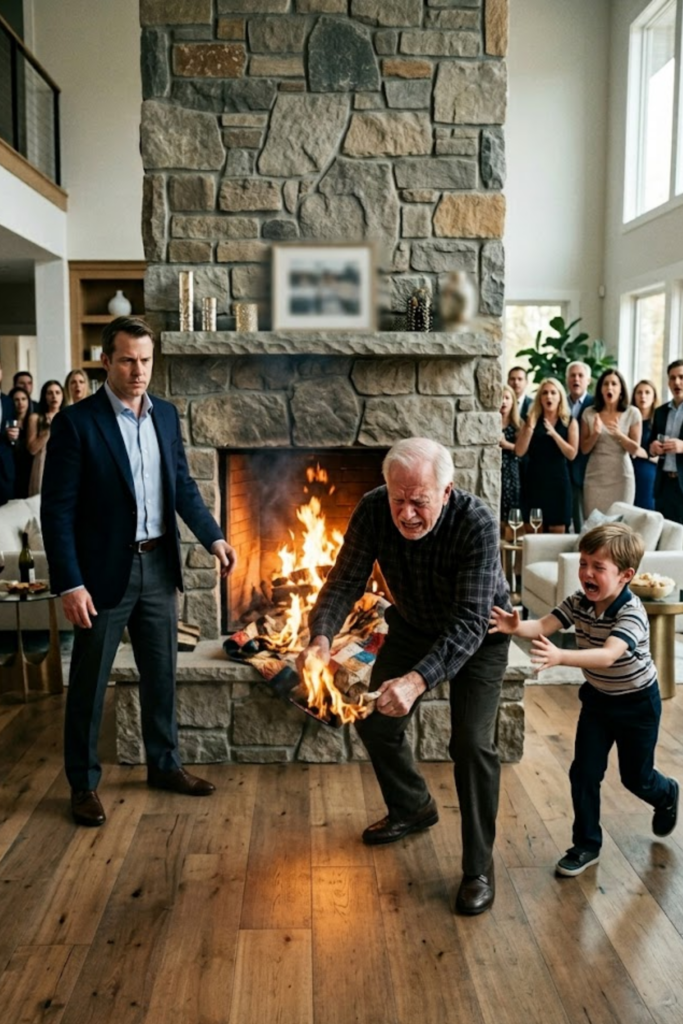
On quiet evenings, when Noah is asleep and the house settles around me, I sit at the kitchen table beneath Dorothy’s photograph and think about that day in James’s mansion. The marble floor. The chandelier. The guests pretending not to watch. The fire taking the corner of the quilt. My son’s face. Noah’s scream.
I think about what would have happened if I had done what pride wanted.
If I had hit James. If I had shouted. If I had let the quilt burn because saving it hurt too much. If I had walked away empty-handed and told myself a blanket was just a blanket.
Dorothy had trusted me with one job.
Keep it safe.
Sometimes a promise looks small when you make it. A quilt. A delivery. A grandfather keeping his word to a dying woman.
Then life opens the seams, and you discover the promise was holding everything.
That day, I reached into fire for a quilt.
What I pulled out was my grandson’s future.
And every morning when Noah wakes beneath Dorothy’s stars, he learns what my wife spent her whole life teaching without speeches, without wealth, without needing a room full of important people to notice her.
That love is patient.
That family is not ownership.
That the most valuable things in this world are not always the things that shine.
Sometimes they are the things someone made quietly, carefully, with tired hands and a whole heart, while nobody was looking.
THE END
✅ End of story — Part 3 of 3
← Read from Part 1