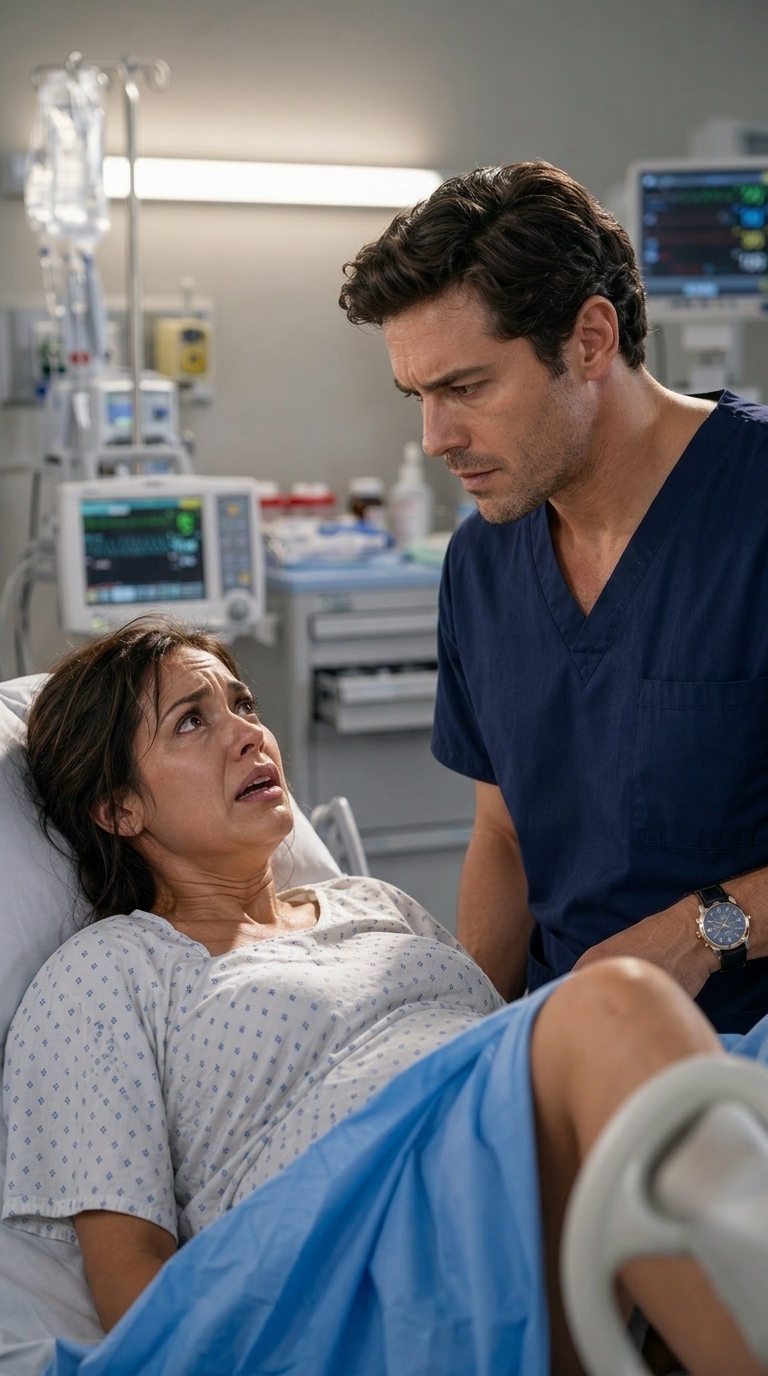
I hear the nurse’s voice before I see the door open.
“Doctor Herrera, the patient is fully dilated, pressure dropping, fetal distress worsening. We need you now.”
For one impossible, agonizing second, the entire delivery room goes silent around me. The heart monitors keep their frantic beeping, the fluorescent lights keep humming their sterile, insect-like drone, and my body keeps tearing itself open from the inside out. But my own heart stops entirely for a completely different reason.
Because I know that name.
Herrera.
Nicolás Herrera.
The man who once kissed my forehead in the quiet dark and promised me forever.
The man who, just nine months ago, stood in the center of our cavernous master bedroom, tossed my packed suitcase onto the freezing marble floor, and told me to disappear before his immaculate reputation was ruined.
The man who never knew I was carrying his child.
I grip the thin hospital sheet until the joints in my fingers scream. Sweat slides down my temples, stinging my eyes. My hair is plastered to my face, heavy and damp, and every breath I try to draw feels as though it is being dragged over broken glass.
“No,” I whisper, the word scraping against my dry throat.
The young nurse beside me—her nametag reads María—leans closer, her brow furrowed in deep concern. “Ma’am?”
I shake my head aggressively, even though the room violently tilts with the motion. “Not him. Please. Anyone but him. I can’t…”
Her face changes. Not because she understands the complicated, jagged history between me and the hospital’s golden boy, but because she understands fear.
Real, unadulterated fear. The kind that does not stem from physical pain alone, but from a deeper, psychological terror.
“There is no one else,” María says gently, though her eyes dart to the fluctuating numbers on the monitor. “The other attending surgeon is in the OR with a multi-trauma. Doctor Herrera is the only obstetric specialist available. He is the best.”
The best. The irony tastes like copper in my mouth.
Before I can formulate a protest, a contraction hits. It does not build; it strikes. It rips through my abdomen like a jagged bolt of lightning, severing my thoughts. I cry out, a raw, animal sound, entirely stripped of dignity. I do not care who hears me. I do not care that a dozen nurses are moving around me like busy ghosts. I do not care that I once made a silent, ironclad vow to myself that Nicolás Herrera would never, ever see me weak again.
All that matters is the violent seizing of my muscles and the tiny, fragile life fighting to survive inside me.
Then, the heavy double doors swing open.
The chaotic noise of the hallway spills into the room, followed by the man himself. He walks in, and the temperature in the room seems to plummet.
Perfect. Expensive. Cold.
Nicolás Herrera enters my nightmare wearing his pristine white coat like a king’s mantle. His dark hair is perfectly styled, defying the frantic nature of an emergency call. His jaw is clean-shaven, hard as granite, and the $40,000 Rolex on his left wrist catches the harsh overhead lights, flashing as if to remind everyone in the room that even time belongs to him.
At first, he does not look at my face. He is a creature of data and control. He looks at the monitors first, his eyes narrowing at the declining numbers. Then he glances at the nurses, projecting an aura of impatient, irritated boredom.
“Vitals?” he snaps, stepping up to the foot of the bed.
María stammers, handing him my chart. “BP is 85 over 50 and dropping. Fetal heart rate is decelerating with contractions. We need to move.”
He flips the file open. His eyes scan the ink.
Then, he finally looks up. His gaze travels from the chart, over the mountain of my swollen belly, and lands squarely on my sweat-drenched, pale face.
Everything stops.
For half a second, the impenetrable mask of the great Dr. Herrera cracks wide open. His mouth parts slightly. His broad shoulders go rigidly stiff. The color drains from his olive skin so rapidly that even María takes a bewildered step back. I can see the gears grinding behind his dark eyes—shock, disbelief, and then, a tidal wave of suppressed memory.
But then he does what Nicolás always does when cornered.
He recovers. He builds a wall.
“Well,” he says softly. His voice is a blade, honed and lethal. “Cecilia Morales.”
My throat constricts. He says my maiden name like it is a disease.
“You have got to be kidding me,” he continues, his tone hardening as he steps closer, towering over my broken form. “Nine months without a single word. Not a phone call. Not a letter. And now you miraculously appear in my hospital? On my floor?”
His dark eyes drop significantly to my trembling belly. The monitors beep faster, betraying my rising panic.
A shadow flickers across his handsome face. Suspicion. Contempt. And underneath it all, a fragile, vibrating shock.
He smiles. It is a terrifying, humorless expression.
“So that was it,” he murmurs, loud enough only for me and the closest nurses to hear. “That is why you vanished so easily into the night.”
I stare back at him through a haze of blinding pain, my pride warring with my agony. “I didn’t vanish,” I whisper, my voice shaking with a rage I thought I had buried. “You threw me out.”
His jaw tightens so hard I can hear his teeth grind.
“Doctor,” María interrupts, her voice slicing through the heavy tension. “The baby’s heart rate is dropping into the 90s. We are losing them.”
He ignores her. He leans down, his face inches from mine, his eyes burning with a dark, accusatory fire.
“Who is the father, Cecilia?”
The question drops into the sterile room like a live grenade.
One nurse freezes halfway through hanging a fresh IV bag. Another abruptly looks down at her shoes. María’s face tightens with professional outrage, but in the empire of St. Raphael Medical Center, nobody questions Dr. Herrera.
I feel another contraction rising, a deep, pulling tidal wave from the ocean floor of my body, but the fiery anger in my chest rises faster.
“You don’t get to ask me that,” I hiss, gripping the metal bedrails.
His eyes narrow to dangerous slits. “In my hospital, in my delivery room, when I am the attending physician responsible for keeping you alive, I get to ask anything I damn well please.”
“No,” I say, panting as the pain crests. “You get to do your job. For once in your life, put the ego away and do your job.”