For the first time since he walked in, his supreme confidence falters. He blinks, caught off guard. Because I am not begging him.
Nine months ago, I had begged. I had fallen to my knees on the hardwood floor of our foyer. I had begged him to look at the financial documents I had uncovered. I had begged him not to believe the glossy, damning photographs his mother, Isabel Herrera, had gleefully thrown across our mahogany dining table like a royal flush.
They were photos of me standing closely outside a downtown hotel with a man named Andrés Velasco.
I remembered the exact, miserable evening those photos were taken. I had gone to that hotel lobby in the pouring rain to meet Nicolás’s private attorney. I had gone because, while organizing the charity gala files, I had found a staggering web of lies. Fake hospital expenses. Inflated surgical charges billed to dying patients. Millions of dollars routed directly through a ghost company registered under Isabel’s maiden name.
I had tried to save him from the fallout. I had tried to protect the man I loved.
Instead, Nicolás had looked at those photos, looked at his weeping, theatrical mother, and accused me of whoring myself out. Isabel, elegant and dripping in pearls, had stood behind his shoulder, her eyes shining with fake tears and a very real, poisonous triumph.
“She is a parasite, Nicolás,” his mother had whispered. “Women from her background always are. They find a host, and they drain it.”
I had stood there, trembling, my hand resting instinctively on my still-flat stomach. I had told him I was late. I had told him we needed to talk about the future.
And Nicolás Herrera had laughed.
It was a hollow, cruel sound that I still heard in my darkest nightmares. “Do not try to trap me with a bastard child to save your meal ticket,” he had sneered.
Then he opened the heavy oak front door to the freezing rain.
I walked out with one suitcase, twenty dollars in my pocket, and a heart so thoroughly shattered I truly believed nothing beautiful could ever grow inside me again. But something did. A tiny, stubborn heartbeat. A reason to endure the drafty rented room, the cheap instant ramen, the humiliating pity of clinic receptionists who saw a woman alone.
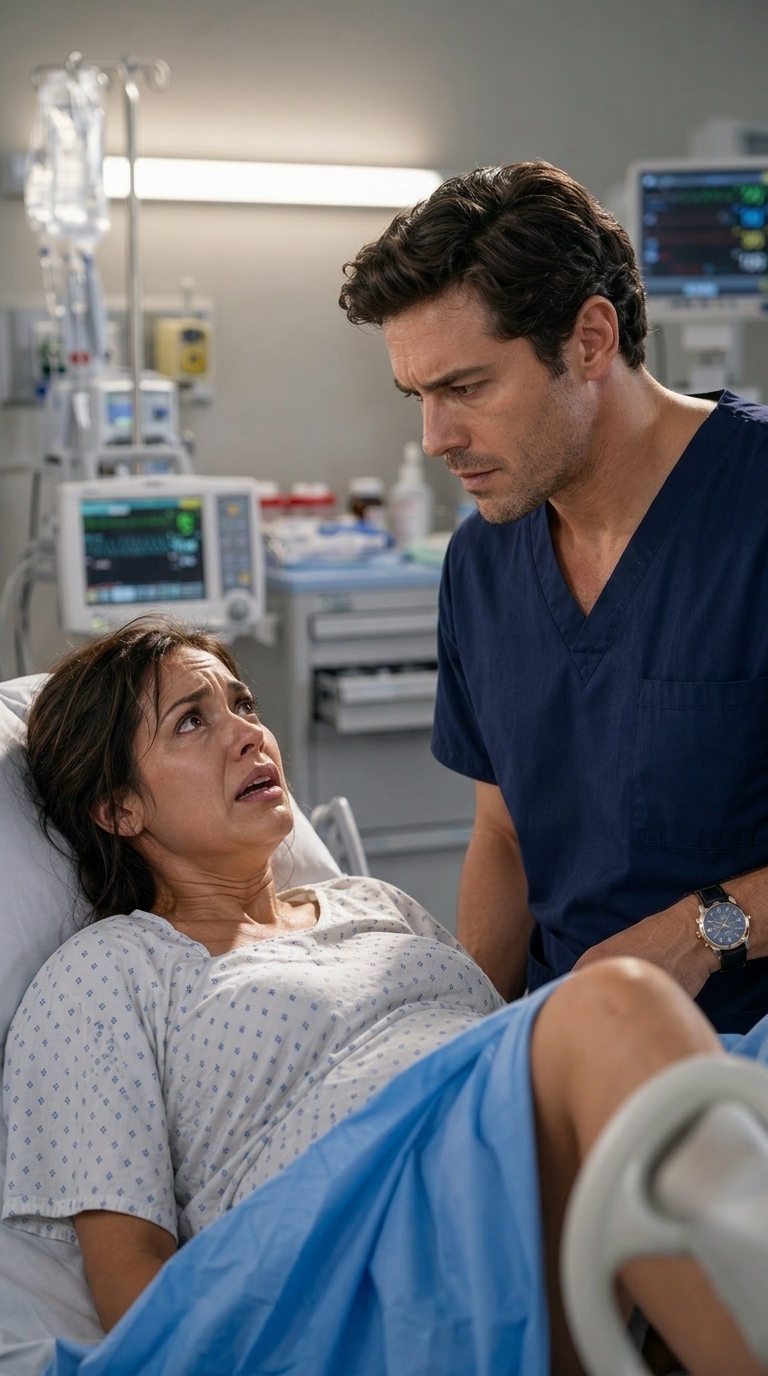
Now, that child is suffocating inside me. And Nicolás is standing over me, staring at my belly as if the ghosts of his past have finally kicked down the door.
“Doctor!” María practically shouts, abandoning protocol. “We need a decision now! Fetal bradycardia is sustained!”
The sharp medical term snaps Nicolás back to reality. He is no longer the betrayed ex-husband; he is the surgeon. He snatches the chart back from the foot of the bed. His eyes dart over the vitals, calculating the grim mathematics of life and death.
The arrogance completely thins out, replaced by a cold, terrifying urgency.
“This is an abruption,” he mutters, his voice tight. “She’s bleeding internally.”
María steps up. “No prenatal records in the system. She was a walk-in.”
I force my eyes open, staring at the blurry ceiling tiles. “I had prenatal care. Just… not in a palace like this.”
Nicolás looks down at me, a complicated storm brewing in his dark eyes. I cannot tell if he pities me or hates me for surviving without him.
But before he can speak, the primary monitor emits a long, shrill, continuous tone.
The baby’s heartbeat crashes.
Nicolás explodes into motion. “Crash C-section! Prepare OR Two! Call anesthesia, get four units of O-negative blood on a rapid infuser! Move her, NOW!”
The room erupts into organized chaos. Brakes are unlocked. Nurses yell overlapping codes. The ceiling lights become a streaking blur as my bed is shoved violently out of the room and down the long, white hallway. Nicolás jogs beside the bed, his hand gripping the metal rail near my head, barking orders into a radio.
As we crash through the double doors of the surgical wing, I reach out with a weak, trembling hand and blindly grab his wrist. His skin is warm.
He looks down at me.
“Please,” I sob, the last of my tough exterior dissolving into a mother’s absolute terror. “Nicolás. Don’t let her die. Just save my baby.”
He stares at me, and for the very first time in our entire history together, I see past the pride, past the anger, past the monolithic ego.
I see pure, unadulterated panic.
“I won’t,” he whispers fiercely, squeezing my fingers. “I swear to God, Cecilia, I won’t let you go.”
But as the heavy OR doors slam shut behind us, a fresh wave of agony rips through my spine, and the metallic taste of blood floods my mouth. I realize, with sudden, terrifying clarity, that the darkness pulling me under is not just exhaustion. It is the end.
Inside Operating Room Two, the world dissolves into a blinding, sterile white and the sharp clatter of surgical steel.
Someone forces a plastic mask over my nose and mouth. The air smells heavily of chemicals and sweet, artificial oxygen. A voice tells me to breathe deep, that I am going under, that they have to work fast to cut the baby out.
Through the dizzying fog of the anesthesia, I search wildly for Nicolás.
He stands directly under the intense halo of the surgical lights, scrubbing in with frantic speed. A nurse ties a sterile gown around his broad back. He snaps his gloves on, his jaw set so tight the muscles twitch. He does not look like the untouchable king of St. Raphael right now. He looks like a man standing on the edge of a crumbling cliff.
“Cecilia,” he says.
His voice cuts through the beeping machinery. It sounds utterly different. Stripped bare.
I roll my heavy head toward him. His dark eyes meet mine over the blue surgical mask.
“I need you to fight,” he commands. “Stay with me.”
I want to laugh, but it comes out as a wet cough. I want to remind him that I spent three years fighting for him, fighting for us, until he locked me out in the cold. I want to tell him that I am so tired of fighting.
But then a monitor blares a warning. My blood pressure is tanking.
I blink heavily, my vision narrowing to a tunnel. “Save her,” I slur, the darkness creeping over the edges of my sight. “That’s all.”
His eyes widen. “Our child?” he asks, the words barely carrying over the noise.
The anesthesia drags me down, wrapping me in heavy chains. “You lost the right to that word,” I whisper into the mask.
Then, the world goes black.
I am trapped in a void of muffled sounds. I feel no sharp pain, just a terrifying, violent tugging deep within my abdomen. It is the horrific sensation of my body being emptied. Voices yell in clipped, frantic bursts. I hear suction. I hear the clatter of metal trays. I hear Nicolás swearing softly, a desperate, continuous prayer mixed with medical commands.
“Come on,” he murmurs. “Come on, come on…”
Then, a sudden, heavy silence falls over the room.
It is the worst silence in the world. It is the absence of life.
I fight the drugs. I drag myself upward through the suffocating darkness, forcing my eyelids open to a slit. The bright lights blind me.
“Why…” I choke out, my throat thick and numb. “Why isn’t she crying?”
Nobody answers. The nurses are frozen.
“Why isn’t my baby crying?!” I scream, but it sounds like a weak croak.
María is moving frantically at a warming station in the corner, her back to me. Two pediatric nurses are huddled over a tiny, motionless form.
Nicolás is standing over my open body, his hands covered in my blood. He slowly turns his head to look at the warming table.
And that is when I see it. The horror.
It completely breaks across his perfect face. The great Dr. Herrera looks like a man who has just watched his soul burn to ash.
“Bag her,” he orders the pediatric team, his voice shaking. “Push epi. Breathe. Breathe!”
The seconds stretch into eternity. One. Two. Three. Four.
My heart stops. I am ready to die. If she is gone, I want to go with her.
Then—a sound.
It cuts through the antiseptic air like a razor. Small. Wet. Furious.
A cry.
My baby cries out against the harsh, cold world, a brilliant, beautiful wail of life.
The sound tears something open inside my chest that the scalpel never could. I sob, a deep, ugly, earth-shattering sound of pure relief. María turns around, tears streaming openly over her mask. “She’s back,” she laughs wetly. “She’s breathing. It’s a girl, Cecilia. A beautiful girl.”
A girl. My daughter.
For a fraction of a second, the heavy dread lifts. The nurses smile.
But Nicolás does not move. He stands absolutely paralyzed.
One of the pediatric nurses hastily wraps the screaming infant in a sterile blanket and carries her toward me so I can see. She is so red, so angry, her tiny fists clenched tight. She is the most beautiful thing I have ever seen.
As the nurse steps closer to the operating table, the edge of the blanket slips down just an inch, exposing the infant’s left shoulder.
Right there, resting just beneath her collarbone, is a distinct, dark, star-shaped birthmark.
Nicolás sees it.
I watch the remaining blood completely vanish from his face, leaving him ashen. I watch the exact, devastating second his past catches up to him and breaks his knees.
Because he has that exact same birthmark.
So did his late father. So did his grandfather. It is the undeniable, genetic stamp of the Herrera bloodline, the very bloodline his mother claimed I was trying to pollute.
Nicolás takes a stumbling step backward. His hip clips a surgical tray. Metal instruments crash to the tiled floor with a deafening clatter. He does not even blink. He is staring at the screaming baby as if the entire universe has just collapsed and rebuilt itself inside this room.
He looks at me, his eyes wide, wet, and utterly destroyed.
I am too weak to feel vindicated. I am too drained to enjoy his devastation.
“Her name is Elena,” I whisper.
His lips part. “Elena,” he breathes out.
The name physically hurts him. It was his beloved grandmother’s name—the only Herrera who ever treated me with kindness.
Before he can take a step toward his daughter, a secondary alarm shrieks.
María points wildly at the suction canisters. “Doctor! She’s hemorrhaging! Uterine atony, she’s bleeding out!”
The warm, victorious glow vanishes, replaced by a freezing, violent tide. The edges of the room immediately turn black. My hands go numb. The noise of the monitors fades into a dull roar.
I hear Nicolás shout my name. Not ‘the patient’. Not ‘Morales’.
“Cecilia! Push fluids! Give me clamps!”
He leans over me, his face twisted in absolute terror. He looks less like a godlike surgeon and more like a desperate man violently pounding on the gates of hell, begging for a soul back.
“Stay with me,” he pleads, tears falling from his eyes onto my cheek. “Please, God, stay with me!”
But the cold is too heavy. I close my eyes. The last thing I hear before the dark water pulls me under is Nicolás Herrera violently ripping off his bloody glove with his teeth and screaming at the nurses.
“Use my blood! Test it now! I’m a universal donor, take whatever she needs! Do not let her die!”
Then, absolute silence.
When I wake, there is no bright light. There is only the soft, muted gray of a hospital room at dawn.
I lie still for a long time, listening to the rhythmic hiss-click of a machine beside me. My body feels as though it has been filled with lead and stitched back together with barbed wire. My mouth is filled with cotton.
But I am alive.
I turn my head slowly. The room is a massive, luxurious VIP recovery suite. And sitting in a leather chair by the window, bathed in the pale morning light, is Nicolás.
He is not wearing a white coat. He is in wrinkled scrubs. His dark hair is a messy, unkempt disaster. There are deep, bruised bags under his eyes, and a thick strip of white medical tape rests in the crook of his arm—where they drew his blood to pump into my veins.
He looks like he has aged ten years.
He senses me moving and immediately sits forward, his hands clasped tightly between his knees.
“She’s alive,” he says, his voice raspy and broken. “She’s stable. She was in the NICU overnight for observation, but she is breathing perfectly on her own. She is perfect.”
I close my eyes. A solitary tear escapes, tracking hot across my temple. The relief is so intense it is almost painful.
“Bring her to me,” I whisper, my voice cracking.
“Cecilia, you just woke up, you need—”
“Bring her to me,” I demand, forcing my eyes open and glaring at him with every ounce of strength I possess. “Now.”
He swallows hard, nodding quickly. He does not argue. He stands up, his tall frame looking strangely diminished, and walks to the door. He speaks quietly to a nurse in the hall.
A few minutes later, María enters. She is beaming softly, carrying a tiny bundle wrapped in a pink hospital blanket.
My heart shatters all over again.
María gently places Elena against my chest. She is warm. So incredibly small. I touch her flushed cheek with a trembling finger, and she instantly turns her face toward my scent, her tiny mouth rooting. She knows I am her home.
I cry silently, the tears soaking my hair. I do not care that Nicolás is watching from the shadows of the room. I do not care about anything else in the world.
“She has your eyes,” Nicolás says quietly from the corner.
I don’t look at him. “She has my strength. She survived despite you.”
He absorbs the blow, flinching as if I had struck him.
María checks my IV, offers a sympathetic squeeze to my shoulder, and slips out of the room, closing the door softly behind her. We are alone. The broken family.
Nicolás takes a slow, hesitant step toward the bed. “Cecilia… I don’t know where to begin.”