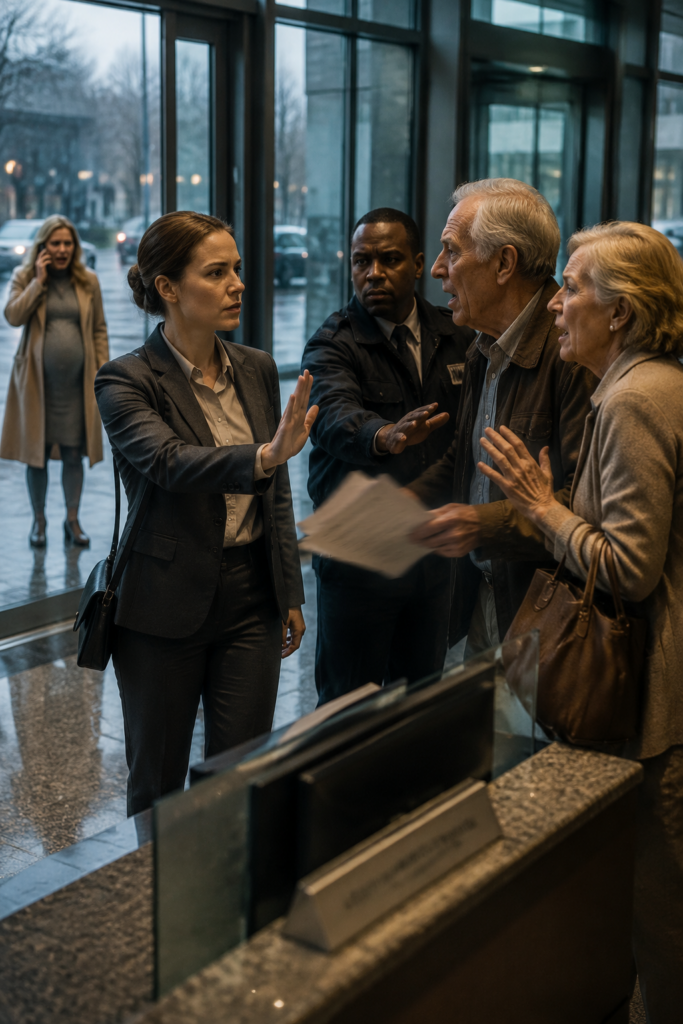
My name is Gina Link, and I am thirty-three years old.
People like to call me strong. They say it like it’s a compliment, like it’s some shiny medal I chose to win. I always smile politely when they say it, but inside, I want to ask them a question:
Do you still call it strength if you were never given a choice?
Because that’s what my life has felt like—one long series of falls with no one there to catch me.
You don’t become strong because you wake up one day and decide to be. You become strong because the ground keeps dropping out from under you, and at some point, you realize no one else is going to lay down a cushion.
So you start learning how to land.
I didn’t used to be alone. Once, a long time ago—okay, not that long, but it feels like another lifetime—I had a husband, a shared apartment, a future mapped out like a Pinterest board in my head. White crib. Neutral nursery. Sunday brunches with a sleepy baby in a stroller and my hand laced through his.
We tried for a baby for two years. Every negative test felt like a small funeral. When I finally saw those two pink lines, I sat on the edge of the bathtub and cried the kind of tears that leave you empty and light all at once.
I told my husband, Mark, by slipping the test into a little gift box and handing it to him when he came back from work.
He opened it, stared, then looked up at me with wide eyes.
“Are you serious?” he asked.
“Yes,” I whispered, my throat thick with emotion. “We’re having a baby.”
He laughed, scooped me into his arms, spun me around the living room until I begged him to stop because I was dizzy and terrified I’d throw up all over his shirt.
I remember thinking, This is it. This is happiness. I made it.
Looking back, I think he left me long before he actually walked out the door.
Pregnancy was not kind to me. I was sick constantly, so exhausted that climbing the stairs to our apartment felt like hiking up a mountain. My hips hurt. My back hurt. I cried at detergent commercials and at the empty spot on Mark’s side of the bed when he started coming home later and later.
“It’s work,” he said the first few times.
“It’s just the guys,” he said after that.
By the time I was visibly showing, I knew something was wrong, but I was too tired and too hopeful to push too hard. I wanted my baby to come into a home that felt stable, safe. I thought if I pretended hard enough, reality would catch up.
It didn’t.
The night I found out about the cheating wasn’t dramatic, not at first. No lipstick on the collar, no mysterious perfume. Just a notification on our shared tablet lighting up with a name I didn’t recognize and a message that began with:
I can’t stop thinking about last night…
My heart stopped. My hands went cold. I remember reading that line over and over, hoping I was misunderstanding it somehow. But curiosity is cruel. I scrolled. There were more messages. Weeks of them. Photos. Plans. Jokes about me, about the pregnant wife who “didn’t get it.”
I didn’t scream. I didn’t throw anything. I just sat very still while my daughter kicked inside me like my body was trying to remind me she was there, that she existed, that I wasn’t alone even as my world cracked in half.
When Mark came home, I was waiting at the kitchen table with the tablet in front of me.
“We need to talk,” I said.
He saw the screen. His eyes flicked over the messages. His face went through five different emotions in thirty seconds—shock, guilt, irritation, defiance, something like boredom. Finally, he sighed.
“Gina, I—”
“Stop,” I said quietly. “I don’t want to hear it.”
He stared at me, thrown off. I think he expected begging. Tears. Maybe drama. That might have made it easier for him to feel like the victim.
Instead, I stood up. My legs were shaking, but I forced them to work.
“Get out,” I said.
“You’re pregnant,” he replied, like I’d somehow forgotten.
“Yes,” I said. “And I’m not raising this child with someone who cheats on her mother while she’s inside my body.”
It was the most powerful sentence I have ever spoken in my life.
He didn’t leave right away. There were fights and insults and logistics and his insistence that I was “overreacting” because we “could work through this,” as if what he’d done was forget to take the trash out. But eventually, I got him out—out of the apartment, out of our lives.
And then it was just me and my daughter, who wasn’t even born yet, floating inside me while I sat in the wreckage of the life I thought I’d built.
After Lily was born, there were no soft-focus photo shoots, no smiling grandparents taking shifts so I could sleep. There was just me, raw and exhausted and bleeding, holding a tiny person who depended on me for everything while the world seemed content to watch from a safe distance.
I rented a small apartment, not in a trendy neighborhood, but the kind you choose because it fits the budget and has locks that work. I was determined. Determined to prove that I could do this alone. Determined not to give anybody a reason to say, “See? She couldn’t handle it without a man.”
I worked. I nursed. I pumped. I cried in the shower so Lily wouldn’t see me fall apart. I learned how to balance a baby on my hip while microwaving leftovers and answering emails. I learned to function on three hours of sleep and caffeine and the stubborn refusal to collapse.
I thought I was doing okay.
My father did not.
“You’re running yourself into the ground,” he told me one Sunday afternoon when he came over and saw the laundry piled on the chair, the dishes in the sink, the dark circles under my eyes. “You can’t keep this up, Gina.”
“What, surviving?” I snapped before I could stop myself.
He didn’t flinch. My dad is a quiet man, not prone to emotional speeches, but he has this way of looking at you that makes you feel twelve years old and seen all at once.
“The house is too big for just me and your mom,” he said. “Come home. Bring Lily. We’ll help. She needs family. You shouldn’t have to do this alone.”
I wanted to believe him so badly it hurt.
“Are you sure?” I asked. “I don’t want to be a burden.”
“You’ll pay some rent,” he said, practical as always. “Help with groceries. It’s not charity. It’s just… family.”
That word again. Family. It still meant something to me then. It still had weight.
So I moved back in.
Not completely for free. I paid them rent—on time, every month. I covered Lily’s daycare, her clothes, her toys, her food. I did my own groceries unless my dad insisted on a joint shop. I kept my room clean, kept Lily’s things organized, stayed out of the way as much as possible.
It was supposed to be temporary. A practical arrangement. A way to rebuild while leaning on supposedly solid ground.
For a while, it worked.
Or at least, it didn’t explode.
If you met my mother for the first time at a party, you’d probably think she was lovely. Warm, charming, quick with compliments. She’s the type who brings homemade pies to neighbors and knows all the gossip before it hits social media. She calls herself “old-fashioned,” like it’s an excuse for everything.
What she isn’t, and what she’s never really been, is nurturing.
When Lily was a baby, my mother always somehow had a reason she couldn’t be alone with her.
“Oh, my back is bad today.”
“I didn’t sleep well last night.”
“I’m just so tired, honey, you know how it is at my age.”
But she always had the energy to watch whoever I hired as a nanny.
She called herself a “baby monitor.”
“I’ll just keep an eye on the nanny,” she’d say cheerfully. “You never know with these girls.”
“Girls” could be twenty-five or fifty-five. To my mother, if you were female and not her, you were a girl. And also a potential threat, apparently.
At first, I laughed when she called herself a baby monitor. It was easier than pointing out how bizarre it was that my own mother didn’t have the energy to care for her granddaughter alone, but had endless energy to supervise someone else doing it.
Still, having my parents around—even at arm’s length—felt safer than leaving Lily with a stranger in a completely separate place. So I told myself this was better than nothing.
For a while, it almost felt… stable.
We had a rhythm. Mornings were chaos—Lily protesting the tangle in her hair, me bribing her with cereal, my mother complaining that kids’ shows these days were “weird.” My father left early for the store, sometimes slipping Lily a piece of chocolate he thought I didn’t see. Evenings were quieter. I’d come home, hug my daughter, help with her coloring or early homework, make dinner, clean up, collapse.
There was distance, sure. My mother and I were polite but not close. My father was kind but distracted. There were cracks. I chose not to look too closely.
Then my sister came back.
That was the crack that split everything open.
It was a Tuesday. I remember because Tuesdays were always the worst—far enough from the weekend that the rest felt like a distant memory, far enough from Friday that there was nothing to look forward to but more work, more routine.
I was exhausted. My feet ached from standing in meetings all day. My head pounded with the remnants of fluorescent office light and too much screen time. All I could think about as I drove home was heating up something simple, checking Lily’s homework, maybe reading her a story in bed before collapsing into my own.
The moment I opened the front door, I heard a voice.
Sharp. Confident. Gratingly familiar.
“I’m telling you, Mom, I can’t sleep if the pillows aren’t just right.”
My stomach dropped before my brain finished registering the words.
No. It couldn’t be.
I stepped fully into the living room and there she was—my younger sister, Sloan.
She was sprawled on my parents’ couch like a queen on a throne, one hand resting dramatically on her heavily pregnant belly, the other scrolling lazily through her phone. Her long hair fell in a perfectly styled curtain over one shoulder, and her legs were propped up on a cushion my mother only brought out for “special guests.”
Apparently that included my sister, but not the daughter who’d been paying rent for over a year.
My mother hovered beside her, fussing with a glass of water, a small mountain of pillows, a bowl of carefully cut fruit, and an array of vitamins and supplements lined up in rows on the coffee table like soldiers.
Sloan looked up at me slowly, like I was the unexpected guest. Her eyes flicked over my work clothes, the exhaustion on my face, the groceries in my hand. Then she smirked.
“Gina,” she said. “You’re early.”
The way she said my name—like a minor inconvenience—made some long-dormant muscle in my chest tense.
“What’s going on?” I asked, my voice already tight with dread.
Before my mother could open her mouth, Sloan answered for her, loud enough to fill the whole house.
“I’m here to stay,” she announced. “Do you have a problem with that?”
Same Sloan. Same tone. Same need to dominate every room she walked into.
I looked at my mother.
“How long is she staying?” I asked.
My mom didn’t meet my eyes. She smoothed the blanket over Sloan’s legs like she was tucking in a child.
“Sloan’s husband got transferred back to the States,” she said carefully. “His company gave him housing, but since Sloan is pregnant, we thought it would be best if she stayed here with us.”
“With us.” Like that word automatically included me, like we were a united front.
“So you’ll be taking care of her?” I asked, unable to keep the edge out of my voice.
My mother nodded immediately, almost eagerly.
“Of course,” she said. “She’s still so young. How could she raise a child alone? She needs help.”
The words hit me harder than if she’d slapped me across the face.
Sloan was twenty-nine.
I was twenty-seven when I gave birth to Lily.
No one hovered over me. No one brought me trays of carefully chopped fruit or fussed over my pillows or lined up vitamins like I was a princess carrying a royal heir. My husband was out partying while I struggled through sleepless nights. My mother told me I “needed to learn motherhood the hard way,” like it was some rite of passage that required suffering.
But now, for her golden child, motherhood was suddenly a group project.
I felt my jaw clench. I glanced at Sloan. She met my eyes with a slow, smug smile and rubbed her belly, fingers splayed like she was posing for a photoshoot.
She had always been like this.
If you ask my parents, they’ll tell you my sister and I “never really got along, but that’s just siblings.” They’ll say it lightly, with a laugh, like the way Sloan treated me growing up was normal, harmless.
They weren’t the ones getting shoved into walls.
Sloan is younger than me by four years, but she’s always been bigger and louder. As kids, she was the one who took up space; I was the one who tried to take up as little as possible. Where I was lean and small, she was strong, broad-shouldered, the kind of girl who could snap a pencil in half with one hand just to prove a point.
There was no single incident that turned her against me. No one fight we could point to and say, “That’s where it started.” As far as I can remember, she simply decided one day that she didn’t like me—and then dedicated her childhood to making sure I felt it.
She would grab my wrist and squeeze until I winced. She would shove me when our parents’ backs were turned, just hard enough that I would stumble, just soft enough that it could be written off as an accident if anyone saw. She’d “borrow” my things and break them. She’d whisper insults in my ear when no one else was around, little knives disguised as jokes.
“Crybaby.”
“Pathetic.”
“No wonder Mom likes me better.”
When I tried to tell my parents, they dismissed it instantly.
“She’s your younger sister,” my mother would say, annoyed. “How could she hurt you? You’re older. Stop tattling.”
“Just ignore her,” my father would murmur, distracted. “You know how kids are.”
So I stopped trying to explain.
I learned distance instead. I learned how to make myself scarce when she entered the room, how to watch her movements out of the corner of my eye, how to disappear into books and schoolwork and eventually, into a college far enough away that going home required planning.