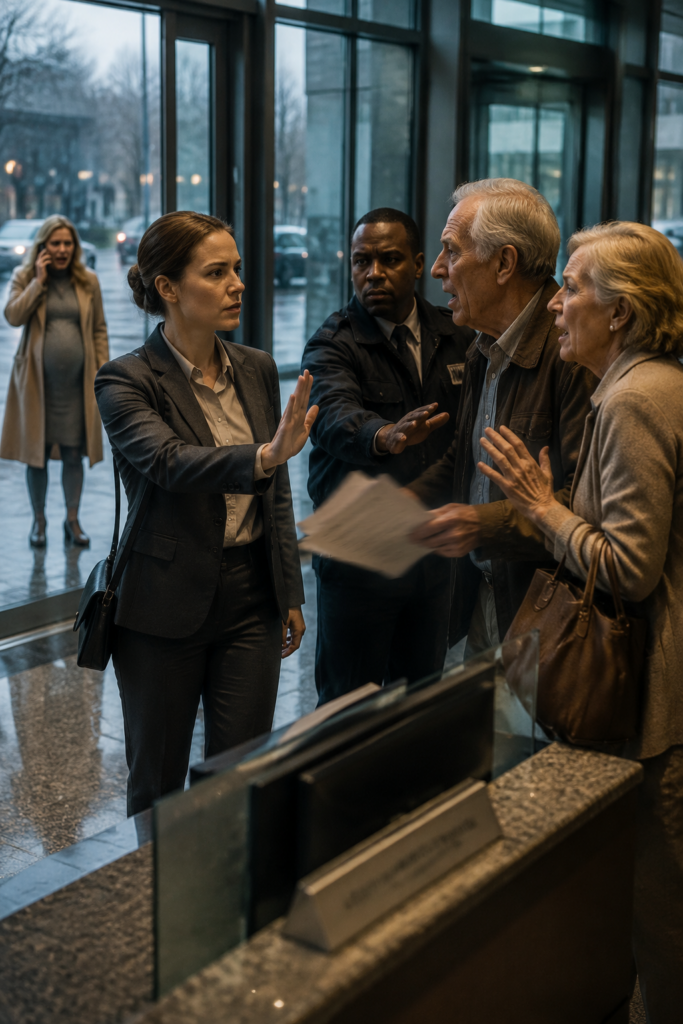
The moment I got the chance, I moved out. I kept contact minimal. Phone calls on holidays. Polite texts on birthdays. Our relationship became something thin and brittle and purely surface-level.
I thought that distance would keep me safe.
I was wrong.
Now she was back, pregnant, installed on the couch like it had been built for her, and my mother was orbiting around her like she was the sun.
My dad walked in a few minutes later, cheerful, oblivious, wiping his hands on a rag that still smelled faintly of motor oil from the store.
“Hey!” he said when he saw me. “You’re home. Great. Guess what?
Sloan’s going to stay with us for a while. Isn’t that nice?”
Before I could answer, Lily came running down the hallway, her little feet pattering against the hardwood floor.
“Mommy!”
She flung herself against my legs, clutching me with the full, desperate affection of a five-year-old who hasn’t seen her mother all day. I bent down, kissed her hair, closed my eyes for a second. This was the part of the day that always made everything worth it.
Then I felt her stiffen.
Her arms tightened around my neck. She went very still. I opened my eyes and followed her gaze.
She was staring at Sloan.
Sloan stared back, tilting her head slightly, eyes cool and assessing. It wasn’t a friendly look. It was the look she used to give me before she did something that hurt.
Lily didn’t say anything. She just pressed closer to me, hiding her face in my neck.
Something cold settled in my chest.
As my mother continued fussing over Sloan—fluffing pillows, adjusting her blanket, offering her snacks—an ugly realization crept over me.
This wasn’t temporary. This wasn’t simple kindness.
This was favoritism, resurrected and repackaged.
And standing there, holding my daughter, watching my sister smile like she’d already won, I had a terrifying thought:
If Sloan was here to stay, someone was going to make sure I wasn’t.
Two days later, my worst fear walked up to me in broad daylight and slapped me in the face.
It was another workday, but one that ended abruptly when a meeting got canceled at the last minute. That almost never happened. Suddenly, my afternoon was free. Instead of staying to catch up on emails, I decided to go home early.
I was excited, actually. I imagined picking Lily up, seeing the surprise on her face, having a slow afternoon.
Maybe we’d make her favorite mac and cheese from scratch. Maybe we’d draw. Maybe we’d just watch a movie and cuddle on the couch like people with simple lives.
As I turned onto my parents’ street, something felt wrong.
You know that sense you get sometimes, the prickle at the back of your neck before your eyes catch up with what’s in front of you? That’s how it felt. My hands tightened on the steering wheel.
Then I saw it.
My suitcase was on the porch.
Not just my suitcase. Boxes. Trash bags. A stack of folded clothes. Lily’s pink backpack—the one with the unicorns—lying on its side like someone had tossed it there. Her stuffed bunny. Her pink blanket, the one she refused to sleep without, crumpled and shoved into a plastic grocery bag like it was an old towel.
And sitting on the front step, knees pulled tight to her chest, was my daughter.
Five years old.
Alone.
For a second, my brain simply refused to process what my eyes were seeing. My first thought—ridiculously—was that they were cleaning. That maybe they were sorting through things. That there was some rational explanation that did not involve my child sitting outside like trash.
Then Lily turned her head, and I saw her face.
Her cheeks were streaked with dried tears. Her eyes were red and swollen. Her lower lip was trembling.
I parked crooked, half on the curb, not even bothering to straighten out. I barely remember shutting off the engine. I ran to her.
“Lily,” I gasped, dropping to my knees so fast they scraped on the concrete. “Baby, what happened? How long have you been out here?”
She didn’t answer at first. She just threw her arms around my neck and clung to me like she was drowning.
“I waited for you,” she whispered into my shoulder, her voice thin and hoarse. “I was scared.”
My hands shook as I held her. I could feel her little heart pounding against my chest.
“Who did this?” I asked softly, trying to keep my voice calm for her sake. “Who put your things outside?”
She sniffled, wiped at her nose with the back of her hand.
“An’ Looooone,” she said, stumbling slightly over the name the way five-year-olds do. “Aunt Sloan.”
The name alone made bile rise in my throat.
“She packed everything,” Lily continued, her voice growing smaller. “She was yelling. She threw your clothes. I didn’t know what to do. Grandma and Grandpa were inside, but… but they didn’t come out.”
Something inside me snapped.
“Did Aunt Sloan hurt you?” I asked, my voice low, already bracing myself for the answer.
Lily shook her head quickly, panic flashing over her face at the thought that I might be angry with her.
“No,” she whispered. “She didn’t hit me. But she yelled really loud. And she stared at me like…” Lily opened her eyes wide, mimicking the look, unblinking and cold. “She said I better not cry.”
Rage surged through me so fast I felt lightheaded. I stood up, Lily still in my arms, and marched to the front door, my pulse loud in my ears.
I walked in without knocking.
Sloan was in my room. Or what had been my room.
The bed had been stripped of my sheets and made with a new, plush comforter I’d never seen before. My framed photos were gone from the dresser. My few decorative items had been shoved haphazardly into boxes stacked in the corner. Sloan stood in the center of the room, arms crossed over her chest, surveying the space like a landlord approving a remodel.
She looked up when I burst in.
“Oh,” she said lightly. “You’re back early.”
“What the hell did you do?” I asked. My voice shook, but it wasn’t from fear. “You packed my things and threw my child outside?”
She didn’t flinch. If anything, her eyes brightened, like she’d been waiting for this.
“Lower your voice,” she said calmly. “Do you really want to be shouting at a pregnant woman? I can call the cops on you for harassment, you know that, right?”
I stared at her, stunned.
“You terrorized my daughter,” I said through clenched teeth. “I can call the cops on you.”
She laughed, a small, disbelieving huff.
“Do you have proof?” she asked sweetly. “Was Mom here when I packed your stuff? Was Dad? Did anyone else see me?” She spread her hands. “You know whose side they’ll take.”
My heart was pounding so hard I could barely hear.
“Mom!” I shouted. “Dad!”
Silence.
“Mom!” I called again, louder. “Dad!”
A door down the hall clicked shut. That was their answer.
Sloan stepped closer. Lily whimpered and buried her face in my shoulder, her small fingers digging into the fabric of my shirt.
“Take a hint,” Sloan said, her voice dropping to a whisper meant just for me. “No one wants you here. I’m pregnant. I need space. This house is for me and my baby now.”
“I pay rent,” I said, my voice trembling with anger. “I’m not freeloading like you.”
She rolled her eyes.
“Do you have a lease?” she snapped. “A written contract? Receipts? No? Exactly. How long are you going to leech off our parents, Gina?”
Her words hit their target. That was the insecurity I’d always carried, the one she’d always known how to poke.
I opened my mouth to answer, but she kept going, sensing weakness.
“No wonder your husband cheated on you,” she added with a cruel smile. “Who’d want to stay with someone like you?”
For a moment, everything went quiet. Her words hung in the air like a bad smell.
Lily went very still in my arms. I could feel her little body tense at the mention of her father, a man she barely remembered.
That was it. That was the line.
I didn’t scream. I didn’t argue. There was no point. The judge, jury, and executioner were all on her side, and they lived down the hall.
I turned around and walked out.
Adrenaline is a strange thing. It makes the world sharp and slow at the same time. I remember every second of those next few minutes in perfect, painful clarity.
I carried Lily outside and set her gently in the car, buckling her into her booster seat with hands that didn’t feel like mine.
“Stay here, baby,” I said. “I’ll be right back.”
Her eyes filled with tears again.
“Are we in trouble?” she whispered.
“No,” I said softly, brushing her hair back from her face. “We’re getting out of trouble.”
I kissed her forehead and closed the door before she could see me cry.
Then I went back inside.
I moved fast. I took whatever I could fit into the car—clothes, important documents, Lily’s favorite toys, her blanket, my laptop, a box of kitchen essentials. Every trip from my room to the car felt like walking through a battlefield with my family choosing not to notice.
My parents never came out of their room.
Not once.
My father, who had begged me to move back in, who had called me “our rock” when I started helping with the bills. My mother, who liked to remind people that she “stood by me” when my husband left, as if presence without protection counted for something.
They stayed behind their locked door while their grandchild sat on the porch and their daughter hauled boxes to her car like a stranger moving out of a rented room.
When I had loaded everything I could, I stood for a moment in the entryway, looking at the house that had been my childhood home.
The photos on the wall. The dent on the baseboard where Sloan pushed me once and I crashed into it. The kitchen where I’d cooked countless meals. The living room where Lily had taken her first wobbly steps toward my father while my mother clapped absently.
I waited for something. A door to open. A voice to call my name. A last-minute apology. A plea to stay.
Nothing came.
So I left.
I drove to the first hotel I could find that had a vacancy and a price that didn’t make my stomach drop. The room smelled like bleach and stale air conditioning. The carpet was a patterned brown that made my eyes hurt if I looked at it too long. The bedspread was thin and scratchy.
But the door locked. And no one else had a key.
That night, Lily didn’t sleep much. Every time she started to drift off, she would jerk awake, eyes wide, whimpering.
“Aunt Sloan is going to find us,” she kept whispering. “She’s mad. She’s really mad.”
I held her close, rubbing small circles on her back, murmuring reassurances I wasn’t sure I believed yet.
“She’s not going to find us,” I said. “You’re safe with me. I promise. I will never let anyone hurt you again.”
In the dark, with the hum of the hotel air conditioner filling the silence between her soft sobs, I made myself another promise—one I’d never said out loud before.
I would rather burn every bridge I’d ever known than let my child sit on another porch alone.
The silence from my parents lasted exactly nine days.
Nine days of hotel rooms and frantic apartment hunting. Nine days of comforting Lily through bed-wetting and nightmares she hadn’t had in years. Nine days of going to work with a smile that didn’t reach my eyes, pretending everything was fine while my life was in cardboard boxes.
Then my phone rang in the middle of my lunch break.
Dad.
I stared at the screen, my salad forgotten. A part of me wanted to let it go to voicemail, to hold onto the silence like a shield. Another part wanted to hear what possible excuse he could have for what they’d allowed to happen.
I answered.
“Gina,” he said immediately, without even a hello. His voice was tight, impatient. “Why didn’t the transfer go through?”
I blinked.
“What transfer?” I asked, though I already knew.
“The rent,” he snapped. “The auto-debit failed. The bank says there weren’t enough funds.”
I laughed. It came out short and sharp, a sound that surprised even me.
“I don’t live there anymore,” I said calmly. “Your golden child made sure of that.”
There was a pause. I could almost hear his brain shifting gears, moving from anger to calculation.
“Well,” he said slowly, “how am I supposed to pay the mortgage now?”
And there it was.
The truth, naked and ugly.
“You were using my rent to pay the mortgage?” I asked, though again, I already knew.
“And the extra five thousand,” he added, sounding almost annoyed that he had to remind me. “You said you’d help us temporarily. The store’s been struggling. You remember.”
I did remember. He had called me months ago, voice tight with stress, saying the store wasn’t doing well. He said they were behind on payments, that he just needed help “this once.” He promised he’d pay me back.
I had said yes because I was still naïve enough to think my parents wouldn’t exploit me. Because I wanted to be a good daughter. Because I wanted to believe that we were a team.
“That’s not my problem anymore,” I said quietly. “Ask Sloan.”
He went silent. After a few seconds, the line went dead.
An hour later, my mother called.
If my father went for blunt practicality, my mother went for emotional artillery.
“Your father is struggling,” she said immediately, her voice sharp with accusation. “And instead of helping, you hang up on him. Did you forget how we stood by you when your husband left?”
I almost choked.
“You let me live there because I paid rent,” I said. “I hired a nanny. You didn’t help with Lily. You watched the nanny. What support are you talking about?”
There was a pause. Then her tone softened, switching tactics.
“Gina, please,” she said. “Sloan is pregnant. She just needed space. This is temporary.”
“Temporary?” I repeated, feeling my jaw tighten. “She didn’t ask me to move. She packed my things. She threw Lily outside. You locked your door and let it happen.”
Silence. Then, quietly, like she was the one who’d been wronged:
“She’s immature. You’re older. Be the bigger person.”
I laughed again, that same disbelieving little sound.
“No,” I said. “I’m done being the bigger person. I’m done being the doormat. You made your choice.”
And in that moment, I made mine.
I hung up.
The next few weeks were a blur of logistics. I found a small apartment—not huge, not fancy, but clean and secure, with decent light and a tiny patch of balcony where Lily could keep a plant if she wanted to. I borrowed the deposit from my own savings, the savings I had been building for “someday.” That someday was now.