I bought cheap furniture, the kind that comes in flat boxes with instruction manuals that lie about how “easy” assembly will be. Lily helped as best she could, handing me screws like they were treasure.
“Is this our new home?” she asked as we unrolled a rug that didn’t quite lay flat.
“Yes,” I said, feeling something unclench in my chest. “This is our home.”
I found a nanny through a coworker—a woman named Martha in her early fifties, with laugh lines around her eyes and a calm, steady way of speaking.
She had a son ten years older than Lily and experience that no online profile could fake.
The first time she met Lily, she knelt down to her height and said, “Hi, Lily. I’m Martha. Your mom says you like drawing. Maybe one day you can show me your favorite picture.”
Lily studied her for a long moment, serious as a little judge, then finally nodded.
“Okay,” she said.
That “okay” sounded like permission from a tiny queen.
I went back to work with a focus I hadn’t had in months. Without the constant tension of living in my parents’ house, my brain had room to breathe. I stayed a little later, volunteered for projects, actually heard my manager’s compliments instead of letting them bounce off the armor I wore every day.
A month after we left, I got promoted.
It didn’t fix everything. Money was still tight. There were still nights when I lay awake thinking about the what-ifs.
But for the first time in a long time, my life felt like something I was building instead of something I was surviving.
And then my parents showed up at my job.
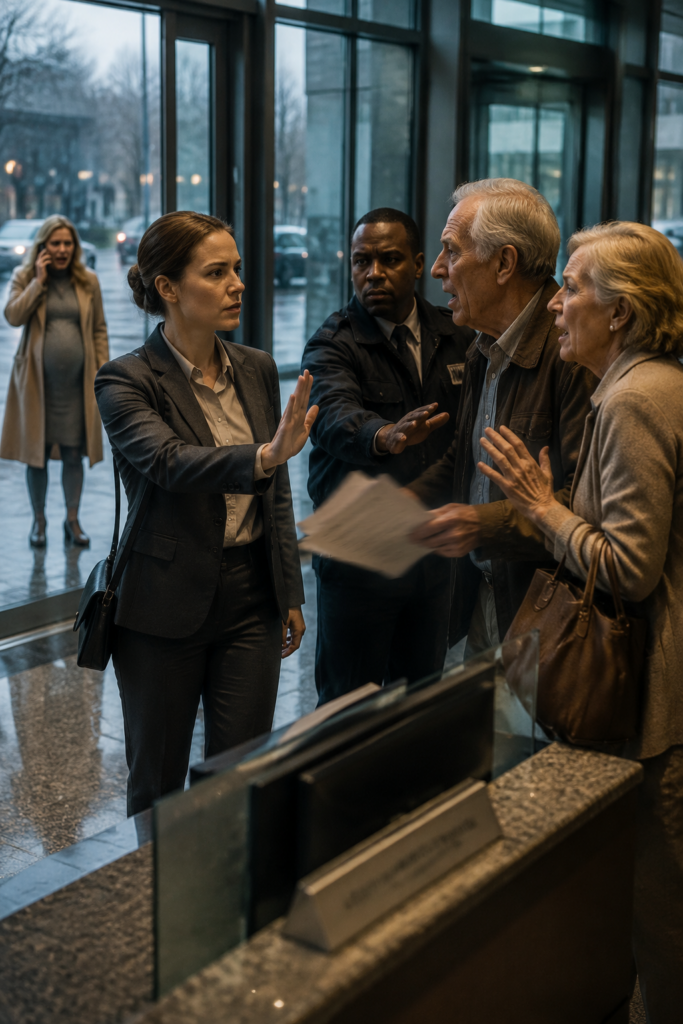
I saw them through the glass wall of our office building before security even called my desk.
My father stood stiffly, his shoulders stooped in a way I’d never seen before. His jacket hung loose, like he’d lost weight that his clothes hadn’t caught up with. My mother clutched her purse with both hands, her hair noticeably thinner and more gray than the last time I’d seen her.
They looked… smaller somehow. Shrunken. Older than their years.
For a moment, my chest tightened. Old instincts flared—the urge to rush in, to fix things, to be the good daughter who smooths everything over.
Then I remembered Lily, sitting on the porch with her knees pulled to her chest, tears drying on her cheeks while they locked themselves in their room.
The tightness loosened.
My desk phone rang. It was reception.
“Hi, Gina,” the receptionist said, sounding a little uncomfortable. “There are two people here asking for you.
They say they’re your parents. Security’s with them because, uh… they’re refusing to leave until they talk to you.”
I looked through the glass again. Security stood near them, not aggressive, but firm. My father gestured animatedly, my mother wiped at her eyes with a tissue. People passing by stared. Whispers spread.
“I can’t meet anyone right now,” I said. “Please let security handle it.”
I hung up.
I tried to focus on my work. I really did. But curiosity clawed at me. I found myself glancing at the clock, at the hallway, at the glass.
Finally, against my own better judgment, I stood up and walked toward the lobby.
As I approached, my mother saw me first.
“Oh, Gina!” she cried, rushing forward like we were reunited long-lost friends. Tears streamed down her face. She reached for me, but I stepped back, just enough that her hands fell uselessly in the space between us.
My father spoke quickly, as if afraid he’d lose my attention.
“We lost the house,” he said.
Just like that. No preamble. No apology. No acknowledgment of what they’d done.
“The bank repossessed it,” he continued. “They kicked us out last month. We couldn’t keep up with the payments. We’re in a one-bedroom apartment now, your mother, Sloan, the baby, and me. The house is up for sale.”
I listened, my expression carefully neutral.
“And Sloan?” I asked.
They exchanged a look, the kind that says you tell her without words. My mother looked down, almost ashamed. My father cleared his throat.
“Her husband kicked her out,” he said. “He found out she was cheating. The baby isn’t his.”
For a second, the words didn’t make sense. They floated in the air like a puzzle missing pieces.
“What?” I said finally.
“All the stories about the transfer, the company housing,” he continued. “They weren’t true. She was hiding here. She didn’t want her husband to find out.”
My mother burst into fresh tears.
“How could we abandon her?” she cried. “She had nowhere else to go.”
“And you used your savings for her medical bills,” I said slowly, piecing it together.
My father nodded reluctantly.
“And you still chose her,” I added, my voice soft but cutting. “You chose her over your five-year-old granddaughter.”
My mother’s face crumpled.
“She’s your sister,” she said. “We thought we had time to fix things with you. But the bank—”
“Why are you here?” I interrupted. “Really.”
They looked at each other again. My father sighed.
“We want to save the house,” he said. “If you could pay the overdue mortgage, we could keep it. Just until we get back on our feet. We’d sign it over to you one day, of course, but right now—”
I raised a hand, stopping him.
“You want me to save the house,” I repeated. “The house you lived in when you stood by and watched your pregnant daughter get screamed at. The house you stayed inside while your granddaughter sat on the porch alone. The house you used my rent to pay for without telling me. That house?”
My mother sniffed.
“It’s still your childhood home,” she said weakly. “Don’t you care about it at all?”
I thought about the dent in the baseboard. The nights I cried myself to sleep as a teenager. The afternoon on the porch.
“No,” I said. “I care about my daughter.”
My manager must have been watching, because later that day she pulled me aside.
“I saw your parents downstairs,” she said. “I hope you don’t mind me saying this, but… have you thought about buying the house yourself? Putting it in your name? It sounds like you’ve basically been paying for it already.”
The idea lodged itself in my brain like a seed.
Buying the house. Making it mine.
Taking the very place where my parents had betrayed me and turning it into something safe for my daughter.
The thought was tempting. Vindicating, even.
That night, I did the math. I looked at my savings, my new salary, my expenses. It would be tight. It would be stressful. But it was possible.
So I called them.
“I’ll make you an offer,” I said. “I’ll pay the overdue mortgage. I’ll take over the payments. But the house will be in my name only. Not a family property. Mine. And Sloan will never live there again. Ever.”
Silence.
Then my mother started crying again.
“How can you say that?” she wailed. “She’s your sister!”
My father said nothing. I could hear him breathing on the line.
“This is my only offer,” I said. “Think about it. Call me back.”
They never called back.
Not the next day. Not the next week. Not the week after that.
So I had my answer.
I found out the house had officially been put on the market through a neighbor. She texted me a photo like it was juicy neighborhood gossip.
The once-proud house stood behind a bright, shiny “For Sale” sign. The lawn looked overgrown. The paint was peeling a little around the windows.
I stared at the picture for a long time. Then I turned my phone face-down, took a deep breath, and went to help Lily with her homework.
That was the moment I realized I was done.
Not angry done. Not fantasizing-about-revenge done. Just finished.
The story of my parents and my sister had been playing on a loop in my head for so long that I had forgotten what it felt like for my brain to be quiet. Now, looking around my small, cluttered, cozy apartment, I realized that their drama didn’t live here.
Not unless I invited it in.
I decided not to.
Life, when it’s not constantly on fire, is surprisingly uneventful.
Our new normal was simple.
On weekdays, I woke up at six. I made coffee. I made Lily’s breakfast—toast shaped like hearts if I had time, just regular toast if I didn’t. I packed her lunch, double-checking that I’d included the one snack she liked that week and not the one she’d suddenly “hated forever” yesterday.
We walked to school when the weather was nice, hand in hand, stomping in puddles we pretended were secret portals. On rainy days, I drove and we sang along to whatever song she was obsessed with.
I went to work. I came home. I listened to her talk about her day in that breathless, tangential way kids have, where you’re not entirely sure if you’re hearing about one story or seven. Some nights we cooked together. Some nights we ate cereal for dinner. Some nights we ordered pizza.
On weekends, we went to the park. We colored. We watched cartoons. She had playdates with Martha’s son, who was patient with her in the way older kids sometimes are when they understand what it feels like to be small.
Slowly, Lily changed.
The nightmares came less often. The bed-wetting stopped. She no longer jolted awake at every small noise, eyes wide, expecting to see Sloan towering over her.
She started sleeping with the door open and the light off, something she hadn’t done since that day on the porch.
One afternoon, as she sat on the living room floor drawing with fierce concentration, she said, “Mom?”
“Yeah, baby?”
“You know that old house?” she asked, carefully coloring in the sky on her picture.
My heart skipped. “Which one?” I asked, even though I knew.
“Grandma’s house,” she said simply.
I swallowed.
“Yeah,” I said. “I know it.”
“I don’t like that house,” she said.
“Me neither,” I said softly.
She nodded, satisfied, like we’d settled something important.
“I like this house,” she added, looking around. “It’s small, but it’s happy.”
I had to look away for a second so she wouldn’t see my eyes fill with tears.
“Me too,” I said.
Sometimes people ask me if I regret it.
Do I miss my parents? Do I feel guilty for not swooping in to save their house when I had the chance? Do I worry about my sister, about the life she’s leading, about the baby she brought into the world under such a cloud of chaos?
The truth is complicated in some ways and very simple in others.
I miss the idea of parents, sometimes. The abstract notion of people you can call when your car breaks down, who show up on holidays with hugs and casserole, who babysit just because they want to spend time with their grandchild, not because you’re paying them or they’re policing someone else. I grieve that fantasy.
But my actual parents?
The ones who chose silence over protection? The ones who locked their door when I screamed their names? The ones who used my money in secret and then tried to guilt-trip me when the consequences came due?
No. I don’t miss them.
I don’t feel guilty for not rescuing their house. Because it was never just a house. It was a symbol of all the choices they made, over and over again, to protect my sister at everyone else’s expense.
Do I worry about Sloan?
Sometimes, in the way you worry about a tornado in another state. You know it’s wreaking havoc somewhere, but you also know you didn’t create it and you can’t stop it. You just pray it doesn’t cross your path again.
I heard through that same neighbor that my parents eventually moved to a smaller place across town, that Sloan still lives with them, that she “doesn’t work” because “it’s too stressful.”
I also heard that my mother tells people there’s a “misunderstanding” with me, that I’m “holding a grudge,” that I “changed after the divorce.”
She never mentions the porch.
She never mentions the look on Lily’s face.
I don’t correct her. I don’t engage. I don’t send long, angry texts or rehearse conversations in my head where I finally say the right thing and they finally get it.
Because they never will.
And that’s okay.
Because the day they chose to lock themselves away while my child sat outside in fear, they made their choice.
And I finally made mine.
A year after everything happened, I stood in front of Lily’s elementary school, watching her walk through the gates with her backpack bouncing against her shoulders.
She turned before she went inside, searching the crowd until her eyes found mine. She lifted her hand and waved, a quick, bright flash of fingers. I waved back.
For the first time in a long time, I felt something like peace settle into my chest. Not the fragile, brittle kind I used to feel when things were temporarily calm, always waiting for the next explosion. This was different. Solid. Quiet. Real.
I had chosen her.
Not my parents’ approval. Not the illusion of a united family. Not a house full of ghosts and obligations.
I chose my daughter.
I chose us.
Our small apartment with its mismatched furniture and slightly crooked bookshelf. Our messy kitchen with crayon marks on the fridge. Our evenings with mac and cheese and laughter instead of tension. The life we were building, one boundary at a time.
People still call me strong sometimes. They don’t know the whole story. They don’t know about the nights in the hotel, or the feel of Lily’s trembling body in my arms, or the way my mother’s voice sounded when she told me to “be the bigger person” while my child sat outside alone.
But I know.
And when someone looks at me and says, “You’re so strong,” I don’t argue anymore. I don’t downplay it.
I just smile and think:
No. I’m not strong because I wanted to be.
I’m strong because I finally realized that my daughter deserves a mother who will choose her, every single time—even if it means losing everyone else.
And that, more than anything my parents or sister could ever offer, is a choice I will never regret.
THE END
✅ End of story — Part 3 of 3
← Read from Part 1