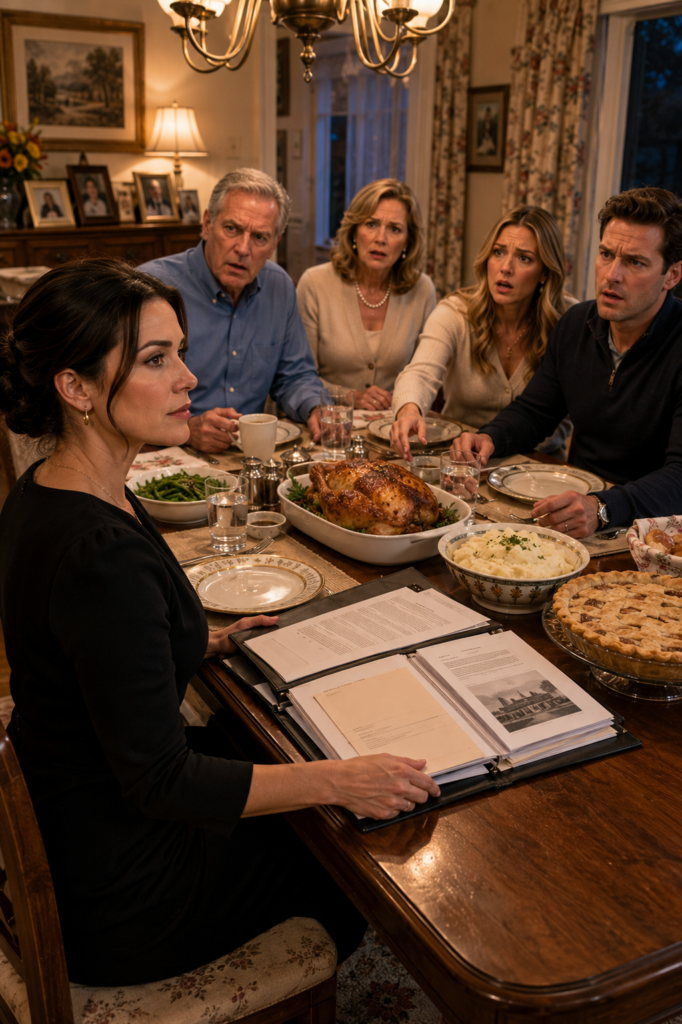
The roast chicken smelled like my childhood.
Garlic, butter, rosemary, and trouble.
My mother only made that dinner when she wanted something from me. Not asked. Wanted. There was a difference in our family, and I had learned it early enough to know that a beautifully browned chicken on my parents’ dining table was never just dinner. It was bait. It had always been bait. The smell filled the dining room the way it had when I was a girl, warm and familiar and almost comforting, if you did not know what usually followed.
My father sat at the head of the table like a tired king in a kingdom he had ruined himself. The overhead chandelier cast yellow light over his thinning hair and the deep creases around his mouth. He had dressed up for the occasion, which meant a blue button-down shirt tucked too tightly into khakis and a watch he wore whenever he wanted people to remember he had once been important at the bank. My mother sat opposite him with her hands folded beside her plate, watching me with that soft little smile she used whenever she had already decided I was going to lose.
My younger sister Natalie sat beside me, scrolling through her phone under the table even though everyone could see the glow against her wine glass. Her boyfriend Kevin leaned back in his chair across from her with one arm draped over the back of her chair, smirking like he had already moved into a place I had never offered.
They thought I did not notice.
I noticed everything.
That had become one of my quietest advantages. When you grow up as the daughter everyone depends on but nobody sees, you either disappear completely or you become very good at watching. I had spent thirty-one years watching my family make plans around me, over me, and sometimes directly through me, as if my agreement were only a small formality to be collected after decisions had already been made.
The dinner table was polished and old, still carrying the uneven marks of a summer I remembered too well. I had been fifteen when my father announced that refinishing the table would be “our project.” He bought sandpaper, varnish, brushes, and a plastic tarp from the hardware store. For one hour, we worked side by side in the garage while the radio played old rock songs and sawdust stuck to my arms.
Then Natalie came home crying because one of her art teachers had said her portfolio lacked direction, and Dad disappeared into the house to reassure her.
He never came back to the garage.
I finished the table alone over the next three days. Sanded it until my hands burned. Brushed on varnish. Waited. Sanded again. Varnished again. My mother told guests afterward that my father had “restored it beautifully.”
That was my childhood in miniature. I did the work. Someone else became part of the story.
Now, sixteen years later, I sat at that same table in a simple black dress, listening to my mother fuss over chicken and watching the people who had trained me to sacrifice decide how much more of me they wanted.
For weeks, the hints had been coming.
Natalie asking if my second bedroom got good light.
My mother saying city apartments were “too lonely” for single women.
My father complaining about the upkeep of their house, sighing heavily whenever property taxes or repairs came up, then looking at me to see whether the hook had caught.
Kevin joking that he could “totally work from my balcony” because, according to him, “the city vibe would be amazing for productivity.”
I smiled through all of it.
I passed potatoes.
I asked Natalie about her art.
I let my mother tell me three separate times that a family should stay close “when life gets difficult.”
I let them believe I was still the same girl they had trained me to be.
The strong one.
The flexible one.
The one who always understood.
In our family, Natalie was the treasure.
I was the tool.
That sounds cruel when stated plainly, but families like mine rarely state things plainly. They teach you through repetition. Through what gets celebrated and what gets expected. Through which child receives a new thing wrapped with a bow and which child is told that being low-maintenance is a virtue. Through which dreams are protected and which are negotiated away under the word family.
Natalie went to private school because she “needed extra attention.” I went to public school because I was “smart enough to manage.”
Natalie got ballet lessons, art tutors, expensive summer camps, and a bedroom redecorated whenever her taste changed. I got hand-me-down furniture, library books, and my mother’s favorite phrase: “You’re so practical, Sophia. You don’t need all that.”
Natalie got a red Toyota for her sixteenth birthday with a bow on the hood and twenty friends screaming in our driveway. I had the four hundred dollars I had saved for a used car taken from a tin box in my closet because my parents were short on property taxes.
Natalie got a six-week art trip through Europe after graduation, because my mother called it “necessary exposure.”
I gave up a full scholarship to the University of Chicago because my father had made a bad investment and the mortgage was behind.
The scholarship had been my escape.
Architecture in Chicago.
Glass towers. Old stone. New streets. Train platforms. A city where nobody knew me as the daughter who always paid for other people’s emergencies.
A week before I was supposed to leave, my father sat me down at that same dining table and said, “Just stay one year, Sophia. Help us get caught up.”
My mother stood behind him like a guard beside a prisoner and said, “Family comes first.”
Natalie was in Paris at the time, posing in front of the Eiffel Tower with paint-stained jeans and a caption about becoming who she was meant to be.
Her future was protected.
Mine was negotiable.
So I stayed.
One year became two.
Then five.
Then ten.
I worked call centers. I cleaned office buildings at night. I answered phones at a doctor’s office by day. I handed over money every month until the family emergency became less of a crisis and more of a permanent job title. My parents stopped saying thank you and started saying, “Can you do a little more this month?” Natalie stopped pretending she felt guilty and started complaining that my help made me act superior.
But what they never knew was that I was building a second life in secret.
At midnight, after cleaning office bathrooms and emptying trash cans from cubicles where people had left behind half-finished coffees and sticky notes with passwords written on them, I sat in my car outside the building and used the free office Wi-Fi to study. The glow of my laptop became my classroom. I learned IT fundamentals first, then networking, security, databases, code. I failed practice exams. I took them again. I earned certifications one at a time, each one a brick in a wall I was building between myself and the life my family had assigned to me.
Then I became a freelance tech consultant.
Then I co-founded a small health-tech startup with a man named Mark Ellison, who became the first person in my professional life to call me partner instead of useful.
We built software for small medical clinics that could not afford expensive systems but still needed secure patient records, scheduling tools, billing support, and something that did not crash every time a receptionist clicked too fast. We struggled. We worked out of a windowless office with one printer that jammed every Thursday as if it knew payroll was due. We almost failed twice. We survived because we were stubborn and because I had spent my entire life learning how to function while exhausted.
Then a venture capital firm backed us.
And slowly, quietly, I became worth more than my family could imagine.
I did not tell them.
Not because I was ashamed. Because I knew exactly what would happen if they understood the size of what I had built. My success would stop being mine. It would become family success. My savings would become available resources. My apartment would become wasted space. My company shares would become something my father had “always known” I could achieve because, in his words, he had made me strong.
So I stayed careful.
I moved into a two-bedroom apartment in the city, not extravagant but beautiful to me. Good windows. A small balcony. A kitchen where every dish belonged to me and nobody opened cabinets without asking. I bought a blue sofa because Natalie hated blue furniture and I loved the idea of choosing something with nobody else’s taste in mind. I placed a small drafting table by the window, not because I had time to draw buildings anymore, but because I wanted to honor the girl who once had.
It was the first home I had ever chosen for myself.
And inside my family’s heads, they had already divided it up.
My parents would take the master bedroom.
Natalie and Kevin would take the second.
I would, apparently, fit wherever they decided I belonged.
The warning came from my aunt Linda on a rainy Tuesday evening.
I was at my desk finishing a security review for a clinic network in Dayton when my phone rang. Aunt Linda rarely called. She was my mother’s younger sister and the only person in the family who had ever looked at me with anything close to honest concern. She was quiet, always slightly overwhelmed by my mother’s force of personality, but she had a conscience that still worked.
“Sophia?” she said when I answered.
Her voice was shaking.
“Aunt Linda? Are you okay?”
“I don’t know if I should be calling you.”
That sentence pulled me upright in my chair.
“What happened?”
In the background, I heard a television, maybe a game show, maybe the evening news. Then a door closing.
“Your parents are talking about moving in with you,” she whispered.
For a moment, I did not understand the grammar of the sentence.
“They said what?”
“They’re telling people you’ll be happy to have them. Your mother told Carol from next door that you’re lonely in the city and it will be good for everyone. Natalie already picked out your second bedroom.”
My hand tightened around the phone.
“She what?”
“She showed pictures of your apartment from the real estate listing, Sophia. She was laughing about where Kevin’s gaming setup would go.”
Something cold moved through my stomach.
My apartment had been listed online years earlier before I bought it. They had searched for it. Studied it. Assigned rooms.
Aunt Linda kept talking quickly now, like she had held the words in too long and was afraid she would lose her nerve.
“Your father said you owe it to them. He said they gave you everything and now it’s your turn. He said you always make a fuss at first, but you do what’s right eventually.”
There it was.
The old script.
I always made a fuss.
Then I did what was right.
What they called right was whatever cost me the most.
“Did they say when?” I asked.
“I don’t know. Soon. Your mother said she was inviting you to dinner. Roast chicken.”
I closed my eyes.
Of course.
“Thank you for telling me.”
“I’m sorry,” she said, and her voice cracked. “I should have said more years ago.”
There are apologies that cannot undo anything but still matter because someone finally names the room you lived in.
“You’re saying it now,” I told her. “That counts.”
After we hung up, I sat in silence while rain streaked down the window glass. The city lights beyond my apartment blurred into long wet lines. The anger I felt was not hot. I had known hot anger in my youth, the helpless kind that burned your throat while you smiled and said okay. This was colder. Cleaner. The anger of an adult who has finally understood that danger is coming and has the means to secure the doors.
Two nights later, I drove to my parents’ house unannounced.
I told myself I was going to pick up a box of old textbooks from the attic. That was partly true. The rest of the truth was that I needed to hear it for myself. Some small, stubborn part of me still wanted to believe Aunt Linda had misunderstood, that perhaps my mother had exaggerated over coffee, that maybe my family was selfish but not truly predatory.
The old house looked smaller than I remembered. The blue siding was peeling near the gutters. The porch light flickered. My father’s pickup sat crooked in the driveway, one tire low. I used my old key and stepped inside quietly.
The front hall smelled like dust, old carpet, and the lemon cleaner my mother used before guests came. Voices carried from the den. My father was on the phone. The door was open just enough.
I froze before I could call out.
“No, no,” he said. “She won’t say no. She’ll make a fuss, probably cry a little, but she’ll do it. She always does.”
A pause.
Then he laughed, not kindly.
“What do you mean, what if she has her own life? I gave her that life. We sacrificed for her. Who paid for her food? Who put a roof over her head? She owes us. We made her who she is.”
My hand gripped the banister.
His voice lowered, but the words still reached me.
“The money she’s making from that little computer thing she does should have been family money to begin with. And that apartment? It’s family property. She doesn’t need all that space. We’re just going to claim what’s ours. Natalie’s excited. It’ll be good for her to be in the city around more culture. Sophia can help support her art.”
Family property.
Claim what’s ours.
Help support her art.
I stood in the hallway while every last childish hope I still had about them dissolved.
They did not see me as a daughter who had suffered for them. They saw me as a stock that had matured. A resource they had invested in by feeding me as a child and now intended to cash out. My apartment was not my home. It was an asset that had been inconveniently placed under my name. My success was not a life I had built out of exhaustion and grit. It was something they were entitled to harvest.