I did not go into the den.
I did not get my books.
I backed out of that house as quietly as a thief and drove away before anyone knew I had been there.
By the time I reached the highway, my hands had stopped shaking.
The cold in my chest had solidified into resolve.
They thought I was the same girl who had unpacked her Chicago boxes and gone to work at a call center because they told her to.
They thought I was the same tool they had forged, ready to be picked up and used whenever they saw fit.
They had no idea what I had become.
On Monday morning, I was sitting in a sleek office on the fortieth floor of a downtown skyscraper, across from an attorney named Evelyn Reed.
Evelyn was in her late fifties, with silver hair cut sharply at her jaw and dark eyes that made unnecessary explanations die on your tongue.
Her office was minimalist in the way powerful people’s offices often are, all glass, steel, and one abstract painting that probably cost more than my first car would have if I had ever been allowed to buy one.
I told her everything.
Not emotionally. Not at first. I laid out facts the way I had learned to lay out system vulnerabilities.
Family history of financial dependence.
Ongoing monthly support.
Pattern of unauthorized expectations.
Threat of forced cohabitation.
Potential claims against my assets.
Startup equity.
Savings.
Apartment ownership.
My father’s exact words: “It’s family property. We’re just going to claim what’s ours.”
Evelyn listened without interrupting, fingers steepled beneath her chin.
When I finished, she nodded once.
“This is not a family argument, Sophia,” she said. “This is asset protection.”
Something in my body loosened.
Not because the situation was less ugly. Because she had named it without pity. She was not asking me to understand them, forgive them, reason with them, or explain myself better. She was treating the threat as real.
“My job,” she continued, “is to make you legally and financially unreachable before they attempt to turn emotional entitlement into practical access.”
“Can they sue me?”
“People can sue for almost anything. Winning is another matter. But litigation is only one risk. Pressure, harassment, coercion, surprise occupancy, forged claims, manipulation through extended family. You need clean ownership structures and documented boundaries.”
She opened a folder.
“Your biggest vulnerability is visibility. On paper, you are wealthy enough to be targeted and emotionally close enough to be pressured. We need to change what the paper says.”
Over the next several weeks, Evelyn helped me build a fortress.
Not a metaphorical one.
A legal one.
We reviewed every account, every asset, every piece of equity, every real estate document. I called Mark and explained that I needed to restructure my personal holdings for family security reasons.
I did not give him every painful detail, but I told him enough.
He sat across from me in our office, hands folded, listening.
When I finished, he said, “Whatever you need, Sophia.”
No suspicion. No demand. No guilt.
Just trust.
That nearly broke me more than my family’s cruelty had.
“I may need to sell part of my shares,” I said.
He nodded slowly. “Then we do it carefully.”
Those shares were the tangible proof of everything I had survived. Giving up part of them felt like cutting into my own body. But Evelyn was right. Equity in a private company was potential. Cash was movable. Protectable. Strategic.
A private equity firm that had shown interest in us before agreed to purchase a minority portion of my shares. The negotiations took two brutal weeks. When the wire transfer finally landed, I sat at my desk staring at the number.
Seven hundred and fifty thousand dollars before taxes.
More money than my father had ever believed I could touch.
More money than my mother would have justified taking if she knew it existed.
Evelyn moved fast.
The largest portion went into an irrevocable trust with its own tax ID number. I was the beneficiary, but I did not directly own or control the principal. It was legally separated from me, protected from personal claims, and managed by a trustee under strict terms.
Then came the apartment.
My sanctuary.
My two bedrooms, my balcony, my blue sofa, my drafting table by the window.
The thought of moving it out of my name made me feel strange, like I was erasing the first place that had ever been mine. Evelyn understood before I said it.
“You are not losing it,” she said. “You are protecting it from people who think ownership is an invitation.”
She created Midwest Property Holdings LLC, a bland name so forgettable it sounded like a filing cabinet. The trust owned the LLC. The LLC purchased the apartment. Then the LLC leased it back to me under a formal rental agreement.
On paper, I became a tenant.
The apartment became a corporate asset owned by an entity my family could not pressure, guilt, or ambush at Sunday dinner.
I closed bank accounts my parents knew about and moved everyday funds into a normal checking account with a modest balance. I adjusted my direct deposit. I documented the end of regular family support and sent my parents one final monthly transfer with a note that said: This concludes my ongoing contribution. I will not be making further payments.
My mother responded with three question marks.
My father responded: We’ll discuss this Sunday.
I did not reply.
When everything was done, Evelyn slid a thick folder across her desk.
Inside were copies of the trust documents, LLC formation papers, deed transfer, lease agreement, account statements, and a short letter she had prepared in case my family attempted to enter or occupy the apartment.
“As of this moment,” she said, “you are a woman with a solid income, normal expenses, and no major assets in your individual name. You rent your apartment from a property company. You own no significant liquid funds outside protected structures. You are no longer the solution to anyone’s financial problem.”
I walked out of her office into the busy city afternoon and felt lighter than I had in years.
For my entire life, my family had tied my value to what I could provide.
I had just legally erased that value from their reach.
They were coming for a feast.
I had cleared the table and locked the pantry.
All that remained was dinner.
My mother called three days later.
“Sophia, honey,” she said, her voice sweet enough to make my teeth ache. “We haven’t seen you in ages. Your father and I are having a special family dinner Sunday. Roast chicken. Your favorite.”
It was not my favorite.
It had never been my favorite.
It was only the meal my mother cooked when she wanted me softened by memory before she made a demand.
“I’ll be there,” I said.
On Sunday evening, I took my time getting ready. I chose a simple black dress, low heels, and small gold earrings I had bought after our first profitable quarter at Healthy. Not flashy. Not sentimental. Business armor disguised as family attire.
In my bag, I placed the folder Evelyn had prepared, not the entire fortress of documents, only the pieces that mattered for the performance my family was about to stage.
The lease agreement.
The LLC ownership summary.
A valuation report.
A letter from Evelyn’s firm.
And one page with a number printed clearly at the top.
$860,000.
That was the apartment’s current market valuation, updated after recent sales in my building.
If they wanted keys, they could bring the money.
I drove to the house with no music playing.
For the first time in my life, I felt no panic approaching my childhood home. No old dread. No rehearsed apologies. No pressure to become smaller before entering.
The porch light was on. Through the window, I could see my mother moving around the dining room, placing dishes on the table with theatrical care. Natalie’s laughter floated through the glass. Kevin’s silhouette leaned in the living room doorway, already comfortable.
When I rang the bell, my mother opened the door with exaggerated warmth.
“Sophia! There you are.”
She hugged me too tightly, pressing perfume and expectation into my skin.
Dad appeared behind her. “Good to see you, kiddo.”
Kiddo. He only called me that when he wanted to sound benevolent.
Natalie lounged on the sofa in a cream sweater and jeans that probably cost more than my monthly grocery budget during my call center years. Kevin stood when I entered but did not bother to hide the way his eyes moved over me, assessing. I could practically hear him calculating square footage.
“Hey, Soph,” Natalie said. “You look fancy.”
“Thank you.”
“Big city CEO vibes,” Kevin joked.
“Not CEO,” I said. “Founder.”
He blinked.
Natalie rolled her eyes. “Same thing.”
No, I thought. Not even close.
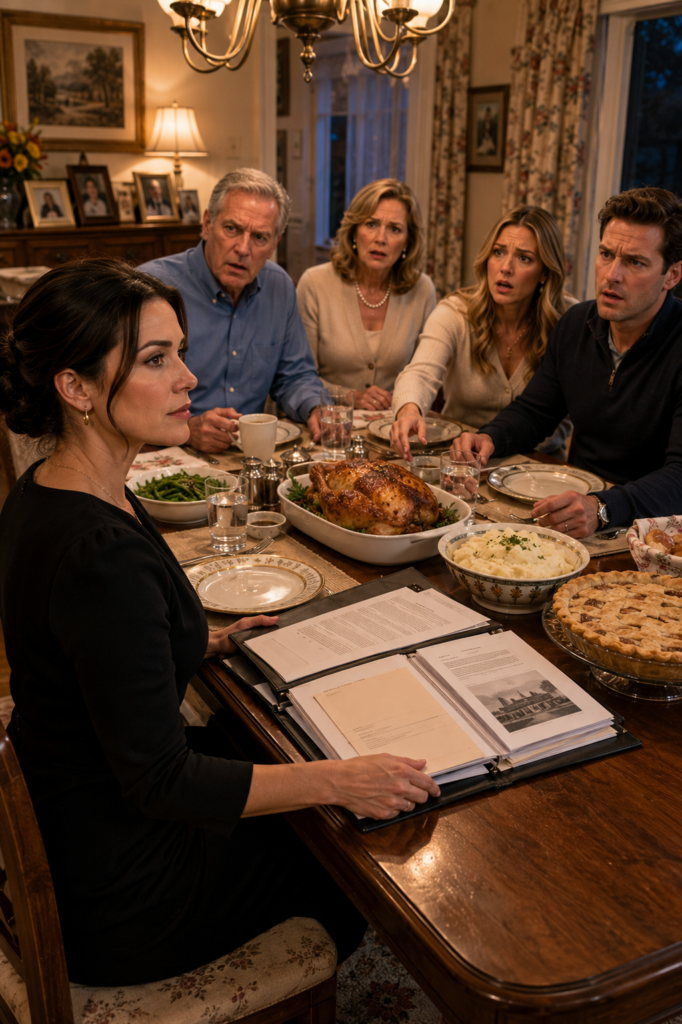
Dinner was theater from the first course.
My mother fussed over the chicken, carving it too carefully, asking if everyone had enough potatoes, smiling whenever she looked toward my father. Natalie talked about needing more space for her art, how hard it was to be creative in “stale suburban energy,” and how the city had “a better frequency.” Kevin asked about the view from my balcony.
“Is it, like, skyline skyline?” he said.
“It’s a city view,” I answered.
“Man, I could write music out there.”
“You write music?”
“I’m getting into production.”
Natalie squeezed his arm proudly, as if he had just announced a medical breakthrough.
My mother asked about work, but her eyes glazed over when I mentioned compliance standards and clinic workflows. Dad interrupted to tell Kevin about how I had “always been good with computers.”
“She saved us a fortune fixing routers back in the day,” he said, laughing.
A skill set reduced to free tech support.
I smiled.
“Useful,” I said.
He did not notice the edge.
Dessert was apple pie, store-bought but transferred to one of my mother’s ceramic dishes so she could pretend. Coffee was poured. Plates were cleared. Natalie stopped scrolling. Kevin leaned back. My mother folded her hands.
My father set down his fork.
The small talk died.
There it was.
He cleared his throat and looked at me with the smug authority of a man about to announce someone else’s sacrifice.
“Sophia,” he began, “your mother and I have made a decision.”
I rested my hands in my lap.
My mother nodded solemnly. “Things have been hard.”
“They’ve been hard for a while,” Dad said. “The house is too much. Upkeep, bills, property taxes. We’re not as young as we used to be.”
Natalie arranged her face into something meant to resemble concern.
“And I really need somewhere peaceful to focus,” she said. “You know, somewhere with light. The suburbs are killing my creative process.”
Kevin added, “Plus, financially, it just makes sense. Why should everyone struggle when there’s space?”
I looked at him. “Everyone?”
He grinned, mistaking my question for engagement. “Yeah. Like, community living. Family ecosystem.”
I almost admired the audacity of a man who had known me less than a year and already felt qualified to ecosystem himself into my apartment.
My father leaned forward.
“So tomorrow,” he said, “we’re moving into your house.”
My mother watched me closely.
“No excuses,” Dad added.
Silence stretched across the table.
They waited for the old Sophia.
The girl who blinked back tears.
The woman who said yes because saying no felt dangerous.
The daughter who made a fuss, probably cried a little, then did what was right.
Instead, I picked up my fork.
I cut a small piece of chicken I had not finished earlier, placed it in my mouth, and chewed slowly.
It was dry.
My mother had overcooked it.
I swallowed, took a sip of water, and smiled.
“Fine,” I said.
Natalie gasped with excitement before she could stop herself.
“Oh my God, seriously?”
My mother’s shoulders dropped with visible relief.
Kevin grinned. “I knew you’d come around.”
My father looked victorious.
I placed my fork down gently and looked him straight in the eye.
“But don’t forget to bring eight hundred and sixty thousand dollars by morning.”
The table froze.
Kevin’s smirk vanished first.
Natalie’s mouth fell open.
My mother whispered, “What are you talking about?”
I reached into my bag, removed the folder, and slid it across the table.
“That’s the current purchase price,” I said calmly. “Because if you want to move into that apartment, you’ll need to buy it from the owner.”
My father’s face flushed red.
“You are the owner.”
I leaned back in my chair.
“No,” I said. “Not anymore.”
The sentence landed like a glass breaking in another room.
Natalie snatched the folder before my father could reach it, flipping pages too quickly to understand them.
“What is Midwest Property Holdings?” she demanded.
“The owner of the apartment.”
“That’s fake.”
“It’s an LLC.”
Kevin leaned over her shoulder. “Wait, so you sold it?”
“Yes.”
My mother’s face had gone pale.
“You sold your home without telling us?”
“My home?” I asked softly. “That’s interesting. A few minutes ago, it was family property.”
Dad slammed his palm against the table, rattling the coffee cups.
“Don’t get clever with me.”
“I’m not being clever. I’m being accurate.”
“You did this to spite us.”
“I did this because Aunt Linda called me.”
My mother’s eyes widened.
I continued, “And because I heard you in the den, Dad. I heard you say I wouldn’t say no. That I’d make a fuss and then do what was right. I heard you say my apartment was family property. I heard you say you were going to claim what was yours.”
His face changed.
For one second, guilt flickered through his expression.
Then anger covered it.
“You were spying.”
“I was listening to the truth.”
Natalie threw the papers onto the table.
“You’re so dramatic. We’re your family.”