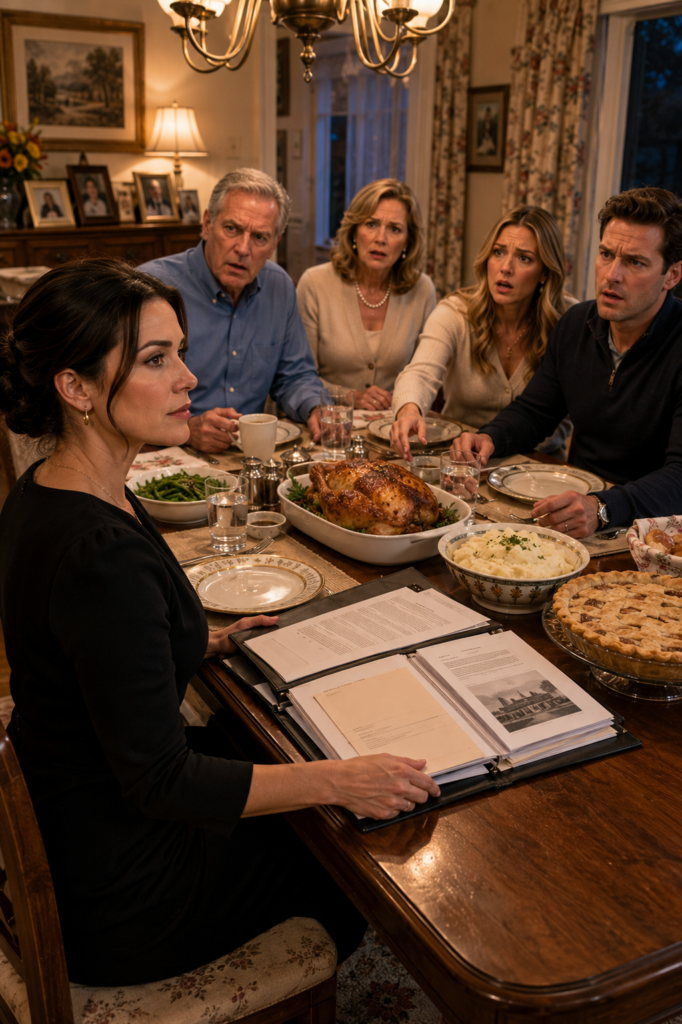
“Are you?”
She recoiled.
My mother pressed a hand to her chest. “Sophia.”
“No,” I said, and the word surprised even me with how sharp it sounded. “You don’t get to say family like it’s a magic spell. Not after everything.”
Dad stood, chair scraping behind him.
“Everything? You mean after we raised you? Fed you? Gave you a roof over your head?”
“You did the legal minimum and billed me for it emotionally for thirty-one years.”
Natalie laughed bitterly.
“Oh, here we go. Poor Sophia. Always the victim.”
I turned to her.
“No, Natalie. I was not the victim. I was the worker. The payer.
The fixer. The one who handed over savings so you could keep your car. The one who gave up Chicago while you went to Europe. The one who worked nights while you painted in a room my income helped fund.”
Her eyes flashed.
“You’re jealous.”
“I was,” I said.
That quieted her.
“For years, I was jealous. Not because you had things, but because nobody ever asked what it cost me for you to have them.”
My mother was crying now, or performing something close to it.
“We never meant to hurt you.”
“That may be true,” I said. “But you also never tried very hard not to.”
Dad jabbed a finger at the folder.
“You think some lawyer papers make you better than us?”
“No. They make me protected from you.”
That was the sentence that ended the dinner.
Something in my father’s face collapsed, not into remorse, but into the shock of a man who had always believed the door would open when he pushed and had finally found it locked.
Kevin stood first.
“This is insane,” he muttered. “I’m not getting dragged into this.”
Natalie turned on him. “Dragged into what?”
“I thought she actually had the place.”
The room went silent again.
Natalie stared at him.
In another life, I might have enjoyed that moment. But by then, I was too tired to enjoy anyone else’s humiliation.
I stood.
My mother reached toward me. “Sophia, please sit down. We can talk about this.”
“We talked for thirty-one years,” I said. “You just weren’t listening.”
I looked at my father.
“You were right about one thing. It is a parent’s duty to provide a roof over their family’s head. Your family, Dad. Not mine.”
Then I placed my napkin beside my plate.
“Thank you for dinner.”
I walked out of the house without running, without slamming the door, without looking back.
The explosion did not end that night.
Entitlement rarely retreats after its first defeat. It looks for another door.
My mother began with social media. Vague posts about heartbreak, abandonment, and children who forgot where they came from. She wrote about aging parents, family values, and the pain of being left alone “after a lifetime of sacrifice.” Friends and distant relatives who knew only the curated version of our family flooded her comments with sympathy.
Some children are so selfish.
Praying for you.
You deserve better.
Natalie went less subtle.
She posted a long furious rant calling me cold, greedy, and “basically rich but pretending not to be.” She claimed I had sold my apartment to keep my own family homeless. She called me a liar and said I had always hated her because she was “the creative one.”
Kevin shared it with a sad-face emoji, then removed it two days later after, according to Aunt Linda, he and Natalie had a fight about whether he was still moving with her “somewhere better.”
The old Sophia would have panicked.
She would have wanted to explain. She would have written long messages in the comments, listing every sacrifice, every payment, every stolen chance, hoping strangers would understand. She would have called her mother crying and begged her to stop.
The new Sophia blocked the posts.
Not because they did not hurt.
Because not every lie deserves your energy.
Then they came to my office.
Healthy had moved by then into a real workspace, not enormous, but bright, with glass conference rooms, plants Mark’s wife kept alive, and a front desk staffed by a receptionist named Tasha who had once handled an angry billing manager with such calm that I considered giving her equity.
I was in a product meeting when Tasha buzzed my office.
“Sophia,” she whispered, “your family is in the lobby.”
My stomach tightened.
“They’re making a scene.”
Mark stood immediately.
“I’ll handle it.”
“No,” I said. “I will.”
When I walked into the lobby, my father was red-faced and shouting at Tasha, who sat perfectly still behind the desk with one hand near the phone. My mother sobbed loudly into a tissue. Natalie paced near the seating area, sunglasses pushed onto her head, fury making her movements sharp. Kevin was not there.
That was interesting.
“There you are,” my father snapped. “You’re going to come with us right now and fix this.”
“This is my workplace,” I said.
“This is family.”
“No. This is trespassing if you don’t leave.”
My mother wailed louder. “How can you speak to us that way? We have nowhere to go.”
“You have options. You just don’t like them.”
Natalie stepped toward me.
“You ruined everything.”
“I prevented you from taking something that wasn’t yours.”
Employees had begun appearing in doorways. I could feel their eyes on us, not cruelly, but with concern. Mark stood near the hallway, silent but ready.
My father pointed at me.
“You owe us.”
The words were quieter this time, but more dangerous.
I looked at him for a long second.
“No,” I said. “I don’t.”
Then I looked past him at the building security guard approaching from the elevator. Evelyn had advised me this might happen. Tasha had already called.
“Sir,” the guard said, “you need to leave.”
My father sputtered. My mother looked horrified. Natalie shouted something about lawsuits. A second guard arrived.
They were escorted out of the lobby in front of my staff.
They had come to humiliate me in my professional space.
Instead, they revealed themselves.
When the elevator doors closed behind them, the lobby remained silent for several seconds.
Then Tasha looked up at me.
“Do you need anything?”
A simple question.
A kind one.
I breathed in.
“No. Thank you.”
Mark came to my side.
“Are you okay?”
I thought about it.
Then I realized I was.
“Yes,” I said. “I think I am.”
After that, consequences arrived without my help.
The bank foreclosed on my parents’ house. They had been too far behind for too long, and without my monthly rescue payments, the numbers became what they had always been: impossible. My father tried to blame me. My mother tried to shame me. Natalie tried to sell paintings online at prices that suggested she believed exposure and talent were interchangeable.
Kevin disappeared first.
Aunt Linda told me he left three days after realizing there would be no downtown apartment, no balcony, no free place to “make music,” and no financial safety net attached to dating Natalie.
My parents moved into a small rental forty-five minutes outside town. My father took part-time work at a hardware store. My mother became a cashier at a grocery store. Natalie waitressed at a restaurant where, according to Aunt Linda, she complained constantly and learned slowly that customers did not tip for artistic potential.
I did not celebrate.
That surprised some people when they found out. They expected triumph, satisfaction, revenge. But watching people fall because you finally stopped holding them up does not feel like victory. It feels like setting down a weight and hearing it crash behind you.
The crash is not your fault.
But you still hear it.
For months, voicemails came.
My mother crying.
My father demanding.
Natalie begging, then insulting, then begging again.
Sophia, please. We need help.
You can’t let them take the house.
You’ve changed.
You think you’re better than us.
Just one more time.
Family comes first.
I listened to the first few.
Then I stopped.
Evelyn told me to preserve them but not engage. So I saved them in a folder and let them go unanswered. Eventually, I blocked the numbers. Every instinct from childhood screamed at me to fix it. To rush in. To be the strong one. To solve the problem so everyone would calm down and call me good again.
But I finally understood something.
If I saved them, the cycle would never end.
They would not learn gratitude.
They would learn that the door still opened if they screamed long enough.
So I did not rescue them.
I let the foreclosure happen.
I let the rental happen.
I let Natalie get a job.
I let my father discover that hardware store customers did not care that he used to work at a bank.
I let my mother stand behind a register and perform politeness for strangers because a paycheck required it.
I let their lives become their own responsibility.
And in doing so, I finally made mine mine.
A year later, I left Ohio.
Not in a panic. Not running. Running would have meant they were still chasing me.
I left because Healthy had grown, because Mark and I were opening a Seattle office, because the wellness platform we had built for clinics had expanded into a broader patient care and stress-management tool, and because one morning I woke up in my city apartment and realized I had outgrown even the protected version of the life I had made there.
Seattle felt new.
Gray, green, rainy, and far enough away that my childhood could not reach me without booking a flight it could not afford.
I bought a small house on the edge of the city, tucked among tall pines with a view of Puget Sound through the living room window. Not large. Not showy. No guest suite waiting for relatives with opinions. One bedroom, one office, a kitchen full of light, a small garden in the back, and a deck where rain tapped softly against the railings in the morning.
It was a house built for one person to find peace in.
That person was me.
For the first few weeks, I kept expecting the quiet to turn into loneliness. It never did. The quiet was not empty. It was spacious. It had room for coffee in the morning, late-night coding, old architecture books reopened without pain, and sketches of buildings I no longer needed to construct in order to escape.
Mark and his wife came over for dinner. So did a few people from the new office. A neighbor named June brought me tomatoes from her garden and told me the raccoons were “organized criminals.” We laughed in the kitchen, and I realized I had found something I had never known growing up.
A family that did not require me to bleed to prove I belonged.
Aunt Linda remained my only real connection to home. She gave me brief updates, always with reluctance, always asking first whether I wanted to know.
My parents were surviving. Barely, but surviving. Natalie was still waitressing, still painting, though now she had begun selling smaller pieces at local fairs and, to her credit, actually earning some money from them. My father complained about his knees. My mother complained about rude customers. None of them apologized.
Not once.
That used to matter to me.
It matters less now.
One evening, nearly eighteen months after the dinner, I sat by my picture window watching the sunset over the water. The sky was orange and purple, dramatic in the way only a rainy city can be when the clouds finally open. I had a mug of tea in my hands. My house was quiet. The garden smelled like wet earth.
I thought about forgiveness.
For most of my life, I had imagined forgiveness as a reunion. A tearful scene. A table reset. My mother crying honestly this time. My father admitting everything. Natalie saying she had been selfish. Me opening the door, letting everyone in, and somehow becoming whole because they had finally named what they took.
But sitting in that quiet house, I understood that forgiveness did not have to be access.
It did not have to mean answering the phone.
It did not have to mean holiday dinners or spare keys or pretending the past was only a misunderstanding.
My forgiveness was private.
It was the decision to stop carrying them inside my chest.
To let their failures belong to them.
To let my sacrificed scholarship be a grief, not a life sentence.
To let the girl who unpacked her Chicago boxes finally rest.
I could not change what happened. I could not go back and board the bus. I could not study architecture in the city I had dreamed about at eighteen. I could not recover the years I spent cleaning offices and answering phones and being called strong when people meant usable.
But I had built something anyway.
Not the life I planned.
A life that was mine.
That mattered more.
My mother’s roast chicken had smelled like childhood because childhood is where the pattern began. Garlic, butter, rosemary, and trouble. A table where decisions were made before I was invited to hear them. A father who mistook authority for ownership. A mother who called sacrifice love as long as I was the one making it. A sister who learned entitlement the way other people learn language.
That Sunday dinner was the last one I ever attended because something ended there that had needed ending for a long time.
Not my connection to them. That had frayed slowly over years.
What ended was my usefulness.
The role.
The tool.
The strong one.
The daughter who always understood.
Now, when I stand in my kitchen in Seattle, barefoot on warm wood floors, watching rain move across the windows, I understand peace differently. Peace is not something people give you when they finally stop hurting you. Peace is built. Protected. Legally structured sometimes. Emotionally defended always.
Peace is a locked door.
A clean bank account.
A phone that does not ring unless you want it to.
A table where nobody has already decided what you owe before you sit down.
And sometimes, peace is a woman taking one bite of overcooked chicken, smiling at the people who thought they owned her, and calmly naming the price of admission to a life they can no longer enter.
✅ End of story — Part 3 of 3
← Read from Part 1