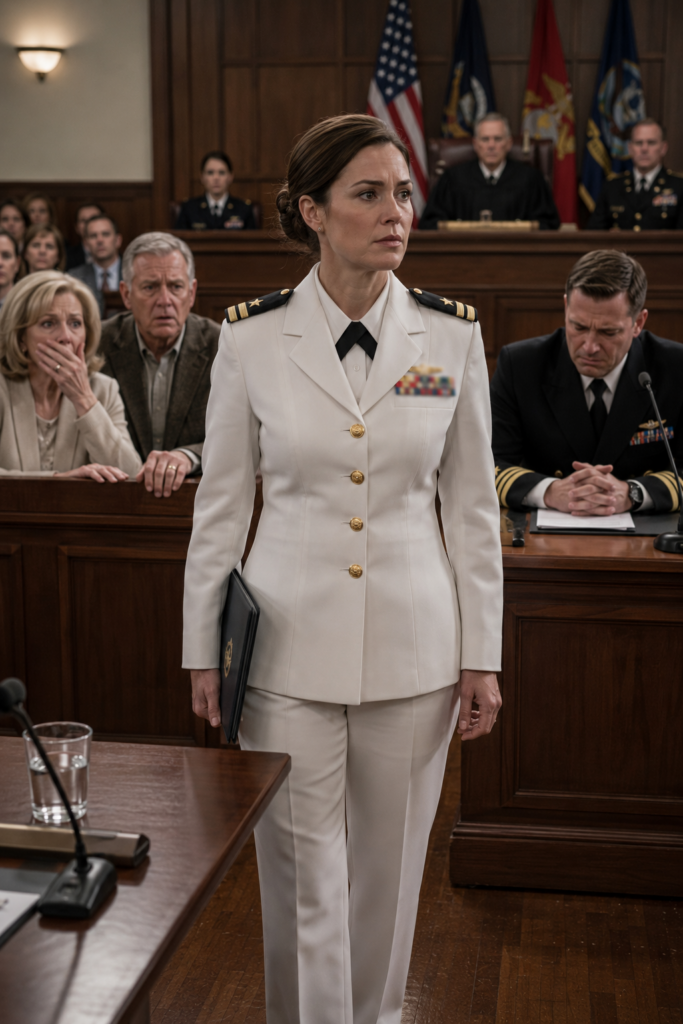
“I believe you’re sorry,” I said. “That’s not the same as making it right.”
He nodded.
“I know.”
The next day, Tom accepted responsibility for the falsified documentation. The judge reviewed the facts and issued the consequences: demotion, administrative discharge, loss of certain benefits. No prison. No dramatic ending. Just the quiet collapse of the career Tom had entered under the shadow of the lie he told about mine.
When it was over, we stood outside the courthouse beneath a bright Virginia sky.
My parents looked exhausted.
Tom looked relieved in a sad, hollow way.
“Well,” he said. “That’s that.”
My father stared at him for a long moment, then placed a hand on his shoulder. It was not forgiveness. Not fully. But it was still fatherhood.
My mother turned to me.
“Could we meet Emily?” she asked.
The question seemed to cost her everything.
I thought of my daughter. Her questions. Her easy way of accepting truth when adults made it complicated. I thought of all the birthdays my parents had missed, all the school pictures, all the bedtime stories, all the ordinary days that never come back once they are gone.
Part of me wanted to say no.
A very honest part of me.
But another part knew that keeping Emily from them would not give me back what I had lost. It would only teach the next generation to inherit the silence.
“She knows about you,” I said.
My mother’s face crumpled.
“She does?”
“Yes.”
“What did you tell her?”
“That adults make mistakes.”
My father looked away.
After a long moment, I said, “You can visit. But slowly.”
My mother nodded quickly.
“Yes. Of course. Slowly.”
Two weeks later, my parents came to Norfolk.
Michael grilled hamburgers in the backyard because he believed food made painful reunions easier, and most of the time he was right.
Emily rode her bike in circles on the driveway, wearing a helmet covered in stickers and narrating her own imaginary race.
When my parents’ car pulled in, she stopped and looked at me.
“Are those the grandparents who made the big mistake?”
I nearly choked.
Michael coughed into his hand.
“Yes,” I said carefully. “Those are my parents.”
Emily considered this.
“Okay.”
Children can be merciful without even knowing it.
My mother stepped out of the car first. She saw Emily and pressed a hand to her mouth, just as she had in the courtroom, but this time the emotion was different. My father stood beside the car, staring at his granddaughter like he was afraid one wrong movement would make her disappear.
Emily walked right up to him.
“Are you my grandpa?”
His voice broke.
“Yes.”
She held out her hand.
“I’m Emily. I like volcano science, pancakes, and dogs, but Mom says we are not getting one yet.”
My father laughed. It came out rough and surprised.
“That’s a good list.”
My mother knelt carefully.
“Hi, Emily. I’m your grandma.”
Emily studied her.
“You look like Mom’s old pictures.”
My mother started crying then, quietly, helplessly.
Emily looked confused and patted her shoulder.
“It’s okay. Adults cry sometimes.”
That broke the rest of us.
The afternoon was awkward at first. Of course it was. You do not step over twelve years of absence as if it is a crack in the sidewalk. You move around it carefully, aware that one wrong word can send everyone falling in.
But the day softened.
Emily asked questions. Michael kept the food moving. My mother offered to help in the kitchen and then stood there staring at family photos on the refrigerator. My father and Michael talked about the loose back fence. Tom did not come that day. I was grateful. Some bridges needed separate repairs.
Before my parents left, my father opened the trunk of his car and brought out a small cardboard box.
“I should have given you these years ago,” he said.
Inside were the Christmas cards.
Every one I had sent.
Some opened. Some still sealed. All saved.
I touched the top envelope, my handwriting younger and neater than it was now.
“You kept them.”
“I couldn’t let them go,” he said.
“But you couldn’t answer.”
He nodded, shame moving across his face.
“No.”
I looked at the box for a long time.
“I don’t know what to do with all this,” I admitted.
My father’s eyes filled, though no tears fell.
“Neither do I.”
That was the first honest thing we shared without trying to make it pretty.
Months passed.
Healing did not come like a wave. It came like small drops of water on dry ground.
My parents visited once a month. My mother brought casseroles because she did not know yet how else to say sorry. My father fixed things around the house that did not always need fixing. Emily accepted them with the easy authority of a child who had decided grandparents were useful for snacks, stories, and school projects.
Tom came later.
He had moved back to Hopewell after his discharge and taken a job managing inventory for a construction company. The first time he visited, he stood in my kitchen looking uncomfortable in civilian clothes.
Emily was coloring at the table.
“Are you Uncle Tom?” she asked.
He nodded.
“Yeah.”
“You’re the one who told the big lie?”
Tom looked at me.
I shrugged. “She values clarity.”
He crouched beside the table.
“Yes,” he said. “I told a big lie.”
“That was bad.”
“It was.”
“Did you say sorry?”
He looked at me again, then back at Emily.
“I’m trying.”
Emily nodded.
“Good. Mom says trying matters, but doing matters more.”
Tom smiled sadly.
“She’s right.”
When Emily went outside with Michael, Tom and I sat at the kitchen table. For a while, neither of us spoke.
“I was jealous,” he said finally.
“I know.”
“I hated that you found something that made sense for you. I hated that Dad was proud in a way he didn’t know how to hide.”
I folded my hands on the table.
“You had his pride your whole life.”
“I know. That’s the stupid part.”
“It’s not stupid. It’s just ugly.”
He accepted that.
“I don’t expect you to forgive me right away.”
“Good.”
A small laugh escaped him.
“I deserved that.”
“You did.”
He looked toward the window, where Emily was showing Michael something in the grass.
“I’m sorry I took them from you.”
The words landed hard.
Not I’m sorry you were hurt.
Not I’m sorry things happened.
I’m sorry I took them from you.
For the first time, he had named the theft correctly.
I felt my throat tighten.
“You took more than them,” I said. “You took versions of me they should have known. You took my wedding from them. My promotions. Emily’s first years. You made me into someone I wasn’t, and they believed you.”
His eyes shone.
“I know.”
“I don’t know when I’ll forgive you.”
He nodded.
“But I don’t want to hate you forever,” I said.
He closed his eyes briefly.
“That’s more than I deserve.”
“Yes,” I said. “It is.”
We both smiled faintly then, because honesty, even painful honesty, is sometimes the first clean air after years in a closed room.
A year after the courtroom hearing, I was promoted again.
This ceremony was different.
Michael stood beside me. Emily sat in the front row, older now and still swinging her feet. My parents sat beside her. My mother held a camera and cried before anything had even happened. My father sat perfectly straight, his hands clasped in his lap, his face arranged into stern control that fooled no one.
Tom stood near the back.
Not in uniform. Not as the golden son. Just as my brother.
When the insignia was pinned, when the words were spoken, when people clapped, I looked out and saw my family watching me become something I had already been for years.
This time, they witnessed it.
Afterward, my father approached me. For a moment, he seemed uncertain whether to shake my hand or hug me. I solved it by hugging him first.
His arms closed around me carefully.
“I’m proud of you,” he whispered.
The words were familiar.
He had written them once, long ago, before the lie.
Hearing them now did not erase the missing years. Nothing could. But it stitched one small torn place, and that was enough for the moment.
That evening, after everyone left, I stood on the porch outside my house. The air was cool, and the flag beside our door moved gently in the breeze. My father had helped Michael mount the bracket the week before. He had spent twenty minutes making sure it sat at the right angle.
Inside, Emily laughed at something Tom said. My mother was helping Michael pack leftovers into containers. My father was probably pretending not to inspect the hinges on our back door.
I stood there and thought about doors.
The one my mother closed in Hopewell.
The courtroom door I walked through in uniform.
The front door my parents entered to meet their granddaughter.
For years, I believed truth was simple. You told it, and people either accepted it or they did not. But truth is not only something spoken. Sometimes it has to survive long enough to be seen. Sometimes it stands quietly in a uniform, in a child’s face, in a box of unopened Christmas cards, in a father’s trembling voice when he finally says he was wrong.
People ask whether I am angry about the twelve years.
The honest answer is that sometimes I am.
Not every day. Not like fire. More like an old bruise that aches when the weather changes. I am angry that my parents did not ask one more question. I am angry that my brother’s jealousy carried more weight than my word. I am angry that Emily’s first steps, first words, and first birthday candles exist only in photographs my parents saw too late.
But anger is not the whole story.
The whole story is that I stayed.
I stayed in the Navy.
I stayed honest.
I stayed open enough that when the truth finally came, it still had somewhere to land.
My father once told me that if I started something, I had to finish it.
For a long time, I thought he meant service. Duty. Work. Endurance.
Now I think he meant something bigger, though he may not have known it at the time.
Finish what you start.
Even love.
Even truth.
Even the long, painful work of becoming a family again.
A lie can close a door for years. Pride can keep it locked. Silence can make everyone believe the house behind it is empty.
But truth has its own kind of patience.
And if people are brave enough to face it, even after twelve years, even in a courtroom, even with shaking hands and broken apologies, the truth can still turn the handle.
THE END
✅ End of story — Part 3 of 3
← Read from Part 1