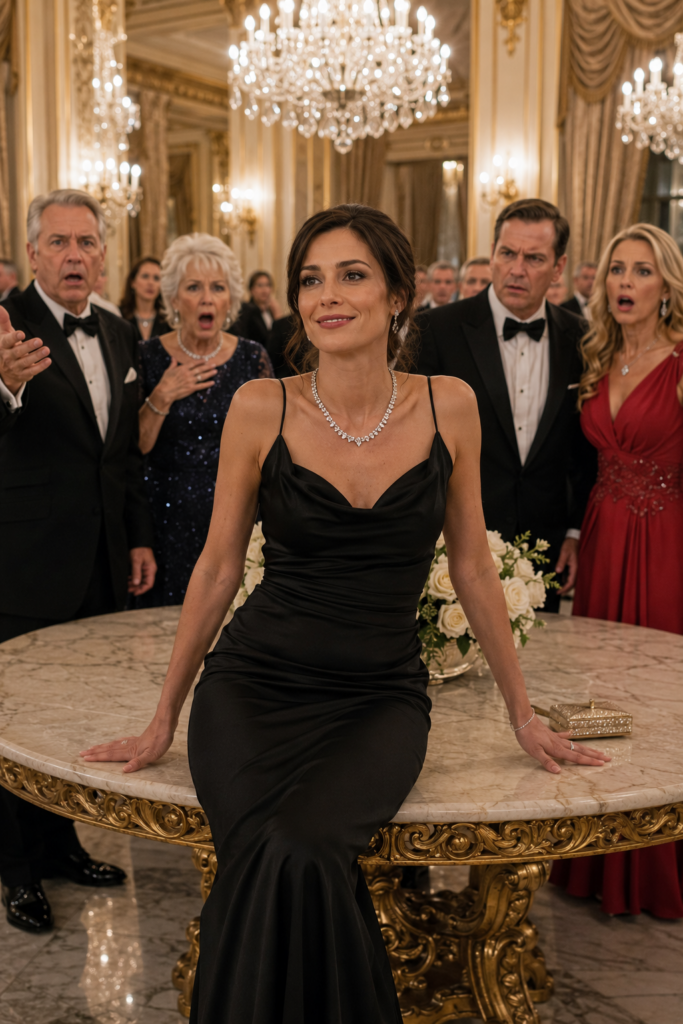
The invitation arrived on a Wednesday afternoon in an envelope so elegant it looked less like mail and more like a warning. Cream stock. Gold embossing. My name written in the kind of careful cursive that seemed designed to remind the recipient of what she was not. Even before I slit it open with the butter knife I kept beside the fruit bowl, I knew it was from my mother. Susan Hayes had a way of turning paper into posture.
Everything she sent stood up straight and expected you to do the same.
I was in the kitchen when it came, standing barefoot on cool tile, one hand wrapped around a mug of coffee that had gone lukewarm half an hour earlier. My daughter Chloe was at the table with her coloring books spread around her like a tiny empire. She was five years old and gloriously serious about shades of purple. She pressed the crayon down with her whole little fist, tongue peeking out from one corner of her mouth, as if the fate of the world depended on whether the dragon’s wings came out lavender or plum.
I opened the envelope and slid out the card.
My father’s sixty-first birthday.
The Grand Crystal Ballroom.
Black tie only.
Even in print, the invitation managed to sound smug.
Then a smaller card slipped loose and landed face up against my wrist. Monogrammed stationery. My mother’s handwriting, angled and expensive.
Evelyn, please dress appropriately. This is an important evening for Gary. Black tie means black tie, not the drab business casual you usually wear. If you cannot manage proper attire, it might be better to skip it. He will understand.
I read it once. Then again. The words did not change, though I suppose a part of me had hoped they might, that a second reading would reveal some softer intention hiding beneath the lacquer. But my mother had never hidden her intentions. She polished them.
The kitchen went very quiet in that strange way a room does when something ugly enters it. Chloe kept coloring. The refrigerator hummed. Outside, a lawn service machine whined somewhere down the block. I stood there with the note in my hand and felt a familiar sensation settle over me, not pain exactly, and not surprise.
More like the cool click of a mechanism I had seen work a hundred times before.
Have you ever been treated like the ghost in your own family? Not the dramatic kind of ghost, not the one people mourn. The useful kind. The one who appears when something needs to be carried, forgiven, absorbed, or quietly excluded. The one who learns, over time, that absence can be more convenient to other people than presence ever was.
I did not cry. I did not call my mother immediately. I did not ask myself what I had done this time to deserve being shaved down and tucked outside the frame. Those questions belonged to a younger woman, one who still believed there must be a formula for becoming acceptable if she could only find it.
Instead, I looked at Chloe.
Her dark curls had escaped the braid I’d made for her that morning and were drifting across her cheek. Without looking up, she moved the paper with the flat of her palm and switched crayons with the solemn efficiency of a surgeon selecting an instrument.
Emotion is bad data in an audit. That was something one of my earliest mentors had said to me when I was twenty-four and trying very hard not to let anyone notice I was the youngest person in the room. At the time I had thought it sounded cold. By thirty-two, I understood it as mercy. Emotion was real, yes. But in a crisis, it often arrived wearing disguises: humiliation dressed up as grief, anger masquerading as certainty, hope pretending to be logic. If you were going to make a decision that mattered, you needed the numbers first.
And at that moment, my life felt like it was under review.
I folded the note once, very neatly, and set it on the counter. Then I reached for my phone.
My mother answered on the second ring, her voice bright with the kind of sweetness that had always reminded me of artificial fruit flavoring. “Evelyn, honey. I was just wondering if the invitation had arrived.”
“It did.”
“Wonderful.” I could hear movement on her end, the faint clink of glass, perhaps her adjusting bracelets or setting down a wineglass. She was probably in the breakfast room, where light from the west windows made her feel younger in the late afternoon. “So you saw the note?”
“I saw it.”
A beat. “Good. I just wanted to make sure there wouldn’t be any… misunderstandings.”
“What kind of misunderstanding?”
“Well.” She drew the word out. “The thing is, Tiffany is bringing someone. A very special someone. His name is Preston Whitfield the Third.”
There it was. Of course.
My sister Tiffany never dated men. She dated portfolios with jawlines.
“Preston’s family is extremely prominent,” my mother continued. “Very traditional. Old values. His father is close to several major investors and, if things continue to progress, there could be significant opportunities for Tiffany. For all of us, really.”
I let her keep talking. My mother always told the truth eventually if you gave her enough room to decorate it.
“We simply think,” she said, “that it might be easier if you sat this one out.”
The sentence was so calm, so polished, that for half a second it almost escaped recognition. Easier. Such an efficient little word. It slid over all the sharp edges and left no fingerprints.
“You are uninviting me from my own father’s birthday party.”
“Not uninviting, dear,” she said quickly. “Suggesting. You work so hard at that little agency of yours. And you’re a single mother. I know it must be difficult to find time for formal things. We don’t want you to feel uncomfortable or out of place.”
She meant she didn’t want me to make them uncomfortable. She meant that next to Tiffany in some red-label gown and Tiffany’s new heirloom boyfriend, I might look like the wrong kind of story. Not tragic enough to inspire pity. Not successful enough, in their minds, to inspire envy. Just inconvenient. A reminder that one of Susan and Gary Hayes’s daughters had once colored outside the lines and kept going.
“I understand perfectly,” I said.
I hung up before she could soften the blade with one last layer of maternal concern.
For a long moment I simply stood there holding the silent phone in my hand.
At the table, Chloe looked up. “Mommy?”
“Yes, baby?”
“Can dragons be purple and green, or is that too many colors?”
“You can never have too many colors.”
She considered that, nodded solemnly, and returned to work.
I turned toward the hallway and walked to my office.
From the outside, the room looked plain. A desk. Bookshelves. A framed print above the filing cabinet. To anyone passing by, it might have read as a single mother’s practical workspace, organized but unremarkable. Which was precisely the point. The point of so many things in my life, in fact, was that no one looked twice.
I sat down, opened my laptop, and watched its glow fill the room.
The truth was not something my family had ever earned. Not because it was dangerous, although some of it was. Not because it was classified, although quite a bit of it was. Mostly because they had shown me, over and over, that they preferred versions of me they could control. Why hand people a map to your world when they had spent years insisting you lived in a ditch?
Officially, I was chief strategic officer for Meridian Defense Solutions, one of the largest private contractors in the region. Unofficially, I was the person people called when multimillion-dollar compliance structures started to crack, when foreign procurement pipelines turned murky, when state contracts teetered on the edge of becoming national scandals. I managed projects with enough security layers around them to make my family’s entire social circle look like children arranging toy soldiers in a sandbox. I had access that senators envied, authority my father would not have believed, and compensation that would have made my mother sit down.
My base salary was seven hundred and fifty thousand dollars. With bonuses and stock, the number grew teeth.
Three years earlier, I had helped untangle a disastrous web of federal exposure tied to a defense infrastructure package that touched half the state’s leadership. If it had gone the wrong way, careers would have ended and headlines would have done what headlines do best. Instead, the scandal evaporated before it could be named, and the governor called me personally to say thank you.
Governor Marcus Sterling was not a man people forgot after meeting. In public he was all measured warmth and reassuring intelligence, the kind of leader who could stand in a flooded town wearing rolled-up sleeves and somehow make devastation look briefly manageable. In private he was quicker, harder, more openly strategic. He saw systems where others saw events. He also had a memory sharp enough to be dangerous.
I pulled up his direct number.
He answered on the second ring. “Evelyn.”
“Marcus.”
A pause. I could almost hear him smiling. “That tone usually means either very good news or a very expensive problem.”
“Both, potentially.”
“Now I’m interested.”
I leaned back in my chair. “Regarding our dinner meeting next Saturday to finalize the defense procurement budget, I’d like to change the venue.”
He didn’t ask why, which was one of the reasons I respected him. He trusted that if I was calling, there was a reason already costed out in my head.
“Where?”
“The Grand Crystal Ballroom. Seven p.m.”
The silence lasted only a breath. Then a soft chuckle. “That’s not a coincidence.”
“No.”
“Would you like me to bring the full team?”
“No. Just you, Caroline, and Lily. Keep it social enough to look social. Formal enough to be seen.”
Another pause. He understood immediately. “Family?”
“Yes.”
“Do they know who you are?”
“No.”
“And you’d like that corrected.”
I looked through the office window into the kitchen, where Chloe was now holding two crayons in one hand, trying to make a sunset obey her. “I’d like a balance sheet settled.”
There was warmth in his voice when he answered. “Done. We’ll take the center table.”
I closed the laptop afterward and sat very still.
Some women have breakdowns. Some women have revelations. I had spreadsheets in my bloodstream and a child in the next room. I did not need to scream into a pillow or call a friend and recount my family’s newest act of decorative cruelty. I had all the data I required.
Still, old memories rose the way they always did when my parents reminded me of the role they had assigned me.
Seven years earlier, when I was twenty-five and halfway through my first year of law school, I had sat in my parents’ formal living room and told them I was pregnant.
The room had looked exactly as it always had: pale rugs nobody stepped on with real shoes, gleaming surfaces nobody leaned against, framed art selected to signal seriousness rather than affection. My father had been by the fireplace with one hand in his pocket. My mother had sat on the edge of the sofa like a woman about to receive condolences rather than news. Tiffany, who had been visiting that weekend, stood by the bar cart in white jeans and cashmere, already performing the expression she would later wear for months: compassion at a safe distance.
I remember how young I was, though I hadn’t felt young until that moment. I remember the way my hand trembled and the fury I felt at my own trembling. I remember my father’s face becoming still in a way that meant danger.
“This is a setback,” he said after I told them. Not, Are you okay? Not, What do you want to do? A setback. Like a market disruption. A supply chain issue. “But it does not have to ruin your life.”
I knew what he meant. We all did.
“There are options,” my mother said, and started crying before I answered.
“I’m keeping her.”
I still remember the exact silence that followed, as if someone had removed all oxygen from the room and replaced it with judgment.
The father of my child was a classmate from law school, bright and ambitious and deeply in love with the idea of his own future. Fatherhood, he informed me two weeks after I told him, was not part of his five-year plan. He said it in the café outside the law library while stirring sugar into his coffee, as if that made it less monstrous. He did not shout. He did not insult me. In some ways that made it worse. He simply declined the life that was arriving. Like a man refusing a timeshare.
My parents did not rage, not exactly. Rage would have implied feeling. They strategized. They asked what people would think. They calculated the cost. My father spoke about practicalities, my mother about shame, Tiffany about timing. I listened and understood, with a clarity so pure it almost felt holy, that the child inside me was the first thing I had ever loved more than I wanted their approval.
When Chloe was born, I dropped out of law school.
In my family’s mythology, that was the moment I ceased to be a person with upward momentum and became a cautionary tale. Never mind that I worked. Never mind that I learned faster than anyone expected, climbed faster than anyone noticed, and built my career in spaces where no one cared what had happened when I was twenty-five as long as I could close the problem in front of them by morning.
At first I worked as a paralegal because it paid immediately and legal structures made sense to me. Then I moved into consulting for a government-adjacent contractor that valued outcomes over pedigree. I was very good at outcomes. Better than good, actually. I could see the hidden fault lines in a deal before most people realized there were faults to find. I could read men in expensive suits and hear which words they were avoiding. I could untangle contradictions and ask the question that made a room go still.
By the time Chloe was three, I had been recruited into defense contracting.
By five, I was running strategy across divisions people with full degrees and better family names had spent fifteen years trying to reach.
My parents knew none of this.
Or rather, they knew what they had decided was true and filtered every new piece of evidence through that old verdict.
At rare family dinners, my father would ask, “Still doing that little assistant thing?” in the same tone another man might ask whether a plant had survived winter.
“Something like that,” I would say.
My mother would sigh and remind me it was not too late to return to school if I wanted to make something of myself.
Tiffany, polished and radiant in whichever season’s designer palette she had decided was organically her, would offer me handbags she no longer used in case I needed “something nice for interviews.”
I never corrected them. Correcting people who are invested in misunderstanding you is an exhausting hobby.
Besides, I had other things to do. I had a child to raise. A house to buy. A future to secure.
They pictured me barely scraping by in a small apartment. In reality, I lived in a four-bedroom home in the best school district in the county, the kind of neighborhood with mature trees and sidewalks and front porches where children could ride bicycles without making their mothers glance up every thirty seconds. I drove a modest sedan to family events because my actual car, a Tesla Model S I kept in a separate garage at the office property, would invite questions I had no interest in answering over chicken marsala and passive aggression. Chloe had a college fund that already held half a million dollars. The house was in my name alone. The mortgage was not a burden. It was a line item.
I had built a life so stable it could withstand weather.
And yet with one handwritten note, my mother had managed to press her thumb on the oldest bruise in my body.
Fine, I thought.
If they wished to organize the evening around appearances, then appearances it would be.
The days before the party passed in a state of almost eerie calm. Not because I felt nothing. On the contrary, I felt a great deal. But feeling and reacting are not the same thing, and long before that week I had trained myself in the difference.
I arranged childcare for a few hours, then changed the plan when Caroline Sterling called and said Lily was thrilled at the idea of spending the evening with Chloe in a “grown-up princess place.” Caroline had a way of making both political wives and overworked executives feel more honest around her than they intended. She was intelligent without sharpening it into performance, warm without being gullible. We had become friends in the sideways way women do when their lives intersect repeatedly in rooms full of men making consequential decisions.
“Bring Chloe,” Caroline said. “Lily’s been asking about her since the education fundraiser.”
“I’m not sure this qualifies as a child-friendly environment.”
“Neither is the governor’s residence, but the girls managed the Christmas party without declaring war on any foreign powers.”
I laughed despite myself. “Fair point.”
There were practical matters too. Attire, for one.
I did not go shopping at a mall and paw through racks under fluorescent lights while saleswomen tried to guess which kind of woman I wanted to look like. On Thursday morning I called a private stylist whom one of Meridian’s board members had once recommended for a diplomatic spouse in need of discretion.
She arrived Friday afternoon with garment bags and a rolling case of accessories, and within minutes my bedroom looked like a couture ambush. There were gowns in jewel tones and liquid metallics and one memorable disaster involving tulle that made me look like a vengeance-themed wedding cake.
In the end I chose black silk.
It was floor-length and severe in the best sense, architectural in its lines, with a neckline that needed no apology and no embellishment. No lace, no beadwork, no frantic attempt to beg for admiration. It was the dress version of a controlled voice in a crisis. Expensive, yes, but not loud about it.
A single diamond pendant. Diamond studs. Hair in soft, precise waves. Makeup that suggested I slept more than I actually did.
When the stylist left, I stood in front of the mirror and studied the woman reflected there.
For a moment I saw the twenty-five-year-old version of myself flicker behind my shoulder: swollen-eyed, exhausted, holding a newborn at three in the morning and calculating whether she could afford both diapers and a second can of formula without dipping into rent. Then the image dissolved, and I saw who I was now.
A woman who had moved through rooms where billion-dollar decisions were made and never once mistaken herself for less because someone older, richer, or louder tried to suggest it. A woman who had walked men through the legal implications of their own arrogance while they still underestimated her. A woman who had built a life not from permission but from competence.
My phone buzzed late that afternoon.
Tiffany.
I stared at her name for one beat before opening the message.
A photograph filled the screen. She stood in what looked like the dressing area of some high-end boutique, one hip angled, red silk pouring down her body like a threat. Her blond hair had been styled into an elaborate cloud of glossy waves, and she wore the smile she reserved for social media and women she secretly considered beneath her.
Thinking of you, sis, the message read. Stay cozy in your sweats tonight. Don’t worry, I’ll tell everyone you were too busy with work to make it. It’s for the best. You wouldn’t want to be the only one there without a label.
I set the phone down without responding.
What would there have been to say? That labels only impress people who have never handled actual power? That the most dangerous women rarely announce themselves in embroidery?
Saturday arrived clear and cold.
I spent the morning with Chloe in the backyard, where she insisted on introducing me to the elaborate mythology of a chalk-drawn kingdom involving a queen, three dragons, a bakery, and a suspicious squirrel. We had grilled cheese for lunch and watched an animated movie while I painted her nails with a pale pink she called “ballerina cloud.” The ordinariness of the day steadied me in a way that strategy never could. Revenge, exposure, correction—whatever name one gave the evening ahead—was still only a sliver of life. The important part was here: a child’s laughter, sunlight on the floor, the knowledge that no matter what happened at seven o’clock, I would come home to truth.
By five-thirty, the house had shifted gears.
Chloe wore a cream dress with a satin sash and tiny black shoes that made her feel, in her own words, “fancy but fast.” I dressed in my room while she sat cross-legged on the bed watching with huge dark eyes.