“Are we going somewhere rich?” she asked.
“Probably.”
“What does that mean?”
“It means there will be too many forks and not enough good desserts.”
She considered this gravely. “Can I still have dessert?”
“You can always still have dessert.”
She seemed reassured.
At six-thirty, I drove the Tesla out of the private garage and onto the boulevard. The car moved with that almost eerie electric silence I had come to love, the sensation less of driving than of gliding through intention.
City lights were beginning to gather in the windshield as dusk folded itself over the skyline. Beside me, Chloe hummed to herself and held her small clutch purse with both hands like an entrusted diplomatic case.
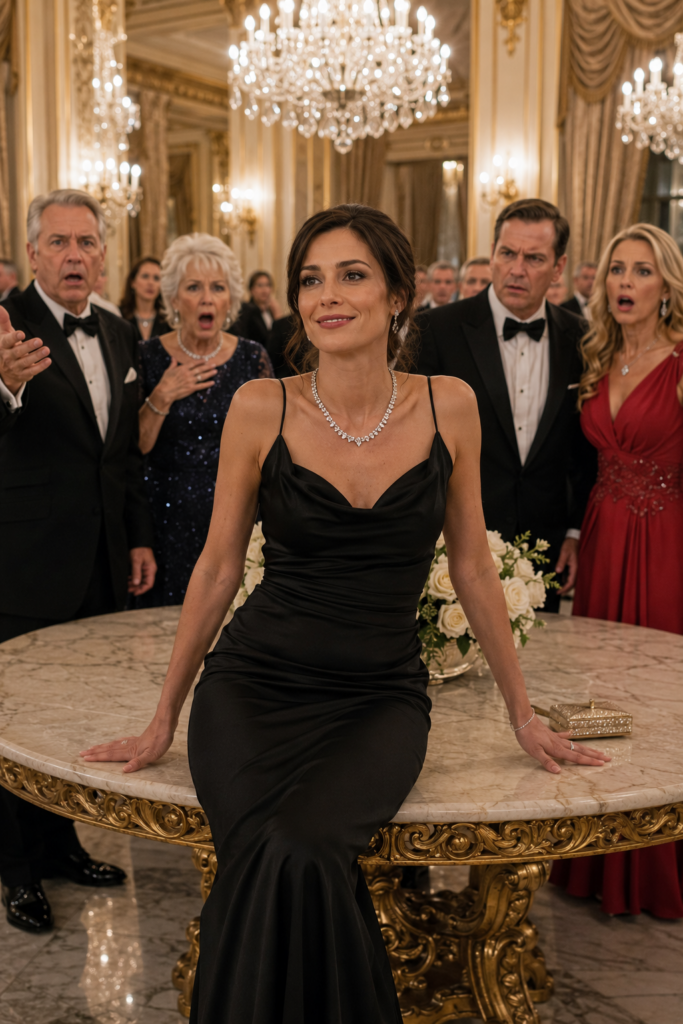
The Grand Crystal Ballroom stood in the center of downtown like a monument to money’s need for spectacle. It occupied the upper floors of a historic hotel that had been restored so meticulously it felt less renovated than embalmed. Marble at the entrance. Brass everywhere. Doors tall enough to flatter anyone who walked through them.
The valet saw the car and moved before I had fully stopped.
By the time I stepped out, another attendant was already at Chloe’s door. She took his offered hand with solemn dignity, and he looked as if he had been knighted.
Inside the lobby, Marcus Sterling stood near the central staircase in a black tuxedo that managed to make him look both distinguished and approachable, which I had long since concluded was its own form of political engineering.
Caroline, elegant in midnight blue, bent to greet Chloe while Lily bounced on the balls of her feet beside her, clutching a tiny handbag that almost certainly contained contraband candy.
“Evelyn,” Caroline said, straightening to hug me. “You look devastating.”
“That is exactly the correct word,” Marcus said.
I smiled. “I trust tonight’s seating arrangement is in order.”
“It is,” he said. “Table One. Best line of sight in the room.”
Of course it was.
We rode the lift to the ballroom level and stepped out into a corridor lined with mirrors and arrangements of white orchids so large they looked funded by a committee. Staff moved around us in the smooth, low-voiced choreography of people trained to make luxury look inevitable.
At the far end of the hall, beyond a pair of glass doors, I could already see fragments of the main ballroom. Chandeliers. Polished floors. Silver. In an adjoining private annex, partially visible through another set of doors, my family’s event was taking shape.
Long table for twenty-five.
My father at the head position, already standing like a man preparing to accept admiration in waves.
My mother floating between guests with her fixed smile.
Tiffany near the bar, red silk unmistakable even from a distance.
And beside her, no doubt, Preston Whitfield III, the human investment prospect.
We did not turn toward the annex.
We entered the main ballroom and crossed directly to Table One.
It sat in the center of the floor beneath the most extravagant chandelier in the room, positioned not merely for visibility but for dominance. Anyone entering the annexes or crossing toward the private rooms had to pass it. It was the table reserved for heads of organizations, elected power, old donors, the kind of people staff noticed before the doors finished opening.
The maître d’ himself pulled out my chair.
As I sat, I looked once toward the private annex.
Tiffany was the first to see me.
There are moments in life when another person’s face becomes more honest than language. From across the room I watched confusion arrive first, then recognition, then the kind of shock that strips vanity right down to bone. She nudged my mother. Susan turned. Her hand froze halfway to her mouth.
Even then, I don’t think they understood. Not really. Not until Marcus sat across from me. Not until Caroline settled at my side. Not until the governor’s chief aide placed a secure leather folder beside my plate and murmured, “The Sterling notes you requested, ma’am.”
Chloe and Lily were seated together with coloring books and child-sized portions arranged by some miracle of competent staff work, and for a brief, surreal moment the evening looked exactly like what it was supposed to look like: a high-level dinner in one of the most expensive rooms in the city.
Except this time, I was not at the margins of the frame.
“Before the others arrive,” Marcus said casually, unfolding his napkin, “I want to review the compliance notes on the Sterling infrastructure package. Your signature remains the final gate.”
“Of course,” I said.
Anyone watching would have seen a poised professional exchange. Anyone listening closely would have heard the engine underneath. The Sterling package was enormous. Regional supply chain authority, multiple subcontractors, federal oversight, years of public-private leverage. It was the kind of deal firms reshaped themselves for.
My father’s firm, Hayes Industrial Logistics, happened to be a primary bidder for one of the core subcontracts.
He did not know that.
More specifically, he did not know who had already reviewed the file.
The first wave of guests from my father’s event entered the corridor at seven-twenty-five.
I heard them before I saw them: laughter, greetings too loud, the movement of people performing significance for one another. Then they appeared at the main doors in a cluster.
My father led the procession in a tailored tuxedo that fit well enough to suggest he had dressed with extra care for the evening. He looked flushed with expectation, his chest carrying that particular male pride that comes from believing the room is about to validate everything you think you are. My mother followed, elegant and brittle in silver. Tiffany came behind them, one hand looped through Preston’s arm, her red gown impossible to ignore.
There were others, of course—business acquaintances, relatives, men from the club, women who had been orbiting my mother socially for years and knew precisely how to sound intimate without ever becoming so.
To reach the private annex, they had to pass Table One.
I watched the exact instant my father saw me.
He stopped dead.
Three feet from our table, his body simply forgot whatever motion had been governing it. Confusion flashed first, then irritation, then something stranger and much closer to fear. My mother nearly collided with him from behind. Tiffany’s expression hardened so quickly it looked painful.
“Evelyn?” my mother whispered.
I did not rise.
I did not fuss with my napkin or perform surprise or offer anyone an explanatory smile. I looked up at them from my seat, hands folded lightly on the table, and said in the pleasant, neutral tone I used in negotiations that were about to become ugly, “Hello, Mom. Happy birthday, Dad.”
“What…” My father’s mouth worked once before language returned. “What are you doing here?”
Before I could answer, Marcus stood.
He did it slowly, effortlessly, in the unhurried manner of a man accustomed to the fact that rooms adjusted to him rather than the other way around. He extended his hand to my father.
“Robert Hayes, I presume. Marcus Sterling. Happy birthday. It’s a pleasure to finally meet Evelyn’s family.”
My father stared at the hand for a heartbeat too long before taking it. “Governor Sterling. I—I had no idea you were acquainted with my daughter.”
“Acquainted?” Marcus smiled, and there was something very sharp in it. “Evelyn is one of the most trusted strategic and legal minds working with my administration.”
The silence that followed felt like a silk curtain dropping over a stage.
My mother blinked. Tiffany actually laughed, but it came out wrong. Preston’s posture changed in a way that told me he, unlike the rest of them, was beginning to calculate.
“That’s not possible,” Tiffany said. “Evelyn works at some tiny agency. She dropped out of law school.”
I turned my head toward her, slowly.
Before I could speak, Preston leaned forward, eyes fixed on me with sudden recognition. “Wait. Evelyn Hayes?”
“Yes.”
“Meridian Defense Solutions?”
I held his gaze. “Yes.”
The color shifted in his face. Not embarrassment. Comprehension.
“My father talks about you,” he said, almost to himself. “Senator Whitfield. He’s mentioned you in D.C. briefings. He said you’re the reason the Henderson Aerospace review didn’t turn into a congressional disaster. He’s been trying to recruit you to the Federal Compliance Board.”
The corridor had gone very still around us. My father’s guests, sensing blood of some kind if not yet understanding whose, had stopped pretending not to listen.
My father sat down abruptly in a nearby chair that did not belong to him. “This is absurd,” he said, but the force had drained out of the word before it reached us. “Evelyn is… she’s been doing assistant work. She never finished—”
“Actually,” I said, “I’ve been building a career while raising my daughter.”
I kept my voice level. Not loud, not theatrical. It did not need to be.
“I earn seven hundred and fifty thousand dollars a year before bonuses. I own my home outright. Chloe’s college fund holds five hundred thousand dollars. I hold security clearances most federal employees will never see. I did not tell you any of this because you never asked. You were too busy being embarrassed by the version of me you created.”
My mother’s hand rose to her throat. “Evelyn…”
“Why didn’t you tell us?” my father asked, and there it was at last—the bewildered outrage of a man discovering reality had failed to consult him.
Because your opinion of me had never been based on facts, I thought.
Aloud, I said, “Because I learned a long time ago that your image of me had nothing to do with my actual life.”
My mother found her voice first. “Honey, if we had known—”
“You didn’t want to know.”
“That’s not fair.”
“No?” I tilted my head. “You sent me a handwritten note telling me not to come to my father’s birthday unless I could dress appropriately. You suggested I stay home because Tiffany’s boyfriend comes from a ‘very traditional’ family and I might make people uncomfortable.”
Tiffany flushed scarlet beneath her makeup. “You’re twisting this.”
“Am I?”
My father looked around as if searching for an exit hidden in the wallpaper. “This is not the place.”
“No,” I said softly. “You’re right. The place would have been any one of the last seven years when I attended family dinners and let you ask if I was still doing my ‘little assistant thing.’ The place would have been every holiday you used me as contrast so Tiffany could shine brighter. The place would have been when you forged my signature.”
That landed.
Not loudly. Not all at once. But I saw it hit him.
His face changed in a way the others noticed without understanding yet. My mother’s eyes snapped to his.
Marcus remained standing, one hand lightly on the back of his chair, saying nothing. That was one of the most powerful things about him. He understood when silence itself was a form of pressure.
I turned and opened the secure leather folder beside my plate.
The movement seemed to pull the air tighter around us.
“Since we are discussing place,” I said, sliding one page from the folder, “let’s discuss business in the most appropriate setting available. Dad, your firm is the lead bidder on a Sterling infrastructure subcontract. Correct?”
His mouth opened. Closed. “Yes.”
“It’s a significant opportunity for Hayes Industrial.”
“Yes.”
“I reviewed the file.”
For the first time, desperation flickered openly in his eyes. Whatever else he felt—humiliation, panic, fury—something brighter pushed through it: hope. Pathetic, naked hope.
“If there are concerns,” he said quickly, “we can address them. Evelyn, if you could simply explain to the governor that any irregularities are clerical—”
“Not irregularities,” I said. “Discrepancies.”
I let the paper rest between my fingers.
“Specifically, a forty-thousand-dollar inheritance withdrawal routed through a subsidiary account in 2023. The authorization signature on the file matches mine.”
My mother made a choking sound.
My father went completely still.
“You didn’t think I would ever be in a position to review your compliance filings,” I said. “That was the calculation, wasn’t it? Because I was the disappointing daughter. The one who had ruined everything. The one no one had to account for.”
“Evelyn,” he said, and his voice had changed. It was smaller now. Older. “I can explain.”
“I’m sure you can.”
“It was temporary. A bridge. I was going to replace it.”
“With what?”
The question cut deeper because it was simple. Men like my father prepared for outrage. They did not prepare for precision.
My mother began to cry. It would have moved me once. Perhaps it would have moved me three years earlier. But tears used as leverage develop a recognizable texture after enough exposure.
“We’re family,” she whispered. “Please. Your father will lose everything.”
I looked at her and thought of all the times family had been invoked like a debt instrument, collectible only in one direction.
“For seven years,” I said quietly, “I stayed silent while you judged me. I stayed silent while you excluded me. I stayed silent when you treated my daughter like a complication that should have been corrected before birth. I even stayed silent when Dad used my name to stabilize his books.”
My father flinched as if struck.
“I gave you every opportunity to be family. Tonight, you informed me I was not appropriate for your world. So I’m going to meet your standards and be professional.”
I uncapped my pen.
The corridor had become a theater of suspended breath. Guests from three different functions had begun to notice the stillness around Table One. Staff hovered at a distance, exquisitely trained not to stare and entirely incapable of not listening.
The page before me was not an approval.
It was the formal notice of non-compliance and suspension of bidding rights pending civil review.
For a moment, my father looked not like the powerful man he had spent sixty years performing, but like someone who had just realized the trapdoor he installed under someone else’s feet had opened beneath his own.
“Evelyn,” he said one last time.
I signed.
Not with flourish. Not with anger. Just a clean, final line.
Then I passed the document to Marcus’s aide, who stepped forward and accepted it with the impersonal efficiency of the state.
“This isn’t revenge,” I said.
The words surprised even me with how true they felt.
“This is accounting. And your account is closed.”
No one moved.
My father stared at the vanished folder as if he might still call it back by will alone. My mother’s hands shook. Tiffany looked from him to me and back again, trying to decide which part of the evening was the greater offense: the collapse of the family myth or the collapse of the business that supported it.
Marcus broke the silence with the smooth public warmth of a man stepping back into his elected face. “Robert,” he said, “enjoy your birthday. It’s certainly memorable.”
My father did not answer.
He was still looking at me.
Not with love. Not even with hatred. With the stunned disbelief of a man confronting the possibility that the world has been happening beyond his field of vision for years and he has mistaken his ignorance for authority.
Tiffany recovered first, if by recovery one means choosing fury over shock.
“You planned this,” she hissed. “You set this up to humiliate us.”
I leaned back in my chair. “I scheduled a dinner meeting with the governor. You chose to stop at my table.”
“It’s Dad’s birthday!”
“And yet somehow we’ve arrived at your feelings. Impressive.”
She took a step toward me. Preston, to his credit or cowardice, did not follow. In fact he had eased half a pace away from her, which told me all I needed to know about both his instincts and her future.
“You think you’re better than us now?” she demanded.
“No,” I said. “I think I was more competent than you understood long before tonight.”
She laughed, but it cracked in the middle. “You’re still just a single mother.”
The words hit the air between us and died there.
Some insults rely on the other person agreeing to their logic. I no longer did.
“Yes,” I said. “I am a mother. And while you’ve spent your life performing success, I’ve been busy achieving it.”
Her face twisted. For a second I saw the child she had once been beneath the lacquer—competitive, frightened, forever checking which direction our parents were looking before deciding how brightly to shine. Then the moment passed, and she was only Tiffany again.
I turned my gaze to Preston.
“If I were you,” I said mildly, “I’d read the prenuptial terms very carefully before signing anything connected to this family.”
He swallowed. He did not defend her. He did not defend any of them. Men raised near power know when a building is no longer structurally sound.
A pair of security officers appeared discreetly at the far end of the corridor, summoned by nothing more than atmosphere and experience. The maître d’ approached with tact sharpened into art.
“Mr. Hayes,” he said gently, “if your party would like to continue in the private annex, we’re ready to receive you.”
Ready to receive you somewhere less visible, he meant.
My mother dabbed at her eyes and tried one final time. “Evelyn, sweetheart, please. Talk to the governor. Your father didn’t mean—”
I moved my arm before she could touch it.
“This,” I said, “is what it looks like when meaning catches up with outcome.”
The officers did not have to physically direct anyone. Shame is often a better usher than force.
One by one, they began to move.
Guests avoided my eyes. A few stared too long. Whispers bloomed and died. My mother looked suddenly older, not because of wrinkles or posture but because social confidence had been stripped from her and she did not know how to stand without it. Tiffany walked rigidly, every vertebra a statement. Preston followed with the expression of a man revising several life plans at once.
My father was last.
Halfway past the table he stopped and braced one hand on the back of an empty chair. For a second I thought he might say something—an apology, a threat, a plea. Instead he simply looked at me.
He had always been a man who believed in leverage. In hierarchy. In the basic naturalness of his own authority. Tonight, perhaps for the first time, he was seeing me not as his daughter in the emotional sense but as a person with institutional power. A person whose decisions did not require his blessing. It was not love in his eyes, and not respect exactly. More like stunned recognition of a fact he had somehow overlooked while it was growing teeth.
Then he turned and walked into the annex.
The moment the doors closed behind them, the ballroom breathed again.
Cutlery resumed. Voices returned in cautious layers. Somewhere near the windows a woman laughed too loudly, eager to prove she had not been listening. Staff flowed back into motion with the miraculous professionalism of people who work around wealth for long enough to stop being surprised by its fractures.
The maître d’ appeared at my side. “Miss Hayes, would you prefer a more private setting?”
I lifted my wineglass and looked out through the floor-to-ceiling windows at the city spread below us in lights and geometry.
“No,” I said. “The view from here is exactly what I needed.”
And it was.
Not because public humiliation is nourishing—it isn’t, not even when deserved—but because from that seat I could finally see the whole architecture. Years of silence. Years of small cuts. Years of being assigned a place in the family ecosystem as designated disappointment, tolerated at the edges so others could feel brighter by comparison. None of it had been accidental. And none of it had survived contact with reality.
Dinner continued.
Marcus, with the tact of a statesman and the instincts of a seasoned operator, shifted the conversation back to business without making it abrupt. Caroline asked Chloe and Lily about their coloring pages, which had somehow evolved into a collaborative kingdom now featuring two queens, one dragon, and a cake festival. The girls dissolved into laughter over something involving glitter and treason.