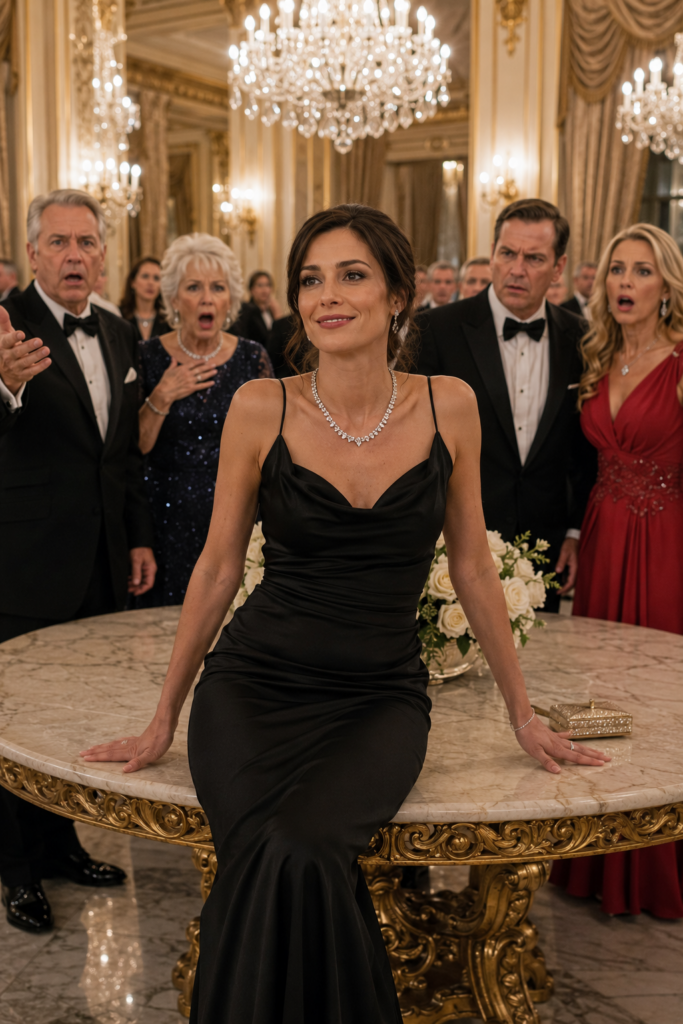
A server poured wine. Another replaced cooled plates with impeccable timing. The filet arrived perfectly seared. The room, having consumed its drama, settled greedily back into elegance.
For the first time all evening, my body registered that it had been tense. I let out a breath I hadn’t noticed I was holding.
“How do you feel?” Caroline asked quietly.
I considered the question honestly.
Not triumphant. Not vindicated in the cinematic way stories promise. Revenge, when it actually arrives, often lacks the music people expect. What I felt was cleaner than that.
“Accurate,” I said.
She smiled, understanding.
Marcus lifted his glass. “To accuracy, then.”
We drank.
As the evening unfolded, fragments of the earlier confrontation floated back to other tables and dispersed into the city’s bloodstream by way of text messages and strategic gossip. By morning, I knew, versions of the story would exist in every social circle that had ever mattered to my mother. Governor seen dining with estranged daughter of Hayes Industrial patriarch. Compliance issue. Bidding rights suspended. Daughter is apparently some kind of legal prodigy. You know how these things travel—first as scandal, then as caution, finally as legend once enough people decide they always believed it might be true.
But at the table, what mattered most was smaller.
Chloe leaned against my side after dessert, sleepiness softening her edges. Lily asked if she could come over to our house to play dragons next weekend.
Caroline told me, in a low amused voice, that one of the state senators across the room had just tried and failed to pretend he wasn’t watching us. Marcus outlined next steps for the procurement package, then broke off mid-sentence to make a paper swan for the girls out of a folded menu card.
Somewhere inside that ordinary tenderness, I realized something I should have understood sooner.
All those years I had thought silence was the price of peace.
In truth, silence had simply been a luxury I could afford while the damage remained mostly emotional. Tonight it had crossed into financial fraud, professional interference, active exclusion. My family had assumed, as people often do, that because I endured something without complaint I would endure it forever. They had mistaken restraint for incapacity.
A little after ten, the event wound down.
Marcus and Caroline left first with Lily, all hugs and promises of future playdates.
One of the governor’s aides discreetly confirmed that the suspension notice had already been entered and forwarded to the relevant review offices. I thanked him. The machinery was in motion now. It would not stop for family sentiment.
When Chloe and I finally made our way through the lobby, the hotel had the after-hours hush of money at rest. The valet brought the Tesla around immediately. My daughter yawned so wide I could see the tiny gap where one of her baby teeth had recently given way.
“Did you have fun?” I asked as I buckled her in.
“Mmm-hmm.”
“What was your favorite part?”
She considered with the gravity of a much older woman. “The fountain. And the cake. And when the governor made the bird.”
“A strong list.”
She patted my hand. “You looked pretty, Mommy.”
The words nearly undid me in a way my mother’s cruelty had not.
“Thank you, baby.”
The drive home was quiet. Chloe fell asleep before we reached the freeway, one hand still curled around her tiny purse. Streetlights slid across the windshield in measured intervals, bright-dark, bright-dark, and with each passing mile the evening seemed to recede from performance into fact.
At home, I carried her to bed.
There are few sensations in the world as grounding as the weight of a sleeping child on your shoulder. I laid her down gently, slipped off her shoes, tucked the blankets around her, and brushed a curl from her forehead. In sleep, her face still held traces of the baby she had once been, the infant my parents had wished into nonexistence for the sake of appearances. The thought landed with surprising force. They had looked at this child—this fierce, funny, dragon-loving little person—and once categorized her as an obstacle.
No wonder I had never been able to forgive them all the way.
Downstairs, the house was very still.
I changed into soft clothes, poured myself a glass of water, and sat in the darkened living room with only the lamp by the fireplace on. Outside, moonlight moved through the trees in the backyard and silvered the edges of the patio furniture. It should have felt like the aftermath of battle. Instead it felt like the air after a storm has finally broken and moved on.
Then my phone began to buzz.
Once. Twice. Again.
I did not need to look to know.
When I finally picked it up, the screen confirmed exactly what I expected.
Twelve missed calls from my father.
Five texts from my mother, each more frantic than the last.
Evelyn please call us.
Your father did not mean any of this.
We can fix it.
Talk to the governor.
We’re family.
There was also a two-minute voicemail from Tiffany, and just seeing its duration told me everything I needed to know about its structure: fury first, then bargaining, then an appeal disguised as accusation. Another text followed from an unknown number I recognized as Preston’s.
I’m sorry for tonight. I had no idea.
Interesting. But not interesting enough.
I opened the family group chat, the one titled He’s family, after some forgotten dispute years earlier in which my mother had urged me to “be the bigger person” once again. The icon was a cropped photograph from a holiday party five years before. I had been on the edge of the original image holding toddler Chloe. In the group icon, only half my shoulder remained.
I stared at it for a long moment.
Then I hit delete and exit.
The thread disappeared.
And with it, something inside me unclenched.
Because that was the truth my father had never understood. He thought success was a lever I would eventually use to force my way back into his esteem. He thought one day I would reveal everything in the hope that he would finally be proud, finally claim me, finally say the version of me he had rejected turned out to be worth displaying after all.
But I did not need his pride.
I did not even need his apology.
I simply needed him to stop being in my way.
In the weeks that followed, the consequences unfolded with the slow, grinding certainty of institutional process.
Hayes Industrial’s suspension from bidding triggered a deeper civil audit. Once the books began opening, other discrepancies surfaced—hidden debt, irregular transfers, liabilities papered over with optimism and bad signatures. My father had been propping up his image with increasingly fragile scaffolding for years. The Sterling subcontract had not merely been a major opportunity. It had been the keystone intended to hold the whole structure together.
Without it, gravity did what gravity does.
My mother called less often after the first week. Then not at all. Whether from shame or strategy, I did not know. Tiffany sent one spectacularly venomous email accusing me of destroying the family over “a few social misunderstandings,” then two days later another asking if I would be willing to clarify certain facts to Preston’s father, “strictly to avoid confusion.” I did not respond to either.
Preston and Tiffany, as it turned out, did not survive the month.
That surprised no one.
Marcus kept his promise about mercy.
I could have pursued the forged signature into criminal territory. The evidence would have allowed it. But I chose not to. Some people hear mercy and imagine softness. They are wrong. Mercy can be a colder instrument than punishment. Prison would have turned my father into a martyr in certain circles—a man who made regrettable decisions under business pressure, a patriarch fallen from grace, a tragedy people could discuss over expensive lunches. Civil collapse gave him no such narrative. It left him to live among the ruins of his own decisions without the romance of being persecuted.
The house was sold by autumn.
The club membership lapsed.
By winter, I heard through one of the endless channels by which polite communities digest each other that my parents had moved into a modest two-bedroom condominium on the edge of town. My mother, it was said, told anyone who would listen that I had become far too busy for family. That line traveled especially well among women who found ambition acceptable only when it remained decorative.
The irony was not lost on me.
I was busy.
I was busy taking Chloe to school in the mornings and listening to her explain the social politics of kindergarten as if briefing a secretary of state. Busy reviewing legal frameworks over black coffee at dawn. Busy stepping into my newly public role after I accepted Marcus Sterling’s standing offer to serve as deputy legal counsel to the governor.
The announcement made the front page of the state business journal.
There was my photograph. My name. My title, no longer hidden behind operational confidentiality. I was no longer the invisible architect working in shadowed corridors. I was visible now, if visibility was what the world required in order to believe. The article mentioned my work in public-private procurement oversight, my reputation for legal strategy, my role in modernizing compliance protocols across major infrastructure projects. It did not mention my parents. It did not need to.
The day the article came out, my inbox filled with congratulations from colleagues, former partners, current officials, people from three different states, two senators’ offices, and one law school classmate who had once warned me that having a baby would end my professional future. He wrote that he had “always known” I was exceptional. I deleted the message without reply.
That evening, Chloe sat at the kitchen table doing math homework and looked up at the framed copy of the journal I had not intended to display but which Caroline had sent over already matted and impossible to hide in a drawer.
“Is that you?”
“It is.”
“Are you famous now?”
I smiled. “No. Just busy.”
She nodded as if this confirmed a theory. “Can I still have macaroni?”
“You can absolutely still have macaroni.”
And that was, in many ways, the whole point.
Power is often misdescribed by people who have only seen its costumes.
My father believed power was image. The tuxedo. The long table. The room arranged so others could watch you at the center of it. My mother believed power was social acceptance so polished it became indistinguishable from virtue. Tiffany believed power was proximity to wealth, the reflected glow of someone else’s name on your skin.
They were all wrong.
Image can open doors, yes. Social grace can smooth corridors. Wealth can purchase silence and interest and chandeliers. But real power is quieter. It is competence when no one is clapping. It is discipline when humiliation would be easier. It is building a life so solid that another person’s contempt becomes an inconvenience rather than a prophecy.
For years, I had thought the story of my adulthood was one of survival. Single mother. Dropped out. Built career in spite of family disappointment. It was an understandable narrative, and on bad days I accepted it because exhaustion loves simplification.
But survival was never the whole story.
I had not merely survived. I had chosen.
I chose Chloe before she existed in anyone else’s imagination as anything but a problem.
I chose work that frightened me because stable mediocrity would have cost more in the long run.
I chose discretion over validation, even when part of me wanted desperately to turn up at Thanksgiving in a better car and watch my father do the math.
I chose silence until silence became complicity.
And then, when the time came, I chose visibility with precision.
People sometimes ask, in the aftermath of stories like mine, whether the confrontation was worth it. Whether publicly exposing my family on my father’s birthday was too harsh, too calculated, too cold.
I understand the question. Civility has a way of being demanded most fiercely from those who have absorbed the most damage.
But the evening was never about humiliating them for sport. It was about ending a system. A private family mythology had crossed into public consequence. My father’s lies were no longer confined to dinner table condescension and social cruelty; they had entered contracts, signatures, filings, and procurement channels. In my world, that changes everything.
Would I have preferred a smaller reckoning? A private confession? An adult conversation over coffee where everyone finally chose honesty? Of course. But such fantasies rely on mutual good faith, and mutual good faith had been absent from that relationship for years.
The truth is simpler and less cinematic.
At some point, people become accountable not for whether they once misunderstood you, but for what they did after having every opportunity to understand and still choosing contempt.
My parents had years. They spent them poorly.
Spring came.
Chloe lost another tooth and became obsessed with cartwheels. My office moved to a larger suite inside the administration building. Marcus joked in one meeting that I had reduced three senior advisors to silence with a single sentence, and Caroline later told me this was now considered one of my defining professional traits. I took Chloe and Lily to the zoo on a Sunday and watched them race each other toward the giraffes. On quiet evenings I sat on the back porch after Chloe went to bed and listened to the sprinklers click across neighboring lawns.
Sometimes, rarely, the old grief returned.
Not because I regretted what I had done, but because no amount of justice fully erases the sorrow of being unloved in the shape you needed. There were still moments—a school recital, a birthday party, a holiday photo—when some small inner child glanced up expecting grandparents who would arrive whole and joyful and proud. Then reality would answer, and the ache would pass.
Healing is not a straight road. It is more like weather. Some mornings are clear, others gather old clouds for no obvious reason.
On one such evening, months after the ballroom, I found myself sorting a box in the attic and came across a photo album from my law school days. There I was at twenty-four, smiling with a certainty I no longer recognized, holding casebooks and ambition in equal measure. I sat cross-legged on the attic floor and turned pages until I reached the sonogram photo I had slipped between them years ago.
Tiny, grainy, miraculous.
I laughed then, unexpectedly, because if anyone had shown that young woman a film of her future, she would have misunderstood almost everything about what counted as loss and what counted as winning.
She would have seen the child and thought: impossible, terrifying, expensive, world-ending.
She would have seen the dropped degree and thought: failure.
She would have seen the family estrangement and thought: unbearable.
She would have seen the government buildings and contracts and public role and thought: perhaps eventually I recovered.
But the real story was stranger than recovery.
I had not returned to the original path after a detour.
I had become someone the original path could never have produced.
That, I think, is what frightens certain kinds of families most. Not that you fail. Failure is manageable. It confirms their theories. It keeps the hierarchy intact. What unsettles them is transformation outside their approval. Growth they did not authorize. Excellence that no longer needs witness from the people who withheld it.
A few months after my appointment became official, there was a state gala held in the same ballroom where my father’s birthday had detonated. Different event. Different guest list. Same chandeliers. Same polished floor. I attended in a dark green gown and stood near the dais speaking with a federal liaison when I saw my reflection in the glass.
For a heartbeat, memory overlaid the present: my mother’s pale face, my father’s silence, Tiffany’s rage.
Then the reflection steadied.
I looked calm. Capable. Entirely at home.
And for the first time since that night, I felt not the aftershock of confrontation but gratitude. Not gratitude for their cruelty, never that. Gratitude for the fact that none of it had the final word.
Later, on the drive home, the city unspooled around me in ribbons of light and I thought about all the versions of success I had been offered growing up. Marry well. Behave correctly. Avoid scandal. Protect the family image. Never need too much. Never want too loudly. Never step so far outside the approved story that the neighbors have to revise their assumptions.
No one had ever taught me the version I now lived.
Wake early. Work with ruthless honesty. Love your child without making her responsible for your sacrifices. Build private stability before public status. Let people underestimate you until it no longer serves the objective. Keep your promises. Read every page before you sign. Learn the difference between revenge and consequence. Understand that dignity is not given by witnesses. It is practiced alone, repeatedly, until it becomes indistinguishable from character.
By the time I got home, Chloe was asleep, one sock half-off as usual.
I stood in her doorway for a long moment.
She would grow up knowing different things from the ones I had been taught. She would know that motherhood is not a diminishment. That ambition and tenderness are not opposites. That being chosen by the wrong people is far less important than choosing oneself with integrity. That the world is full of institutions, parties, hierarchies, and rooms built to intimidate, and almost all of them become smaller the moment you understand what they are made of.
Most of all, she would know this:
No one gets to define your value because they stood near your beginning.
Years later, perhaps, she may hear a simplified version of the story. Family rift. Business fallout. Dramatic dinner. People adore compression because it lets them treat lives like parables.
But lives are not parables.
They are long accumulations of choices, silences, griefs, jokes, invoices, tiny kindnesses, unanswered texts, school pickups, late-night work sessions, dresses chosen carefully, signatures placed steadily, and daughters who ask whether dragons can be both purple and green.
Yes, baby, they can.
They can be whatever colors they are.
And so can we.
That is the ending people like best, I suppose—the one where the discarded daughter rises, the cruel family falls, and justice arrives wearing silk under chandeliers. There is satisfaction in that shape, and I won’t pretend it is false. A reckoning did happen. A table was turned. A man who thought image could save him learned otherwise.
But the deeper ending, the truer one, happened later and more quietly.
It happened in the months after the spectacle, when no one was watching and I discovered that peace was not made of victory but of absence—absence of begging, absence of explaining, absence of that old ache to be correctly seen by people committed to distortion.
It happened when I stopped checking whether my mother had called.
When my father’s name on a document felt administrative rather than emotional.
When Tiffany became not a rival or wound but simply someone from a prior life who never understood the assignment.
It happened when home felt uncomplicated.
When Chloe laughed more because I did.
When success stopped being a secret and started being a platform.
When I realized I had not lost a family in one ballroom on one winter night. I had lost the hope of a certain fantasy family, yes, but the real losses had occurred years earlier in smaller rooms, quieter comments, withheld love. The ballroom had only illuminated what was already broken.
Light is often accused of destroying things when all it really does is reveal where the cracks have been all along.
If there is a moral—and I distrust morals in stories like these because they tend to domesticate what should remain sharp—it is perhaps this: the best revenge is not noise. It is not screaming. It is not even the perfect comeback, though God knows those are satisfying in memory.
The best revenge is clarity.
Clarity about who you are.
Clarity about what happened.
Clarity about what no longer gets access to you.
Everything else is just décor.
And décor, as my mother spent a lifetime proving, never saved anyone at all.
THE END
✅ End of story — Part 3 of 3
← Read from Part 1