IF YOU CAME FROM FACEBOOK, HERE’S THE NEXT PART OF THE STORY, ENJOY !!
“Put Dad on the phone.”
“He doesn’t want to argue.”
“I’m not arguing. I’m telling you the truth.”
“Tom wouldn’t make something like that up.”
I stood there in the barracks, surrounded by movement and noise, and felt something open beneath my feet.
Tom wouldn’t make something like that up.
Not, Let me check. Not, Are you sure? Not, Sarah, tell me what happened.
Just that.
Tom wouldn’t lie.
Which meant I would.
The call ended soon afterward. I do not remember exactly how. I remember holding the phone after the line went dead, staring at the wall while someone behind me laughed at a joke I did not hear.
I remember thinking that if I could only go home in person, if I could stand on the porch in uniform and show them proof, everything would make sense again.
Families misunderstood things.
Families made mistakes.
Families fixed them.
That was what I still believed.
A few months later, when I finally got leave, I drove eight hours back to Hopewell. I rehearsed the conversation the entire way. I would not yell. I would not accuse. I would explain. I would show them paperwork if they needed it. I would make them understand that whatever Tom had said, it was false.
When I pulled onto our street, the house looked exactly the same. White siding. Blue shutters. The porch swing my father had repaired twice. The flag moving gently in the Virginia air.
For a moment, I sat in my car and let myself breathe.
Then I walked up the steps and knocked.
My mother opened the door halfway.
Not wide. Halfway.
“Mom,” I said.
She looked behind her, into the house, as if asking permission from someone I could not see.
“Your father doesn’t want to argue.”
“I’m not here to argue.”
Her eyes moved over my face, but not my uniform. That was the part that struck me later. She seemed afraid to look too closely.
“Tom told us what happened,” she said.
“That’s the problem.”
My father appeared behind her in the hallway. His face was harder than I had ever seen it.
“You couldn’t finish it,” he said.
“I did finish.”
“Tom said they let you go.”
“That is a lie.”
The word lie hit the air like a dropped glass.
My mother flinched.
My father’s jaw tightened.
“We raised you better than that,” he said.
I stared at him. “Yes. You did. That’s why I’m standing here telling you the truth.”
He looked past me toward the driveway, then back at my face.
“You should have told us yourself.”
“I’m telling you now.”
My mother’s eyes filled with tears, but she did not move toward me.
“We need time,” she whispered.
“Time for what?”
“To process this.”
“There’s nothing to process. Call my command. Look at my papers. Ask anyone.”
My father shook his head.
“You come home after embarrassing yourself and now you want to drag your brother into it?”
I felt my throat tighten.
“You believe him more than me.”
No one answered.
That was the answer.
My mother closed the door. Not slammed. Not violently. Just firmly, like ending a conversation she had already decided could not be repaired that day.
I stood on the porch for a long time.
Behind that door were the people who had taught me truth mattered. Honor mattered. Finishing what you started mattered. And they had decided, without checking, that I had failed at all three.
I drove back to base that night with the radio off.
After that, something in me changed.
Not in a dramatic way. There was no single moment where I hardened into someone new. It was quieter than that. More practical. I learned how grief can become a schedule. You wake up. You train. You work. You eat. You sleep. You do not let one broken part of your life destroy the rest of it.
For a while, I kept sending letters.
At first, I wrote explanations. Then updates. Then short notes. I sent a Christmas card that first year with a message inside: Love you. Thinking of you. Still serving.
No reply.
The next year, another card.
No reply.
The third year, one came back stamped Return to Sender.
That one sat on my desk for three days before I finally put it in a drawer.
But I did not quit.
Not the Navy.
Not myself.
I learned logistics first, the unglamorous bloodstream of military operations. Supplies, transfers, fuel, inventory, schedules, maintenance coordination, documentation. People outside the service rarely understand how much depends on quiet precision. A missing part can delay a mission. A false signature can hide a failure. A shortcut can become danger before anyone sees the crack.
I learned to respect details because details carried lives.
My first assignment out of Norfolk was aboard a logistics support ship where the days blurred into work, drills, weather, inspections, and long stretches of gray water. It was not romantic. It was not the kind of service people make movies about. But it mattered. I liked that. I liked being part of something larger than my own hurt.
I became known for staying calm.
“Mitchell doesn’t panic,” one commander said after a supply issue nearly turned into a mess during rough weather.
He meant it as praise. I took it that way.
Panic was wasteful. Anger was heavy. I had already carried enough of both.
Still, there were moments the silence from home found me.
Christmas was the worst. I would smell cinnamon somewhere on base or hear an old song my mother used to play while baking pies, and suddenly I would be back in our kitchen in Hopewell, watching her roll dough while my father untangled lights in the living room and Tom complained that I was blocking the television. Those memories did not disappear because my family believed the wrong thing. If anything, they became sharper, crueler.
Years passed.
I earned promotions. I made friends. I built a life.
Then I met Michael Turner.
He was a Navy pilot, steady in the way some men are loud. The first time we had a real conversation, I was in the base cafeteria staring into a cup of coffee that tasted like punishment. He sat across from me without asking, set down his tray, and said, “You look like someone canceled Christmas and blamed you for it.”
I laughed before I could stop myself.
“Long week,” I said.
“That coffee won’t fix it.”
“It might keep me upright.”
“Low standard, but respectable.”
Michael had kind eyes, but not soft ones. He understood pressure. He understood duty. He did not ask for pieces of me I was not ready to hand over. Over time, that made me trust him more than any grand gesture could have.
We dated between deployments, training cycles, bad schedules, missed dinners, and phone calls from different time zones. He learned quickly that I did not talk about my family easily. One night, after nearly a year together, he asked, “Are they gone, or just gone from you?”
The question was so gentle it broke through me.
“Gone from me,” I said.
He nodded. “That can hurt worse.”
Three years later, we married in a small chapel near the base. Nothing elaborate. A simple dress. A few friends. A reception with too much laughter and not enough chairs. I mailed an invitation to Hopewell even though Michael warned me to protect my heart.
No one came.
I told myself I had expected that.
I had.
It still hurt.
Michael saw it, but he did not try to fix it with easy words. During the reception, while our friends danced and someone spilled champagne near the door, he took my hand and whispered, “You don’t have to carry everything alone anymore.”
For the first time in years, I believed that might be true.
Two years after that, our daughter Emily was born.
She came into the world angry, loud, and perfect, with Michael’s eyes and my stubborn little chin. When the nurse placed her in my arms, I understood something I had not understood before. Love could make you brave, but it could also make you terrified. Here was a person who would one day trust me to believe her. To listen. To ask questions. To stand with her.
I thought of my mother then.
I did not want to.
But I did.
When Emily was three weeks old, I sent a letter to Hopewell. Inside was a photograph of her wrapped in a yellow blanket, her tiny fists tucked beneath her chin. I wrote only one line.
You have a granddaughter.
No reply came.
Life continued anyway.
That is one of the hardest truths to accept. Pain does not pause the rest of the world. Babies grow. Careers move. Bills arrive. Dinner has to be made. Teeth come in. Fevers happen at two in the morning. Deployments take your husband away for weeks at a time. Promotions come. Friends leave. New ones arrive. You become older than you were the last time your mother hugged you.
Emily grew into a bright, curious child who asked impossible questions and expected honest answers. When she was six, she asked why she had only one set of grandparents.
Michael looked at me across the dinner table.
I put down my fork.
“Because sometimes adults make mistakes,” I told her.
“What kind?”
“The kind that take a long time to fix.”
She considered that with the seriousness only a child can manage.
“Are they bad?”
I thought about my parents. My mother’s careful hands. My father’s Memorial Day flags. The closed door.
“No,” I said slowly. “I don’t think they’re bad. I think they were wrong.”
Emily nodded as if that made perfect sense.
“People should say sorry when they’re wrong.”
“Yes,” I said. “They should.”
By my tenth year in the Navy, I had become Lieutenant Commander Sarah Mitchell. My promotion ceremony took place on a warm day at Norfolk. Michael stood beside me in uniform. Emily sat in the front row in a dress she had chosen herself, swinging her feet and saluting me with solemn determination when they pinned the insignia on my collar.
“Good job, Mom,” she said afterward.
I laughed and hugged her.
That night, after the celebration ended and the house grew quiet, I sat alone on the back porch. I imagined my parents sitting in that front row. My mother taking too many pictures. My father standing with his hands clasped, pretending not to be emotional. Tom making some joke that would have annoyed me and made me smile anyway.
They had missed it.
Not because I failed.
Because they believed I had.
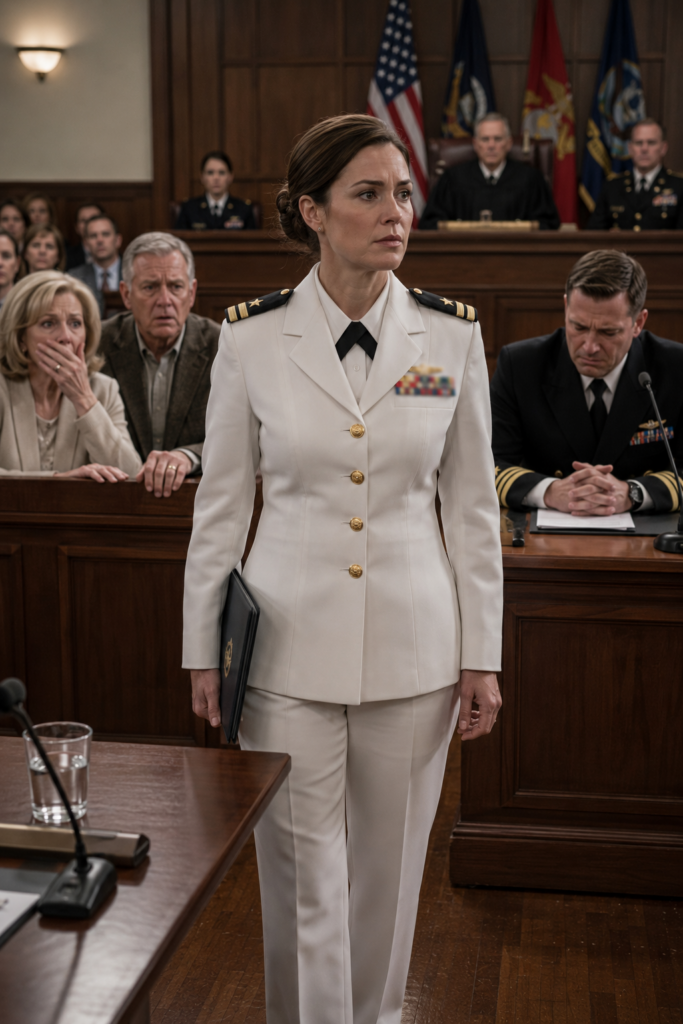
Two years later, the past came back through a case file.