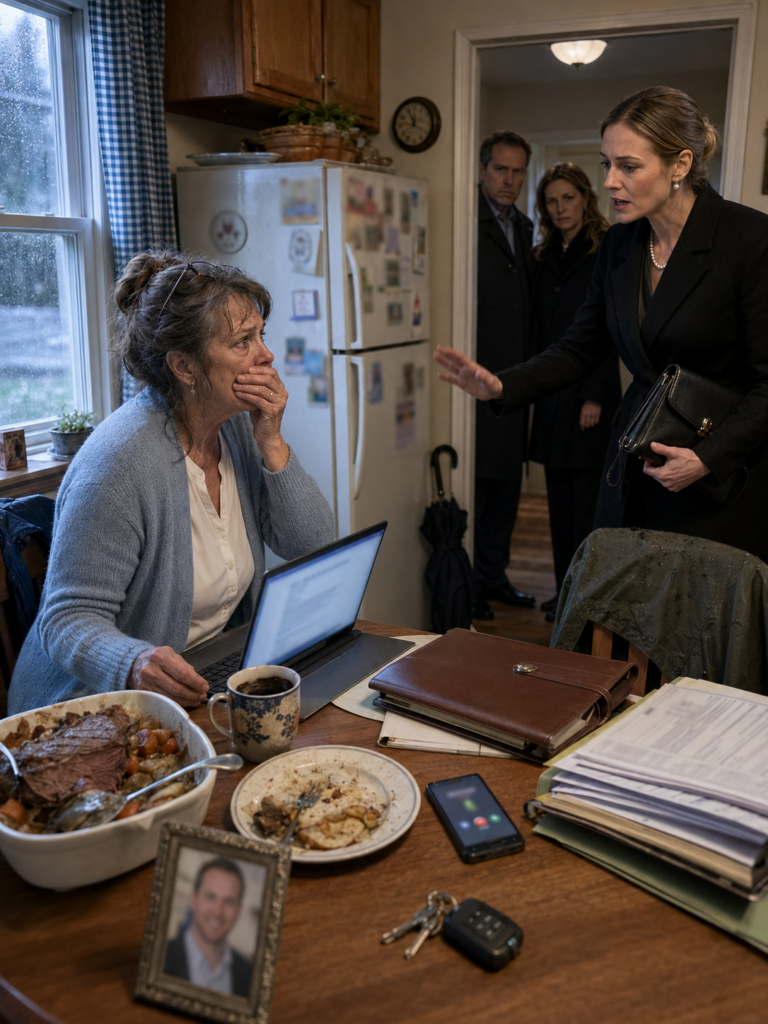
At home that evening, I opened the email Callum had sent me after he left my house.
I had not seen it before because it went to the account I used mostly for documents, not daily messages. The subject line was simple.
For Mom.
The attachments were trust summaries, contact information, legal memos, financial statements I barely understood. Beneath them, in the body of the email, was a note.
Mom,
If you’re reading this after something happened to me, don’t meet with anyone from her family without your lawyer present. Don’t sign anything. Don’t let them in the house.
I love you.
C.
I read it once.
Then again.
Then I printed it because suddenly digital words felt too easy to lose.
By the fourth reading, I could no longer pretend my son had merely been anxious.
He had been afraid.
Three days after the funeral, I called Mrs. Ainsworth.
Her full name was Margaret Ainsworth, though no one who respected her called her Margaret without permission. She had handled Peter’s estate twelve years earlier, guiding me through probate with the calm patience of a woman who understood grief made paperwork feel obscene. She was in her late sixties now, with silver hair, navy suits, and a voice that never wasted motion.
“Eleanor,” she said when she answered. “I heard about Callum. I am so sorry.”
The kindness almost undid me.
“I need help,” I said.
“Tell me.”
So I did.
The transfer. The trust. The Sunday visit. The shaking hands. The insurance mention. The email. The warning.
Mrs. Ainsworth did not interrupt.
That was one of the things I valued most about her. She listened as if silence were a tool, not a gap to be filled.
When I finished, she was quiet for a moment.
Then she said, “Do not speak to anyone from that family without me on the phone or in the room. Not one word.”
“They haven’t contacted me.”
“They will.”
“They’re grieving too.”
“Perhaps.”
The word was not cruel.
It was cautious.
“Eleanor, your son moved twelve million dollars into a trust in your name shortly before his sudden death. He left written instructions warning you not to meet with his wife’s family or sign anything. We are not assuming facts, but we are preserving your position. Do you understand?”
My hand tightened around the phone.
“Yes.”
“Forward me everything. Do not delete messages. Do not open your door to them.
If they arrive, call me. If they call, say only, ‘Please contact my attorney.’ Then hang up.”
“I feel ridiculous.”
“Good. Ridiculous is often safer than trusting the wrong person.”
Mrs. Ainsworth was right.
They called eleven days after the funeral.
Lydia’s number appeared on my phone while I was washing Callum’s pot roast container. I had found it in my refrigerator, untouched. I must have put it there after he left, though I had no memory of doing so. The sight of it made me sit down on the kitchen floor that morning and sob until my throat hurt.
When the phone rang, I dried my hands slowly.
Then I answered.
“Eleanor,” Lydia said. “I hope I’m not catching you at a bad time.”
A bad time.
My son had been in the ground eleven days.
“What do you need, Lydia?”
“I wanted to see how you were doing.”
“I’m alive.”
A pause.
“Yes. Well. We all are trying to process this.”
She sounded almost irritated by my lack of softness.
“My family would like to get together to discuss some financial matters related to the estate,” she said.
“There’s no need for that.”
“I think there is.” Her voice remained pleasant. “There appears to be documentation suggesting certain assets were transferred improperly in the months before Callum’s death. I’m sure we can clear it up informally before things become formal. That would be in everyone’s best interest.”
Improperly.
She said it easily. Practiced.
I looked at the printed email on my kitchen table.
Don’t meet with anyone from her family without your lawyer present. Don’t sign anything. Don’t let them in the house.
“I’ll have my attorney contact yours,” I said.
Silence.
Then Lydia gave a small laugh. “There’s no need to involve lawyers at this stage.”
“There is.”
“Eleanor, I really think—”
“Have your attorney call Mrs. Ainsworth.”
I gave her the number and hung up before she could turn my name into a leash.
My hands shook afterward.
Not because I doubted the choice, but because the old rules of politeness still lived in me. I was a woman raised to make people comfortable. To offer coffee. To answer questions. To explain myself. To avoid sounding rude even when someone stepped toward me holding a knife hidden in velvet.
That day, I understood that manners can become a trap if you apply them to people who have abandoned decency.
That afternoon, I went to Callum’s apartment.
He and Lydia had maintained an apartment in the city even after buying a house in her family’s preferred suburb, though she had never liked the apartment. She called it his “bachelor cave,” as if the books, workbench, old guitar, and framed photo of us in Savannah represented a childish life she had tolerated rather than a private place he needed. She had gone to stay with her parents after the funeral, which seemed natural at first and then strange the longer I thought about it.
The apartment manager let me in because Callum had put me down as an authorized contact two years before.
I found that detail in the trust folder. He had prepared for so much.
The apartment smelled faintly of dust and his soap. I stood in the entryway for a long time before turning on a lamp. His shoes were by the door. A navy jacket hung over the back of a chair. A mug sat in the sink, unrinsed. On the kitchen counter was a half-used bottle of vitamins, a box of green tea he hated but drank because some doctor told him coffee was making his sleep worse, and a banana gone brown at the stem.
Small things are cruel after death.
They keep insisting the person was just here.
I moved slowly through the rooms.
The bookshelf held programming books, science fiction, biographies, a battered copy of The Phantom Tollbooth from his childhood that he had stolen from our house years ago and denied stealing. His desk was neat except for one notebook filled with diagrams and half-written thoughts. On his nightstand stood the Savannah photo.
We were under live oaks in one of the squares, Spanish moss overhead, sun in our eyes. His arm around my shoulders. Both of us laughing at something I cannot remember. That trip had been his gift to me after the partial sale of his company, when he said, “Pick anywhere, Mom,” and I chose Savannah because it was close enough not to feel greedy and far enough to feel like a dream. We walked for four days in humid heat, ate shrimp and grits, toured old houses, got lost twice, and laughed more than we had since Peter died.
I touched the frame.
Then I went to the closet.
I do not know why.
Maybe because Callum had always hidden important things in unimportant places. As a teenager, he kept cash inside an old board game box. At twenty-five, he stored backup hard drives in an empty cereal container because, as he explained, “Burglars have priorities.”
In the back of the closet, behind a pair of hiking boots he never used, was a shoebox labeled Miscellaneous in his handwriting.
Inside was an envelope.
My name was on it.
Mom.
I sat on the closet floor before opening it.
Inside was a USB drive and a folded piece of paper.
Mom,
Drive has audio, January through April. You’ll understand.
C.
My breath stopped.
I took the box, the envelope, and the Savannah photo.
At home, I sat at my kitchen table with my laptop open and the USB drive in my hand for nearly twenty minutes before plugging it in.
I understood immediately why Callum chose me.
Not because I was powerful.
Because I would listen.
There were eleven recordings.
Some were phone calls. Some were conversations captured on what sounded like a small digital recorder, the kind reporters use. The dates ran from January to April. Callum had labeled each file carefully.
Jan_14_Arthur_Insurance
Feb_03_Lydia_MaritalTrust
Feb_19_Graham_Policy
Mar_11_Lydia_IPTransfer
Apr_02_Arthur_PrivateCall
And so on.
I opened the first.
Arthur Vale’s voice filled my kitchen, smooth and paternal.
“Callum, men in your position have to think beyond themselves. Liquidity after death is not morbid. It’s responsible. A four-million-dollar policy is modest given your net worth.”
Callum sounded tired. “I already have coverage.”
“Old coverage. Inadequate coverage. You have a wife now. A legacy. Potential children. Complex assets. Do you want Lydia fighting your mother over access to operating capital if something happens?”
“My mother wouldn’t fight Lydia.”
Arthur gave a soft laugh.
“Everyone says that until money enters the room.”
I paused the recording.
The kitchen was silent except for the refrigerator.
I wrote the date and summary in a notebook.
Then I played the next.
Lydia’s voice. Careful. Soft.
“You keep treating this like my father is trying to take something from you.”
Callum: “He keeps sending documents that transfer control away from me.”
“That’s dramatic.”
“It transfers voting rights to a marital entity. That’s what the document says.”
“You don’t trust me.”
“I trust you. I don’t trust him.”
A long silence.
Lydia’s voice changed.
“That’s not something I can unhear, Callum.”
The file ended.
I went through all eleven.
By the seventh, I had stopped crying.
By the ninth, I had become very still.
The recordings revealed pressure applied slowly and skillfully. Arthur encouraging insurance. Graham discussing “beneficiary alignment” with language that made my stomach turn. Lydia pushing for signatures. A lawyer whose voice I did not recognize saying intellectual property needed to be “protected from third-party maternal claims,” which meant me. Arthur suggesting Callum’s consulting venture would be better positioned if certain assets were brought under the Vale advisory umbrella.
The March recording stopped my breath completely.
It sounded like a bedroom. Low voices. Intimate space turned battlefield.
Lydia: “You just need to sign it.”
Callum: “It’s not a formality.”
“I’ve read it twice.”
“That worries me more.”
“My father had his lawyer look at it. It’s standard.”
“It transfers ownership of the IP.”
“It protects the IP.”
“From whom?”
“From instability.”
“What instability?”
A pause.
“Yours, lately.”
Callum laughed once, but not with humor.
“You mean because I started asking questions.”
“I mean because you’re paranoid.”
“Paranoid people don’t hire independent counsel before signing away ownership.”
Lydia’s voice hardened.
“You don’t trust me.”
“I trust you. I don’t trust your father.”
“That’s not something I can unhear, Callum.”
“No,” he said quietly. “It isn’t.”
The file ended.
Three weeks after that conversation, my son drove four hours in the rain, sat at my kitchen table, ate four bites of pot roast, and told me twelve million dollars was safe.
I took the USB drive to Mrs. Ainsworth the next morning.
Her office looked exactly as I remembered from Peter’s estate: dark shelves, cream walls, two lamps instead of overhead lights, a silver clock on her desk that did not tick loudly. She wore a navy suit and pearl earrings, and when I placed the USB drive in front of her, she did not touch it immediately.
“What is it?”
“Callum left it.”
Her expression changed, but only slightly.
I told her about the apartment, the shoebox, the note.
Then we listened.
Not to all eleven. Enough.
Mrs. Ainsworth’s face did not move while Arthur Vale discussed insurance, while Graham used the phrase beneficiary alignment, while Lydia accused my son of paranoia. She took notes in a legal pad with clean block letters. When the March recording ended, she removed her glasses and closed her eyes for one second.
Then she opened them.
“Eleanor,” she said, “we are going to preserve every copy, document chain of custody, and send this to a forensic audio specialist.”
“Can we use it?”
“Likely. But we will not rely on one thing. We build with layers.”
Layers.
That became the next four months of my life.
Within six weeks of the funeral, Lydia and the Vales filed a formal challenge to the trust. Their petition claimed Callum had been under extreme emotional strain, that I had exerted undue influence over him, and that the transfer of twelve million dollars shortly before his death was suspicious, improper, and inconsistent with his marital obligations.
In plain English, they accused me of manipulating my son into giving me his money while he was vulnerable.
My son, who had driven through rain with shaking hands because he was afraid.
My son, who left me recordings in a shoebox.
My son, who warned me not to meet them without counsel.
I read the petition once and vomited in my bathroom.
Then I rinsed my mouth, sat at the kitchen table, and called Mrs. Ainsworth.
“They’re saying I used him.”
“I know.”
“They know that isn’t true.”
“Truth is not always the first tool people reach for.”
“What do we do?”
“We answer. Then we investigate.”
Mrs. Ainsworth’s team moved with a quiet precision that I came to respect more every week. She brought in a trust litigator, a forensic accountant, a handwriting expert, and an investigator who looked like a retired school principal and spoke like a man who had spent thirty years disappointing liars.
The recordings were authenticated.
The trust documents were clean.
Callum had used independent counsel. He had undergone a competency evaluation before signing. That detail made me cry when Mrs. Ainsworth told me. Not because I doubted my son’s competence, but because he had known they would try to claim otherwise. He had left no easy door open.
“He did this carefully,” Mrs. Ainsworth said.
“Yes,” I said.
Then came the insurance policy.
Four million dollars.
Arthur Vale had encouraged it in January. That much we knew from the recordings. The policy had existed before, but it had been increased significantly. Originally, I was listed as beneficiary for part of the coverage, with a separate amount assigned to Lydia. That was consistent with older documents and Callum’s estate plan.
In February, the beneficiary designation changed.
All proceeds to Lydia.
The signature on the form looked like Callum’s at first glance. It had the tall C, the sharp angle of the W in Whitaker, the slight downward slope toward the end. But it was too careful. My son’s handwriting, even on formal documents, had a rhythm to it. This looked like someone drawing music note by note.
The insurance company had been preparing to pay out when Mrs. Ainsworth sent notice of dispute and preservation demand.
The handwriting expert took one look at the original forms and asked for known samples. We provided tax documents, company filings, old birthday cards, even a grocery list Callum had written in my kitchen one Thanksgiving when he insisted he could make stuffing from scratch and forgot sage.
The report came back nine days later.
Forgery.
Not possible forgery.
Not inconclusive.
Forgery.
I sat in Mrs. Ainsworth’s office while she read the conclusion aloud.
“The questioned signature contains indicators of simulation and lacks natural variation consistent with known exemplars.”
I did not understand every technical phrase.
I understood enough.
Someone had signed my dead son’s name to redirect four million dollars.
The investigation widened.
Arthur Vale’s advisory firm came under scrutiny. At first, through civil discovery. Then through regulatory inquiry after Mrs. Ainsworth shared evidence with the appropriate authorities. I learned phrases I never wanted to know: wire fraud, insurance fraud, forged beneficiary change, fiduciary breach, undue influence, financial elder abuse adjacent but not quite because Callum was not elderly, suspicious policy activity, unauthorized signature, conflict of interest.
I kept a notebook because I did not trust grief to remember accurately.
Every call. Every date. Every document. Every name. Every time someone said idiopathic or beneficiary or transfer, I wrote it down.
The Vales had money. They had attorneys who wore expensive watches and said my name like it was a minor scheduling problem. Lydia’s attorney was good. Arthur’s attorney was better. Graham’s attorney seemed mostly concerned with making sure Graham stopped talking.
They believed I would tire.
I know that now.
They looked at me and saw a sixty-three-year-old widow in a modest house with burnt coffee in her kitchen and no powerful family behind her. They saw a grieving mother. They saw a woman who would eventually decide the process cost too much emotionally, who would accept a settlement, sign a confidentiality agreement, and let the official story remain clean enough for them to keep attending charity dinners.
They did not understand that grief can become stamina when love gives it instructions.
Mrs. Ainsworth warned me early.
“Most people in your position back down,” she said one evening after a deposition prep session left me with a headache behind my eyes. “Not because they’re weak. Because the process is exhausting by design. Opposing counsel may delay, overwhelm, request irrelevant documents, attack your credibility, imply motive. They may make you feel as if protecting your son’s intentions is somehow greedy.”
I looked at the Savannah photo I had placed on her desk that day because I needed him with me.
“He drove four hours in the rain to make sure the money was safe,” I said. “The least I can do is make sure it means something.”
Mrs. Ainsworth nodded.
Then she opened a new folder.
“Then we get to work.”
Depositions were the hardest.
Harder than I expected.
I had imagined depositions as a table, questions, answers. In reality, they felt like being asked to relive your worst days under fluorescent lights while strangers objected to the shape of your grief.
Lydia’s attorney asked me whether Callum and I were close.
“Yes.”
How often did we speak?
It varied.
Could I provide phone records?
Yes.
Had Callum ever expressed dissatisfaction with his marriage?
Not directly.
Had I disliked Lydia?
I tried not to.
That answer made her attorney pounce gently, which is worse than pouncing aggressively because gentleness pretends not to be an attack.
“What do you mean, Mrs. Whitaker, when you say you tried not to dislike your daughter-in-law?”
I looked at Mrs. Ainsworth.
She nodded slightly.
“I mean my son loved her, and I respected that.”
“Did you feel threatened by her role in his life?”
“No.”
“Did you resent her family’s influence?”
“I became concerned about it after hearing the recordings my son left.”
“But before that?”
I paused.
There are truths that can be used against you if spoken poorly. Mrs. Ainsworth had taught me to take my time.
“Before that,” I said, “I noticed her family had strong opinions about my son’s finances. I did not know enough to call it influence.”
“Isn’t it true that your son transferred twelve million dollars to a trust benefiting you after a private visit to your home?”
“Yes.”
“And no one else was present?”
“No.”
“So we have only your account of what occurred.”
I felt my hands shake under the table.
I kept my voice level.
“You have my account, the trust documents, his email warning me not to meet with your clients without counsel, and the recordings he left behind.”
The attorney’s face tightened.
Mrs. Ainsworth wrote something on her legal pad.
Good, she showed me later.
I held onto that for days.
Arthur Vale’s deposition was a master class in polished evasion until the insurance documents appeared.