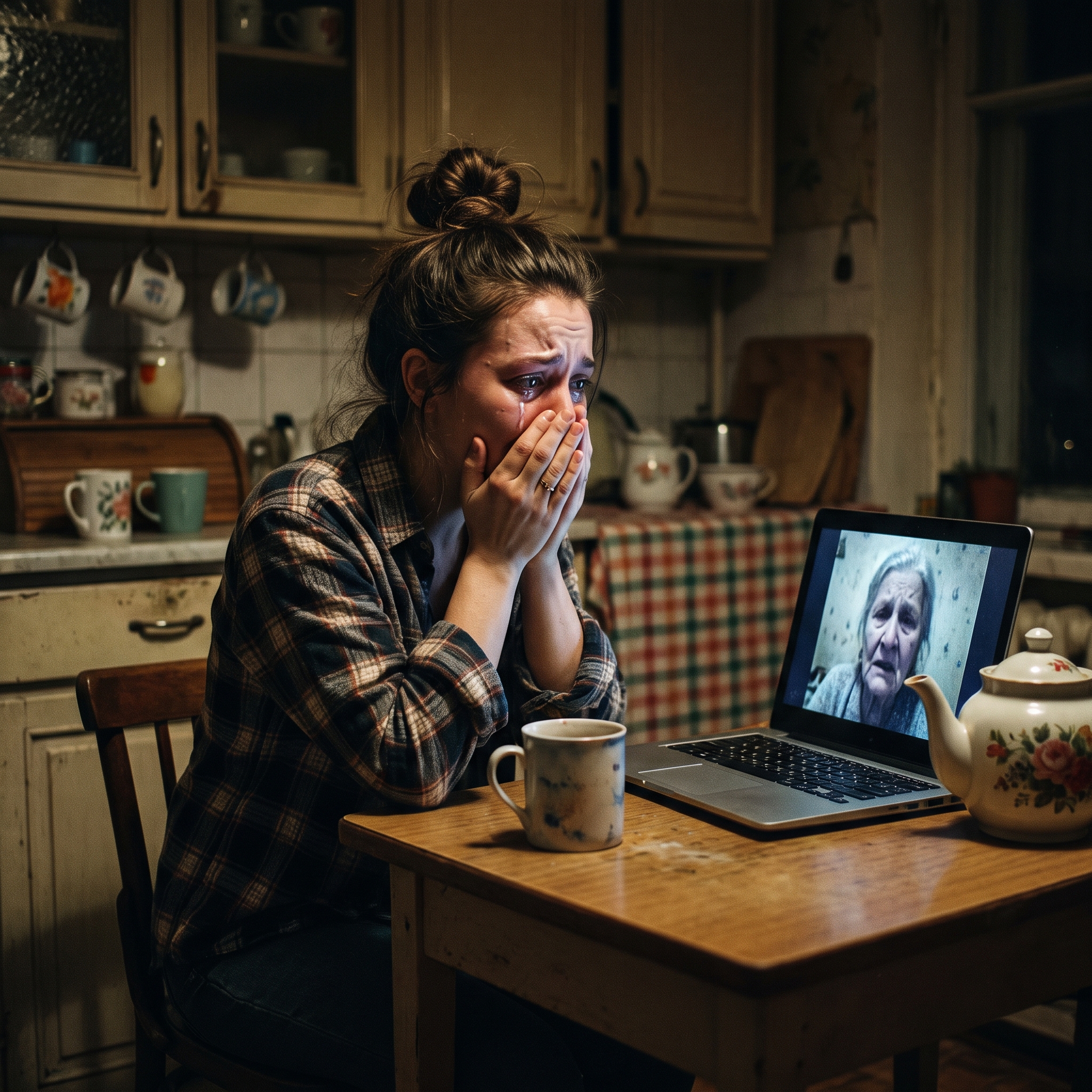
I will never, for as long as I live, forget the exact moment the footage loaded on my laptop. My hands were shaking so badly I could barely click the play button.
It was two in the morning on a Tuesday. I was sitting at my own kitchen table in Phoenix, sixty miles from my mother’s house in Sedona, and I had never felt so far away from her.
I pressed play, watched ten seconds, and my blood ran absolutely cold.
The camera was a small, cheap thing. A little black box I’d picked up at a hardware store for forty dollars.
I had set it right behind the old ceramic flour canister on the kitchen shelf, the one my mother had used for forty years. I told no one. Not even my husband. I had to know the truth.
This nightmare had started right after my father passed.
His name was Walter. He was a kind, steady man who had worked for the postal service for thirty-five years. When he died suddenly from a heart attack in his garden, my mother Rosemary was left utterly alone in that big house they had shared for half a century.
I live in Phoenix with my own family. I have a demanding job and two teenagers. I could not be there every day, as much as it shattered me to admit it. So I did what I thought was the responsible, loving thing. I found a professional caregiver.
Her name was Dolores. A woman in her late fifties, with a warm smile and soft voice.
She came highly recommended. She was from a small town just outside Sedona, and she promised me she would treat my mother like her own.
For the first few months, everything seemed perfect.
“Kathy, you’re a sweetheart for calling,” Dolores would say whenever I phoned to check in. “Your mama is a treasure. We had a lovely chat today. I made her favorite pot roast. She ate every bite.”
And my mother, when I visited, seemed peaceful. She would pat my hand and smile. “Dolores is an angel,” she’d whisper. “Don’t you worry about me, sweetheart.”
But then the cracks began to show.
It was on a Wednesday in early spring when my mother called me in a panic. Her voice was so thin, so frail over the line.
“Katherine, I’m so sorry to bother you,” she said, and I could hear the shame in every word. “But the grocery store said my card was declined. I don’t understand. My pension check just came last week.”
I was confused. My father had left her a modest but comfortable pension, and she received Social Security every month. She had always been so careful with her money.
“It must be a bank error, Mom,” I reassured her. “I’ll look into it.”
But it wasn’t a bank error. I drove up that weekend and sat with her at the kitchen table, going over her bank statements with a magnifying glass. And my heart sank to the floor.
There were charges from a Walmart in Cottonwood, made at eleven o’clock at night. There were ATM withdrawals for $200, $300, sometimes $400 every few days. My mother was seventy-eight years old. She didn’t leave the house after six in the evening. She certainly wasn’t driving to a Walmart thirty minutes away in the dark.
“Mom,” I said, trying to keep my voice steady, “do you remember buying anything at Walmart last Tuesday night?”
She looked at me with those cloudy blue eyes, genuinely bewildered. “Tuesday night? I was in bed by eight, dear. You know I always watch my programs and fall asleep.”
I felt a cold dread creeping up my spine. “Has anyone else used your card? Have you given your PIN number to anyone?”
She hesitated. She looked down at her hands, which were knotted with arthritis. “I don’t think so,” she whispered. But I could tell she was lying. Or more accurately, she was terrified to tell me the truth.
Over the next few weeks, I started paying closer attention. I noticed things I had been too busy to see before. My mother, who had always been proud of her appearance, was losing weight at an alarming rate. Her clothes hung off her shoulders. Her cheeks were hollow. The sparkle in her eyes had simply vanished.
She would flinch every time the doorbell rang.
One Sunday afternoon, I was over for a visit when Dolores arrived unexpectedly. She had a key, of course. I heard the door open, and I saw my mother physically stiffen in her armchair. Her knuckles went white where she gripped the armrest.
“Oh, hello, Kathy!” Dolores chirped as she bustled in, carrying a bag of groceries I hadn’t asked for. “I was just in the neighborhood and thought I’d drop off a few things for your sweet mama. She mentioned she was out of Ensure. Isn’t that right, Rosemary?”
My mother nodded quickly, too quickly. “Yes, dear. Thank you, Dolores.”
But later, after Dolores had left, I went to the pantry. There were already three unopened cases of Ensure on the shelf.
I couldn’t shake the feeling that something was terribly, deeply wrong. I just didn’t have proof.
So I bought the camera. A tiny little thing that connected to my phone. I went over on a Thursday morning, gave my mother a big hug, and while she was in the bathroom, I placed it on the high shelf behind the flour canister. It was perfectly hidden. From that angle, it captured a clear view of the entire kitchen, including the little desk where Mom kept her checkbook and purse.
I told myself I was being paranoid. I prayed I was just a worried, overprotective daughter. I almost talked myself out of ever checking the footage. Almost.
But a week later, at two in the morning, my curiosity and my gut instinct got the best of me. I opened my laptop, logged into the camera’s secure feed, and downloaded the saved events. The motion sensor had been triggered multiple times.
I took a deep breath and pressed play on the first clip.
The kitchen was dim, lit only by the light over the stove. My mother was shuffling in, wearing her old pink robe. She looked so small, so fragile. She went to the refrigerator and took out a small jar of applesauce. That was her nightly snack.
I smiled. It was a normal, peaceful image. I started to relax.
Then I saw a shadow move in the hallway.
Dolores walked into the frame.
She was not wearing her usual kind smile. Her face was hard, her eyes cold. She walked directly to my mother, who had just sat down at the little kitchen desk to eat her applesauce.
“Rosemary,” Dolores said, and her voice was not soft. It was sharp, like a knife. “It’s the tenth of the month. You know what that means.”
My mother looked up, and the expression on her face was one of pure, undisguised terror. Her hand started to shake, and the spoon clattered against the glass jar.
“I—I don’t have it, Dolores,” she stammered. “I already gave you the money for the bills. I don’t have any more.”
“That’s not my problem,” Dolores snapped. She pulled my mother’s checkbook off the desk and slammed it down in front of her. “You will write me a check for $500 right now, or I’m walking out that door and you can sit here and starve for all I care.”
I watched, frozen, my hand clamped over my mouth. Tears were streaming down my face. My mother, my sweet, gentle mother, was crying. She was actually crying, shaking her head, saying, “Please, I can’t. It’s all I have left for my heart medication.”
“I don’t care about your pills, you old bat!” Dolores hissed. I can still hear those words in my nightmares. “Write it. Now. Or I’ll tell your daughter you’ve lost your mind and you belong in a nursing home. Is that what you want?”
My mother sobbed. Her frail, arthritic hand picked up the pen. She wrote the check. She was crying so hard the ink was smeared.
Dolores snatched it from her, stuffed it into her purse, and walked out of the kitchen without a single glance back.
My mother just sat there, her head in her hands, weeping like a lost child.
The footage stopped. The next clips showed variations of the same scene, playing out over days and weeks. Dolores would come in, sometimes in the late evening, sometimes during the day when she was supposed to be providing loving care. She would demand cash, demand checks, take credit cards right out of my mother’s purse. She had been draining my mother’s accounts dry, month after month, for nearly a year.
I was shaking so violently I could barely breathe. I felt a rage so hot and so pure it scared me. And underneath that rage was a crushing, suffocating guilt. I had hired this monster. I had handed her the keys to my mother’s house, to my mother’s life, with a smile.
I didn’t call her. I didn’t give her a chance to explain. I saved the footage to my phone and I got in my car. I drove those sixty miles from Phoenix to Sedona in the dead of night, and I did not obey a single speed limit.
When I arrived at my mother’s house, I used my own key. I found her asleep in her recliner, the television still flickering in the dark. I kissed her forehead, and whispered, “It’s going to be okay, Mom. I promise.”
Then I waited.
The next morning, Dolores arrived at eight a.m. sharp, just like always. She let herself in, calling out, “Good morning, Rosemary!” in that sickeningly sweet voice. She stopped dead in her tracks when she saw me standing in the living room, my phone in my hand.
“Oh, Kathy! What a lovely surprise,” she said, but her smile faltered when she saw my face.
“I know everything,” I said. My voice was quiet, but it was the kind of quiet that comes before an earthquake. “I saw it all. The camera. The checks. The way you spoke to my mother.”
Her face went pale. She tried to laugh it off. “I don’t know what you’re talking about, sweetheart. Your mother gets confused sometimes, you know that—”
“Don’t you dare,” I cut her off, and I held up my phone. “The police are on their way. I’ve already sent them the videos. You’re done, Dolores. You’re going to pay for every single thing you stole from her.”
At that moment, my mother shuffled into the room, still in her robe. She looked from me to Dolores, and then she started to cry again, but this time they were tears of relief. She reached for my hand and held it so tight.
“You came for me,” she whispered. “I was so scared you wouldn’t believe me.”
That broke me. I fell to my knees and hugged her, right there in the living room, and I sobbed right along with her.
The police arrived ten minutes later. They arrested Dolores on charges of financial exploitation of the elderly. They found thousands of dollars in fraudulent checks and cash withdrawals. The investigation revealed she had been doing this for months, and to other elderly clients as well. She is in prison now, where she belongs.
It took a long time for my mother to heal. Not just from the financial loss—we were able to get most of her money back through the courts—but from the emotional damage. The betrayal. The fear of being all alone in this world. I quit my job in Phoenix. I moved my mother into a beautiful little apartment just five minutes from my house. We found her a new caregiver named Eleanor, a woman with the most genuinely kind heart I’ve ever known. She reads my mother poetry in the afternoons and helps her tend her little patio garden.
My mother is gaining weight again. Her laugh is coming back. Just last week, she told me she had a dream about my father, and in the dream he was smiling at her, saying, “I’m so proud of our girl.”
Sometimes, the deepest evil hides behind the most ordinary smiles. But love, real love, never stops fighting. It drives sixty miles in the dark at two in the morning. It hides cameras behind flour canisters. It listens when a fragile voice whispers for help.
If your loved ones are aging, check on them. Not just with a phone call. Sit with them. Look into their eyes. Watch their bank accounts. Ask the hard questions. Because the wolves are always at the door, and sometimes, they already have a key.
If this story moved you, please take a moment to Like our page, Follow us for more heartfelt stories, and Share this post with someone who needs to be reminded to protect the ones they love. Your kindness could change a life.