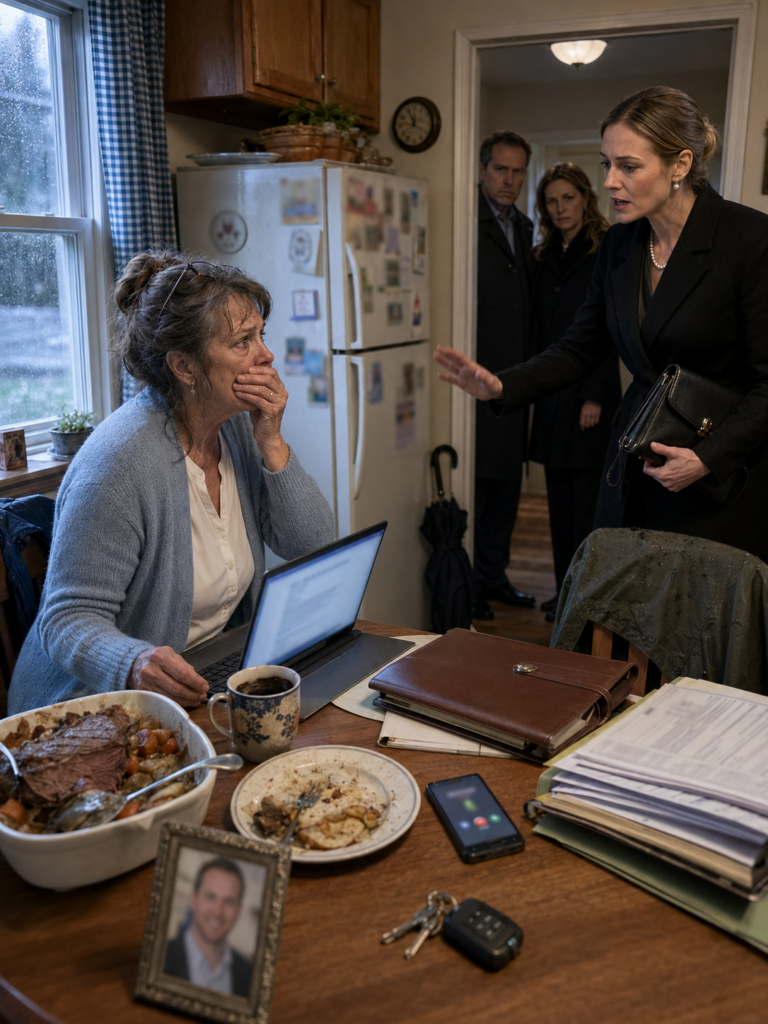
The kitchen smelled like burnt coffee the last time my son came home alive.
That is the detail that comes back to me first, before the ambulance call, before the lawyers, before the USB drive, before the word idiopathic became a stone I would carry in my chest for the rest of my life. Not his thin face. Not the gray exhaustion under his eyes. Not the way his hands trembled when he set his keys on my counter and pretended they hadn’t.
The coffee. That bitter, scorched smell filling the kitchen because I had left the pot sitting on the burner too long while I folded laundry in the back room and argued with myself about whether to call him again.
I remember being embarrassed.
That seems absurd now. A mother can look back on the last hours she spent with her child and find shame in the smallest places, as if grief is not content to destroy the large rooms but must open every drawer. I remember saying something useless like, “I was going to make a fresh pot.”
My son said, “It’s fine, Mom.”
But he wasn’t looking at me.
He was looking out the kitchen window.
His name was Callum Whitaker. To the newspapers later, when there were articles about the trust and the insurance policy and the investigation into his father-in-law’s advisory firm, he became “software entrepreneur Callum Whitaker,” as if ambition had been the main thing about him.
To his wife’s attorneys, he became “the decedent,” as if language could make a man less loved. To investigators, he became “Mr. Whitaker,” then “the insured,” then “the deceased.” But to me, he was Callum. My boy. The baby who refused to sleep unless the washing machine was running. The child who took apart a clock at seven because he wanted to know “where the minutes lived.” The teenager who once argued with his math teacher so respectfully that the teacher called me to complain and ended the call admitting Callum had been right. The man who built something enormous from nothing and still texted me pictures of sandwiches when he thought they were especially good.
He was forty-one years old that Sunday, old enough to have gray at his temples, young enough that no mother should have to say was.
He had driven four hours to have dinner with me without calling first.
That was not unusual in the way other people might think. Callum had always been abrupt with plans, never rude, exactly, just economical. He wrote messages like a man afraid words might charge interest.
At 11:03 that morning, my phone buzzed.
Leaving now. Be there by 2.
No hello. No explanation. No question about whether I was home, because of course I was home on a Sunday. Since my husband died twelve years earlier, my Sundays had narrowed around a routine: church if my knees were behaving, pot roast by noon, coffee too late in the afternoon, laundry, the crossword, and a phone call I sometimes made to Callum and sometimes only thought about making because I didn’t want to be the kind of mother who hovered over a grown man.
I stared at his message for a long time.
Something about it felt wrong. Not the words. The weight behind them. Flat. Final. Like a man checking a box.
I typed back, Drive safe.
Three dots appeared, disappeared, appeared again.
Then nothing.
By the time he arrived, rain had settled over the town in a steady gray drizzle. The sort of rain that makes roofs whisper and yards look smaller. I heard his car in the driveway before the doorbell rang. He still used the doorbell, even though he had a key. That was one of the odd little formalities he kept after he became rich enough for people to call him impressive. He never walked into my house without warning.
I opened the door, and for one second, I saw him as he had been at nineteen, coming home from college with wet hair and a backpack slung over one shoulder, pretending not to need food while scanning the kitchen for leftovers.
Then the present rearranged him.
He was thinner than the last time I had seen him. Not dramatically, not enough that a stranger would comment, but enough for a mother to notice. His cheekbones looked sharper. His eyes seemed set deeper. He wore a charcoal sweater under a raincoat, and the rain had darkened his hair until it looked almost black. He smiled when he saw me, but it didn’t reach the place smiles are supposed to come from.
“Hi, Mom.”
“Hi, sweetheart.”
I reached for him, and he hugged me.
He held on a little too long.
I should have noticed that first too. Instead, I noticed later, after it was too late to ask him why.
“Come in,” I said. “You’re soaked.”
He stepped into the hallway, wiped his shoes on the mat, and looked around the house as if trying to memorize it. The faded runner. The umbrella stand by the door. The framed family photo above the small table, where he stood between me and his father at his college graduation, all three of us squinting into the sun. The vase I only filled when company came. The stack of mail I had not sorted.
He set his keys on the kitchen counter with shaking hands.
I saw that.
I did.
But seeing is not the same as understanding.
“Long drive?” I asked.
“Not bad.”
“You want coffee? I left the pot on too long. I was going to make a fresh one.”
“It’s fine, Mom.”
He walked to the window.
Outside, rain marked the glass in thin crooked lines. Beyond it, my little backyard looked washed out and tired, the flower beds flat for the season, the bird feeder swinging slightly in the wind. Callum stood there with his back to me, looking at nothing I could see.
His wife’s name was Lydia, though I rarely use it now. There are names grief refuses to share the air with. She had been my daughter-in-law for nine years. When Callum first brought her home, I wanted badly to love her.
I want to be honest about that.
I tried.
She was beautiful in a precise way, the kind of beauty that seemed maintained by discipline rather than joy. Thick blond hair always smooth. Pale blue eyes that rarely revealed surprise. Clothes that looked simple until you saw the fabric up close. She had a quick mind and opinions about everything: art, food, politics, architecture, the proper temperature for white wine, the difference between people who had “built wealth” and people who had “stumbled into liquidity.” That last phrase stayed with me because she said it once while talking about a man at a fundraiser, and Callum laughed as if it were a joke.
Her family had money.
Old money, though not as old as they liked to imply. Her father, Arthur Vale, ran a financial advisory firm that catered to people who preferred their money managed by someone who already knew what country club they belonged to. Her mother chaired committees. Her brother, Graham, worked in some part of the firm I never understood because every explanation sounded designed to make simple things opaque.
The first time I had dinner with all of them, at Arthur and Celeste Vale’s house, I noticed how her father looked at my son.
Not rudely. Arthur Vale was too polished for rudeness. He smiled, asked questions, praised Callum’s company, commented on the recent sale of a minority stake as “a smart liquidity event.” But underneath the questions was calculation. I had seen that look once before, on a banker’s face when my husband and I refinanced our house after medical bills. It was the look of someone measuring risk while pretending to measure character.
Callum either did not notice or decided not to care.
He loved Lydia.
And she seemed to love him.
At least in the beginning, she performed love well enough that I kept my doubts to myself. Mothers are always being told not to interfere. We learn to swallow observations because a grown child’s happiness feels too precious to challenge without evidence. So I smiled. I complimented her table settings. I sent her birthday flowers. I learned to say “your family” instead of “the Vales” because Callum once told me she thought I sounded distant.
I tried.
But the Sunday he came home smelling of rain and fear, whatever mask had held his life together had begun to slip.
I set dinner on the table at three-thirty because pot roast forgives timing better than people do. Carrots, potatoes, onions soft enough to break with a fork, gravy thickened the way his father liked it. Callum sat in his old chair. Not the chair he used as a boy—that had broken years before—but the one he always chose when he came over after college and later after work, when he would stop by between flights, eat whatever I made, and answer emails at the table while pretending he was listening to me talk about neighbors.
He took four bites.
Maybe five.
Then he set his fork down carefully on the edge of the plate and folded his hands in his lap.
I asked, “Are you feeling all right?”
He stared at the pot roast as if it had asked him a question.
“I need to talk to you about something.”
The coffee maker hissed behind me.
I should have turned it off earlier.
“All right,” I said.
He did not begin immediately. Callum had always been a man who built sentences in his mind before allowing them into the world. Even as a child, he would pause before answering serious questions, brows pulled together, lips pressed tight. His father used to say, “Give him time, Ellen. He’s loading the whole program before he opens the window.”
My husband’s name was Peter. He had been gone twelve years by then, dead from pancreatic cancer that moved through our life like a wildfire. He had not lived to see Callum sell part of his company, not lived to see the money, the magazine profile, the articles, the world suddenly speaking about our son as if they had discovered him. I have often thought that might have been a mercy. Peter loved Callum fiercely, but he had no patience for rich people, and watching the Vales circle our son would have turned him into a very dangerous man.
Callum reached into his coat pocket and removed a folded envelope.
“I’ve been restructuring some things,” he said.
The word sounded wrong at my kitchen table.
“What things?”
“Assets.”
I stared at him.
He gave a humorless little smile. “I know. Sorry. I sound like Arthur.”
That was the first time I heard bitterness in his voice when saying his father-in-law’s name.
“What assets, Callum?”
“I talked to my financial advisor. Not Arthur. A new one. Independent. And a lawyer. I moved a significant portion of my liquid holdings and some proceeds from the secondary sale into a trust.”
I understood about half of that.
“With your name on it,” he said.
“My name?”
“As trustee and beneficiary, depending on the structure. It’s complicated, but it’s clean. I had real counsel handle it.”
“Why would you do that?”
He looked toward the window again.
“How much?” I asked, though I was afraid of the answer.
He said the number.
I made him repeat it.
“Twelve million dollars,” he said quietly.
For a moment, the room moved away from me.
I had lived most of my life counting. Counting grocery dollars. Counting prescription co-pays after Peter got sick. Counting hours at work, mortgage payments, car repairs, the years until retirement, the days between Callum’s visits when he was busy building his life. Twelve million was not a number to me. It was weather. It was outer space. It was a word men in suits used on television when discussing companies, not something my son placed in my name while I burned coffee.
“No,” I said.
“Mom.”
“No. I don’t want that. Take it back.”
“I can’t.”
“You can. Whatever paper you signed, undo it.”
“It’s done.” His voice was gentle but firm. “It’s been done for three weeks.”
I pushed my chair back and stood because sitting still had become impossible. “Why would you do this?”
“I needed it safe.”
“Safe from what?”
He rubbed both hands over his face.
“Callum.”
“I needed it somewhere with someone I trust.”
“You trust your wife.”
He did not answer.
The silence became a thing in the room.
I sat down slowly.
“Are you and Lydia having problems?”
“Not exactly.”
That answer frightened me more than yes.
“What does not exactly mean?”
“It means I don’t know how much of what’s happening is marriage and how much is business and how much is her family.”
I waited.
He looked tired enough to sleep for a year.
“Arthur has been advising me on some investments,” he said. “For a while. He introduced me to people. Funds. Tax strategies. Insurance structures.”
“Insurance?”
“Life insurance.”
My hands went cold.
“Why?”
“Estate planning. That’s what he called it.”
“Callum.”
“I know.” He closed his eyes briefly. “I know how it sounds.”
“You’re forty-one.”
“High-net-worth estate planning can start early. That’s what he said. Key-person coverage, liquidity, trust funding, business continuity.”
He said the words with contempt, like they had once impressed him and now embarrassed him.
“Did you sign something?”
“A lot of things.”
“Did you read them?”
He looked at me then, and there was a flash of the boy who took apart the clock to find the minutes.
“I read everything. Eventually.”
Eventually.
The coffee maker gave another angry hiss.
He continued. “There were documents about IP transfer. Company structure. A marital trust Lydia wanted me to sign. Arthur’s lawyer prepared some of it. I thought it was standard at first. Then I had my own counsel review it.”
“And?”
“It wasn’t standard.”
I could feel the air changing, becoming too thin.
“What did they want?”
He looked down at his hands.
“Control.”
That was all he said at first.
Just one word, sitting between the pot roast and the burnt coffee and the rain.
I wanted to ask a dozen questions. I wanted to say I told you. I wanted to say leave her, come home, stay here, we’ll fix it, we’ll hire whoever needs hiring, we’ll call police, lawyers, God, anyone. But mothers of grown sons learn that panic can sound like command, and men who feel cornered do not always move toward the person waving frantically.
So I said, “What do you need from me?”
His face changed then.
It softened in a way that nearly broke me.
“Exactly what you’re doing.”
“I’m not doing anything.”
“You’re listening.”
He opened the envelope and slid several papers across the table. Not the full trust documents, but a summary with names, contacts, instructions. My name. Mrs. Ainsworth’s name, though I had not given it to him. My lawyer. The woman who handled Peter’s estate after he died.
“How do you know Mrs. Ainsworth?”
“I looked through Dad’s estate file years ago when I helped you organize the cabinet.”
That made me want to cry for reasons I could not explain.
“She’s good,” he said. “Careful. If anything happens, call her before you talk to anyone.”
“If anything happens?”
“I’m not being dramatic.”
“You sound dramatic.”
“Maybe I should have sounded dramatic sooner.”
I reached across the table and took his hand.
It trembled under mine.
“Are you in danger?”
His eyes flicked toward the window again.
“I don’t know.”
That answer is another stone I carry.
Not no.
Not yes.
I don’t know.
He left around six.
The rain had thickened by then. I wrapped leftovers in containers he would probably forget in the car and forced them into his hands anyway. He stood in my doorway with his collar turned up and the envelope tucked inside his coat.
“Text me when you get home,” I said.
“I will.”
He hugged me.
Longer than usual.
I felt his ribs through his sweater. I almost said, Stay. The word rose in my throat and stopped there because he was a grown man with a wife, a house, lawyers, assets, problems too large for my kitchen. Because I did not understand yet that sometimes a grown child comes home not for advice but for a witness.
“I love you,” he said.
“I love you too, sweetheart.”
He pulled away first.
Then he walked through the rain to his car.
I stood in the doorway until his taillights disappeared.
He did not text when he got home.
At nine-thirty, I told myself traffic was bad.
At ten-fifteen, I told myself he was unloading, talking to Lydia, too tired to remember.
At eleven, I called. No answer.
At eleven-thirty, I called again. No answer.
At midnight, I sat on the edge of my bed with my phone in my hand and told myself not to become ridiculous. He was forty-one years old. He had driven four hours, talked about heavy things, driven home in rain. He had likely gone straight to sleep.
That is what I told myself.
In the morning, Lydia called.
His wife.
Not crying.
That is the detail that comes back next.
Her voice was controlled, almost careful, as if she were reading from something not written down.
“Eleanor,” she said.
No one called me Eleanor except banks, doctors, and people who wanted distance. Callum called me Mom. Friends called me Ellen. Peter had called me Ellie when we were young and then El after twenty years of marriage made syllables optional.
Lydia said Eleanor.
I sat up in bed.
“What is it?”
“There was an incident last night.”
The world narrowed to the phone.
“What incident?”
“Callum was found unresponsive.”
I stood too quickly and almost fell.
“We called an ambulance,” she said. “They did everything they could.”
“Where is he?”
Silence.
“Lydia, where is my son?”
Her voice flattened.
“He’s gone.”
He’s gone.
She said it the way someone might say he is traveling or he is unavailable. I remember that because some detached, still-functioning part of my mind noted the absence of tears like evidence.
I do not remember the rest of the call.
I remember sitting on the edge of my bed afterward, phone still in my hand, staring at the carpet. There was a brown thread near my foot where the seam had begun to fray. I stared at that thread for a long time because looking anywhere else might require living in the world where my child was dead.
He was forty-one years old.
The official cause of death was cardiac arrest.
He had no known heart condition.
I insisted on an autopsy.
People were gentle with me when I insisted, which made me insist harder. Grief makes others want to soften the room around you. It made me want sharp edges. Facts. Names. Times. Reports. Signatures. I called the county medical examiner myself, sitting at my kitchen table with a notebook open in front of me and a pen that left ink on my fingers.
The autopsy found nothing conclusive.
Idiopathic cardiac arrest.
No identifiable external cause.
No obvious structural heart disease.
Toxicology unremarkable.
Idiopathic. From the Greek, the medical examiner told me kindly when I asked, meaning arising from itself. Unknown cause.
Unknown.
The word should have been humble. Instead, it felt like a door slammed in my face.
The funeral happened in a blur of lilies and expensive suits.
The Vales filled the front rows with people who smelled like wool coats, perfume, and money. Arthur Vale shook hands as if receiving condolences for a public inconvenience. Celeste, Lydia’s mother, dabbed her eyes with a monogrammed handkerchief, producing tears only when someone was close enough to see them. Graham stood beside his father, jaw tight, watching everyone.
Lydia wore black.
She looked beautiful.
I hated that I noticed.
She stood beside the casket without touching it. When I approached, she took both my hands in hers.
“We’re all devastated,” she said.
All.
I wanted to ask if devastation always left a person’s makeup so perfect. Instead, I nodded, because my son was in a coffin and I had not yet learned how to be dangerous.
People spoke at the service. Former employees. Investors. A college friend. My son’s business partner, Aaron, who cried openly and said Callum had once slept under his desk during a server crisis because “going home would have been inefficient.” People laughed through tears.
I did not speak.
I could not fit a life into words in front of people who might have helped end it.
That thought came too early and too late.
After the burial, Lydia invited me to her parents’ house for a reception. I said no. She looked surprised, then wounded. I told her I was tired. That was true, but not the truth.