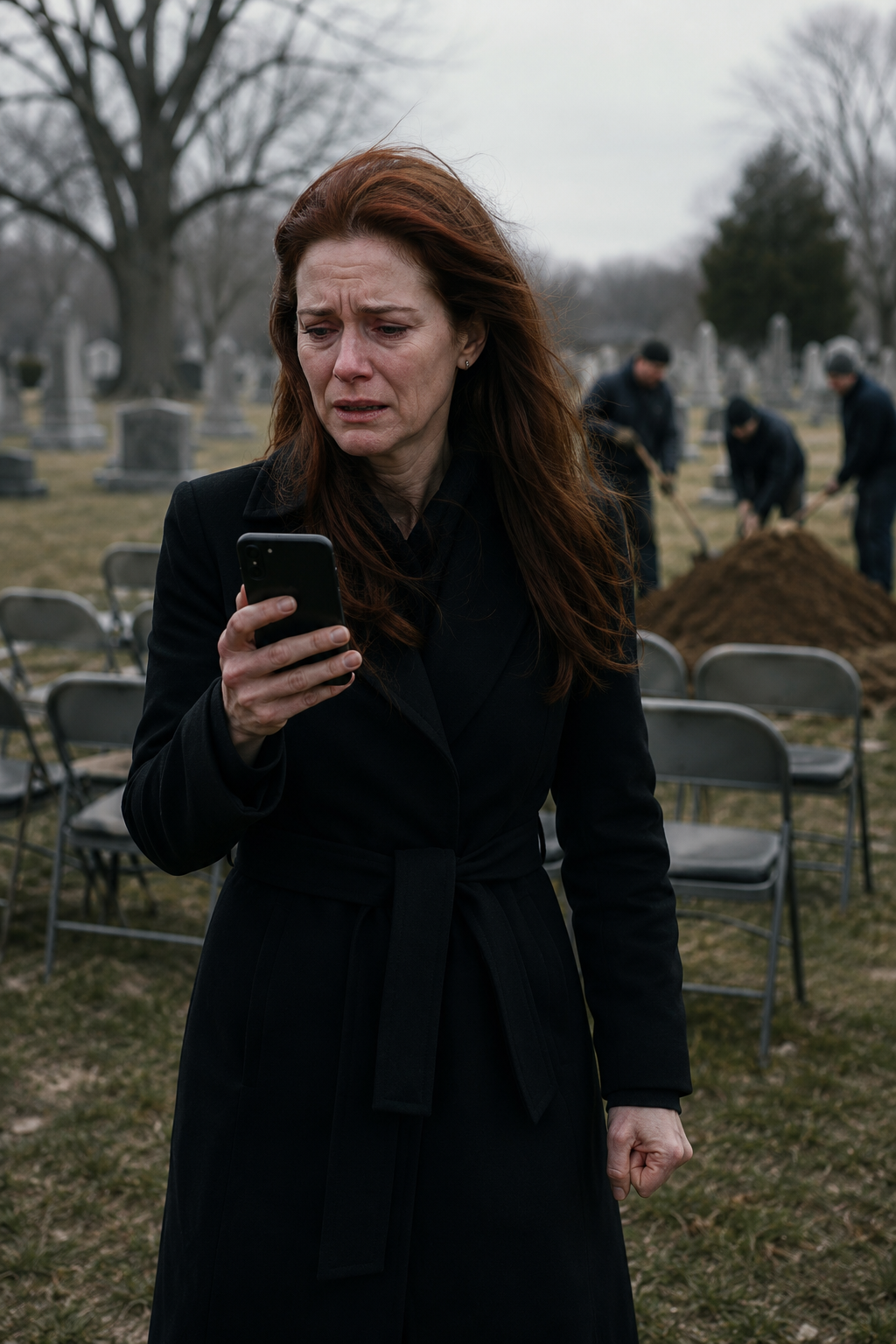
Because Julian had taught me a long time ago to always have a backup.
There was a secondary phone tucked in a side pocket of my cosmetic bag. It looked like an old relic, its case scratched, its screen faintly cracked at the corner, but it worked. And that was enough.
That night, the house seemed to inhale and hold its breath. My suitcase lay still unpacked by the bed in the guest room—my old bedroom, repainted years ago in a color my mother had declared more “mature.”
I couldn’t sleep. Instead I lay in the dark listening to the faint sounds of the house: pipes clanking softly, the air conditioning sighing through vents, a floorboard creaking as someone moved down the hallway.
Around midnight, I gave up. Padding barefoot into the hallway, I intended to go to the kitchen, maybe just get a glass of water and prove to myself that this was still, somehow, home.
Halfway there, I heard my mother’s voice.
For a moment, I thought she was on the phone. The tones were hushed, intimate, that particular cadence she used with friends when talking about other people’s lives.
Then I heard my name.
I stopped.
The kitchen was lit by the small pendant lamp above the island, a warm pool of light against the surrounding darkness. From the shadowed hallway, I could see the edge of my mother’s figure, her hand gesturing, the flash of her wedding ring as it caught the light.
My father sat at the table, turned slightly away from me, his shoulders hunched.
“She has no idea how much there is,” my mother said. “Six Manhattan lofts. The villa. The firm. It’s too much for her in this state. She’s barely functioning.”
“She’s grieving,” my father replied. His voice was low, uneasy. “She just lost her husband, Steph. Maybe we should—”
“Jeffrey.” The way she said his name sliced off the rest of his sentence. “This is exactly why we have to act now. Once the psychiatrist signs off, we can take control. She’ll thank us later.”
A cold sweat broke across my skin. I pressed my back against the wall, suddenly aware of my own heartbeat.
“Are we sure this is… legally safe?” my father asked. “It’s her money. Her property. If she—”
“She’s unstable,” my mother interrupted. “Emotional instability is easy to document. You heard her on the phone.
You saw how she stared at the table at dinner. She’s not fit to manage this. Not right now.”
My mind replayed the evening. I had stared at the tablecloth because I couldn’t look at their faces and not scream. Who knew that would double as useful evidence in a story they were writing about my mental state?
“We’ll start with a seventy-two-hour hold,” my mother continued, her voice clinical. “An emergency psychiatric evaluation. Once she’s in the facility, we file for temporary conservatorship. Financial and medical. It’s just a formality once the doctor signs. By the time she hires a lawyer—if she even thinks of it—we’ll have everything locked down. Accounts, properties, all of it.”
My father exhaled slowly. “Steph…”
“We are protecting her,” she said. “And ourselves. She has no experience with this level of wealth. If she makes bad decisions, it will affect the estate. Our estate.”
Our estate.
As if she’d earned one square inch of those lofts, one grain of sand on that villa’s beach.
My stomach turned.
“What about the doctor?” my father asked. “Will he… cooperate?”
“Gary understands,” she replied. “He owes us. I told him what we needed. A professional opinion. On paper. We’ll make sure she looks confused enough.” She paused. “I’ve already started. The sedatives are mild, but in a higher dose they’ll make her… blurry. Forgetful.”
My mouth went dry.
Sedatives.
In my tea.
The tea she’d pushed across the table earlier that evening, insisting that I drink it all, that it would “help with the stress.”
“You’re sure she won’t suspect?” my father asked.
“She trusts us,” my mother said, and the satisfaction in her voice made my skin crawl. “She’s always trusted us. That’s what happens when you raise a good girl.”
Good girl.
Translation: obedient. Grateful. Blind.
I slid backward as quietly as I could, each step measured. The hallway suddenly felt like a corridor in a museum at night—dark, echoing, every sound amplified.
Once in the guest room, I closed the door with the slow, careful precision of someone handling explosives. My legs trembled, but my mind had never been clearer.
At thirty-one, I had just overheard my parents plotting to drug me, declare me incompetent, and take control of the life my husband had entrusted to me.
I sank onto the edge of the bed, stared at the wall for exactly three seconds, then reached for my cosmetic bag.
The backup phone turned on with a small, familiar buzz. My hands still shook as I scrolled to Garrett’s number, but I forced myself to press call. When he answered, his voice was thick with sleep but immediately alert when he heard mine.
“I need the audit,” I said. “All of it. And I want Julian’s trigger activated.”
He didn’t ask if I was sure. He knew Julian, and he knew me.
“I’ll start the process,” he replied. “It will track any irregular movements around your accounts, trusts, and prior transactions. And Madison… remember that you have options. You’re not trapped.”
For the first time in my life, someone with power had said those words to me plainly.
You’re not trapped.
We hung up. I sat in the darkness for a long time, listening to my breathing.
Grief had tilted my world off its axis. Betrayal had spun it again, more violently. But somewhere under all of that, a third force had started turning: calculation.
I thought about my job. I’m a curator at a museum, the kind of person who spends her days deciding which objects will tell a story to strangers. I preserve things. I authenticate them. I ensure that they are what they claim to be.
It hit me then, with a sharp, almost ridiculous clarity, that I’d never applied that skill to my own life. I’d checked the provenance of a seventeenth-century painting with more skepticism than I’d ever applied to my father’s “annual trust statements.”
Maybe it was time to curate my own evidence.
The next day, my mother took my primary phone “for safekeeping” and replaced my usual herbal tea with her special calming blend, watching closely as I lifted the cup. I brought it to my lips, let the steam kiss my face, took a small sip, and set it back on the saucer.
“Drink, sweetheart,” she urged. “You need to rest.”
I lifted it again, tipped it just enough for the surface to move, then lowered it. “In a minute,” I murmured, letting my voice drift.
She smiled with tight-lipped satisfaction, misreading my delay as compliance.
In the afternoon, when she thought I was asleep, I slipped into the guest bathroom. I perched my phone on the edge of the sink and logged into the secure system Garrett had given me access to. The dead man switch—Julian’s last line of defense—was already humming along in the background now, monitoring everything.
Previous transactions. Transfers I hadn’t authorized but that had my name on them. Trust distributions that never reached me. Everything was being forced into the light.
I sent Garrett a message: I’ll need full documentation. All of it. And I’ll need it fast.
He responded: Understood. The audit may reveal things you didn’t expect.
What he meant was: prepare yourself.
That night, at 1:17 in the morning, I got out of bed and moved down the hallway like a shadow. The house smelled like lemon cleaner and old secrets. Outside my parents’ bedroom suite, an air vent sat low on the wall. I knelt, fingers cold against the metal, and unscrewed the cover as quietly as I could.
The digital recorder was no bigger than my palm. I’d bought it months earlier for a project at work, intending to use it to capture oral histories from donors. Instead, it was about to capture something much more valuable.
I pressed the recorder into the duct, secured it with double-sided tape, and hit record. Then I replaced the vent cover and tightened the screws. My hands were steady. If anything, they felt steadier than they had at the funeral.
If they wanted to turn my grief into evidence, I would do the same to their greed.
The next day, the front door chime rang around noon. It chimed twice, polite and cheerful, announcing the arrival of someone whose presence immediately made the house’s temperature feel cooler.
Dr. Gary stepped into the living room holding a leather bag and the faint smell of antiseptic. He’d been our family doctor since I was a teenager—a tall man with thinning hair and an expression that had always made me feel like I was being studied.
“Madison,” he said, lowering his voice to what I assume he thought was a comforting register. “I’m so sorry for your loss.”
I lay on the couch in a slumped posture, a blanket tucked around me for good measure. My mother sat nearby in an armchair, one hand on her chest, as if even this visit were an emotional strain she heroically endured.
“She hasn’t been herself,” she said. “Barely sleeps. Can’t remember what day it is. We’re very worried, Doctor.”
My father paced behind the couch, running a hand through his hair like he hoped the gesture made him look distressed rather than guilty.
Dr. Gary took a seat on the coffee table near my knees and clicked open his pen. The small, sharp point of light he flashed in my eyes made me want to swat his hand away, but I forced myself to blink slowly.
“Can you tell me what day it is?” he asked.
“I…” I let my gaze drift to the window, where the afternoon light slanted in. “It’s… Saturday?” I made it a question, even though I knew perfectly well it was Thursday.
“It’s Thursday,” my mother supplied softly, as if this proved her point.
He nodded, made a note.
“What month?” he asked.
“March?” I said.
It was October.
He made another note.
“Do you know why I’m here?”
“To…” I let my voice falter. “To… help?”
He nodded. “Your parents say you’ve been very confused. Distraught. Is that how you feel?”
“Yes,” I whispered. “Everything feels… foggy.”
That part, at least, was not entirely an act. It wasn’t from sedatives—those I’d poured down the sink when my mother wasn’t looking—but from the surreal sensation of watching your life become a story someone else was trying to write over you.
Dr. Gary glanced at my parents. “Has she been eating?”
“Barely,” my mother said quickly. “She stares off for hours. She talks to Julian as if he’s still here.”
That was a lie. I hadn’t spoken to Julian aloud since the night he died. Our conversations lived inside my head, where my mother couldn’t twist them into symptoms.
My father added, “She left the stove on yesterday. Dangerous. She’s not herself.”
That was also a lie. I hadn’t touched the stove since arriving.
The recorder hidden in the vent quietly drank in every word.
Dr. Gary sighed, the kind of practiced sigh that doctors reserve for families they think are handling something “so bravely.”
“I think,” he said, “that a temporary stay in a facility might help. Somewhere safe, where she can be monitored, adjusted, supported.”
My mother reached for my hand and squeezed. “Whatever is best for her,” she said.
He took out a form and began filling it in. Emergency psychiatric evaluation. Temporary incapacity. Recommendation for supervised care.
The pen scratched across the page.
I lay still and let him write my fate in ink that I fully intended to dissolve.
Four days later, the audit arrived in my inbox like a quiet bomb.
I sat in my office at the museum, the air smelling of old paper and faint dust, the dim light of the computer screen illuminating row after row of numbers. The staff thought I was still on bereavement leave. I had come in late, slipped through the side entrance, and closed my door. Among the artifacts and neatly cataloged collections, surrounded by centuries of human history, I opened the file that contained mine.
Garrett had been right. The audit didn’t just map the present. It dug into the past with surgical precision.
My childhood trust fund—the one my grandparents had set up for me with solemn ceremony when I was five—had been siphoned slowly, quietly, over decades. One-point-five million dollars, moved out in small, careful portions, laundered through shell companies that had names suspiciously similar to my father’s more legitimate ventures.
For years, I’d received annual statements on heavy paper with the trust’s name letterheaded at the top. They’d shown conservative gains, slow and steady, reassuringly boring.
Those statements were forgeries.
My father had been forging them in his home office, printing them on that same thick paper, signing them with the name of a trustee I’d never met, while my mother reassured me that I didn’t need to worry about money because “family takes care of family.”
In reality, my family had been taking care of themselves with my money.
I stared at the screen and tried to feel something like shock. It didn’t come. Instead, there was an odd, hollow clarity, like looking at one of those transparent anatomy models where you can see every organ, every bone.
I had spent my career verifying the authenticity of objects. I could spot a forged signature from three rooms away, identify the period of a painting by the pigments in its background, trace a sculpture’s journey across continents.
And I had never once thought to verify the authenticity of my own future.
I forwarded the audit to my personal email, then to another address Garrett and I had set up. Then I sent a copy to a man named Marcus Ruiz, an assistant district attorney who owed Garrett a favor and, by extension, now owed me one.
Subject line: Potential financial crime and medical fraud. Evidence attached.
The body of the email was simple. I explained who I was, who my husband had been, what my parents and their doctor were attempting to do, and what the attached documents contained.
I ended it with one sentence: I am willing to testify.
When I hit send, my finger trembled for the first time in days.
That evening, I went back to the Whitmore estate.
I might have stayed away. I might have checked into a hotel, or moved into one of the lofts immediately, or driven straight to the villa and locked the door. But for reasons that had as much to do with psychology as strategy, I went back.
I told myself it was because I needed to see this through. Because pulling away too soon might make them suspicious, might change their timeline and complicate the legal framework we were setting up.
But deep down, there was another reason. Some part of me still wanted to stand in front of them when the truth came down. I wanted them to see, for once, the person they had underestimated.
That night, the living room felt like a theater minutes before the curtain goes up. My mother arranged herself in the armchair again, my father paced, and I lay draped on the couch, eyes half-lidded, my body a picture of the broken daughter they so badly needed me to be.
Dr. Gary arrived with his leather bag and his serious expression. He sat down next to me with his clipboard and began asking the same questions.
“What year is it?”
“Two thousand… twenty-three?” I whispered, even though it was 2026.
He made another note.
“What month?”
“April?” I said.
He frowned with faux concern. “It’s October.”