“Is it?” I murmured. “I lose track…”
My mother dabbed her eyes with a tissue. “You see?” she said softly. “She’s getting worse. We’re scared something will happen if we don’t act.”
“Given her recent bereavement, the confusion, the poor self-care,” Dr. Gary said, “I think we can justify an emergency hold. Seventy-two hours, for evaluation.”
My father stopped pacing. “And her finances?” he asked.
“In cases like this, a temporary conservatorship is standard,” Dr. Gary said. “Just until she’s stable.”
My mother leaned forward, eyes shining faintly. “We only want what’s best for her,” she said. “We’re prepared to take on that responsibility.”
Dr. Gary uncapped his pen and began signing. The tip glided over the paper, completing the form that would have been my cage.
It was an oddly quiet moment. No dramatic thunder outside, no flickering lights. Just the smooth, ordinary sound of ink sliding across paper as three people calmly tried to steal my life.
When he finished the last signature, he looked up at my parents. “I’ll file this today,” he said. “The facility has a bed open. They can admit her tonight.”
My mother exhaled a shaky breath she’d clearly been holding. “Thank you,” she said.
Dr. Gary turned back to me. “Madison,” he said. “This will help. You’ll be in good hands.”
I stared at him for a long second.
Then I sat up.
Not slowly, not in a dazed, unsteady way. I sat up with purpose, the blanket sliding off my shoulders.
The room went very still.
“Actually,” I said, my voice clean and steady, “I think my hands are just fine.”
My mother’s face froze, then rearranged itself into a look of startled confusion. “Madison, what are you—”
I ignored her and reached into the pocket of my cardigan. The recorder felt small and solid in my hand.
“What’s that?” my father asked, his voice hitching.
“This?” I held it up between two fingers. “This is your voice, Mom. And yours, Dad. And yours, Doctor.”
I pressed play.
For a moment, there was only the faint hiss of the recorder.
Then my mother’s voice filled the room. The sound quality wasn’t perfect, but the words were unmistakable.
“Once the doctor declares her unfit, we take control…”
My father’s voice followed, uncertain, wobbly. “Are we sure this is necessary?”
My mother again, sharper now. “Of course it is. She can’t handle this kind of responsibility. Not in her state…”
Their words hung in the air like smoke.
My mother lunged toward me, her hand outstretched. “Turn that off,” she snapped. “You don’t understand—”
“Sit down, Stephanie,” a new voice commanded from the entryway.
The front door banged open behind us. The sound made the walls seem to vibrate.
I looked past my mother to see two uniformed officers entering the room, followed by Garrett in his dark suit and a man I recognized from a quick online search earlier that week: Assistant District Attorney Marcus Ruiz.
My mother went very pale.
“What is this?” she demanded, turning to me. “Madison, what have you done?”
“I called for backup,” I said.
The officers moved efficiently, each one targeting a different person. One approached Dr. Gary, who had gone utterly still on the edge of the armchair. The other stepped toward my parents.
“Doctor Gary Holland,” the first officer said, reading from a note Marcus handed him. “You’re being detained on suspicion of medical fraud, conspiracy to commit involuntary psychiatric commitment under false pretenses, and violation of professional ethics pending investigation. You have the right to remain silent…”
Dr. Gary sputtered, his face flushing. “This is absurd. I was just—”
Marcus spoke over him. “We have your communication logs, Doctor. The ones where you discussed ‘adjusting’ your evaluation to accommodate the financial concerns of your long-term clients. You can explain that to the licensing board.”
The second officer took my mother’s wrists. The click of the handcuffs closing around them sounded louder than it should have.
“Stephanie Whitmore,” he said. “You are under arrest for attempted unlawful conservatorship, conspiracy to administer controlled substances without consent, and financial fraud, among other charges. You have the right to remain silent…”
My mother stared at me, fury and fear battling for dominance in her eyes.
“You ungrateful girl,” she hissed. “After everything we’ve done for you—”
“Everything you’ve done was with my money,” I replied. “And behind my back.”
The officer turned to my father. “Jeffrey Whitmore, you are under arrest for conspiracy to commit fraud and misappropriation of trust assets. You have the right to remain silent…”
My father looked at me then, really looked, as if he was seeing me not as a daughter or a resource, but as a person he didn’t recognize.
“You could have talked to us,” he said, his voice cracking. “We’re your parents.”
“I tried,” I said. “I called you from Julian’s grave. None of you came.”
He flinched like I’d struck him.
My mother twisted in the officer’s grip. “This is a mistake,” she insisted. “We were just trying to protect her. She’s not well. You saw the doctor’s evaluation!”
Marcus held up the form Dr. Gary had just signed. “This evaluation?” he asked. “The one you asked him to falsify? The one we listened to you planning on this recording?”
The recorder in my hand was still playing, looping through a shorter clip now—my mother calmly discussing the sedatives she’d been slipping into my tea.
“Next time, double the dose…” her disembodied voice said, and my father closed his eyes.
“Turn it off,” he whispered.
I did.
Not for him. For me.
I wanted to hear the room without their lies for once.
As the officers guided my parents and Dr. Gary toward the front door, my mother threw one last comment over her shoulder.
“You’ll regret this, Madison,” she said. “You think you’re strong, but you are alone. We were all you had.”
I watched her step out into the flashing red and blue lights that bathed the Whitmore lawn in dizzying color.
“No,” I said, mostly to myself. “You were all I had. Now I have something better.”
“Like what?” she shouted back, but the door closed before I could answer.
The house exhaled. The lemon cleaner smell suddenly felt less suffocating.
Marcus turned to me. “You did the right thing,” he said quietly. “This won’t be easy, but you’ve got a strong case. Between the audits and the recordings, we have enough to proceed.”
“That’s good,” I replied. My voice shook for the first time.
Garrett stepped closer, his usually impassive expression softened.
“You all right?” he asked.
I took a deep breath. “I don’t know yet,” I admitted. “But I think I will be.”
That night, I packed my suitcase again. This time, it didn’t feel like I was running back into a cage. It felt like I was walking out of one.
I took only what belonged to me—clothes, a few photographs, nothing bought with money I now knew had been stolen from my own trust. I left the rest. The furniture, the art, the polished silver. They could be cataloged later as evidence or assets or relics of a life I was no longer obligated to participate in.
Two weeks later, I stood barefoot on the deck of the villa Julian had bought near the ocean. The house wasn’t huge or ostentatious. It was simple—white shutters, wide windows, pale wood floors. The Atlantic stretched out in front of me, restless and endless, waves rolling in at their own pace.
The first morning I woke up there, I listened for footsteps in the hallway, for my mother’s voice picking apart my decisions, for my father muttering about “financial reality.”
There was only wind and seagulls.
The legal process moved forward quickly because paper trails don’t forget and digital records don’t play favorites. Dr. Gary’s license was suspended immediately and later revoked. My parents’ attorney tried to paint them as concerned, confused caregivers who had simply made mistakes in the fog of grief.
The recordings and audits told a different story.
In the end, my parents accepted a plea deal. Probation. Heavy fines. A restitution plan that would take the rest of their comfortable lives to fulfill. A permanent court order barring them from ever petitioning for conservatorship over anyone.
Their sentences didn’t feel triumphant. Justice rarely does. It felt… appropriate. Measured.
Alexa moved out of state, away from the fluorescent fallout. She texted sometimes:
I didn’t know it was that bad.
I’m sorry.
I never replied with more than a few neutral lines. I wasn’t interested in assigning her the same level of guilt. She had been a participant, yes, but a shallow one, floating across the surface, benefiting without ever really understanding the depth.
Some bridges, I realized, don’t collapse with explosions. They just quietly sink, piece by piece, until there’s nothing left to walk across.
I didn’t run out and spend my inheritance. I didn’t buy myself a new life in glossy pieces.
Instead, I sat at the long wooden table in the villa’s kitchen, the windows open to let in the salt air, and started making lists.
The first list was simple: what belongs to me.
Not just physically, but conceptually. My time. My choices. My work. The way I wanted to be spoken to. The limits of what I would tolerate.
The second list was about what to do with the money.
Julian hadn’t earned it by accident. He’d worked for every dollar with a kind of quiet, focused intensity that had always impressed and slightly worried me. He’d also grown up watching his own mother struggle to leave an abusive situation because she had no financial independence.
“I want you to be safe,” he had told me once, long before we married. We’d been sitting on the floor of our first tiny apartment, eating takeout from plastic containers. “Even if I’m not around. Especially if I’m not around.”
You are safe, I’d told him then, thinking he meant himself.
I understand now that he meant me.
One of the lofts in Manhattan had particularly good light—high ceilings, big windows, an open floor plan. It had been sitting empty between tenants. I walked through it one afternoon and felt something click into place.
Six months later, the building directory listed a new tenant on that floor: The Julian Harper Resource Center.
It started small. A handful of offices. A modest conference room. A waiting area with secondhand chairs and a coffee machine that worked only half the time. But the women who came through those doors didn’t care about the furniture. They cared about what we offered: information.
We helped them understand their bank statements. Taught them the basics of wills, powers of attorney, conservatorships. Showed them how to read fine print and how to ask questions without apologizing.
We didn’t fight their battles for them. We handed them tools.
Sometimes, I told my story. Not all the details, not the names. Just the broad contours: how easy it is to believe that family equals safety; how hard it is to accept that sometimes, it doesn’t.
One evening, after a workshop on financial literacy, a woman about ten years older than me lingered by the door. She had deep lines around her mouth, like someone who’d spent years clenching her jaw.
“Did they ever apologize?” she asked.
“Who?” I replied, though I knew.
“Your family,” she said. “For what they did.”
“My sister did,” I said. “Sort of. My parents didn’t.”
“And how do you live with that?” she asked. Not angrily. Curiously. As if she were examining an artifact.
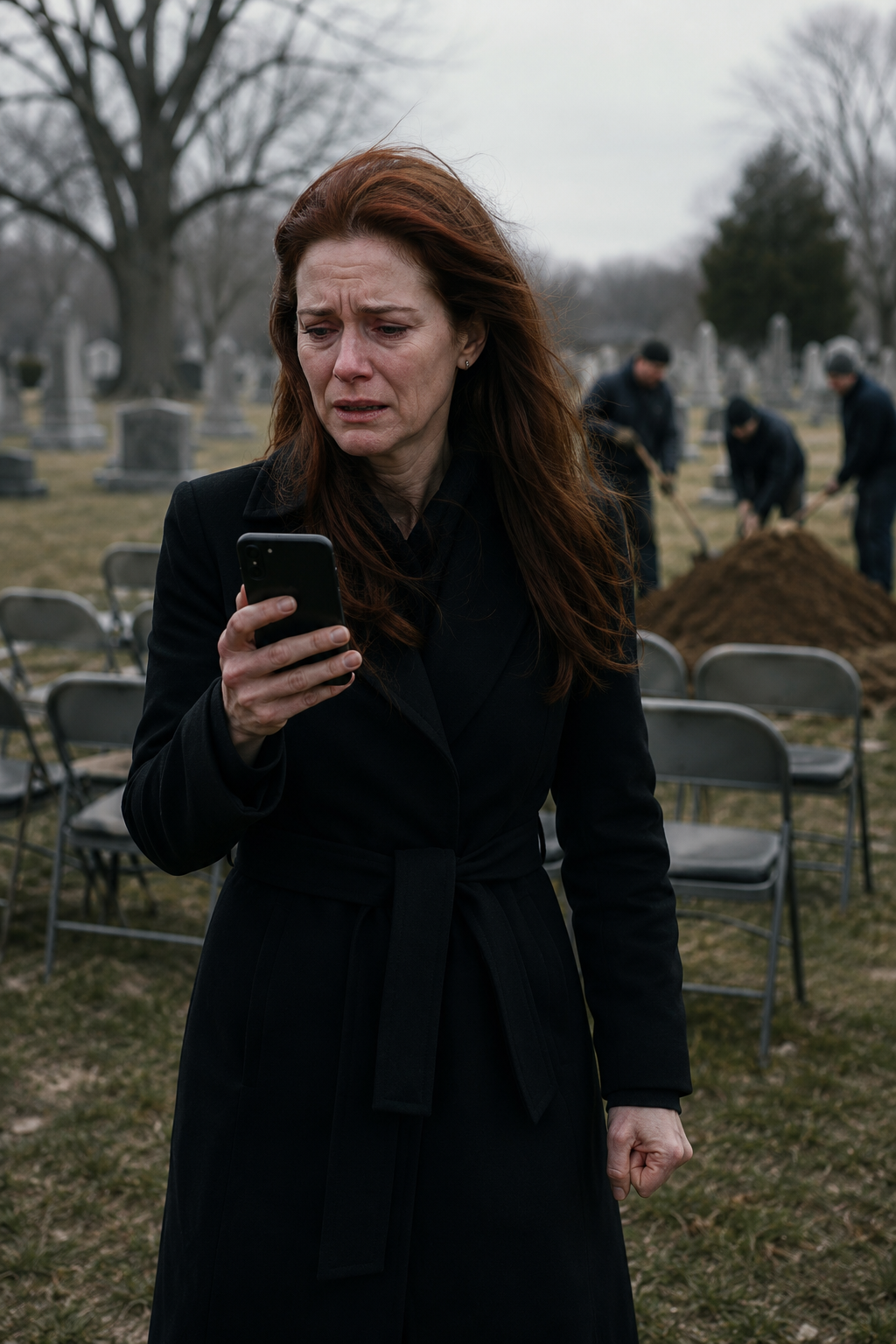
I thought of standing alone by Julian’s grave. Of the empty chairs. Of the way my mother had looked at me as the cuffs closed around her wrists.
“I stopped waiting for them to,” I said. “That helped more than anything.”
Out at the villa, on quiet nights when the sky turned dark and clear enough to show a scatter of stars, I sat on the deck with a blanket and a cup of tea I’d brewed myself.
I thought about the girl I had been: the one who believed love was something you earned by being accommodating, by being quiet, by being grateful. The girl who wired money without asking for receipts, who read forged statements and thought they were real, who stood at a grave and assumed the problem was that she wasn’t lovable enough, not that her family was absent by choice.
Grief didn’t vanish. It changed shapes. Some days, it was a sharp little stone in my shoe. Other days, it was a soft ache when I saw a couple laughing together in public. But it no longer owned me.
Julian’s absence wasn’t a hole anymore. It was a foundation—a hard, solid plane on which I’d built something else.
I still see my parents sometimes.
Not in person. In court updates. In legal notices when they miss a payment and their lawyer petitions for adjustments to the restitution schedule. Their names show up like faint ghosts at the bottom of emails, attached to docket numbers and case files.
I no longer feel the urge to pick up the phone and call them. I no longer wonder if maybe, this time, they’ll sound different.
Family, I’ve learned, is not a contract written in blood. It’s a series of daily choices. Who do you answer? Who do you trust? Who gets access to your time, your energy, your heart?
My parents made their choices.
I am making mine.
Some mornings, I wake up before dawn and walk along the beach in front of the villa, the wet sand cool under my feet. The ocean doesn’t care who I am. It doesn’t know about bank accounts or psychiatric holds or inheritance. It just moves, endlessly, doing what it does.
I walk until the horizon starts to glow pink and gold, and I think about that moment in the living room, when I sat up and said no.
The truth is, justice rarely looks like a blazing triumph. Sometimes, it looks like a woman pushing play on a recorder and letting other people’s words convict them. Sometimes, it looks like closing a bank account. Sometimes, it looks like walking away.
When I think back to Julian now, I don’t think about the hospital or the funeral. I think about the night we sat on the floor eating cheap takeout and he told me he wanted me to be safe.
“You are,” I tell him now, in the quiet of my own mind. “You did it. I’m safe.”
But I also know something else.
He gave me the tools—a will, a system, a safety net. The rest, I did myself. Sitting at his desk at midnight, revoking access. Calling Garrett. Installing the recorder. Sending the email. Sitting up.
Saying no.
That’s the part no one can leave you in their will. You have to build it.
And I did.
For a long time, I thought my story would end at a grave. Now, I know better. The grave was not an ending. It was a pivot.
One year ago, I stood beside a hole in the ground thinking I had lost everything.
I was wrong.
I had lost people who were willing to abandon me at my worst moment. I had lost illusions about what family meant. I had lost the comfortable lie that money only reveals who you really are when you win the lottery, not when you inherit a tragedy.
What I gained was harder to measure but far more valuable.
I gained myself.
THE END
✅ End of story — Part 3 of 3
← Read from Part 1