My name is Madison, and I learned what justice feels like on the day two police officers clicked a pair of handcuffs around my mother’s wrists while I calmly handed a small black recorder to the prosecutor. Her own voice, cold and careful, slept inside that device, waiting to wake up and end the life she thought she controlled.
But that day was still far ahead of me on the timeline. First, there was a grave, and a Thursday morning so gray it felt like the sky had given up.
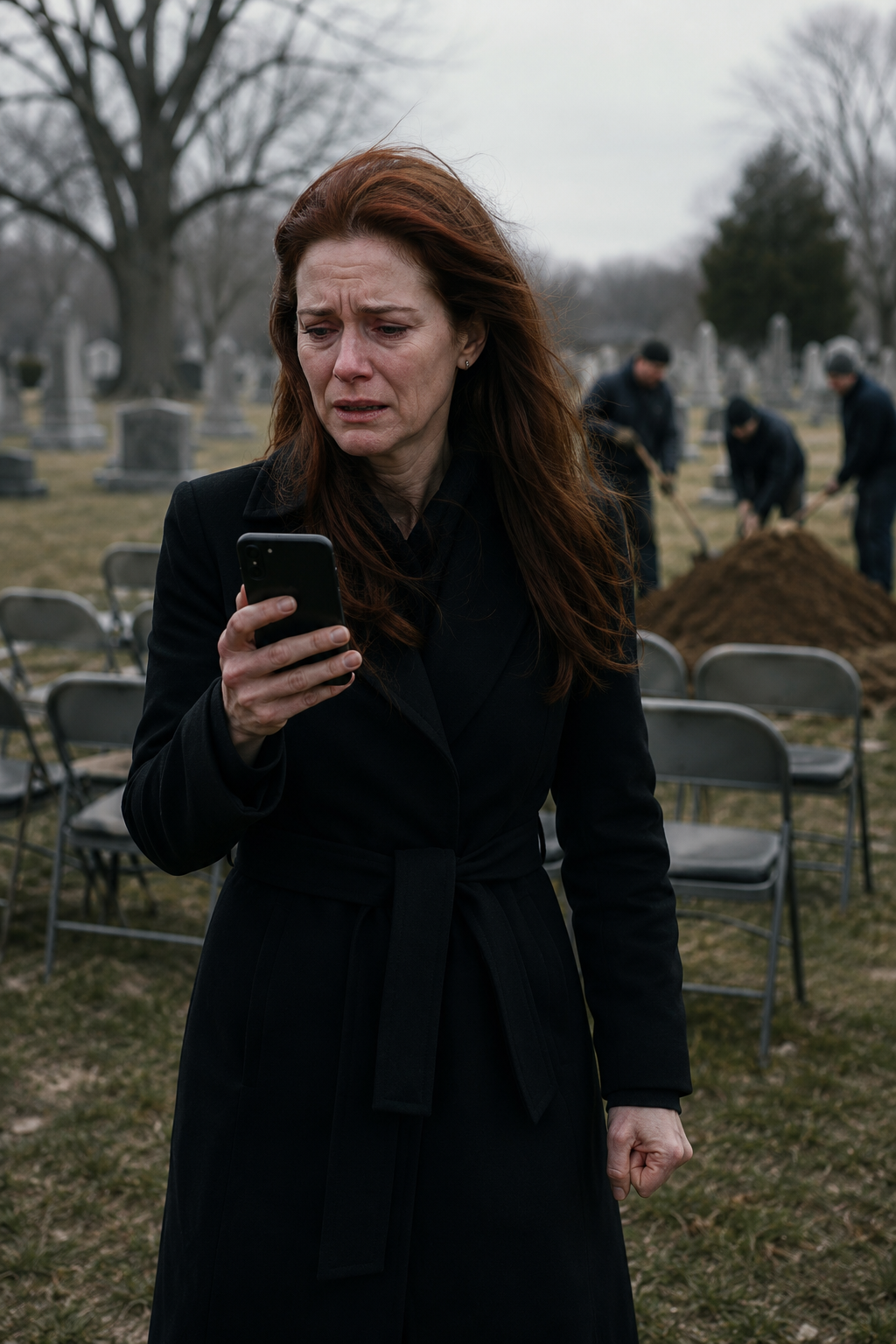
Oakwood Cemetery in Westchester looked like something out of a painting—rows of stones in muted colors, trees already shedding their leaves, the wind worrying the branches into nervous gestures. I stood beside the freshly dug plot where my husband, Julian, lay in a polished coffin under the damp October air, and the wind felt like the only thing that had bothered to show up for me.
There were three neat rows of folding chairs facing the grave. Twenty seats. Twenty blank, empty faces of metal and vinyl. The priest closed his book with a soft thud and glanced at me with the kind of compassionate look that belongs to people who can walk away and forget you after an hour.
“Would you like a moment alone?” he asked gently.
I looked at the empty chairs, the untouched programs stacked on the little podium, the way the grass seemed almost embarrassed to be this green next to freshly turned soil.
“Yes,” I said. “But I suppose I already have one.”
He hesitated as if he wanted to say something else, then nodded and walked away, his shoes crunching softly on the gravel path until even that sound dissolved into the distance.
For a long moment there was nothing—no shuffling, no whispers, no latecomers breathless with apologies about traffic. Just the wind and the slow, methodical thud of dirt landing on wood as the cemetery workers began their work.
The sound was dull, final, like a door closing in a long hallway.
I told myself I should cry. Julian would have expected that. He used to tease me because I cried at insurance commercials where dogs found new homes and old men got heart surgeries.
“You’re going to flood our living room one day,” he’d say, wiping my cheeks with the sleeve of whatever expensive shirt he was wearing, like it was the most natural thing in the world to use a two-hundred-dollar cuff as a tissue.
But standing there with the October wind cutting through my black dress, my eyes stayed dry. My heart didn’t feel shattered. It felt like it was cooling, hardening, taking shape into something sharper. A shield, not a wound.
The workers moved with the efficiency of people who can’t afford to feel anything about the bodies they bury. Shovels dug in, lifted, tipped. The dirt thudded down, muffled and relentless. When the coffin was covered and the last of the equipment rolled away, I was still alone.
Not emotionally. Logistically. Literally.
I took my phone out with hands that didn’t quite feel like mine and stared at the time. The funeral had started late, but not that late. It wasn’t like I’d gotten the date wrong, or the location, or wandered into a different burial by mistake.
I dialed my mother.
She picked up on the fourth ring, just long enough to make it clear she’d considered not answering.
“Hello?” Her voice sounded light, almost buoyant, as if we were talking about lunch plans.
“Where is everyone?” My own voice surprised me. It came out so calm it might have belonged to someone else.
There was a silence—not the natural kind where someone is thinking, but the heavy, deliberate kind, like a curtain being pulled across a stage.
“People grieve in their own way,” she said finally. “Your father wasn’t feeling up to it. Alexa had to work at the boutique. We didn’t want to crowd you.”
I turned in a slow circle, taking in each perfectly empty chair. Twenty places where bodies could have been. Twenty reminders that they weren’t. My breath left my lungs in one clean, cold exhale.
“You wouldn’t have crowded me,” I said.
There was another breath of silence. I could almost hear her choosing words like cutlery from a velvet-lined drawer.
“You’ve always been strong, Madison. You don’t need a spectacle.”
To my mother, my husband of eleven years being lowered into the ground wasn’t a farewell, or a sacred moment, or even a duty.
It was a spectacle.
“Go home and get some rest,” she added. “We’ll talk later.”
The line went dead. She’d hung up on me at my husband’s grave.
I stared at the phone, then at Julian’s name already carved into the smooth granite headstone. The letters were too fresh, too sharp. It looked temporary, like it could still be peeled off if I protested loudly enough.
A text buzzed a moment later from my younger sister, Alexa.
Mom said the funeral went fine. Call us later.
It went fine.
Like a dentist appointment. Like dry-cleaning pickup. Like an errand that could be checked off a list.
I sank into the driver’s seat of my car and gripped the steering wheel until my fingers ached and my knuckles went white. Anger wasn’t a wildfire this time. It was a scalpel. Clean, precise, controlled.
I didn’t scream. I didn’t sob. I didn’t demand explanations.
I drove home.
By the time the sky outside my windows had turned from bruised purple to flat black, I was sitting at Julian’s desk in our home office. Heavy mahogany, polished to such a shine that it caught the desk lamp in a perfect reflection, like a second sun on a private horizon. It still smelled faintly of his cologne and old paper. This was where he drafted contracts, built cases, wrote emails that made grown men nervous.
It was the last place in the house where I could feel him.
The digital clock in the corner of the monitor read 11:51 p.m.
I rested my fingertips on the keyboard and tried to summon grief, tears, something.
Instead, I summoned accounts.
Julian had been the primary benefactor for the Whitmore family estate—my parents’ gorgeous, impressive Westchester home with its old-money façade and new-money debt. The gleaming security system, the “family emergency accounts,” the shared vault. The things they liked to gesture at in conversations, as if they had pulled them out of thin air through sheer moral superiority.
Julian had pulled them out of his bank account. And I had helped.
He’d trusted me with access to everything. I’d set up their emergency accounts, the shared digital vault, the notifications. I knew every login, every code, every backdoor. I had been the unseen IT department of my own family’s lifestyle.
Now, as the sole executor of his estate, all those keys were officially mine.
Grief is supposed to make you irrational. Unfocused. Vulnerable. I felt none of that. Every click of my mouse sounded crisp and deliberate in the quiet room.
By 1:23 a.m., every code had been reset.
I removed my mother, Stephanie, from the security protocols. Then my father, Jeffrey. Then my sister, Alexa. Their names vanished from the list like old contacts deleted from a phone.
It wasn’t revenge. It was accounting.
They had chosen not to show up for me when it mattered. I was choosing not to let them keep their hands in the vault Julian had built.
When I finally pushed the chair back from the desk, the house was absolutely silent. No television murmuring in some other room, no clink of plates or running water. Just the low hum of the refrigerator and the faint rattle of the air vents.
I turned off the desk lamp, and the reflection of my face in the polished wood disappeared into darkness.
The next morning, the lobby of Clemens & Row, the law firm where Julian had made partners sweat and clients relax, looked almost offensively clean. The marble floors gleamed. The glass walls had no smudges. Everything smelled faintly of lemon polish and success.
I walked up to the reception desk, gave my name, and sat in one of the firm’s sleek leather chairs while the receptionist made the call. The chair tried to swallow me in comfort; I refused to sink fully into it.
I wasn’t here for comfort. I was here for numbers.
“Mrs. Harper?” A voice spoke my married name with practiced professionalism.
I stood. Thomas Garrett, one of the senior partners, waited near the doorway. Silver hair carefully combed back, tie perfectly straight, suit so well-tailored it might as well have been sewn directly onto him. His expression was measured—somewhere between pity and respect.
“Madison,” he corrected himself softly. “Let’s talk in my office.”
His office was an exercise in controlled power: heavy desk, framed degrees, a wall of law books that probably hadn’t been opened in years but still radiated authority.
We went through the expected stack first: burial authorizations, insurance forms, releases. Things you sign when someone’s life has ended but the paperwork hasn’t caught up yet.
My signature looked foreign to me, like a stranger forging my name.
Then Garrett set that stack aside and opened a different folder. Thicker. He rested his hand on it for a moment, as if it weighed more than paper.
“There’s something you need to know,” he said. “Julian updated his will eight months ago. As a precaution.”
A precaution, I thought. My heartbeat stumbled. Against what?
“He left everything to you,” Garrett continued. “In full. No subdivisions. No contingencies.”
For a moment, I didn’t understand what “everything” meant. Then he began reading.
Six luxury lofts in Manhattan, fully owned, all generating high rental income. A private villa near the water in the Hamptons. Various investments. Assets that might as well have been in a different language a few minutes earlier and now sat squarely in my lap.
“And the consulting firm,” he finished. “You are now the sole owner. The combined value of the estate is approximately eight and a half million dollars.”
The air in the room changed. It felt heavier, denser, like something you could chew.
I heard the number, but it didn’t feel real. Julian and I had lived comfortably, but he’d always brushed off specifics with a few words and a kiss on the forehead. “We’re fine,” he’d say. “I want you to focus on your work, not the market.”
Now the market was looking back at me from a stack of documents and a man in a silk tie.
“Why didn’t he tell me?” I asked, my voice softer than I meant it to be.
Garrett folded his hands on the desk. “He wanted you secure. Completely secure. He told me, if anything ever happens to me, I want Madison protected from everyone.”
Everyone.
Not from tragedy, or from random strangers, but from “everyone” in the global sense. The way you say “lock all the doors,” not “lock the front one.”
And that word dropped into my mind like a stone in dark water. Everyone.
Images rose up uninvited: my father’s excited voice when I quietly wired fifty thousand dollars to patch yet another one of his businesses that was “just a small push away” from taking off. The way he’d insisted on lecturing me about spending habits afterward, as if I were a teenager and not the source of his reprieve.
My sister Alexa, crying because the bank didn’t think her boutique idea was solid enough. The way I’d signed my name on her lease as guarantor, using money I could have invested in my own future, then listened as she bragged to her friends about her “independent” success.
My mother’s casual comments about how “fortunate” it was that Julian was doing well. How some families had to worry about retirement, and thank goodness we weren’t like them.
I had been the invisible line item in the Whitmore family budget for a decade. The silent investor in their curated lives and their curated version of me.
I signed the last form with a steady hand.
As I pushed the pen across the page, I felt something shift. I was no longer the daughter begging, silently, to be approved of. I was someone holding eight and a half million dollars in legal authority and six properties that glowed with potential on paper.
Garrett walked me to the reception area and paused.
“This kind of news won’t stay private for long,” he said carefully. “If you’re considering making any decisions about… friends or family, I’d advise you to consult me first.”
I nodded. I knew what he meant. Not all wolves show their teeth. Some smile and ask how you’re holding up.
Outside, the city roared and honked and glittered like it always did. People hurried past with coffee in one hand and phones in the other, their faces preoccupied with problems that had nothing to do with graves or inheritances or the way your own blood might be planning your undoing.
I took a taxi back to the house Julian and I had shared. The moment I stepped inside, the silence felt different. Even the dust motes in the air looked like they were holding their breath.
I lasted three hours alone.
Then I called my parents.
My mother answered on the first ring this time.
“Madison,” she said, her voice dipped in sorrow like sugar-coated poison. “You shouldn’t be alone in that big house. Come stay with us for a while. Just until you feel better.”
Just until you feel better.
I knew her too well not to hear the subtext. Just until we know exactly what Julian left you. Just until we can count the pieces.
Still, I agreed.
Because for thirty-one years, I had been trained like a lab rat in a maze to run toward the familiar hand, even if it sometimes held a knife.
The Whitmore estate smelled exactly the same as it had when I was a child—lemon cleaner, vaguely floral air freshener, and something heavy from the kitchen. Back then, that smell had meant safety, warmth, pot roast on Sundays, birthdays with neatly wrapped gifts.
Now it smelled like a stage set: a carefully designed illusion you could walk through, touch, believe in… until you saw the wires.
“Madison!” My mother swept into the foyer as soon as the housekeeper opened the door. She wore a silk blouse and pearls, like grief had a dress code. Her hair was perfect. Her expression was one part concern, one part calculation.
She wrapped her arms around me with a hug that lasted exactly long enough to check my posture, my weight, the sharpness of my edges.
“You look exhausted,” she murmured into my hair. “We’ll take care of you for a while.”
Behind her, my father hovered, hands in his pockets, eyes unsure of where they were supposed to land. He’d always been better with spreadsheets than emotions.
“Mad,” he said awkwardly. “We’re… we’re really sorry. Julian was a good man.”
He had never liked Julian’s quiet ease with money. It made his own constant scrambling look small. But now he said the words like a line he knew he was expected to deliver.
“Thank you,” I replied.
Alexa came down the stairs a few minutes later in a loose sweater and leggings, her hair up in a messy bun that probably took twenty intentional minutes to style.
She hugged me too, softer and shorter than my mother had. Her eyes slid past me to the suitcase at my feet.
“Is that all you brought?” she asked, surprised.
“For now,” I said.
We had dinner together like a normal family. My mother insisted I sit at the head of the table—Julian’s widow, our poor Madison. She piled my plate with food, offered me wine, asked a lot of questions about whether I’d been sleeping, eating, resting.
She didn’t ask a single question about how I’d felt at the cemetery. About how it had been to stand by my husband’s grave alone, in front of those empty chairs.
Later, when she suggested in the most caring tone imaginable that I give her my phone so I wouldn’t “get overwhelmed by messages from people who didn’t really understand,” I handed it over without argument.