“The Woman He Buried in His Heart”
Not the man.
Not the girl.
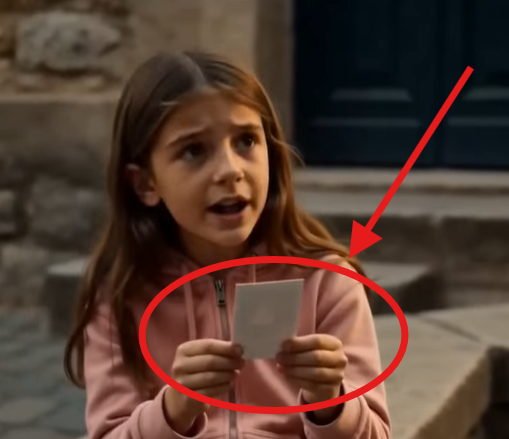
Not even the trembling photograph between them.
it made the impossible sound real.
The little girl turned her head toward the far end of the lane.
The man did too.
At first he saw only light and shadow between the stone buildings.
Then a woman stepped into view.
She was thinner than the woman in the photograph. Paler. Tired around the eyes. But there was no mistake.
It was her.
His wife.
The woman he had buried in his heart years ago because everyone told him she was gone.
The woman whose death certificate he had signed with shaking hands.
The woman whose grave he had stood beside in black silence.
She stopped when she saw him.
All the strength in her face vanished at once.
The man looked from her to the child, and the truth struck him in pieces too fast to stop:
the same eyes,
the same mouth,
the same way the little girl held fear and certainty together.
His voice came out broken.
“Eva is… mine?”
The woman shut her eyes for a second, then opened them again with tears already there.
She nodded once.
That hurt more than shouting would have.
Because it meant he had not only lost his wife.
He had lost years of his daughter.
He stepped toward them, then stopped.
Not because he didn’t want to run to them.
Because he didn’t know what kind of lie could make a family disappear while one man kept mourning them in public.
The woman finally spoke.
“They told me you signed the papers.”
His whole face twisted.
“What papers?”
“The ones giving up your rights. The ones saying you wanted nothing to do with us after the accident.”
That was the moment the past rearranged itself.
Years ago, after the crash, he had been unconscious for weeks. When he woke, his powerful father handled everything. He was told his wife had died, the child had died with her, and there was nothing left to save but his own future.
But she had been told the opposite:
that he survived, rejected them, and used his family’s money to erase them quietly.
The girl looked between them, confused and scared now.
“Mom?”
The woman knelt and pulled her close with one arm, but her eyes never left him.
“I wanted to come back,” she whispered. “But every time I tried, they found me first.”
That landed like a blade.
Because suddenly the tragedy wasn’t fate.
It was design.
His family had not protected him from grief.
They had manufactured it.
The man stepped closer, slowly this time, like he was approaching something holy and breakable.
He looked at the little girl.
“At night,” he said softly, “does she still sing before you sleep?”
The woman’s face broke completely.
Because that was theirs.
A private thing.
A tiny song no one else should have known.
The little girl looked up at him and asked the one question that made the whole street feel too small for what was happening:
“Are you the man in the picture who never stopped smiling at her?”
He dropped to one knee in front of her.
Not as a rich man.
Not as a husband.
Not even as someone wronged.
Just as a father who had arrived years too late.
And in that golden narrow street, with the photograph still trembling in a child’s hand, three lives stood in the wreckage of one lie finally falling apart.