I will never forget the first time I saw Daniel Harper sitting alone in my sixth-grade classroom at Roosevelt Elementary, way back in 1974.
He was a quiet boy, all sharp elbows and hollow cheeks, with brown eyes that seemed to carry the weight of the world.
It was September, and the mornings in Millbrook, Indiana already had that crisp edge to them, but Daniel never brought a coat.
He would sit at his desk near the back, hands folded, watching the other children pull out lunchboxes and brown paper bags with an expression I couldn’t quite place.
At first, I thought he was just shy.
But then I started noticing the little things.
The way his stomach would growl so loudly during silent reading that the students around him would snicker.
The way he’d linger by the water fountain at recess, filling up again and again as if trying to fill something else.
The way he never, ever brought a lunch.
One morning, I called him up to my desk while the other kids were working on their math problems.
“Daniel, sweetheart,” I said softly, “did you eat breakfast today?”
He stared at his shoes, worn sneakers with a hole near the toe, and didn’t answer.
I knelt down to meet his eyes.
“It’s just you and me talking here, honey. I want to make sure you’re okay.”
“I’m fine, Mrs. Vance,” he whispered. “Just not real hungry in the mornings.”
But the way he said it, the way his thin shoulders hunched up around his ears, told me everything.
It wasn’t that he wasn’t hungry.
It was that there wasn’t any food to be had.
I learned later from the school records that his mother had passed away from an illness two years before, leaving just Daniel and his daddy.
His father, a proud man named Mr. Robert Harper, worked hard but struggled to make ends meet.
He refused any charity from the church or the school.
“We take care of our own,” he’d apparently told the principal when a kind offer of assistance was made.
And so they did the best they could, which often meant empty cupboards by Wednesday.
The next day, I brought an extra sandwich and an apple, wrapped neatly in wax paper, and offered it to Daniel during lunch period.
He looked at the food, then at me, and I saw something break inside him.
“Thank you, ma’am, but I can’t take it,” he said, his voice barely above a whisper.
“Why on earth not?” I asked gently.
“My daddy says we don’t take things we didn’t earn. He says a man’s pride is all he has.”
I could have pushed.
I could have called his father and tried to reason with him.
But I had been teaching long enough to know that sometimes the walls people build around their dignity are the only thing holding them up.
And I could see that for Daniel, taking that sandwich in front of everyone, knowing his secret was out, would have been a humiliation he might not recover from.
So that night, I lay awake in my little house on Maple Street, staring at the ceiling, and I thought.
What could I do that would feed a hungry child without robbing him of his pride?
And then, around two in the morning, an idea came to me.
The next morning, I arrived at school before the sun was fully up.
The hallways were dark and silent, smelling of floor wax and chalk dust.
I walked to the row of dented metal lockers outside my classroom and stopped at number forty-seven, Daniel’s locker.
From my pocketbook, I pulled out a crisp one-dollar bill.
I folded it twice into a tiny square, no bigger than a postage stamp, and I slipped it gently through the narrow vent slats near the top.
I heard the soft whisper of paper falling inside, landing on whatever books or papers he might have stored there.
Then I walked away, my heart pounding as if I’d done something wrong instead of something deeply right.
That morning, I watched Daniel open his locker.
He didn’t notice at first, just reached in for his reader.
But then his hand paused, and I saw his back stiffen.
He glanced around the hallway, left and right, but no one was paying him any mind.
Slowly, he pulled out the folded dollar and unfolded it, staring at it with an expression of pure bewilderment.
Then he tucked it into his pocket, and when he walked into my classroom, there was something different in his step.
At lunchtime, I noticed that he ate a hot meal from the cafeteria line, and for the first time since school started, he didn’t look away when I smiled at him.
And so it began.
Every morning, before the first bell, I would walk to locker forty-seven and slip a folded dollar through the vent.
Sometimes if I had a little extra, I’d fold a five instead, but mostly it was just a single bill.
I never left a note.
I never said a word.
This went on for two years.
Autumn turned to winter, and I’d wear gloves to hide the chill as I stood in that dark hallway.
Winter turned to spring, and the morning light would catch the dust motes floating around me.
Daniel never asked.
He never thanked me, not out loud, but sometimes when he walked past my desk, he’d set a small wildflower or a particularly smooth stone by my coffee cup, and his eyes would meet mine for just a second longer than necessary.
I understood that this was his language, his way of saying what his father’s pride wouldn’t let him speak.
His grades improved.
He started raising his hand in class.
The hollow look in his cheeks softened, though he remained slim, and his smile became a little less rare.
I never told a soul, not even my late husband, George, who would have understood.
It was my secret, and somehow, it felt sacred.
Toward the end of the 1976 school year, Daniel came to my desk after class.
“Mrs. Vance,” he said, “I just wanted to tell you that we’re moving away.
My daddy got a job at a factory in a different town.”
My heart dropped.
“Oh, Daniel, I’m going to miss you terribly,” I said, fighting to keep my voice steady.
“I’ll miss you too,” he said, and then he did something he’d never done before.
He reached out and took my hand, just for a moment, and I could feel the calluses on his young palm from helping his father with odd jobs.
Then he added, very quietly, “Thank you for everything.”
I just squeezed his hand back and said, “Be a good man, Daniel Harper. That’s all any teacher could ever want.”
And then he was gone.
I thought about him often over the years.
I’d wonder where he was, whether he had enough to eat, whether he’d grown into the kind of gentle, strong man I sensed he would become.
Life went on.
I taught at Roosevelt Elementary for another thirty-two years, retiring in 2008 as an old woman with silver hair and a thousand memories stored in my heart.
George passed away in 2015, and my little house on Maple Street began to feel too big, too quiet.
I had no children of my own, just the hundreds of students who had passed through my classroom door, and I loved each one of them as if they were mine.
This year, at eighty-two, I made the difficult decision to move into a retirement community where I could have a little help and some company.
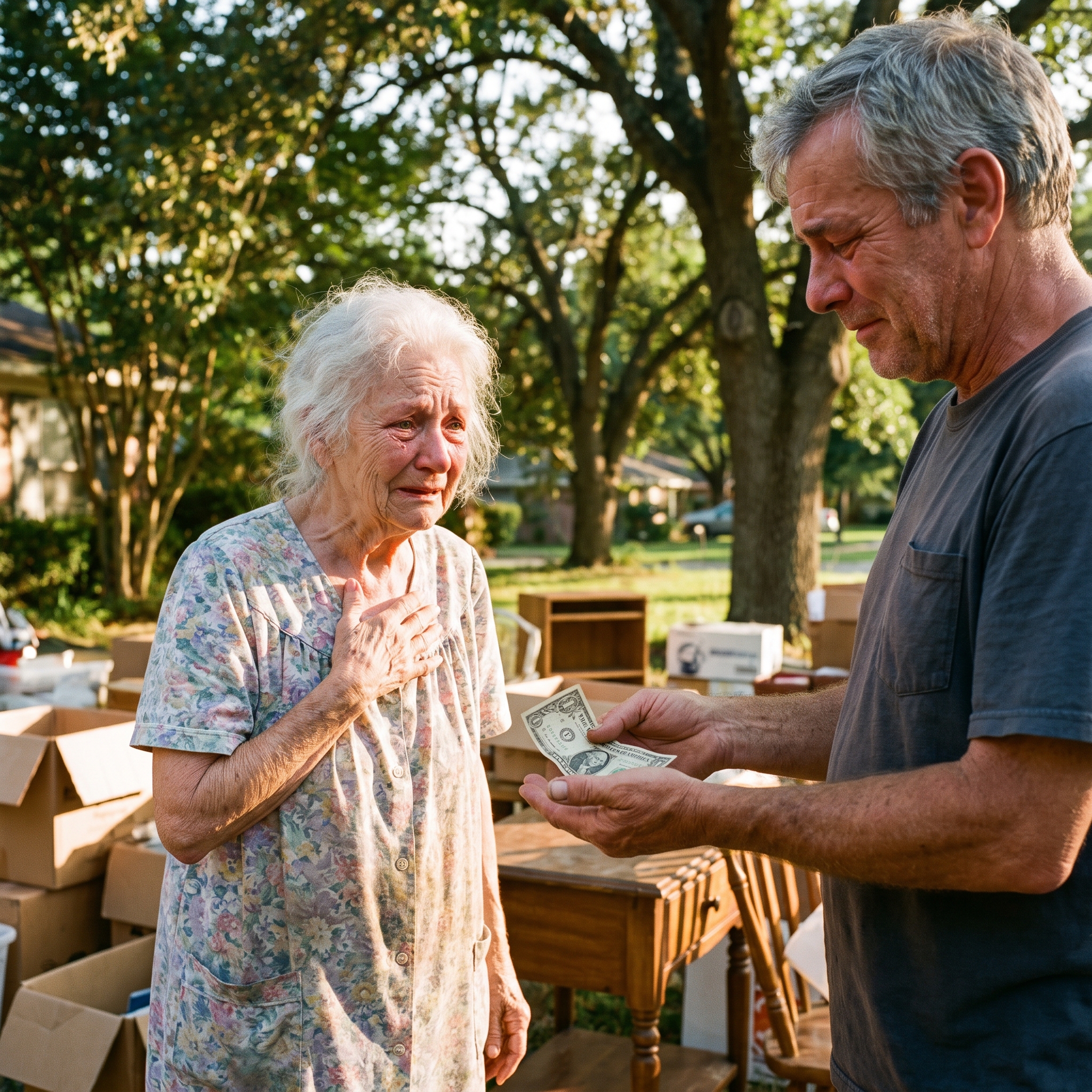
And so, last month, I held a moving sale.
It was a crisp October Saturday, the kind of autumn day that reminds you of fresh starts and quiet endings all at once.
I had set out tables in the front yard covered with old books, teacups, picture frames, and the accumulated treasures of a long life.
Neighbors and strangers wandered through, picking up items and putting them down, haggling good-naturedly over prices.
I sat in my garden chair, sipping lemonade, feeling nostalgic and a little sad.
Around midmorning, I noticed a man standing at the edge of the yard, near the old elm tree.
He was tall, with a full head of gray hair and a face that looked lived-in and kind.
He didn’t browse the tables.
He just stood there, hands in his pockets, watching me with an odd intensity.
A full hour passed, and he didn’t move.
He bought nothing.
He just waited.
I began to feel nervous, wondering if he was someone I should be wary of.
But there was something about him, something so familiar that it tugged at the edges of my memory like a half-remembered song.
When the crowd finally thinned around noon, he walked slowly up the driveway toward me.
His steps were measured, and his eyes never left my face.
“Can I help you, young man?” I asked, putting on my best friendly smile.
He stopped in front of me, and I saw that his eyes were glistening.
“Mrs. Vance?” he said, his voice rough with emotion.
“Yes, that’s me,” I replied, studying his face.
“I don’t know if you’ll remember me,” he said. “My name is Daniel Harper. I was in your sixth-grade class back in ’74, at Roosevelt Elementary.”
The world seemed to tilt for a moment.
“Daniel Harper,” I breathed, and then my eyes filled with tears before I could stop them.
“Oh, sweetheart, of course I remember you. How could I forget?”
He smiled, and it was the same smile he’d had as a boy, a little shy, a little sad, but full of goodness.
“I’ve thought about you every day for almost fifty years,” he said.
“Well, goodness, I’ve thought about you too,” I said, reaching out to take his hand. “Come, sit, tell me everything.”
He pulled up a folding chair beside me, and for a while we just sat there, two people connected by a thread that spanned decades.
Then he said, “I have something I want to show you.”
He reached into his back pocket and pulled out a battered leather wallet, worn smooth at the edges.
He opened it carefully, almost reverently, and from a special compartment he pulled out a dollar bill.
It was folded, faded, and soft as old cloth, the ink barely legible.
“Do you recognize this?” he asked, holding it out to me.
I took it between my fingers, and suddenly I was transported back to that dark hallway, the smell of chalk, the sound of my own footsteps.
“I… I don’t understand,” I whispered, though deep down, I think I did.
“You gave me this dollar,” Daniel said. “Through the vent in my locker. Back in 1974. I never spent it, because it meant more to me than food ever could. It meant that someone saw me. Someone cared.”
I couldn’t speak.
Tears were streaming down my cheeks, and I didn’t try to wipe them away.
He continued, his voice steady but thick with emotion.
“After we moved away, things got better. My daddy found steady work. I went to college, became a teacher myself, right here in Indiana. And every year, since 1989, I’ve done the same thing you did for me. I find the kid who comes to school hungry, the one who’s too proud or too scared to ask for help, and I slip a folded dollar into their locker. No note. No fanfare. Just a dollar, and the knowledge that someone is in their corner.”
I sat there, holding that worn dollar, and I felt as though my heart might burst from the sheer beauty of it all.
“You kept the dollar,” I finally managed to say. “All this time.”
“It’s the most valuable thing I own,” he said simply. “And I wanted you to know that what you did wasn’t just for me. It rippled out, Mrs. Vance. Dozens of kids over the years have gotten those dollars. And I always tell them, if they ever get the chance, to pay it forward.”
We talked for another hour, really talked, about our lives, our losses, our small triumphs.
He introduced me to his wife, who had been waiting patiently in their car, and she was just as lovely as he was.
When they finally left, I stood in my yard as the afternoon shadows lengthened, and I looked at the old elm tree and the empty tables and the last of the leaf piles, and I felt something I hadn’t felt in a very long time.
I felt that my life, with all its quiet routines and unassuming ways, had truly mattered.
Not because of grand gestures or public accolades, but because of a few folded dollar bills slipped through a locker vent in the dark of early morning, given to a hungry little boy with proud, desperate eyes.
And to know that he had carried that kindness forward, over and over again, was perhaps the greatest gift I have ever received.
I still have that worn dollar bill.
Daniel insisted I keep it, and I have it tucked into the frame of my favorite photograph, the one of me standing in front of my classroom at Roosevelt Elementary on my last day of teaching.
It reminds me every single day that compassion is never wasted.
That even the smallest act, done with love and without expectation, can echo through the years and change lives in ways we may never know.
And maybe that’s the lesson I wish every person could take to heart.
You don’t need to be rich or powerful to make a difference.
You just need to see someone clearly, to notice the hunger in their eyes, and to lift a hand quietly, without waiting for thanks.
As I prepare to move to my new apartment at the retirement community, I find myself thinking about all the Daniel Harpers out there still.
The children sitting in classrooms right now with empty stomachs and proud fathers.
The ones who would never take a sandwich from a teacher’s hand but might just find a folded dollar in their locker on a cold, hard morning.
And I hope, with all my heart, that there are more people willing to do the small, secret things.
Because those are the things that truly change the world.
Thank you for reading my story.
If it touched your heart, I would be so grateful if you would tap the “Like” button and share it with someone who might need a reminder that kindness is never too small.
And please, if you haven’t already, follow our page for more stories that celebrate the quiet, powerful goodness in this world.